Berliner-Joyce / Berliner Aircraft Co / B/J Aircraft Corporation

Emile, a German immigrant living in Washington D.C., was already a prodigious inventor when he began to dabble in aviation. He received a number of notable patents for substantial improvements he made to the design of gramophones, phonographs, and telephone transmitters. In 1903, he became fascinated with powered flight and experimented with a large rocket-powered model airplane.
In 1907, Emile began work on a helicopter with a tandem intermeshing-rotor system. The father-and-son team of Emile and Henry Berliner became the first Americans to make any significant progress towards the creation of a practical helicopter. Before 1926, they pioneered a number of experimental helicopters with only moderate success.
On July 11, 1908, Berliner’s first “test-rig” helicopter design demonstrated that it had the potential to lift twice its own empty weight.
However, the Berliners’ final versions displayed the best performance of any American helicopter project until Igor I. Sikorsky unveiled his VS-300 fifteen years later.
Emile then constructed a larger version with a 55-hp motor, which he dubbed the Aeromobile. Simultaneously, Berliner cooperated with J. Newton Williams on a coaxial design. Neither effort progressed very far as the demands of operating the Gyro Motor Company distracted Emile’s attention. However, this did not prevent him from conceiving new approaches to the problem of vertical flight. In 1910, Berliner began to consider the use of a vertically mounted tail rotor to counteract torque on his single main rotor design.
In 1923, Henry Berliner left the Air Service becoming sales rep in America for Morane Saulnier, a job that lasted two years. He joined Curtiss Wright as a pilot and three years later, was a test pilot for Vought Aircraft, demonstrating the Corsair to the Mexican gov¬ernment.
Henry Berliner formed the Berliner Aircraft Co. of Alexandria, Pennsylvania, in 1926 and was developing his direct lift machine when Lindbergh made his flight. Suddenly, the world was interested in airplanes – -high wing monoplanes, not things that tried to go straight up. H. A. Berliner was the son of Emile Berliner, designer of an aero engine, a helicopter and a record player.
At this time, Henry Berliner was looking for a partner who could sell his ideas. He found him in Temple Joyce. Berliner was the solid thinker, a man with his feet on the ground; Joyce, the gregarious salesman/pilot. The combination was a natural.

Temple Joyce entered the Air Service soon after graduation and was sent to France but never saw action. At the Air Service base in Issoudun, he served as a test pilot testing both new Allied aircraft and captured enemy aircraft. He was cited by General Pershing in April of 1919 for his excellent work. Before leaving France, he completed a record 300 consecutive loops.

The Berliner/Joyce Aircraft Corp. was organised in 1928 with a capital of $1,000,000 and the assets of the former Berliner Aircraft Co.
By mid 1930, Henry Berliner had left the company, though Joyce remained as an executive test pilot until late in 1934. During the early 1930s, a series of stock manipulations threatened the existence of the company. In 1933, North American Aviation Co., Inc., took over the assets of Berliner/Joyce, changing its corporate name to the B/J Co. At this time, North American did not manufacture any airplanes; it was a holding company division of General Motors which had absorbed Atlantic Fokker as General Aviation.
In December of 1934, Congress passed a law requiring companies to manufacture a product. This was one of Franklin Roosevelt’s lesser known acts aimed at spurring employment. North American, faced with the pros¬pect of having to go to work or go out of business, elected to scrap all B/J activities and relocate in Southern California where the climate was bet¬ter. The B/J Co. ceased to operate.

Henry Berliner was the founder of Berliner Aircraft Company, and founder of Engineering Research Corporation, Riverdale, Maryland, in 1930 – producer of the Ercoupe.
Berkshire

The Berkshire company started out as a fiberglass aircraft repair shop founded by Arthur Zimmermann and Wolfgang Schaer, but quickly progressed to aircraft design and construction.

The Concept 70 was produced from 1971. Production ceased, when Zimmermann died in 1974, after 21 were built.

Beriev

Starting seaplane design in 1928, Georgi. M. Beriev became the leading designer of Russian waterbased aircraft. Beriev had gained considerable expertise as an assistant to French designer, Paul-Aime Richard, during the latter’s stay in the Soviet Union from 1928 to 1930.
Chief designer of the TsKB seaplane group and the bureau of G M. Beriev, at Taganrog on the Azov Sea.
In 1930, he was responsible for the twin-engined MBR-2 flying-boat, Be-2 reconnaissance seaplane and Be-4 flying-boat. Beriev design bureau became center of Soviet seaplane development in 1945, a major flying-boat project being the twin-jet Be-10. Be-12 twin-turboprop antisubmarine and reconnaissance amphibian manufactured between 1963 and 1973 and used widely by Soviet/Russian Navy until about 1997, when withdrawn; several Be-12s have been modified for civil uses, including transport and firefighting. A-40/Be-40 Albatross Mermaid turbofan-powered intermediate-range antisubmarine, search-and-rescue and patrol amphibian, first flown December 1986 and ordered for the Russian Navy in 1992 but not funded.
An improved search-and-rescue variant became the Be-42 (sometimes referred to in the West as A-45).
A laser-gun test-bed aircraft based on the llyushin II-76 was produced by Beriev and has been flown since 1980s as A-60, while in 1978 the first flight took place of the Beriev A-50 Mainstay airborne early warning and control aircraft, also based on the II-76 and in Russian operational service since 1984. Beriev Be-32 16-passenger twin-turboprop transport (first flown 1976), similar to earlier Be-30 (first flown 1968), was still to enter production in 1998. Be-102 multipurpose amphibian designed in 1993 but remained project in 1998. Be-112 Pelican larger multipurpose amphibian under consideration for development, while Be-200 twin turbofan multipurpose amphibian (initially for firefighting) first flew in 1998. Be-103 six-seat light amphibian, also suited to cargo carrying, survey and other roles, first flew July 1997; has twin piston engines carried on mounts either side of the rear fuselage. Very heavy lift cargo and passenger amphibians have been projected as Be-1200 and Be-2500, possibly to fly next century. Company then named Joint Stock Company “Taganrog Aviation Scientific- Technical Complex named after G.M. Beriev,” and became part of the AVPK Sukhoi organization.

Bergonzi, Pier Carlo

In addition to Ardea, the Italian had several pre-war projects. The first was a certain airplane Bergonzi-Vigano “Vi-Ber” about which nothing is particularly known. In the same 1912, an all-metal sports double monocoque took off according to the “duck” Tonini-Bergonzi-Negri “Italia I” scheme with the Gnome-Rhone 50CV engine. The plane was too heavy for such a motor, and besides, it was destroyed during the tests by Tonini who did not have the right to pilot it – Bergonzi should fly on it.

Bergamaschi Cantieri, Aeronautici

Originally operator of a flying school and began in 1927 to build single-seat and two-seat training aircraft, the Bergamaschi C-1 and C-2 respectively, which incorporated improvements to facilitate flying training. These included a well-sprung landing gear and aerodynamic features to improve stability. Absorbed into Caproni group 1931 as Caproni Aeronautica Bergamasca.

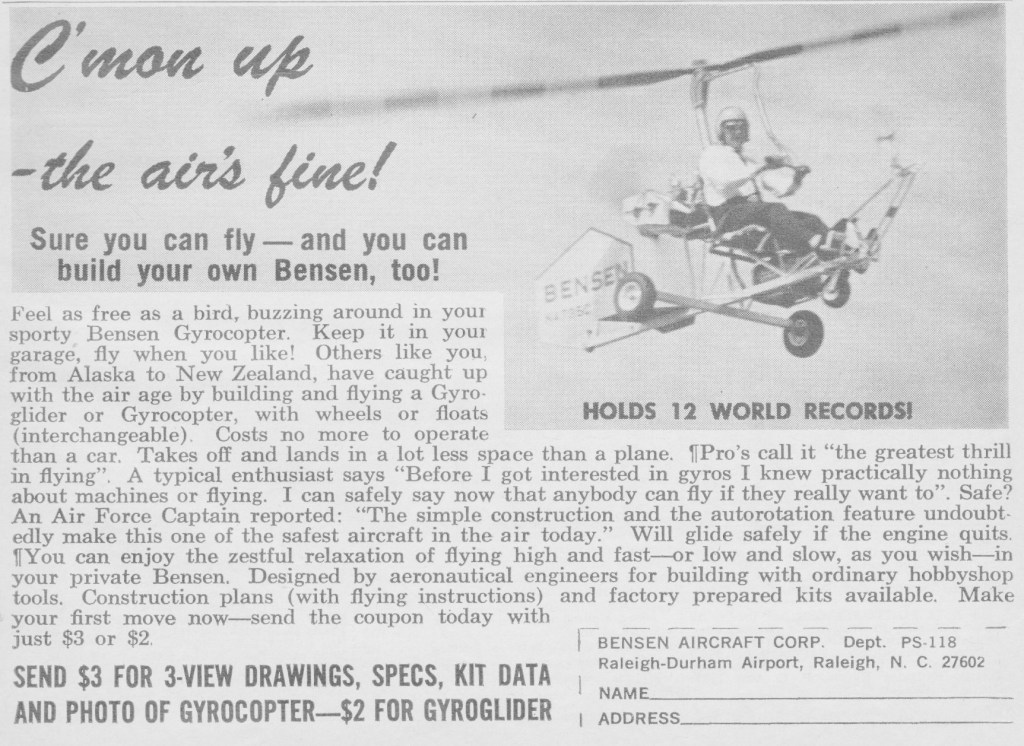
Bensen

Founded by Dr. Igor B. Bensen, formerly chief research engineer of the Kaman Corporation, to develop a series of lightweight autogyros. Examples built and supplied to USAF for research purposes, but marketed primarily in kit form for amateur construction. Also attempted to develop Cargolifter as multi-helicopter lifting platform, with eight-rotor sub-scale prototype flown in early 1980s.

November 1969