Gion Bezzola
rte. Payerne 21
CH-1470 Estavayer-le-Lac
Switzerland
UL builder
Gion Bezzola
rte. Payerne 21
CH-1470 Estavayer-le-Lac
Switzerland
UL builder
2008: Leonard Milholland, P. O. Box 747, Brookshire Tx, 77423
LSA builder
Founded to undertake development of the Be-200 amphibian, combining Beriev, Taganrog, and Irkutsk aircraft production associations, and Geneva ILTA Trade Finance SA of Switzerland. Be-200 now recognized as a Beriev program.
1998:
BP 943
F-82009 Montauban
France
After a period of crisis, the Best Off company opened its doors in 1998 but produced only one model; the SkyRanger.
Involved in aviation almost all his life, Harold Best’s earliest flight training came in a World War I Avro 504 trainer. He built his first aircraft, a Mignet HM-14 Flying Flea, in 1935 while still a schoolboy and soon became involved with the British homebuilt movement, assisting in the development of several designs that were available prior to World War II.
During the war, Harold was involved in photo reconnaissance and converting Spitfires for photo recon service. In1942 he was secretly dropped into occupied France and worked with the French Resistance to sabotage German aircraft production in that country. After the war, he helped found the Popular Flying Association in the U.K. and maintained his close ties to the very active French amateur built aircraft movement. This connection was extremely valuable during his service with the British Air Registration Board, now the Civil Aviation Authority, where he was able to transfer the French acceptance of amateur built aircraft into the U.K.’s then restrictive regulations.
England’s Harold Best-Devereux, who was best known to U.S. EAAers as the eloquent master of ceremonies for the evening programs at Oshkosh until his untimely death from cancer in July of 1985, played a far more important role in the international affairs of UK homebuilders. The European Director of EAA for over 20 years, Harold worked tirelessly to make it possible for Europeans to build and fly their own aircraft, to make rules less restrictive in those nations that did allow homebuilding and to bring sport pilots of every nation together. Fluent in French, he and EAA Founder Paul Poberezny traveled extensively in France and other countries helping establish the legitimacy of amateur built aircraft throughout Europe. For these and other achievements, Harold was awarded the prestigious Paul Tissandier Diploma by the Federation Aeronautique Internationale and, although a citizen of the United Kingdom, was elected a member of a select group of French aviation pioneers.
An active pilot until his death, Harold owned a number of aircraft over the years, including a Tailwind he bought in the U.S. One of his most treasured aviation experiences came in the summer of 1977 when he and his son, Igor, flew a 1937 Miles Whitney Straight from Halifax, N.S. to Lake Tahoe, CA, with a stop at Oshkosh to participate in that year’s EAA Convention. At the time of his death, Harold was rebuilding a 1947 Miles Messenger and extensively researching the life of Henri Mignet.
Marcel Besson et Cie
Societe des Constructions Aeronautiques et Navales Marcel Besson
Known originally as Marcel Besson et Cie, Societe des Constructions Aeronautiques et Navales Marcel Besson was responsible for construction of some triplane flying-boats, all powered by single engines in a pusher configuration. Built also in 1927 the M.B.35 monoplane seaplane and M.B.36 three-engined flying-boat.
Oakland/Emeryville, Ca. 1933

Besler Aero is known for flying a Travel Air 2000 powered by one of their steam engines.
1983: Besam Aircraft, Old Woodhouse, Stottesdon, Kidderminster, Worcestershire, Great Britain.
UL builder
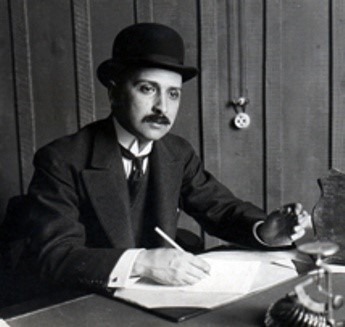
José Luis Sanchez Besa was born in Santiago, Chile, on February 13th, 1879. He came from a wealthy family that had made its fortune in the sugar industry. He thus had the money to live a bohemian life. He moved to France as a young man and studied law and engineering. He became interested in aviation and ballooning. He became a friend of Alberto Santos-Dumont and closely followed the Brazilian’s first flights in 1906.
He made his first flights in July 1909, becoming the first Chilean to fly. Together with his compatriot and friend Emilio Edwards Bello he bought two Voisin planes. One of them was entered at the 1909 Grande Semaine of Reims, but since the two Chileans hadn’t learned to fly it was reportedly piloted by Léon Bathiat. The brand-new machine wasn’t correctly rigged and only made some ground runs, but they were invited to the meetings in Berlin and Hamburg later in the year, where their appearances resulted in damaged machines.
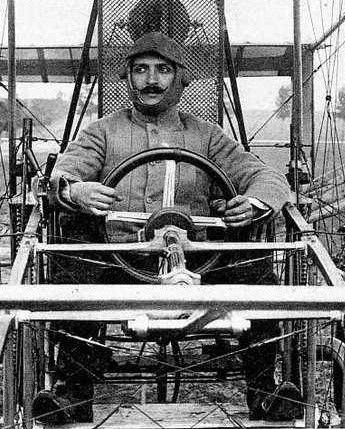
Sánchez Besa started a flying school at Reims and began producing his own machines at Boulogne-Billancourt, first inspired by Farman and later by Voisin designs. When Émile Train and Roger Sommer left the aviation industry he bought their factories. His first designs were not very successful, but later seaplane designs, developed together with Léon Bathiat, were more successful. Several were sold and participated in meetings in 1912-1914.
Some of Besa’s aircraft were used by the Chilean Military Aeronautics.
During WW1 his factories where involved in licence production of Breguet, Sopwith and Caudron machines and according to himself employed some 2,000 people. Since there was no demand for aircraft after the war they were used for maintenance of railway cars and manufacture of boxes, but in 1921 “Etablissements Louis Clement et Sanchez-Besa” displayed a “venetian blind-type” multiplane machine.
José Sánchez Besa passed away in Paris on March 2nd, 1955, after a heart attack.
He was granted French “Brevet de Pilote” (Pilot’s Licence) No. 155 on August 9th, 1910, having made the qualification flights on a machine of his own make.
José Sánchez Besa participated in the following air race meetings:
Reims 1909
Berlin 1909
John Berry (1849-1931) was an inventor, mechanic, car-dealer, and builder of balloons in St. Louis who in 1907 was slated to race his airship in the dirigible races held in conjunction with the Gordon Bennett balloon race.
Berry made his first balloon flight on a smoke balloon, in 1862 at the age of 13 from Rochester, N.Y., and his first gas balloon flight the following year. “The Dean of American Aeronauts”, Capt. Berry made more than 500 balloon flights during his aeronautical career which lasted sixty years; his last flight taking place in 1922.

