1998:
Heinerich-Heine-Straβe 15
D-52249 Eschweiler
Germany
Built the Project Aachen
1998:
Heinerich-Heine-Straβe 15
D-52249 Eschweiler
Germany
Built the Project Aachen
First flew in 1977 Eagle II two-seat unlimited-class aerobatic biplane; hundreds of kits sold for amateur construction. In 1983 acquired former Pitts Aerobatics company and this plant at Afton in Wyoming became company headquarters. Thereafter added Pitts Special aerobatic biplane to product line, plus A-1 Husky two-seat cabin monoplane (first flown 1986) as assembled and certificated aircraft.
Circa 1912, Christie built a radial engine. Details are unknown.
Chrislea was based originally at Heston, Middlesex, in 1936, building joint designs of R. C Christophorides and B. V. Leak. In 1938 one L.C.1 Airguard was built, a two-seat, low-wing cabin monoplane for Civil Air Guard. Company transferred to Kentish Town shortly before Second World War, undertaking subcontract work for aircraft industry. Moved again in 1947 to Exeter Airport, where during 1948-1950 a series of four-seat lightplanes were constructed: Series 1 CH.3 Ace, Series 2 CH.3 Super Ace, and Series 4 CH.3 Skyjeep. The first of these high-wing cabin monoplanes was flown in August 1946, but high operating costs and unacceptable control system affected sales of the Ace and Super Ace; more conventional system used on 1949 Skyjeep. Total production (all three types) about 26 aircraft. In 1952 assets acquired by C. E. Harper Aircraft Ltd and all surviving models were scrapped.
In response to the considerable aging and reduction of the inventory of the country’s air fleet, the FAA encouraged a plan for the progressive replacement of the fleet through manufacturers of national origin.
It was decided for Chincul SACAIFI to manufacture aircraft under license from Piper Aircraft Corporation. The company was a wholly owned subsidiary of “La Macarena S.A.”, Piper’s Argentine distributor. Thanks to Piper’s licensed production plan to produce aircraft. abroad, it envisaged assembly in emerging third world countries, with the main benefit of commercial penetration and the reduction of labor costs that this implied.
With industrial promotions, which gave reductions and tax deferrals to certain areas of the country, they took the owners of Chincul to settle in the town of Pocito in the province of San Juan.
There were built two hangars: Endings, and production: 70 m front by 110 m long. Together with other sectors and annexed workshops, the total covered area reached 14,000 sq.m covered.
The inauguration of the plant occurred on December 12, 1972. The plant maintained a simultaneous process with 10 assembly lines, with about 450 employees (between technicians and aeronautical mechanics), working 24 hours a day, 365 days a year “24×7”. In total they produced some 960 aircraft. In 1978 there were 500 employees.
By the middle of the 1980s, the Sanjuanina plant started a slow downward slope due to the inflationary process that was experienced at that time, in addition to the bankruptcy of its Piper Aircraft mother house.
The Cuyano settlement of the Beraza tried to keep the head for a while longer, but 10 years of setbacks prevented it.
Signed agreement with Bell Helicopter Textron 1990 for helicopter co-production.
Finally, between 1991 and 1994, a final series of the PA-18 Super Club model was produced, definitively ceasing the activity on January 31, 1995, the date on which its huge gates were closed at the Pocito plant.
Today the facilities offer the image of a sad abandonment.
Founded at Chilton, near Hungerford, Berkshire, in 1937 to build D.W.1 single-seat light aircraft designed by Hon Andrew W. H. Dalrymple and A. R. Ward, both former de Havilland students.
A low wing open-cockpit wooden monoplane with fixed “trousered” landing gear and Carden-Ford engine, first flown April 1937. Three D.W.1 s built, followed by one faster D.W.1 A, first flown July 1939. Design of D.W.2 only half finished when Second World War began and it was never completed.
During the war company did subcontract work for MAP and aircraft industry generally. Dalrymple died in a flying accident in December 1945, and company reregistered on June 5,1946 as Chilton Aircraft Company Ltd.
The death of Dalrymple in a flying accident on Christmas Day 1945 brought an end to the aeronautical activities.
Prototype Olympia single-seat sailplane built 1947; rights in this sold to Elliotts of Newbury Ltd. in 1952. Company began work in electrical industry.
Chichester-Miles developed the Leopard four-seat sports executive jet, powered in latest production form by two Williams International FJX turbofan engines (first flown December 1988 and production deliveries anticipated from the year 2002).
The Chevrolet Brothers Aircraft Company firm started after Arthur and Louis Chevrolet had left the automotive industry. Louis Chevrolet and his younger brother Arthur built cylinder heads and aftermarket speed equipment for Model T Fords in the 1920s. Around 1925 Louis started taking a deeper interest in aviation, attending air shows in and around the Indianapolis area. In 1926 he entered into negotiations with a group of Ohio businessmen who were looking to develop a new airplane engine.
In the spring of 1927, the Chevrolet brothers completed their first aviation engine, an air-cooled, single-overhead-cam, 4-cylinder engine. This engine was installed in a biplane built by the Moundsville Aircraft Corp of West Virginia. There are photos of Charles Lindbergh inspecting the engine in that airplane in the summer of 1927. On the plane’s maiden flight, it was forced to make an emergency landing because of engine trouble. The Chevrolet brothers went back to the drawing board, and news of their venture quickly disappeared from the public eye. In late 1927 or early 1928 the brothers had a heated argument, split up, and did not talk to each other for several years to follow. Given the failure of the first aero engine, and the events that took place in early 1928, it would appear that the argument stemmed from the design of their airplane engine.
In the spring of 1928, Louis left the Chevrolet Brothers Manufacturing Company and started a new company called the Chevrolet Aircraft Corporation. Louis then spent the next year developing his new engine
In late 1928, Louis sold a 90% interest in the Chevrolet Aircraft Corporation to Glenn L. Martin, and he was retained by Mr. Martin to be president of the company.
In January of 1931 Martin changed the name of the company to the Glenn L. Martin Motors Corporation, and Louis’ title was changed to VP and General Manager. The economic depression was drying up capital, and sales took a nose dive. Louis ultimately resigned from the Martin Company in December of 1931, but he did hold onto his stock. When the Glenn L. Martin Company had its initial Public Offering in 1934, Chevrolet and Martin were the only stockholders of the company, Louis still owning 1,000 shares (Martin half a million shares). In 1939 Martin sold the patent rights, and existing inventory of engines and spare parts to the Phillips Aviation Corporation.
The new company was overtaken by its creditors who sold rights to the engine to the Glenn L. Martin Company.
For a long time there has been confusion regarding these engines, some sources calling Louis’ a Chevolair, and so forth. Likewise there have been misunderstandings over the names of the two different companies. When Louis left his brother Arthur in late 1927, Art retained ownership of the Chevrolet Brothers Manufacturing Company. Louis then filed articles of incorporation for the Chevrolet Aircraft Corporation. In the fall of 1928, Art changed the name of the Chevrolet Brothers Mfg Co to the Chevrolet Aviation Motors Corporation. Complicating matters was the fact that Louis’ contract with Glenn L. Martin called for the exclusive use of the “Chevrolet” name. The brothers then had a hearing before the Indiana Secretary of State over the use of the name. Following that hearing Art changed the name of his company in early 1929 to the Arthur Chevrolet Aviation Motors Corporation. Later that year, the name of Art’s company was changed for a third time to the Chevolair Motors Corporation. Muddying the waters further, Glenn L. Martin (for reasons unknown) changed the name of the Chevrolet Aircraft Corporation to the Glenn L. Martin Motors Corporation in January 1931.
1927: Louis and Arthur form the Chevrolet Brothers Manufacturing Company, but their engine proves faulty. Louis exits the venture in late 1927, leaving Arthur full ownership of the firm.
1928: Louis files articles of incorporation for the Chevrolet Aircraft Corporation (fall of 1928).
1928: Arthur changes name of the Chevrolet Brothers Manufacturing Company to the Chevrolet Aviation Motors Corporation.
1929: Arthur changes name of Chevrolet Brothers Manufacturing Company to Arthur Chevrolet Aviation Motors Corporation as a result of a legal dispute with Louis. Apparently, Louis’ contract with his partner – Glenn L. Martin – in the Chevrolet Aircraft Corporation, called for the exclusive use of the Chevrolet name. Arthur changed the name of the original company as a result of a hearing before the Indiana Secretary of State.
1929: later this year, Arthur changes the name of his company once again (a third time) to the Chevolair Motors Corporation.
1931: for reasons unknown, Glenn L. Martin changes the name of the Chevrolet Aircraft Corporation to Glenn L. Martin Motors Corporation in January 1931.
USSR
A 1928 graduate of Leningrad Institute of Transport Engineering, I. V. Chetverikov worked briefly with D. P. Grigorovich before joining the Tsentralnoe Konstruktorskoe Byuro (Central Design Bureau; TsKB). From 1931 -1933 was in charge of seaplane development section; responsible for designing MDR-3 reconnaissance flying-boat, OSGA-101 light amphibian, and related SPL submarine-borne small floatplane. His ARK-3 flying-boat was a failure, but the three-seat MDR-6 (or Che-2) of 1937 was produced for Soviet Naval Aviation, 50 being built at Taganrog between 1939 and German invasion of Crimea in 1941. Development, but no further production, of MDR- 6 continued during Second World War; after completion in 1947 of three prototypes of the eight-passenger TA-1 flying-boat, this bureau was closed down in 1948 and Chetverikov became a lecturer.
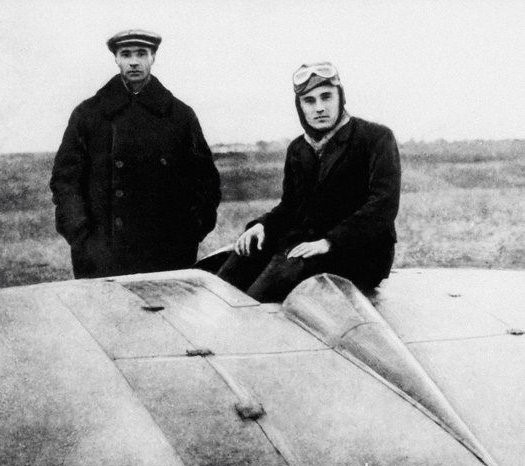
B. I. Cheranovsky was born on either 1 or 13 July 1896 in Pavlovychi, Volhynian Governorate, Russia. By profession he was painter and sculptor, but in 1920 became interested in aviation. From 1924 to 1927 he studied at the Air Force Academy. From 1922 on he engaged in the design and construction of airframes and aircraft of the flying wing configuration. Notable for creating aircraft with a characteristic tailless parabolic wing. — the BICh-1 and BICh-2 gliders from 1924, and the powered BICh-3 later. For his services to the aviation industry, Cheranovsky was awarded the Order of the Red Star. He died in Moscow, Soviet Union, on 17 December 1960.

