1982: Aerokit Industrie, Rustrel, 84400 Apt, France.
UL manufacturer
1982: Aerokit Industrie, Rustrel, 84400 Apt, France.
UL manufacturer
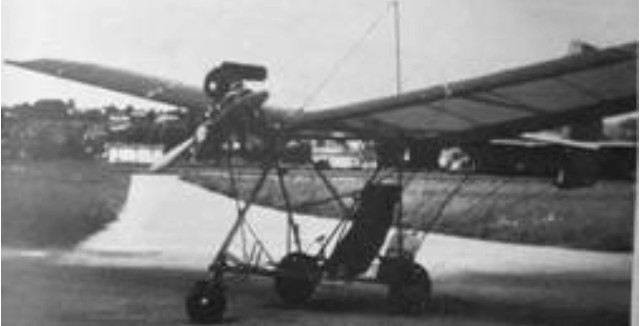
Designed by Serge Cardot in 1984. 2-Axis control. Kingpost bracing.
Engine: 26 hp Rotax 277
Length: 15.1 ft
Height: 8.2 ft
Wing span: 27.9 ft
Wing area 138 sq.ft
Empty weight 207 lb
Payload 256 lb
Structural limits +6 Gs / -4.5 G
Glide ratio 6:1
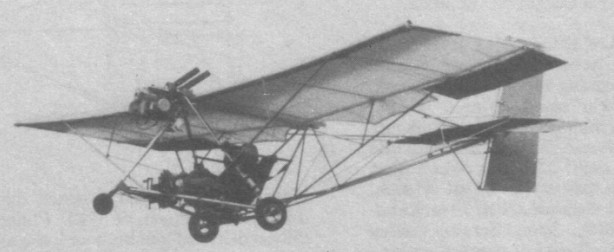
A two seat, side by side, single engined, high-wing monoplane with conventional three axis control. The wing has unswept leading edge, swept forward trailing edge and constant chord, cruciform tail. Pitch control is by elevator on tail, and yaw control by fully flying rudder; roll control by half span ailerons; control inputs through stick for pitch/roll and pedals for yaw.
The wing is braced from below by struts; with a double surface wing profile. The undercarriage has three wheels in tricycle formation; no suspension on the nosewheel and bungee suspension on the main wheels. Push right go right nosewheel steering is connected to the yaw control. No brakes. An aluminium tube framework, without pod, the engine is mounted below wing driving pusher propeller.
On the two seater Aerokart 4320 the kingpost and wire used on this company’s single seaters is replaced by struts. The horizontal stabiliser, stiffened in flight and landing by cables, has the outer sections of its leading edge joined by tubes to the spars carrying the tail assembly. These tube joints form a structure of high structural integrity rather than low drag.
The 4320 has its motor mounted in front of the wing on silent bloc bushes, driving a twin bladed propeller behind the trailing edge from toothed belt reduction. The 1983 standard power pack for this aircraft was the twin cylinder in line Hirth 2701R of 43hp fitted with a tuned exhaust for each cylinder, this system having been developed by Aerokart.
The hot air from the cooling fan is fed to the carburettor and air filter by a movable flap when atmospheric conditions demand de icing and switched back at other times.
This two seater is delivered in standard form with an electric starter while retaining the capability of manual starting. Electric fuel pump and double surfacing for the wing, ailerons and tail areas, and alloy rims for the main wheels are all standard fittings on the 4320. The machine is transportable on a trailer, folded dimensions being 16.9 x 6.3 x 5.9ft (5.10 x 1.90 x 1.76m).
Engine: Hirth 2701R 03, 43 hp at 6750 rpm
Propeller: 55 x 32 in, 1.40 x 0.80 m
Reduction ratio: 2.5/1
Power per unit area: 0.19hp/sq.ft, 2.2hp/sq.m
Max static thrust: 287 lb, 130kg
Fuel capacity: 5.3 US gal, 4.4 Imp gal, 20.0 lt
Length overall: 19.0ft, 5.8m
Optional fuel capacity: 7.9 US gal, 6.6 Imp gal, 30.0 lt
Height overall: 9.8ft, 2.94m
Wing span: 34.5ft, 10.5m
Chord at root: 6.4 ft, 1.92m
Chord at tip: 6.2ft, 1.89m
Dihedral: 1.5 deg
Sweepback: 0 deg
Tailplane span: 9.1 ft, 3.00 m
Total wing area: 216 sq.ft, 20.0 sq.m
Total aileron area: 12.9 sq.ft, 1.2 sq.m
Rudder area: 12.1 sq.ft, 1.12 sq.m
Tail¬plane area: 21.6 sq.ft, 2.0 sq.m
Total elevator area: 12.3 sq.ft, 1.14 sq.m
Wing aspect ratio: 5.4/1
Wheel track: 5.7ft, 1.70 m
Wheelbase: 5.8ft, 1.72m
Nosewheel dia. Overall: 10 in, 26 cm
Main wheels dia. Overall: 16 in, 40 cm
Empty weight: 322 lb, 146kg
Max take off weight: 707 lb, 320kg
Payload: 385 lb, 174 kg
Load factors: +5.5, 2.5 design
Max wing loading: 3.27 lb/sq.ft, 16.0 kg/m
Max level speed: 56mph, 90kph
Max power loading: 16.4 lb/hp, 7.44kg/hp
Never exceed speed: 75mph, 120 kph
Max cruising speed: 50 mph, 80 kph
Economic cruising speed: 40mph, 65kph
Stalling speed: 22 mph, 35 kph
Max climb rate at SL: 450 ft/min, 2.3 m/s
Min sink speed: 31 mph, 50 kph
Min sink rate: 430 ft/min, 2.2 m/s
Best glide ratio: 7/1 at 45 mph, 65 kph
Take off distance: 230 ft, 70 m
Landing distance: 98 ft, 30 m
Service ceiling: 10,000 ft, 3050 m
Range at ave cruise: 186 mile, 300km.
The A Kart 30 was developed into two other prototypes; the tandem 4320 two seater and the single seat 3315, both of which made their first flights at the beginning of summer 1982.
Aerokart continued the trials, refining and developing the machines, until that Septem¬ber, at the first European Microlight Salon at Lyon Bron, it was able to show two pre¬-production machines. The first was a single-¬seater, the type 3315 and the second was the 4320 side by side two seater. Both went on sale in November 1982, though the company has put most of its marketing effort into the Aerokart two seater. This manufacturer uses the first two digits of the type number to indicate the maximum power of the motor used, while the last two numbers indicate the wing area in square metres.
The single seater 3315 uses a Hirth 260R engine of 338 cc developing 33 hp at 7250 rpm, with a 23/1 reduction drive and a 51 inch (1.3m) two blade propeller. The type 4315 is more powerful and is fitted with a Hirth 2701R, 493cc engine developing 43hp at 6750rpm with toothed belt reduction. Of traditional configuration, these machines use of ailerons instead of spoilers, and their engine is fitted inverted in front of the wing below the level of the leading edge. It drives through the reduction drive to a shaft which crosses the wing to connect with a pusher propeller at the trailing edge. Flexible mountings absorb the vibrations caused by using such a long shaft whilst retaining for the Aerokart the advan¬tages of prop wash over the tail surfaces and a well cooled engine.
The machine is trans¬portable on a road trailer.
4315
Engine: Hirth 2701R 03, 43 hp at 6750 rpm
Propeller: 55 x 32 in / 1.4 x 0.8 m
Reduction ratio: 2.5/1
Max static thrust: 287 lb / 130 kg
Power per unit area: 0.27hp/sq.ft / 2.9hp/sq.m
Wing span: 34.5ft / 10.5m.
Fuel capacity main: 5.3 US gal, 4.4 Imp gal, 20.0 lt
Constant chord: 4.8ft / 1.43m.
Fuel capacity reserve: 2.6 US gal, 2.2 Imp gal, 10.0 lt
Dihedral: 1.5 degrees
Total aileron area: 25.9 sq.ft / 2.4 sq.m
Sweepback: 0 degrees
Total wing area: 161 sq.ft / 15.0 sq.m
Tailplane span: 9.1 ft / 3.0 m
Fin area: 7.5 sq.ft / 0.7 sq.m
Rudder area: 12.1 sq.ft / 1.12 sq.m
Tailplane area: 21.6 sq.ft / 2.0 sq.m
Wing aspect ratio: 7.35/1
Total elevator area: 12.3 sq.ft / 1.14 sq.m
Wheel track: 5.7 ft / 1.70 m
Nosewheel dia. overall: 10 in / 26 cm
Wheelbase: 5.8ft / 1.72 m
Main wheels dia. Overall: 16 in / 40cm
Empty weight: 278 lb / 126 kg
Max take off weight: 497 lb / 225 kg
Payload: 219 lb / 99 kg
Max wing loading: 3.07 lb/sq.ft / 15.0 kg/sq.m
Max pwr loading: 11.6 lb/hp / 5.2kg/hp
Load factors: +5.5, 2.5 design
Max level speed: 65 mph / 105 kph
Never exceed speed: 75 mph / 120 kph
Max cruise: 56 mph / 90 kph
Economic cruising speed: 50 mph / 80 kph
Stalling speed: 22 mph / 35 kph
Max climb rate at SL: 600ft/min / 3.0m/s
Take off dist: 165 ft / 50 m
Best glide pwr off: 8/1 at 40 mph / 65 kph
Landing distance: 82 ft / 25 m
Range ave. cruise: 186 sm / 300 km
Service ceiling: 10,000 ft / 3050 m
Min sink rate: 430 ft/min at 31 mph / 2.2 m/s at 50 kph
Known under the name of A Kart 30, this first machine did not go on sale. It was instead developed into two other prototypes, one tandem two seater and the other a single seater, both of which made their first flights at the beginning of summer 1982.
Spain
Produces kits to build the AJ.1/RF-5 Serrania, a variant of the French Fournier RF-5.
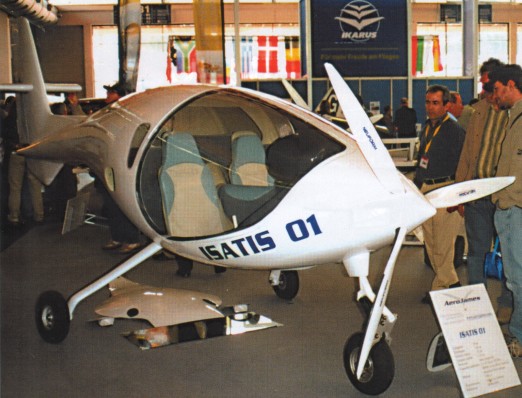
Stall: 30 kt / 34 mph / 55 kmh
Cruise: 124 kt / 143 mph / 230 kmh
VNE: 146 kt / 168 mph / 270 kmh
Empty Weight: 270 kg / 595 lbs
MTOW: 472 kg / 1041 lbs
TO dist (50ft obstacle): 330 ft / 100 m
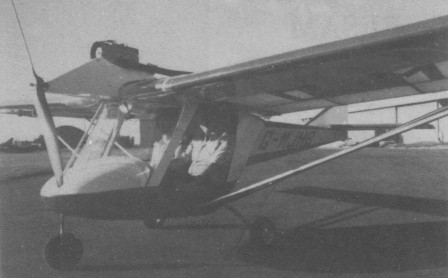
A side by side two seater single engined high wing mono¬plane with conventional three axis control. Wing has swept back leading edge, swept forward trailing edge and tapering chord; conventional tail. Pitch control by elevator on tail; yaw control by fin mounted rudder; roll control by half span ailerons; control inputs through stick for pitch/roll and pedals for yaw. Wing braced from below by struts; wing profile NACA 4415 (root), 4412 (tip), 100% double surface. Undercarriage has three wheels in tricycle formation; glass fibre sus¬pension on all wheels. Push right go right nosewheel steering connected to yaw control. Optional brakes on main wheels. Glass fibre fuselage, partially enclosed. Engine mounted above wing driving tractor propeller. Fuselage uses bonded internal framing made from uni directional glass fibre impregnated with aircraft quality resin. Ribs and I section spar from laminated glass fibre and foam; spruce spar caps. Leading edge is pre formed foam and glass fibre; trailing edge is spruce; rest of wing covered with zero porosity Dacron.
Just as the Aero & En¬gineering Services’ Lone Ranger is derived from its Striplin namesake, so the British Sky Ranger is taken from the Striplin Sky Ranger.
The aircraft has been considerably mod¬ified for European conditions, in a manner very similar to that applied to the Sky Ranger. Standard engine is the Cuyuna 430 with reduction drive. One aircraft was been produced with a Hunting HS525A engine.
Unlike the Lone Ranger, the standard cabin has no fixed side panel, both sides being left open unless the optional doors are ordered.
Engine: Cuyuna 430, 30 hp at 6300 rpm
Propeller dia x pitch: 60 x 36 in / 1.52 x 0.91 m
Total fuel capacity: 9.6 USG / 8.0 Imp gal / 36.3 litre
Micro V belt ratio: 2.2/1
Power per unit area: 0.19 hp/sq.ft / 2.0hp/sq.m
Length overall: 17.0 ft / 5.18 m
Height overall: 8.0 ft / 2.44m
Wing span: 36.0 ft / 10.97m
Chord at root: 5.0 ft / 1.52m
Chord at tip: 4.0 ft / 1.22m
Dihedral: 5 degrees
Sweepback: 1.5 degrees
Tailplane span: 8.4 ft / 2.56 m
Fin height: 3.5 ft / 1.07 m
Total wing area: 162 sq.ft / 15.1 sq.m
Total aileron area: 16.6 sq.ft / 1.54 sq.m
Fin area: 6.2 sq.ft / 0.58sq.m
Rudder area: 4.4 sq.ft / 0.41 sq.m
Tail¬plane area: 10.0 sq.ft / 0.93 sq.m
Total elevator area: 9.1 sq.ft / 0.85 sq.m
Wing aspect ratio: 8.0/1
Wheel track: 5.0ft / 1.52m
Wheelbase: 4.8ft / 1.46 m
Nosewheel dia overall: 11 in / 28 cm
Main wheels dia overall: 14 in / 36 cm
Empty weight: 330 lb / 150kg
Max take off weight: 760 lb / 345kg
Payload: 370 lb / 168kg
Load factors design: +4.0 / 2.0
Load factors ulti¬mate: +6.0, 3.0
Max wing loading: 4.69 lb/sq.ft / 22.8 kg/sq.m
Max power loading: 25.3 lb/hp / 11.5kg/hp
Max level speed: 80 mph / 129 kph
Never exceed speed: 90 mph / 145 kph
Max cruising speed: 75 mph / 121 kph
Economic cruise: 65 mph / 105 kph
Stalling speed: 28 mph / 45 kph
Max climb rate at SL: 450 ft/min / 2.3 m/s
Take off distance: 220 ft / 65 m
Land¬ing distance: 350 ft / 105 m
Service ceiling: 8000 ft / 2440 m
Min sink rate: 260 ft/min at 35 mph / 1.3 m/s at 56 kph
Best glide ratio pwr off: 15/1 at 39mph / 63 kph
Range at ave cruise: 250 sm / 402 km
A single seat single engined high wing monoplane with conventional three axis control. Wing has swept back leading edge, swept forward trailing edge and tapering chord; conventional tail. Pitch control by elevator on tail; yaw control by fin mounted rudder; roll control by half span ailerons; control inputs through stick for pitch/roll and pedals for yaw. Wing braced from below by struts; wing profile NACA 4415 (root), 4412 (tip), 100% double surface. Undercarriage has three wheels in tricycle formation; glass fibre sus¬pension on all wheels. Push right go right nosewheel steering connected to yaw control. Optional brakes on main wheels. Glass fibre fuselage, partially enclosed. Engine mounted above wing driving tractor propeller. Fuselage uses bonded internal framing made from uni directional glass fibre impregnated with aircraft quality resin. Ribs and I section spar from laminated glass fibre and foam; spruce spar caps. Leading edge is pre formed foam and glass fibre; trailing edge is spruce; rest of wing covered with zero porosity Dacron.
The Aero & Engineering Services Lone Ranger started life as a British ¬built Striplin Lone Ranger, David Wilson’s company having the sole European agency for the Striplin machines. However, it has since been substantially modified to suit British tastes and British weather conditions, and must now be regarded as an aircraft in its own right.
The principal change is to the wing design and mounting. The wing section has been increased at the root to a 15% thick NACA4415, tapering to 12% at the tips, while the wing is mounted much more squarely, with virtually no sweepback at the leading edge and a small sweep forward at the trailing edge. The sweepback change is designed to give the effect of increased dihedral, making the aircraft easier to handle in less than perfect conditions. Each wing contains a fuel tank.
Another alteration is the use of convention¬al wood and fabric elevator, ailerons and rudder, rather than foam cored; all the control surfaces are of larger area than on the American machine. Push pull rods are used for the elevator and aileron controls, with a cable for the rudder.
Some early aircraft were fitted with Chrys¬ler engines, which were later rejected in favour of the Zenoah 250. The standard cabin has a windscreen and one side panel; the other side is left open, but a door can be supplied as an extra, making the aircraft totally enclosed.
Engine: Zenoah, 22 hp @ 6300 rpm
Prop: 50×27 in / 1.27x 0.69m
Power per unit area: 0.14hp/sq.ft / 1.5 hp/sq.m
Total fuel capacity: 9.6 USG, 8.0 Imp gal, 36.3 litre.
V belt reduction, ratio: 2.3/1
Length overall: 15.8 ft / 4.82 m
Height overall: 7.2ft / 2.19m
Wing span: 34.0 ft / 10.36m
Chord at root: 5.0ft / 1.52m
Chord at tip: 4.0 ft / 1.22m
Dihedral: 5 degrees
Sweepback: 1.5 degrees
Tailplane span: 8.0 ft / 2.44 m
Fin height: 3.0 ft / 0.91 m
Total wing area: 153 sq.ft / 14.2 sq.m
Total aileron area: 16.6 sq.ft / 1.54 sq.m
Fin area: 4.5 sq.ft / 0.42 sq.m
Rudder area: 4.0 sq.ft / 0.37 sq.m
Tail¬plane area: 8.0 sq.ft / 0.74 sq.m
Total elevator area: 8.0 sq.ft / 0.74 sq.m
Wing aspect ratio: 7.5/1
Wheel track: 3.0 ft / 0.91 m
Wheelbase: 4.5 ft / 1.37 m
Nosewheel dia overall: 11 in / 28 cm
Main wheels dia overall: 11 in / 28 cm
Empty weight: 210 lb / 95kg
Max take off weight: 476 lb / 216 kg
Payload: 210 lb / 95 kg
Max wing loading: 3.11 lb/sq.ft / 15.2kg/sq.m
Max power loading: 21.6 lb/hp / 9.8kg/hp
Load factors: +4.0, 2.0
Design load: +6.0, 3.0 ulti¬mate
Max level speed: 75 mph / 121 kph
Never exceed speed: 80 mph / 129 kph
Max cruising speed: 55 mph / 88 kph
Stalling speed: 21 mph / 34 kph
Max climb rate at SL: 450 ft/min / 2.3 m/s
Min sink rate: 210 ft/min at 33 mph, 1.1 m/s at 53 kph
Best glide ratio pwr off: 17/1 @ 38mph / 61kph
Take off distance: 180 ft / 55 m
Landing distance: 250 ft / 75 m
Service ceiling: 10,000 ft / 3050 m
Range at ave cruise: 250 mile / 402km
1983: Aero & Engineering Services Ltd, 15 Donkin Road, Armstrong, District 2, Washington, Tyne & Wear, Great Britain.

