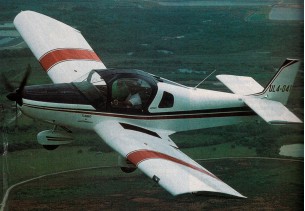
AILE PX-2000

Single seat single engined high wing monoplane with conventional three axis control. Wing has swept back leading and trailing edges, and constant chord; cruciform tail. Pitch control by elevator on tail; yaw control by fin mounted rudder; roll control by fullspan ailerons; control inputs through stick for pitch/roll and pedals for yaw. Wing braced from above by kingpost and cables, from below by cables and struts; wing profile Clark Y; double surface. Undercarriage has three wheels in tricycle formation with additional tailskid; rubber suspension on nosewheel and steel spring suspension on main wheels. Push-right go right nosewheel steering connected to yaw control. Optional brakes on main wheels. Aluminium tube framework, partially enclosed. Engine mounted above wing driving tractor propeller.
The PX2000 design studies began in December 1982 following an idea of Patrick Lemonnier. The construction of the prototype was begun in February 1983 and it made its first flight on the 3 April. Its test programme included as much static testing as flight testing, static tests being entrusted to Ingenerie Technique Atlantique (ITA), a specialist aeronautical and marine laboratory.
By 1982 the single seater had already largely confirmed the calculated performance figures. The figures quoted below correspond to the prototype which is fitted with a Fuji Robin EC44 2PM, hand started and developing 43 hp. It was tested without the glass fibre pod with polycarbonate windscreen, and the three wheel fairings which will be fitted to the production models.

Engine: Robin EC442PM, 53 hp at 6750 rpm
Prop¬eller diameter 65 inch, 1.64m
Toothed belt reduction, ratio 2.5/1
Max static thrust 309 lb, 140 kg
Power per unit, area 0.39hp/sq.ft, 4.2 hp/sq.m
Fuel capacity 1.8 US gal, 6.6 Imp gal, 30.0 litre
Length overall 17.5 ft, 5. 30 m
Height overall 7.9ft, 2.40m
Wing span 29.9ft, 9.10m
Chord at root 4.3ft, 1.29 m
Chord at tip 2.7ft, 0.82m
Dihedral 2 deg
Sweepback 5 deg
Tailplane span 8.7 ft, 2.61 m
Fin height 3.9 ft, 1.20 m
Total wing area 136 sq.ft, 12.6 sq.m
Total aileron area 31.5 sq.ft, 2.92 sq.m
Fin area 9.1 sq.ft, 0.85 sq.m
Rudder area 7.5 sq.ft, 0.70 sq.m
Tail¬plane area 12.7sq.ft, 1.18 sq.m
Total elevator area 10.3 sq.ft, 0.96 sq.m
Wing aspect ratio 6.59/1
Wheel track 4.7 ft, 1.40 m
Wheelbase 4.7 ft, 1.40 m
Nosewheel diameter overall 10 inch, 25 cm
Main wheels diameter overall 12 inch, 30cm
Empty weight 3091b, 140kg
Max take off weight 574 lb, 260kg
Payload 265 lb, 120kg
Max wing loading 4.24 lb/sq.ft, 20.7 kg/sq.m
Max power loading 10.83 lb/hp, 4.9kg/hp
Load factors; +6.0, 4.0 ultimate
Max level speed 87mph, 140kph
Never exceed speed 106mph, 170kph
Max cruising speed 81mph, 130kph
Economic cruising speed 65mph, 105kph
Stalling speed 22mph, 35kph
Max climb rate at sea level 1000ft/min, 5.1m/s
Min sink rate 400fpm at 34 mph, 2.0 m/s at 55 kph
Best glide ratio with power off 10/1 at 37mph, 60kph
Take off distance 115 ft, 35 m
Landing distance 131 ft, 40 m
Service ceiling 10,000 ft, 3050 m
Range at average cruising speed 218 mile, 350km
AILE Patrilor 3

Side by side two seat single engined high¬wing monoplane with conventional three axis control. Wing has swept back leading edge, swept forward trailing edge and tapering chord; cruciform tail. Pitch control by elevator on tail; yaw control by fully flying rudder; roll control by ailerons; control inputs through stick for pitch/roll and pedals for yaw. Wing braced from above by kingpost and cables, from below by struts; wing profile double surface. Undercarriage has three wheels in tricycle formation; no suspension on any wheels. Push right go right nosewheel steering connected to yaw control. No brakes. Aluminium tube framework, with optional pod. Engine mounted above wing driving tractor propeller.
A Patrick Lemonnier design, the Patrilor 3 two seater was assembled without any prior engineering drawings, in his automotive repair and panel beating shop.
Prototype 01 made its first flight at the end of May 1982 and was shown at the end of July at the Brienne amateur constructors’ convention. Number 02 then appeared but prematurely terminated its career with a dicey landing and was followed by a number 03, which successfully completed the first London to Paris in the hands of Jacques Toulorge.
Production models have been on sale since November 1982 and have met with exception¬al success. The company, in April 1983, added to this strut braced machine a kingpost and landing wires, which give increased structural integrity and which have the secondary effect of improving aileron efficiency by stiffening the wing. This machine is therefore now one of those rare aircraft which use two struts in a V to support each wing plus wires stiffening it from above.
In standard form the Patrilor 3 is delivered built and tested by the manufacturer. It is deriggable by one person in 20 min and trailer transportable. The folded dimensions are 21.8 x 6.2 x 8. 0 ft (6.60 x 1. 88 x 2.45 m). Options include a fairing for the forward part of the framework (made of transparent polycarbonate), dual controls, carburettor heat kit, plus an instrument panel with basic instruments. Additionally, the standard Hirth engine can be replaced by the Robin EC44 2PM of 53 hp. Planned is a second model, the Patrilor 3bis with flaps, and a crop spraying version named Agrilor. For North America, Patrilors are delivered as kits and the 40 h building time is the responsibility of the dealer.

Engine: Hirth 2701R, 43 hp at 6750 rprn
Propeller diameter 56 inch, 1.42 m
Toothed belt reduction, ratio 2.5/1
Max static thrust 254 lb, 115 kg
Power per unit area 0.18hp/sq.ft, 2.0hp/sq.m
Fuel capacity 8.5 US gal, 7.0 Imp gal, 32.0 litre
Length overall 19.4 ft, 5.90 m
Height overall 8.0ft, 2.45m
Wing span 38.7ft, 11.75m
Chord at root 5.5ft, 1.64m
Chord at tip 3.5ft, 1.05m
Dihedral 3 deg
Sweepback 8deg
Tailplane span 11.1 ft, 3.38 m
Total wing area 233 sq.ft, 21.6 sq.m
Total aileron area 17.2 sq.ft, 1.60 sq.m
Rudder area 8.2 sq.ft, 0.76 sq.m
Tail¬plane area 17.2 sq.ft, 1.60sq.m
Total elevator area 11.8sq.ft, 1.10 sq.m
Wing aspect ratio 6.4/1
Wheel track 5.6ft, 1.72m
Wheelbase 6.2ft, 1.88m
Tailwheel diameter overall 10 inch, 25 cm
Main wheels diameter overall 16 inch, 40 cm
Empty weight 320 lb, 145 kg
Max take off weight 707 lb, 320 kg
Payload 387 lb, 175 kg
Max wing loading 3.03 lb/sq.ft, 14.8 kg/sq.m
Max power loading 16.4 lb/hp, 7.4 kg/hp
Load factors; +4.5, 3.8 ultimate
Max level speed 56 mph, 90 kph
Never exceed speed 68 mph, 110 kph
Max cruising speed 50 mph, 80 kph
Economic cruising speed 43mph, 70kph
Stalling speed 22 mph, 35 kph
Max climb rate at sea level 500 ft/min, 2.5 m/s
Min sink rate 600 fpm @ 24 mph, 3.0 m/s @ 40 kph
Best glide ratio with power off 8/1 at 37 mph, 60 kph
Take off distance 115 ft, 35 m
Land¬ing distance 115 ft, 35 m
Service ceiling 10,000ft, 3050 m
Range at average cruising speed 125 mile, 200 km

Agrocopteros MXP-740 / ICP MXP-740 Savannah

In development since 1990, Agrocopteros redesigned and built from scratch modified versions of the Zenair Zodiac CH 601HD and STOL CH 701 kitplanes, designating them MXP-640 and MXP-740.

The 740 features a Mitsubishi auto turbocharger fitted to a Rotax 912, increasing power from 80 hp to 118 hp. Electronically operated full-span flaperons are interlocked with elevator trim, and span 8 ft 8 in with 10 inch chord. They travel 18 deg down and 24 deg up. The vertical tail is a one piece, all moving type. Undercarriage is shock-absorbing spring aluminium.
An Italian distributor in Turin acquired 18 MXP-740s.

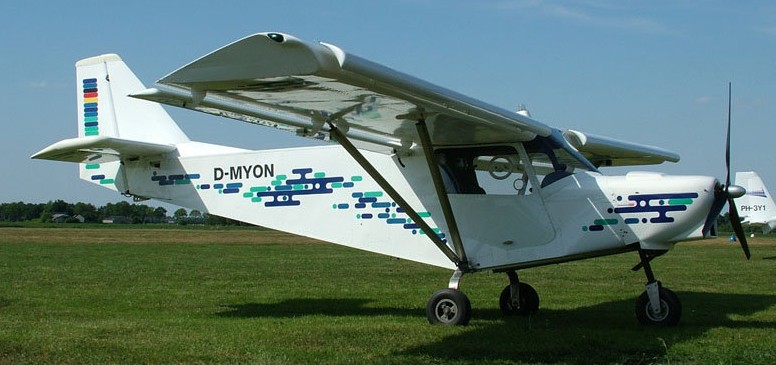
The ICP MXP-740 Savannah is a two-seat, single-engine, all metal shoulder-wing microlight airplane with a fixed tricycle undercarriage with steerable nosewheel wheel.

Engine: Rotax 912 turbo, 118 hp
Prop: Ivoprop vp.
Length: 10 ft 7 in.
Cruise: 4000rpm 34 in/ 130 mph.
Cockpit width: 45 in.
Baggage cap: 40 lbs.
Fuel cap: 14 USG usable.
Wing: NACA 65018

Agrocopteros MXP-640

In development since 1990, Agrocopteros redesigned and built from scratch modified versions of the Zenair Zodiac CH 601HD and STOL CH 701 kitplanes, designating them MXP-640 and MXP-740.
The 640’s primary structure is aluminium alloy extrusions or sheel, with the ribs, frames, extrusions, stringers, rigid hinges, reinforcements and skin panels all sharing the structural load. The wing is a single piece main spar with no sweep, with two fuel tanks. The fuselage is a semi-monocoque with steel firewall, and fibreglass fairings and cowl.
The fixed, tricycle undercarriage employs bungee-cord shock absorbers, and 5.00×5 tyres.

MXP-640T
Engine: Rotax 912 turbo, 118 hp
Prop: Ivoprop vp
Length: 9 ft
Wings: NACA 65018, 12% thickness
Aspect ration: 5.2-1
Fuel cap: 27 USG usable
Empty wt: 660 lb
Mtow: 1300 lb
Load: +5/-4g
Max cruise: 135 mph
Vne: 170 mph
Econ cruise: 120 mph
Range @ 120 mph: 600 mile
Max Maneuver: 120 mph
Max flap ext: 80 mph
Stall: 45 mph
ROC: 1230 fpm @ 95 mph
ROC @ 10,000ft: 870 fpm
TO dist: 250 ft
Ldg dist: 330 ft

Agrocopteros Ltda / Tecnologías Aeronauticas S.A. / Aeroandinas S.A.

In 1961 Máximo Tedesco founded the aircraft company AGROCOPTEROS LTDA. and began the design and production of autogyros for air spraying.

1997: Apartado Aeros 1789, Cali, Columbia.

A licenced distributor for a number of light fixed- and rotary-wing kit aircraft since the 1970s, Agrocopteros assembled and modified many for agricultural roles.

Tedesco developed ten aircraft: Autogiro, Scamp B development of the Aerosport Scamp Biplane, Canard Gold-wing, Zenith 4 seats, Zenith Aerobatic, MXP-740 Savannah version of the Zenair CH-701 and MXP-640 Amigo version of the Zenair CH-601 in assembled and kit forms, MXP-650 Amigo S, MXP-750 Air-spraying and MXP-100 Aventura.

In 1998 Agrocopetros Ltda was dissolved.

In 1998 Máximo Tedesco with his son Filippo, formed Tecnologías Aeronauticas S.A. were he acted as Technical Director and Chief of Projects.

In 2001 Máximo Tedesco began the MXP-800 FANTASY for the European market, an all metal two place high wing airplane that incorporates the technical characteristics of weight and performance contained in the new Common European Air Regulations for Light Aircraft.

The Aeroandinas S.A. company has retaken all of the strengths of the previous two companies. Here, Tedesco designed and developed the all new high performance airplane MXP-1000 TAYRONA, for the North American and European markets and complying with the new international LSA Rule.

Agriplane Condor 2090

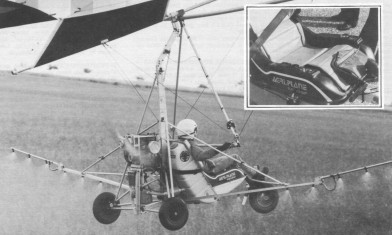
Single seat single engined flex wing aircraft with weight shift control. Rogallo wing with keel pocket. Pilot suspended below wing in trike unit, using bar to control pitch and yaw/roll by altering relative positions of trike unit and wing. Wing braced from above by kingpost and cables, from below by cables; rigid cross tube construction with single surface (33% double surface optional); not enclosing cross tube; pre formed ribs. Undercarriage has three wheels in tricycle formation; rubber suspension on all wheels. Push-right go left nosewheel steering independent from yaw control. Brake on nosewheel. Aluminium tube trike unit, without pod. Engine mounted below wing driving pusher propeller.
Designed by Patrice Renaud with the assistance of M Michelot and C Cardineau, the prototype Agriplane flew for the first time in February 1981, which makes it the first agricultural weight shift microlight in the world. Patrice was the victim of an accident in the course of a flight on another machine which laid him up for a long time, which explains why the machine was shown at the aeronautical and space salon at Le Bourget in June 1981, even though the first Agriplane Condors were not sold until March 1982.
Essentially intended for use as an agricultural tool, this microlight can nevertheless be fitted with a second seat and used as a tandem two seater dual control machine. A kit allows for this dual control adaption. The Condor is supplied with a glass fibre seat with a foam covering which forms the 23.8 US gal (19.8 Imp gal, 90.0 litre) tank for the spray medium. An autonomous hand controlled electric pump supplies the medium to the two spray booms mounted either side of the trike. Three lengths of boom were offered 19.8, 26.6 and 39.5ft (6.0, 9.0 and 12.0 m) fitted together with quick release couplings, which allows their fitment in 3 min. Interchangeable atomisers allow the amount of product sprayed to be varied between 1.0 and 2.0 US gal/acre (0.84.6 Imp gal/acre, 15.30 litre/ hectare).

Engine: Hirth, 46 hp at 7800 rpm.
Toothed¬ belt reduction.
Power per unit area 0.19hp/sq.ft, 2.0hp/sq.m.
Fuel capacity 5.8 US gal, 4.8 Imp gal, 22.0 litre.
Length overall 13.1 ft, 4.0 m.
Height overall 11.6 ft, 3.50 m.
Wing span 32.8 ft, 10.0 m.
Dihedral 4 degs.
Nose angle 135 degs.
Total wing area 248 sq.ft, 23.0 sq.m.
Wing aspect ratio 4.3/1.
Wheel track 5.7ft, 1.70 m.
Nosewheel dia¬meter overall 16 inch, 40 cm.
Main wheels diameter overall 16 inch, 40cm.
Empty weight 298 lb, 135kg.
Max take off weight 696 lb, 315kg.
Payload 398 lb, 180kg.
Max wing loading 2.80 lb/sq.ft, 13.7 kg/sq.m.
Max power loading 15.1 lb/hp, 6.8kg/hp.
Load factors; +5.5, 2.8 ultimate.
Max level speed 47mph, 75kph.
Never exceed speed 53mph, 85kph.
Max cruising speed 40mph, 65kph.
Economic cruising speed 34mph, 55kph.
Stalling speed 23 mph, 38 kph.
Max climb rate at sea level 600 ft/min, 3.0 m/ls.
Best Wide ratio power off 7/1 at 34 mph, 55 kph.
Take off distance 82 ft, 25 m.
Landing distance 50 ft, 15 m.
Range average cruise 68 mile, 110 km.

Affordable Aircraft Affordaplane

The Affordaplane was introduced in 2001 as a simple to build, affordable ultralight. Featuring three axis control, full span ailerons, and classic lines, the Affordaplane can be built in 250 hours with no welding involved. 2009 price was US$3000. Designed by Dave Edwards this aircraft is for the first time builder and plans are available.

Length: 17’3”
Height 5’0”
Wingspan 27’6”
Wing Area 117 sq. ft
Empty Weight: 115 kg / 254 lbs
MTOW: 245 kg / 540 lbs
Stall: 23 kt / 27 mph / 43 kmh
Cruise: 56 kt / 65 mph / 105 kmh
VNE: 74 kt / 85 mph / 137 kmh