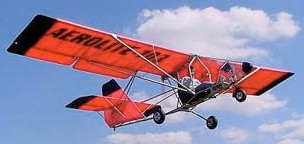
Aero-Works Aerolite-103

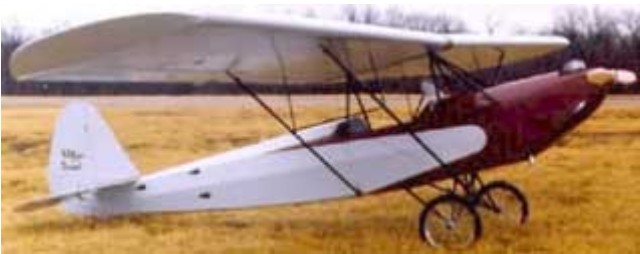
A kit built ultralight featuring aircraft grade aluminum tube, steel tube and fabric construction. There is a Kwik Kit for the Aerolite 103. The jig built air frame comes 100% complete with everything needed to fully assemble and finish your new Aerolite 103. The Aerolite’s airframe features Aircraft Grade aluminum tubing, hardware, bolts, rivets, and professionally welded 4130 steel components throughout it’s construction. The exposed aluminum tubing is clear anodized for cosmetic appearance and protection from the elements. The 4130 steel components are both primed and finished in Aerolite Trim Black.
Single seat, high wing, with trigear, the fuselage comes completely framed and includes several items such as the seat, 4-point safety harness, fuel-tank and engine mounts already installed. The fuselage needs only the wheels, windshield, engine, prop, gauges, and flying instruments to complete. The wing panels and all flying surfaces are completely built and are ready for covering. The wing struts and tail-boom assemblies are pre-built and only require final adjustments during the final assembly of the airframe. Pre-sewn Dacron covers slide onto the pre-built flying surfaces and the covers are secured to the air frame by a combination of zippers, quick latch straps and wing rib battens. The wing ribs are inserted into pre-sewn pockets inside the wing covers.
The control surface set up and final rigging is made easy by using the supplied push-pull stainless steel cables that securely lock into place, and with only the final adjustments needing to be made.
Normal Take-Off uses full throttle, accelerating to 30 mph, rotate, and climb at Vy 45 mph. A Short Field Take-Off uses 15 – 20 degrees of flaps and climb at Vx 40 mph. Cruise Flight is at 45 – 63 mph indicated airspeed.
Normal Landing involves 45 – 50 mph on final and wheels touch down at 30 mph.
Short Field Landing or Landing Over an Obstacle uses 30 – 40 degrees of flaps and a minimum 40 mph from base to final. Maintain 40 mph on final and wheels touch down at 30 mph.
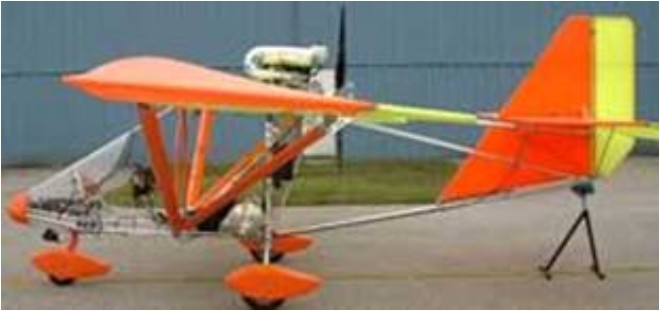
Engine Power Requirements: 28 hp. – 50 hp.
Reduction: Cog Belt / B-model gearbox / ratios 2.5/1, 2.58/1, 2.6/1, 3.0/1
Empty Weight: 252 lb – 300 lb
Gross Weight: 600 lb.
Rec. Gross TO Wt: 450 lb-525 lb
Wingspan: 26ft 10in
Wing Loading @ Gross Wt: 4.8 lb. / per sq. ft.
Wing Area: 124 sq. ft.
Propeller Maximum Diameter: 63″
Design Load Limits: +4 / -2
Stall Speed: 26 mph – 35 mph
Cruise Speed: 45-63 mph
Top Speed: 63-70+ mph
Rate of Climb: 800-1000 fpm
Sink Rate: 350-400 fpm
Glide Ratio: 9:1
Roll Rate 45 deg-45 deg: 2.5 seconds
Take-Off Distance: 100-200 ft
Landing Distance: 100-200 ft
TO dist (50ft obstacle): 300 ft / 91 m
Landing distance (50ft obstacle): 300 ft / 91 m
Fuel Capacity: 5-6 US gallons
Endurance: 1.5 – 2.5 hrs.
Fuel Consumption: 2-4.5 USG/.hr
Range: 80 – 120 sm
Vne: 65 kt / 75 mph / 121 kmh
Va (design maneuvering speed): 50 mph
Vfe (maximum flap extend speed): 70 mph (0 – 40 degrees)
Vy (best rate of climb speed): 45 mph
Vx (best angle of climb speed): 40 mph
Vr ( take-off rotation speed): 30 mph
Maximum Crosswind Component: 15 mph
Maximum Wind Speeds: 25 mph
Maximum Bank Angle: 45 degrees
Maximum Pitch Angle (up & down): 30 degrees

Aerolite 103 (1996)
Engine: 35 hp 2si
Wing span 26.8′
Length: 17′
Height: 6′ 5″
Wing area: 124 sq/ft
Empty weight: 250 lb
Useful load: 270 lb
Cruise speed: 55 mph
Stall speed: 28 mph
Structural limits: +4Gs, -2.8 G
Steerable nose wheel
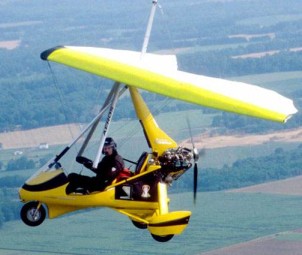
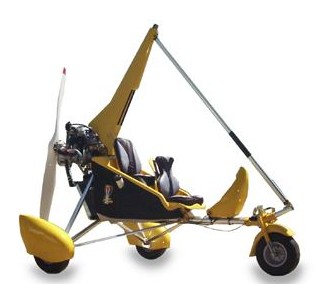
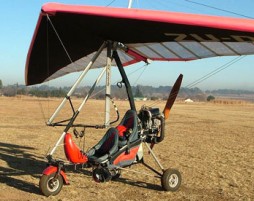
Aerotrike Cobra / Naked Cobra      

The first production Cobra, C-001, flew 46,000 km around the world in the Millennium Microlight Adventure, which proved as an extensive test flight and debugging exercise. Several advances and developments were made to the Cobra following information provided about the performance, comfort and other factors of the Cobra during its rough operations and incredibly long flights of this expedition.
The Cobra was offered with fairing of without (the ‘Naked Cobra’).
Aircraft-grade 4130 chromoly steel and aluminium construction for operation on rough terrain and large diameter aluminium are used. Steel and ali are treated for corrosion protection. All junction points on the Cobra are rubber-bushed to increase the lifespan and ruggedness of the trike.
The Cobra is equipped with a folding ‘click-up’ pylon for easy rigging and de-rigging allowing one person to lift the wing and click the pylon into place and bolt. No removing of the fuel tank and seats is involved. Independant seats have full composite backreasts and padding.
A 3/4 nose and pylon fairings encloses all peripherals such as the ballistic parachute. The 55 litre (14 US gal) fuel tank has side access for refuelling with the optional 76 litre (20 US gal) fuel tank (not fitted on the standard 503 model) endurance can be 7 hours and 700 kms depending on engine and other factors.
The Rotax 912 or 912S 4-stroke motors can be fitted to the Cobra with a radiator scoop with adjustable flap (includes full rear underbelly fairing) allowing the radiator to be out of sight. The adjustable intake flap allows the pilot to manually control the airflow onto the radiator to maintain engine temperatures as well as preventing stone and sand damage to the radiator while maneouvring on the ground. (This feature is an option and is only available when the 582, 912 or 912S engine options are selected).
An integral landing light option for after dark taxiing is available.
Equipped with front wheel telescopic suspension through non-degrading poly-urethane with large diameter mecahnical drum brake, mudflap, parking brake, and the front fork pivots on two heavy-duty ball bearings that make steering easier.
Rear wheel suspension is through telescopic poly-urethane shocks though rear nosewheel steering not available on the Cobra.
Standard configuration includes a Rainbow Aircraft Spirit 15 New Generation Dual Surface Wing, Rotax 503 DCDI Engine with Dual Ignition and Twin Carbs (52 HP), and “B” Series Gearbox (reduction 2,58:1). The Aerotrike Cobra is certified by the South African Civil Aviation Authority (CAA) to be fit and safe for general ultralight use.

Naked Cobra

For $1,250 (2009) less than the price of the standard Cobra, the ‘Naked’ Cobra offers open flying. Still retaining the pylon fairing, large wheel spats and composite seating arrangement, the Naked Cobra removes the front fairing and replaces it with a banana pod. This trike can still be fitted with the Rotax 912 engine (and 912S), or the 2-stroke Rotax 503 or 582 engines.

Cobra
Engine: Rotax 582, ‘C’ Gearbox
MTOW: 450 kg / 990 lb
Design Loads: +6g -3g
Typical Useful Load: 247 kg / 543 lb
Empty Weight (trike and engine): 153 kg / 337 lb

Cobra
Engine: Rotax 912
MTOW: 450 kg / 990 lb
Design Loads: +6g -3g
Typical Useful Load: 214 kg / 470 lb
Empty Weight (trike and engine): 186 kg / 409 lb

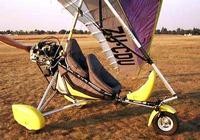
Aerotrike Scout

Replacing the Safari, the Aerotrike Scout is certified by the South African Civil Aviation Authority (CAA).
Primarily of steel construction the Aerotrike Scout is available as a kit, including the ‘kinked’ pylon, and new rear suspension. The Scout features front wheel ‘trailing link’ suspension and rear wheel suspension through non-degrading polyurethane. The folding pylon allows rigging and de-rigging without removing the fuel tank and seats – just one safety clip and bolt.
The engine mounting has vibration absorbing mounting rubbers and large side luggage bags cover a 55 litre (13 US gal) fuel tank. Individual bucket seats with back rests and lap restrainers are standard.
Standard configuration includes a Rotax 503 DCDI Engine with Dual Ignition and Twin Carbs (52 HP), “B” Series Gearbox (reduction 2,58:1), 2-bladed propeller, 55-litre (14 US gal) fuel tank, side luggage bags, rear wheel pants, and small instrument panel (no instruments).

Empty Weight (trike and engine only – no wing): 107 kg / 235 lbs
Typical Useful Load (Pilot, Passenger, Fuel & Gear): 290 kg / 640 lbs
MTOW: 450 kg / 990 lbs
Design Loads: +6g -3g

Aerotrek Eurofox / A-220 / A-240

A220

Until 2009, the Aeropro aircraft had the model name EuroFox for both the tricycle-gear and taildragger airplanes. To reflect the considerable development and evolution of the aircraft designs over the years, and with developments since the Aeropro aircraft have been delivered into the U.S. in the S-LSA category, the tricycle-gear aircraft model designation was changed to A240 and the taildragger aircraft given the model designation A220, and the aircraft sold in the U.S. and Canada are sold under our Aerotrek banner.

A240

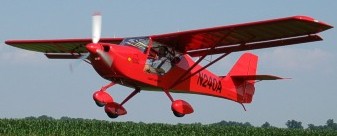
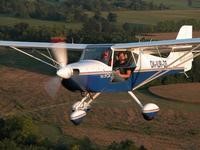
The Aerotrek A220 and A240 are factory-built two-seat aircraft, FAA-approved S-LSA (Special Light Sport Aircraft) that have a quick-folding wing design (only one-person, only 10 minutes).
Both the Aerotrek A220 and A240 are built in series-production.
The Aerotrek A220 taildragger has a range of 600+ miles, a cruise speed up to 120 mph, and a climb rate of over 1,000 fpm with the 100 hp engine. The cockpit has side-by-side seating, dual stick controls and is 44.1″ wide.
The Aerotrek A220 taildragger features a composite main landing gear and has wide-spaced main wheels to aid with cross-wind landings and takeoffs. The forward visibility of the A220 is helped by having clear polycarbonate doors for visibility out the side of the aircraft. The A220 also features a new dual toe brake system and larger tundra tires.

Aeropro EuroFox

The Aerotrek A240 tricycle-gear and A220 taildragger S-LSA have payloads of 585- and 650-pound useful loads respectively, and more than 400 of them have been flying worldwide since 1990. Options include Dynon SkyView, tundra tires and a “well-equipped” price of US$84,950 (2012).

The Aerotrek A240 tricycle-gear and A220 taildragger S-LSA have payloads of 585- and 650-pound useful loads respectively, and more than 400 of them have been flying worldwide since 1990. Options include Dynon SkyView, tundra tires and a “well-equipped” price of US$84,950 (2012).

Aerotrek A240

Aeropro CZ EuroFox
Empty Weight: 288 kg / 636 lb
MTOW Weight: 599 kg / 1320 lbs
Stall: 35 kt / 40 mph / 64 kmh
Cruise: 103 kt / 118 mph / 190 kmh
VNE: 111 kt / 128 mph / 206 kmh
Climb Rate: 1200 ft/min / 6 m/s
Glide Ratio: 14:1
Take-off distance (50ft obstacle): 400 ft / 122 m
Landing distance (50ft obstacle): 460 ft / 140 m
2009 Price: 39500 EURO

Aerotique Aviation Parasol

Constructed from gusset reinforced rectangular tubing. The fuselage weighs 12 lbs. Wood wings with ½ span ailerons. Centre mounted joy stick, rudder pedals, and tail skid.

In 1984 the Aerotique Parasol could be built from plans ($75) for about $2500 including a 28 hp engine.

Engine: Rotax 277, 27 hp
Empty wt: 250 lb
Wing span: 32 ft
Wing area: 144 sq.ft
Height: 6 ft 2 in
Length: 17 ft 6 in
Fuel capacity: 5 USG
Construction: Steel, Wood, Fabric.
Max wt: 520 lb
Stall: 22 mph
Max speed: 60 mph
Vne: 78 mph
Climb rate: 700 fpm @ 40 mph
Design limit: +6, -2.5g
Glide ratio: 12-1
Wing loading: 3.61 lbs/sq.ft
Power loading: 19.26 lbs/hp

Engine: Cuyuna UL II-02, 35 hp
Wing span 32’
Wing area 140 sq/ft
Length 17.5’
Height 6.17’
Empty weight 250 lbs
Payload 270 lbs
Cruise speed 60 mph
Stall speed 24 mph
Climb rate 700 fpm
Load factors +6 G, -2.5 G
Glide ratio 12:1
Build time 150 hrs