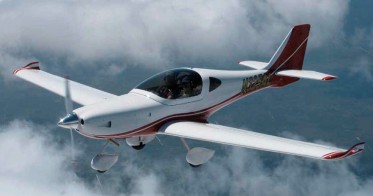
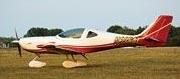
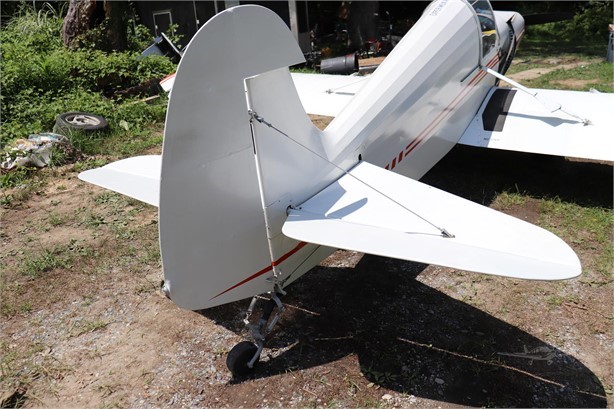
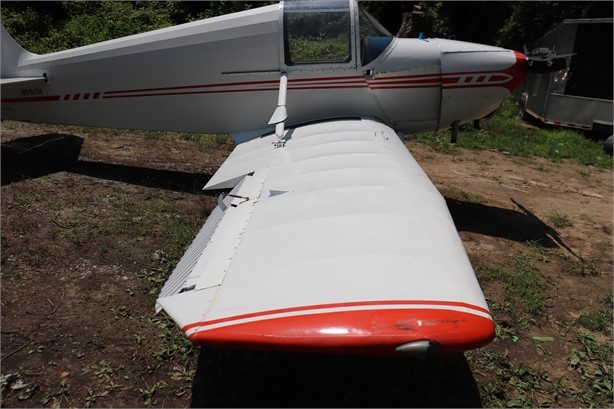
Arion Aircraft design of the Lightning structure was tested extensively for symmetrical and asymmetrical flight loads to over 9 G at a gross weight of 1320 lbs. Torsional testing of the fuselage and tail, load testing of welded parts rounded out the strength testing profile. A Ballistic Recovery Systems was designed for the Lightning. This is instaled inside the molded skins. Through a mix of molded fiberglass components and welded 4130 steel structures, the construction method has no epoxy layups are needed to complete the kit. Trimming and fitting the parts, some final fabrication of the parts and bolting the plane together is all that is required from the kit. Aircraft grade hardware is used throughout. The Lightning cruises at 175 mph on 120 hp, burning 5.5 US gallons per hour. Solo climb rates is at 1700 fpm. Roll rates exceed 45 degrees/second. Top speed is 190 mph, and the touchdown speed is under 50 mph. The Lightning was available with extended tips for LSA.
A carryover from the kit-built market, the all-composite, American-built Arion LS-1 Lightning was available in 2012 in Experimental-built kit form with a 135-140 knot cruise. The base price 2012: $119,900.
Arion LS-1 Lightning
Lightning Engine: Jabiru 3300, 120 hp Propeller: Sensenich WC62FK-58 Carbon Fiber Ground Adjustable Wing Span: 27′ 2″ Length: 20′ Height: 6’6″ Wing Area: 91.0 sq ft Empty Weight: 825 lbs Gross Weight: 1425 lbs Fuel Capacity: 23 gallons std or 30 gal optional Maximum Speed: 190 mph Cruise Speed @ 8000 ft 75% pwr: 150 – 170 mph Vne: 208 mph Stall (Full Flap): 45 mph Stall Clean: 56 mph Glide Ratio: 17:1 Take Off Roll: 315 ft Landing Roll (with brakes): 500 ft Climb Rate (at gross): 1200 ft / min Turn Rate 45/45o: <1 second Maneuvering Speed: 125 mph Endurance: 5 hr w/ reserve (30 gal tanks) Range w/ res: 750 sm Cockpit Width Elbow: 43″ Cockpit Width Shoulder: 41″ Brakes: Independent Hydraulic Rudder Pedals: Adjustable even in flight Construction: Vacuum infused oven post cured fiberglass Canopy: Forward Hinged Clear or Tinted Flaps: Electric Std Trim: Electric Std Max Loading: + 5G -3.8
Lightning Sport Engine: Jabiru 3300, 120 hp Propeller: Sensenich WC62FK-56 Carbon Fiber Ground Adjustable Wing Span: 30′ with extended tips for LSA Length: 20′ Height: 6’6″ Wing Area: 91.0 sq ft Empty Weight: 800 lbs LSA Gross Weight: 1320 lbs for LSA Fuel Capacity: 23 gallons std or 30 gal optional Maximum Speed: 150 mph Cruise Speed @ 8000 ft 75% pwr: 138 mph Vne: 208 mph Stall (Full Flap): 40 mph Stall Clean: 51 mph Glide Ratio: 17:1 Take Off Roll: 275 ft Landing Roll (with brakes): 350 ft Climb Rate (at gross): 1800 ft/min Turn Rate 45/45o: <1 second Maneuvering Speed: 125 mph Endurance: 5 hr Range w/ res: 700 sm Cockpit Width Elbow: 43″ Cockpit Width Shoulder: 41″ Brakes: Independent Hydraulic Rudder Pedals: Adjustable even in flight Construction: Vacuum infused oven post cured fiberglass Canopy: Forward Hinged Clear or Tinted Flaps: Electric Std Trim: Electric Std Max Loading: + 5G -3.8
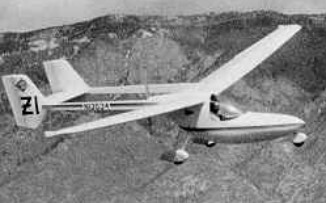
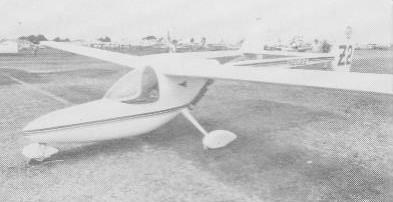
The Zia was originally conceived as a tailless motor glider and transformed by Oshkosh 1983 into the twin-boom pusher.
George Applebay entered the ultralight world with a very soaring oriented design, the Zia, whose control system consists of tip rudders, angled so that they work in roll as well as yaw and controlled by stick and pedals through a mixer, and a slotted flap occupying 25% of the canard surface, which provides pitch control. Glidepath control is by flaps which extend to 45 degs. The tricycle undercarriage has a steerable nosewheel and the braked main wheels are suspended on glass fibre struts reinforced with Kevlar. He designed the Zia according to the JAR22 standard, using composite construction in the main but with Dacron wing covering. Single seat single engined mid wing monoplane with conventional three axis control. Wing has swept forward leading and trailing edges, and tapering chord; no tail, canard wing. Pitch control by flaps on canard; yaw/roll control by angled tip rudders; control inputs through stick for pitch/yaw/roll and pedals for yaw/roll. Cantilever wing; wing profile; double surface. Undercarriage has three wheels in tricycle formation; suspension on nosewheel and glass fibre/Kevlar suspension on main wheels. Flush right go right nosewheel steering connected to yaw control. Brakes on main wheels. Composite construction fuselage, totally enclosed. Engine mounted at wing height driving pusher propeller. The engine is started by a pull rope either on the ground or for air starting.
Engine: Robin EC25PS, 18 hp. Power per unit area 0.14 hp/sq.ft, 1.6 hp/sq.m. Fuel capacity 4.0 US gal, 3.3 Imp gal, 15.0 litre. Length overall 13.1ft, 4.00m. Wing span 43.3ft, 13.20m. Total wing area 125sq.ft, 11.6sq.m. Empty weight 209 lb, 95kg. Max take off weight 452 lb, 205kg. Payload 243 lb, 110kg. Max wing loading 3.62 lb/sq.ft, 17.7 kg/sq.m. Max power loading 25.l lb/hp, 11.4kg/hp. Never exceed speed 81 mph, 130kph. Cruising speed 59mph, 95 kph. Stalling speed 28 mph, 45 kph. Best glide ratio with power off 27/1 at 42 mph, 67 kph. No. of Seats: 1
1982: Applebay Sailplanes, 206 Industrial Park Road, Rio Rancho, New Mexico 87124, USA. 2008: 9412 Gutierrez Rd Ne, Albuquerque, Bernalillo County 87111-2512, NM, USA
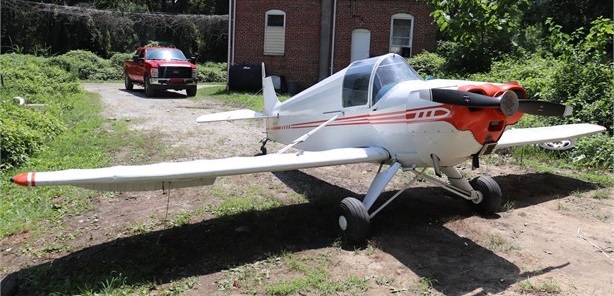
The Apollo Fox is built according to the BCAR Section S constuction norm. The aircraft has welded steel alloy tube fuselage covered with ceconite fabric. The wings are made of aluminium alloy both spars and ribs and then covered with ceconite. Wing can be folded backwards. One pilot can do it within 10 minutes. The landing gears are aluminium plate sheet as year suspension. Wheels are equipped with hidraulic disc or mechanical drum brakes. Available tail or nose wheel configurations. Engine opts: Rotax 582 UL Mod 99 (65Hp) Rotax 912UL (80 Hp) Rotax 912 ULS (100 Hp) Jabiru 2200 (80Hp) Subaru EA 81 (100 Hp). Stall: 35 kt / 40 mph / 64 kmh Cruise: 81 kt / 93 mph / 150 kmh VNE: 97 kt / 112 mph / 180 kmh Empty Weight: 274 kg / 604 lbs MTOW Weight: 450 kg / 992 lbs Take-off distance (50ft obstacle): 460 ft / 140 m Landing distance (50ft obstacle): 660 ft / 200 m
Apollo Ultralight Aircraft is a Hungarian aircraft manufacturer based in Eger. The privately held company specializes in the design and manufacture of ultralight aircraft, gyroplanes and ultralight trikes, in the form of kits for amateur construction and ready-to-fly aircraft for the European Fédération Aéronautique Internationale microlight and the American light-sport aircraft categories.
The company produced a wide variety of aircraft including five ultralight trike models, the Delta Jet, Jet Star, Monsoon, Racer GT, C15D Toples and the Classic. Apollo also makes a single fixed wing microlight, the Fox which is a copy of the Denney Kitfox and a gyroplane, the Gyro AG1.
The company has an American distributor, Apollo Aircraft, which has completed US Federal Aviation Administration light-sport aircraft certification for the Fox fixed wing microlight as well as the Delta Jet, Jet Star and Monsoon trikes.
Apollo exhibited at AERO Friedrichshafen in 2013 as well as the Al Ain airshow in the United Arab Emirates.