1995: 27518 County Rd 561, Travares, FL 32778, USA.
1997: 152 E. Eighth St., Apopka, FL 32703, USA.
Glider and LSA manufacture
Glider
Addyman Zephyr
The second design of Erik T.W. Addyman was the Zephyr. A single-seat sailplane built in 1933 by Addyman.
The Zephyr was of very light conventional wooden construction, with a primary type fuselage with a ply and fabric covered nacelle cockpit.
The undercarriage was a main keel, plus tail bumper. No airbrakes or flaps were fitted. The wings were wire braced.
One only was built, flown by Addyman from many fields in the Lake District and the Pennines before the war. It is believed that the Zephyr was not flown after the war and it remained in storage until Mr Addyman died in 1963. The Zephyr was the acquired by J.C. Riddell but it was found to be suffering from glue failure. It was stored in Riddell’s factory in Hunslet, Leeds.
In September 1970, when it was to have become the property of NAPS as BAPC.39, but it was mysteriously burned before delivery.
Wingspan: 12.73 m / 41 ft 9 in
Length: 5.64 m / 18 ft 6 in
Wing area: 18.12 sq.m / 195 sq.ft
Aspect ratio: 9.5
Tare weight: 83.91 kg / 185 lb
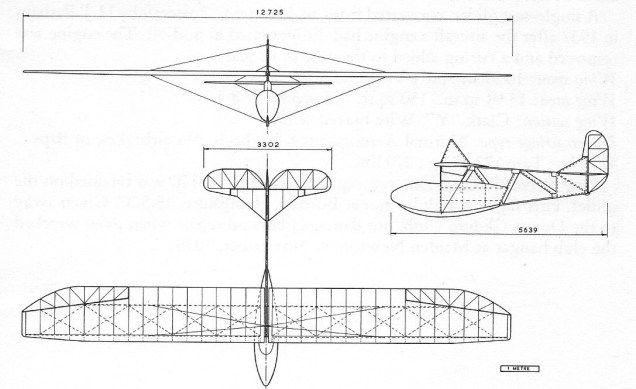
Addyman STG / Standard Training Glider
Erik T. W. Addyman designed and built his STG single seat primary glider at Harrogate, UK, for low cost basic training. As such, it was a simple, wooden, aerodynamically unrefined aircraft with a relatively low aspect ratio wing, a cockpit nacelle under it and a flat open truss girder fuselage aft. The unswept wing had parallel chord with blunt tips and was built around two spars. There were no flaps or airbrakes. Above the wing landing wires ran from about mid-span on each wing from the spars to the top of a centrally mounted inverted V-strut; below, similarly arranged flying wires ran to the lower nacelle longerons.
Attached immediately behind the single open cockpit headrest at the forward wing spar, the nacelle extended rearwards only to the wing trailing edge, suspended from an inverted V pair of struts to the rear spar. A landing skid extended over most of the length of the nacelle. Aft of the nacelle, the fuselage was an uncovered converging Warren girder structure carrying the tail surfaces and braced laterally by wires to the mid-span wing points. The fin was very small but carried an almost rectangular rudder which extended to the fuselage keel via a cut-out in the elevators. The tailplane was straight tapered, with a swept leading edge. A wire tail bumper completed the undercarriage.
The STG was built at Harrogate and flew for the first time in June 1934.
It seems that two STGs were built. One of them was originally based at Wigan, the other at Harrogate. Addyman was the Honorary Secretary of The Aircraft Club, Harrogate; a letter from him to Flight in July 1942 says that one STG was there, “overhauled”, and another was three-quarters built, though the former was unable to fly because of a Government ban on glider use at that point of the War. The fate of the partially built STG is not known. There were plans to build another after World War II but construction probably did not start. The two completed aircraft survive in store in 2010.
Another STG was begun, intended for powered flight using an Anzani engine. Parts of this machine, which has become known as the Addyman UL (UltraLight), also survive in store.
Wingspan: 37 ft 6 in (11.43 m)
Wing area: 187.0 sq ft (17.37 m2)
Aspect ratio: 7.5
Airfoil: Gŏttingen 436
Length: 19 ft 4 in (5.90 m)
Crew: 1
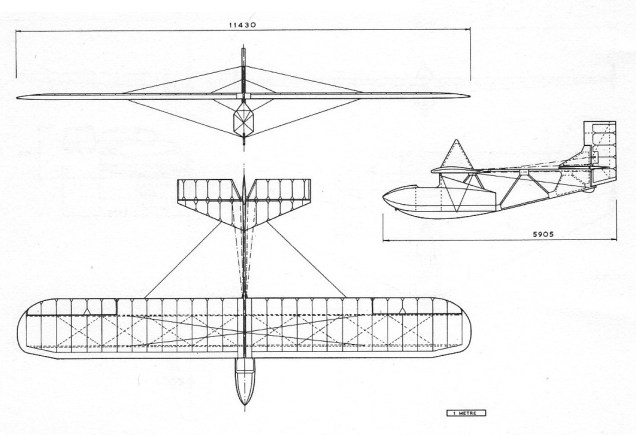
Addyman, Erik T. W.
Glider pilot Erik T.W. Addyman designed two gliders at Harrogate, UK, in the 1930s, despite having previously lost a hand in a gliding accident.
Addyman intended to produce an ultralight aircraft from an airframe similar to his Standard Training Glider. It was started in 1936 and was to have an Anzani engine but it was never completed. It became the property of The Aeroplane Collection Ltd (formerly Northern Aircraft Preservation Society) as BAPC.16. It was in store at Irlam, Manchester, UK.
Addems, Walter J
1916
Loda IL.
USA
First airplane, a glider, was built in 1916 from plans in Aviation Week and flown successfully enough to qualify the teenager for membership in the Early Birds organization.
1920
Judd IA.
USA
c.1955
Atherton CA
USA
On retirement from a career flying for Natl Air Transport and UAL, Addems became well regarded for his faithful reproductions of classic aircraft.
Abrial A-13 Buse
In 1954 Abrial came back to the design of tailless aircraft, with the A-13 “Buse” project. But this glider was never built.
Abrial A-12 Bagoas
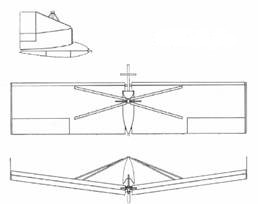
Georges Abrials main interest was soaring, so he decided to design a tailless glider: the A-12. After testing successfully a scale model at the St Cyr wind tunnel, he built the full-size prototype. This glider had an aspect ratio of 6 to 1. During the development of this new glider, in 1932, Georges Abrial had to face so much technical difficulties that he decided to give up the project. He christened his project “Bagoas”, the name of a famous Persian poisoner.
Peyret-Abrial A-5 Rapace
The Peyret-Abrial “Rapace”, aka Abrial A-5, single-seat sailplane, was designed with the assistance of Louis Peyret and Professor Toussaint. One was built. The “Rapace” beat the international altitude record with 720 m. 16m span
Abrial A-2 Vatour
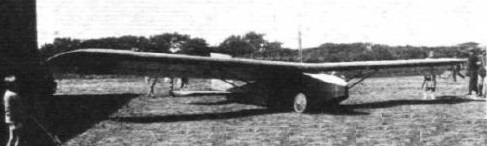
The A-2 Vautour was designed by Georges Abrial of the Institut Aérotechnique de Saint-Cyr and built by Louis Peyret. Each wing, joined to a centre-section on top of the fuselage with light dihedral, had a rectangular plan apart from an angled tip and carried a broad chord aileron which filled about 60% of the span. They were of mixed construction with two rectangular section dural spars and plywood ribs. Each wing was braced with a pair of parallel struts, dural tubes enclosed in streamlined, wooden fairings, between the lower fuselage longerons and the wing spars just inside the ailerons.
Its fuselage was rectangular in section, with spruce longerons and laminated wood frames. The sides were everywhere vertical but ahead of the wing it narrowed in plan and decreased in depth to a rounded nose. The downward sloping upper surface here was not flat but curved, formed from thin aluminium sheet. The pilot’s open cockpit was just in front of the leading edge, with a rubber-cord restrained canvas sheet between him and the aluminium surface, intended as protection in a crash. It contained some basic instrumentation, including an airspeed indicator and an altimeter, both with sensors well above the wing centre-section on a mast, as well as a compass.
The horizontal tail of the Vautour, mounted at mid-fuselage height, was similar in plan to the wing. The tailplane was much narrower than the one piece elevator. The fin was likewise narrower than the rudder and together had a rhomboidal profile, allowing the elevator clearance below. Both surfaces were wood-framed and ply covered, with the exception of the fabric covered rudder.
Its landing gear was very simple, with wheels close to the sides on a split axle mounted within the fuselage. Rubber cord shock absorbers were used and the tailskid was also mounted elastically.
The date of the first flight of the Vautour is not known but it made its first major public appearance in the meeting held at Vauville from 22 July to 11 August 1925. The competition included both gliders and low-powered aircraft. The Vautour, flown by Auger, gained the prize for greatest altitude above the starting point, reaching 720 m (2,360 ft). It was placed second in a competition to fly the maximum number of 1 km (0.62 mi) laps, managing 36. It remained at Vauville after the contest and in February 1926 Auger returned to it with the intention of an attack on the altitude and distance records, as well as competing in several contests. By April the attempt had been abandoned due to unsuitable winds and the glider was dismantled and returned to Paris, with the hope of later using a site in Eure. There is no record that these attempts were made.
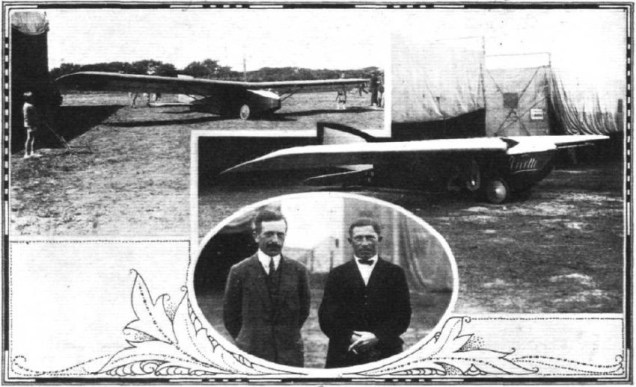
Wingspan: 12.65 m (41 ft 6 in)
Wing area: 20 m2 (220 sq ft)
Aspect ratio: 8
Airfoil: Royer
Length: 6.25 m (20 ft 6 in)
Empty weight: 106 kg (234 lb)
Gross weight: 180 kg (397 lb)
Crew: 1
Abrial-Levasseur A-1
Georges Abrials first full-size glider was the Levasseur-Abrial A-1 of 1922. It was destroyed on its fourth take-off.

