Aero Designs Inc Condor

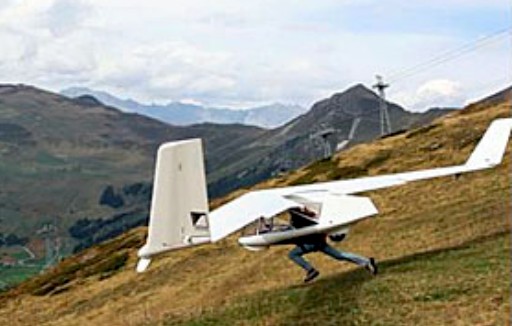
pilot Dave Morss

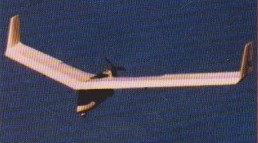
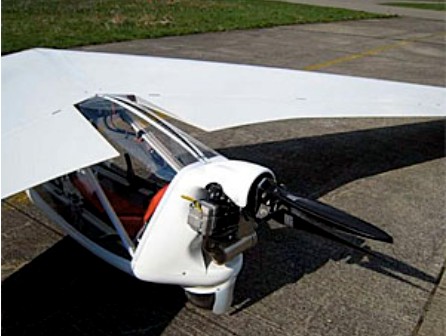
The Condor built by ADI in 1981 was a two place, powered sailplane made out of composite materials and powered by a Revmaster 2100 cc VW engine.

The Condor wing has foam ribbing, fibreglass covered, with a single aluminium spar.

While taking off at night, the engine stopped and the aircraft glided into a hill. The aircraft was totally destroyed.

Engine: Revmaster 2100 cc VW, 65 hp
Prop: Fahlin 34 x 58
Span: 32 ft
Length: 17 ft 11 in
Wing area: 130 sq.ft.
MAUW: 1100 lb
Useful load: 520 lb
Max speed: 95 mph est
Stall: 46 mph
Climb rate: 700 fpm

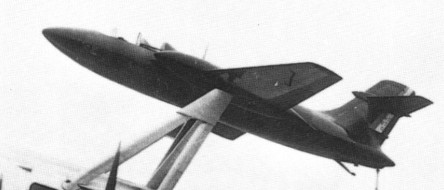
Aerocentre NC.271

NC.270.01

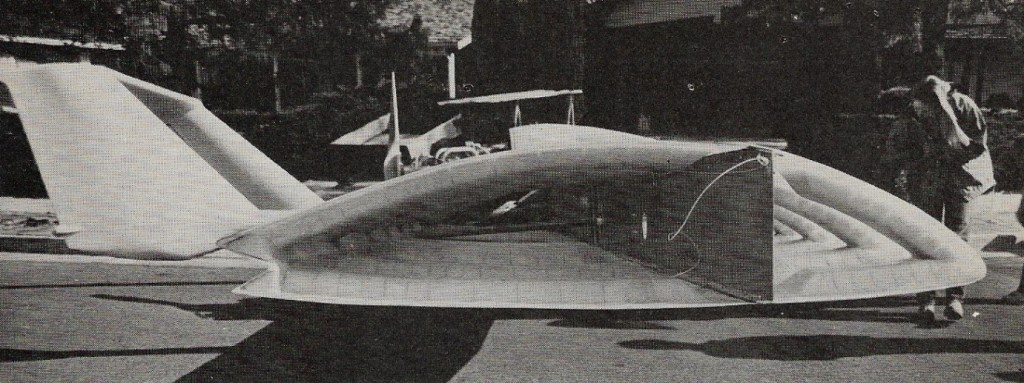
Planned shortly after the end of WW2, as a jet powered NC.270 bomber with two Rolls-Royce Nene turbojets, the airframe of this light bomber was based on curved lines with flying surfaces (including a T-tail) of modest sweep. Power was provided by two engines located in the wing roots, and the design envisaged an 11,023-lb (5000-kg) bombload carried internally plus a defensive armament of four 15-mm cannon in a TV-controlled tail barbette. Validation of the design was entrusted to a pair of reduced-scale machines, the engineless NC.271-01 and the rocket-powered NC.271-02. The NC.271-01 flew in 1949 (air-launched from a piggyback position above a Languedoc transport aeroplane), but before the NC.271-02 could be flown later in the same year the parent company folded and the whole NC.270 programne was terminated.

Aero VSB 66 Orlice

Members of the VSB (the Aircraft Faculty of Brno Military Academy, Czech Republic) produced the VSB-66-S Orlice V-tailed single-seat Standard Class design which first flew on 17 September 1970.

Length: 26.509 ft / 8.08 m
Wingspan: 60.696 ft / 18.5 m
Wing area: 174.377 sq.ft / 16.2 sq.m
Max take off weight: 1102.5 lb / 500.0 kg
Weight empty: 829.1 lb / 376.0 kg
Max. speed: 130 kts / 240 km/h
Landing speed: 36 kts / 67 km/h
Wing load: 6.36 lb/sq.ft / 31.0 kg/sq.m
Glide ratio: 43.0
Crew: 2

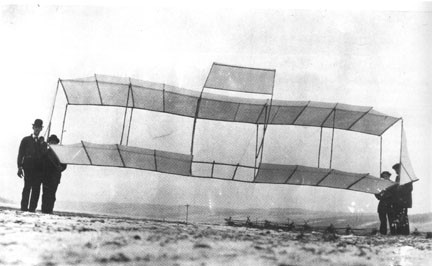
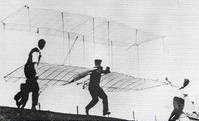
Aerial Experiment Association 1907 Glider

Alexander Graham Bell, inventor of the telephone, had a passionate interest in aviation and had experimented with scientific kites since 1891. He was also a good friend of the Dr. Samuel P. Langley, the builder of the unsuccessful Aerodrome. Bell was Langley’s successor determined to develop a practical airplane with the apparent blessing of the U.S. Army.

In September of 1907, he organized the Aerial Experiment Association to build a practical airplane.

Initial plans were to build four flying machines, and for each member to personally oversee at least one project. The first of these was to be Bell’s kite, equipped with one of Curtiss’ motors. It took shape by December of 1908, but Bell wanted to test it as a glider before engine installation, so Selfridge, somewhat experienced in flight, was towed by a motorboat across a lake near Baddeck. The kitelike machine rose to an estimated height of about 170 feet, but then settled in the water still on tow, ruining many of its silk cells. While it was tediously undergoing repair, the group’s thoughts shifted to more conventional aircraft, such as those being flown in Europe at the time.

Aériane P-Swift / Brightstar P-Swift

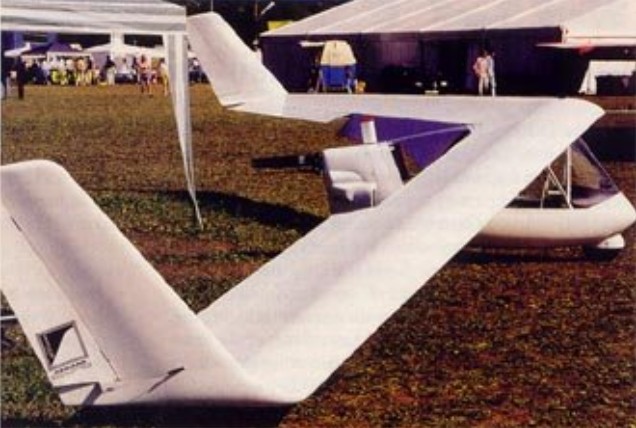
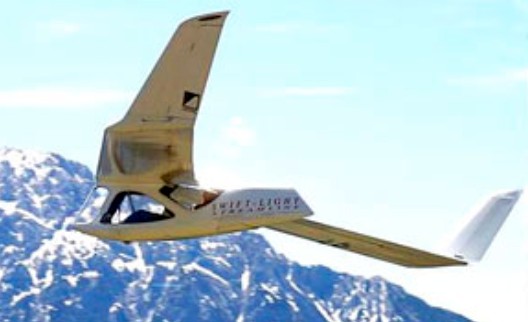
Though the Swift is popular in Europe, it began life as an American design from U.S. producer Brightstar. The San Francisco-area company created the unpowered Swift in the early 1990s. Soon after its introduction, Brightstar offered the Motor Swift, but the company didn’t go nearly as far with it as Belgium-based producer Aeriane, which bought the manufacturing rights.

The European company finished the cockpit area and has fully enclosed it and the aft engine. These streamlining efforts have boosted glide performance by several points.

Equipped with a fixed motor and effectively a motorglider/microlight with a glide ratio of 27:1 and a sink rate of 140 fpm, the Motor Swift is quite competitive, and it is unique for its tailless design. This 253-pound plane has been flying for a decade without problems.

The Motor Swift comes with easily removed wings for simple transport and storage and is sold ready to fly with starter, folding prop, and instruments for about $25,000 (circa 2010).

The Motor Swift can qualify as a Part 103 ultralight. There is also a tandem cage adaptable on the same wings.

Flying the Aériane P-Swift

Engine: Zanzotera F34, 25 hp
Hp range: 10-30.
Top speed: 93 mph.
Cruise: 80 mph.
Stall: 25 mph.
ROC: 700 fpm.
TO dist: 120 ft.
Ldg dist: 160 ft.
Service ceiling: 15,000 ft.
Empty wt: 200 lbs.
MTOW: 450 lbs.
Height: 5 ft.
Length: 14 ft.
Wing span: 39 ft.
Wing area: 135 sq.ft.
Seats: 1.
Undercarriage: 2 wheel tandem.
Glide ratio: 25-1.

Engine: Zanzoterra MZ 34, 25 hp
Empty weight: 110 kg
Wing span: 12 m
Wing area: 12.5 sq.m
Fuel capacity: 18 lt
MAUW: 230 kg
Seats: 1
Max speed: 140 kph
Cruise speed: 120 kph
Minimum speed: 40 kph
Climb rate: 3.5 m/s
Fuel consumption: 4 lt/hr
Price (1998): 800 000 FB ht

Engine: Konig SC430, 24 hp.
Speed max: 63 mph.
Cruise: 53 mph.
Range: 230 sm.
Stall: 27 mph.
ROC: 500 fpm.
Fuel cap: 3 USG.
Weight empty: 230 lbs.
Gross: 470 lbs.
Height: 7 ft.
Length: 10 ft.
Wing span: 39 ft.
Wing area: 135 sq.ft.
Seats: 1.
Landing gear: nose wheel.
Aériane Swift / Brightstar Swift

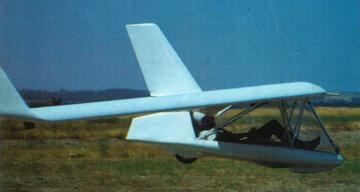
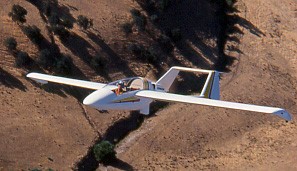
The original Swift (Swept Wing with Inboard Flap Trim) was made by Bright Star Gliders in California. When they were looking for a manufacturer for the European market, they found Aériane in Belgium.

The pilot lies flat in this 24-1 glide ratio motor glider. For Advanced pilots, it can switch from powered to unpowered in 30 minutes. The Swift PAS is equipped with an auxiliary motor.

The Swift was marketed by Bright Star Gliders Inc in California. From 1997 Aériane was the only manufacturer building and marketing all versions of the carbon fibre / kevlar construction Swift light sailplane.

When Bright Star closed Aériane continued building the Swift.

Gallery

Wing Span: 11.898 m
Empty weight: 63 kg
Wing area: 12.54 sq.m
Vne: 120 km/h
Stall: 35 km/h
Vzmin: 0.65 km/h
Glide Ratio: 25 @ 60 km/h
Price (1998): £ 11,750

Aériane Swift Light
Wing area: 12.54 m²
Wing span: 12.7 m
Aspect ratio: 12.86
Hang glider weight: 46 kg
Minimum pilot weight: 55 kg
Maximum pilot weight: 105 kg
Minimum speed: 35 km/h
Maximum speed: 120 km/h
Max glide ratio (L/H): 27
Max glide ratio speed: 75 km/h
Minimum sink rate: 0.6 m/s
Nose angle: 140 deg

Aériane Swift Standard
Wing area: 12.54 m²
Wing span: 11.89 m
Aspect ratio: 11.27
Hang glider weight: 60 kg
Minimum pilot weight: 55 kg
Maximum pilot weight: 105 kg
Minimum speed: 35 km/h
Maximum speed: 120 km/h
Max glide ratio (L/H): 25
Max glide ratio speed: 75 km/h
Minimum sink rate: 0.6 m/s
Nose angle: 140 deg

Advanced Soaring Concepts Falcon

The kit built 15 m. racing class counterpart of the Standard Class ASC Spirit, the Falcon came with optional 18 m. wingtip extensions, full span trailing edge flaps and top surface Schemmpp-Hirth type airbrakes. Built with GFRP sandwich, GFRP spar, and aramid reinforced cockpit, welded tube frame, and designed by Tor Jensen.

Wing span: 15m / 49.2 ft
Empty wt: 263 kg / 580 lb
Max L/D: 44
Seats: 1

Advanced Soaring Concepts American Spirit

The Spirit, which first flew in 1992, is the kit built Standard Class 15m design. It was designed by Tor Jensen in USA, to accommodate a 193 cm. / 6′ 4″ pilot weighing up to 118 kg / 260 lb with parachute. A composite sailplane with detachable wings, built with GFRP sandwich, GFRP spar, and aramid reinforced cockpit welded tube frame.

Speed max: 135 mph.
Cruise: 70 mph.
Stall: 38 mph.
Aspect ratio: 23.9:1.
L/D: 44:1 fpm.
Min sink: 106 fpm.
Weight empty: 505 lb.
Gross: 1157 lb.
Height: 3.92 ft.
Length: 21.6 ft.
Wing span: 49.2 ft.
Wing area: 106.2 sq.ft.
Seats: 1.
Landing gear: single wheel.