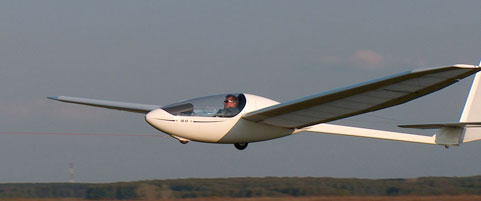
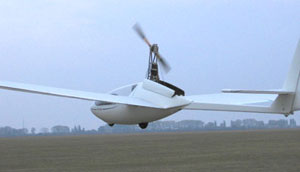
AFM Chevron / Aviation Enterprises Chevron

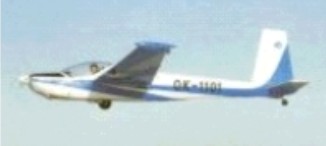
Promoted as a motor glider, the side-by-side two seater has long, cantilevered wings.

After corporate difficulties the Chevrn returned to production by Aviation Enterprises. Aviation Enterprises markets the Chevron 2-32C two-seat composites microlight trainer (first flown 1983 in original prototype form). Over 40 were sold worldwide.

Aviation Enterprises Chevron 2-32C

Gallery

Aviation Enterprises Chevron 2-32C
Engine: Konig SD 570, 32 hp
Wing span: 13.4 m
Wing area: 17.6 sq.m
MAUW: 390 kg / 860 lbs
Empty Weight: 184 kg / 406 lbs
Fuel capacity: 50 lt
VNE: 86 kt / 99 mph / 159 kmh
Max speed: 120 kph
Cruise: 60 kt / 69 mph / 111 kmh
Stall: 28 kt / 32 mph / 52 kmh
Climb rate: 2.0 m/s
Glide Ratio: 17:1
Take-off distance (50ft obstacle): 750 ft / 230 m
Landing distance (50ft obstacle): 460 ft / 140 m
Certification: Vz, BCAR S
Seats: 2
Price (1998): £25,850

Aer Pegaso M100S / Aeromere M-100S / Avionautica Rio S. p. A M-100S / CARMAM M-100S Mesange (Tomtit) / CVT / Centro di Volo de Torino (Turin Gliding Center) M-100S

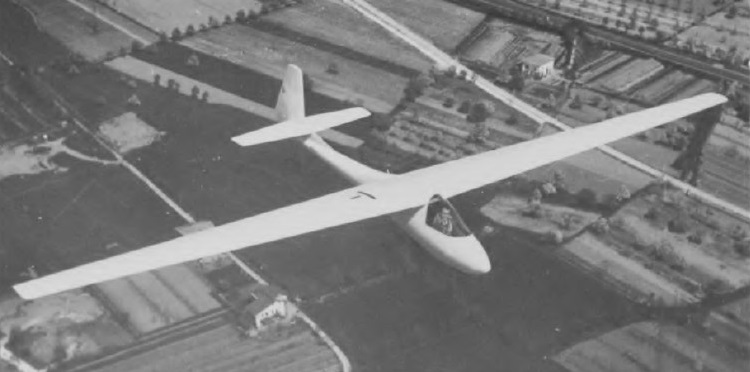
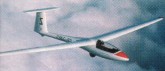
Designed by Alberto and Piero Morelli the M-100 was developed in the late 1950’s. The all-wood and fabric airframe has a semi-monocoque fuselage and wings with beech main spars and partial plywood skinning. It is stressed for normal aerobatics but not inverted maneuvers. Glidepath control is by a system of rotating disc segments opening on both upper and lower wing surfaces. The wing span was later increased to 15.0 m.

In its M-100 form it first flew in 1957, winning an Italian Aero Club competition for the best design of a single-seat sailplane.

The M-100 version served Italian clubs for a time as their standard trainer. It was followed by the M-100S
which featured a 15m (49ft 2.5in) span wing to meet Standard class requirements, and which first flew in prototype form in January 1960.

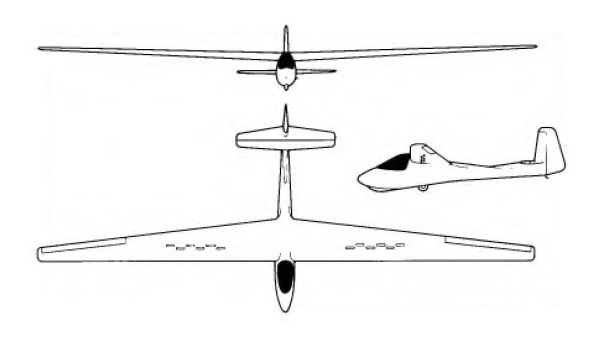
The M-100S is fully aerobatic (except for inverted flight) and is of conventional all-wood construction; the wing span is of beech and the wing is covered with plywood and fabric, with a leading edge torsion box. The slotted ailerons are fabric-covered and the air brakes consist of three pairs of light alloy rotating plates above and below each wing. Rudder and elevators are fabric covered, while the landing gear consists of a rubber-sprung nose-skid and a non-retractable mono-wheel with a disc brake; there is also a tailskid. Oxygen and radio equipment are stowed behind the pilot’s seat.

Production took place in Italy by Centro di Volo de Torino (Turin Gliding Center) (CVT) and, under license. Production of the M-100S was undertaken in Italy by Aeromere, which built 41, by Avionautica Rio S. p. A., which started production in June 1963, and by the French licensees CARMAM (Cooperative d’Approvisionnement et de Reparation de Material Aeronautique de Moulins), who built the type as the M-100S Mesange (Tomtit), beginning deliveries in June 1963.

Several improved features were introduced by CARMAM from aircraft No 23 onward, including light alloy air brakes instead of plastic ones, a new metal-framed one piece canopy of Italian manufacture hinged sideways and a wooden seat for the pilot.

Air transport certified, altogether about 180 of the M-100S were produced both in Italy and by CARMAM at Moulins-Avernes.

M-100
Wing span: 14m / 45ft 11in

M-100S
Wing span: 15m / 49 ft 2.5 in
Wing Load: 24.05 kg/sq.m / 4.9lb/sq.ft
Wing area: 13.1sq.m / 141sq.ft
Airfoil: NACA 63-618/615 mod.
Length: 6.56 m / 21 ft 6in
Height: 5ft 5in
Empty Weight: 200kg / 441lb
L/DMax: 32 @ 77 kph. /42 kt / 50 mph
Gross Weight: 315kg / 694lb
Water ballast: None
MinSink: 0.65 m/s / 2.15 fps / 1.27 kt at 41.6 mph / 36 kt / 67 km/h
Max speed: 137 mph / 124 kt / 230 km/h (in smooth air)
Max rough air speed: 75.5 kt / 140 km/h
Stalling speed: 27.5 kt / 51 km/h
Seats: 1
Aspect ratio: 17.1
Structure: wood/fabric wings and tail, wood fuselage.
Number built: 180
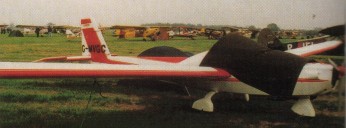
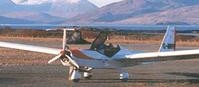
Aero Vodochody VT 100 Demant

Glider, Czech Republic

Length: 24.934 ft / 7.6 m
Wingspan: 59.055 ft / 18.0 m
Wing area: 73.839 sqft / 16.15 sq.m
MTOW: 837.9 lb / 380.0 kg
Weight empty: 639.5 lb / 290.0 kg
Max. speed: 119 kts / 220 km/h
Landing speed: 35 kts / 64 km/h
Wing load: 4.92 lb/sq.ft / 24.0 kg/sq.m
Glide ratio: 34.0
Crew: 1

Aero Vodochody Narodni Podnik

Aero Vodochody Ltd
After World War 2 the Czech aviation industry was nationalised under central control although the Aero 140 was sold under the Aero name.

Aero Vodochody Narodni Podnik Article

Aero Vodochody Narodni Podnik was established on July 1, 1953, perpetuating the old Czech name Aero.
Achieved technical distinction and international success during 1963-1974, when the major product (for several countries) was the Delfin jet trainer (first flown April 1959; more than 3,000 built). This was succeeded in production in late 1972 by the L-39 Albatros jet trainer and light attack aircraft (first flown November 1968), following its selection as standard jet trainer of all Warsaw Pact countries except Poland; the L-39 as part of training system, comprising also special simulator, ejection training simulator and mobile automatic test equipment.
Aero Vodochody received the Red Banner award of the Ministry of Engineering and UVOS seven times.
Renamed Aero Vodochody Ltd.
In May 1997 the Board selected a consortium made up of Boeing (90%), the former McDonnell Douglas, and CSA Czech Airlines (10%) to take a major stake in the company as strategic investors. Product range then comprised the L-39 Albatros, L-59, L-139 Albatros 2000 (using US engine and avionics) and L159 ALCA jet trainers and light combat aircraft, and the Ae 270 Ibis transport as a partner with AIDC in Ibis Aerospace.
The L159 did not sell and in 2004 the Czech government bought the firm back for a nominal sum.

Aerotecknik L 13 Vivat

Designed by Karel Dlouhy in the middle of 70´s as a powered self-launching derivative of the LET L 13 Blanik, the Vivat uses a rear fuselage and wings very similar to the L 13. Of all metal with fabric covered control surfaces. The wings do not incorporate the flaps of the L 13, but retain the DFS type airbrakes. The center section and cockpit area are widened to make room for the two-place side- by-side seats. The main wheel is retractable, and the wingtip outrigger wheels fold back at the same time. The tail wheel is steerable, being linked to the rudder circuit. It can also be unlocked and be fully castoring outside the normal rudder-linked range. The Vivat was offered with a choice of engines, the SHE with the Czech Walter mikron, matched to a three position Hoffmann propeller, and the SL with a German Limbach fitted with a Muhlbauer electrically operated constant speed feathering propeller. The engine compartment is fitted with cooling shutters which can be closed to reduce drag when the engine is off. Both models were offered with a two wheel non-retractable landing gear as an alternative to the single retractable wheel with tip outriggers.

Around 200 units of the L-13 Vivat were successfully exported to USA, Canada, Australia, South Africa, Egypt, Israel, Germany, Sweden and many other countries.
Production of the L13 Vivat motorgliders ended circa 2005.

Vivat L 13
Engine: Walter Mikron III AE, 64bhp/ 48kW
Wing span: 16.8m / 55.1ft
Wing area: 20.2sq.m / 217.4sq.ft
Empty Weight: 500kg / 1102lb
Payload: 220kg / 485lb
Gross Weight: 720kg / 1587lb
Wing Load: 35.64 kg /sq.m / 7.3lb/sq.ft
Aspect ratio: 13.7
L/DMax: 24 @ 100 kph / 54 kt / 62 mph
Seats: 2
MinSink: 1.1 m/s / 3.60 fps / 2.13 kt
Airfoil: NACA 63(2)A-615, root; -612, tip

Aeros AC-21      

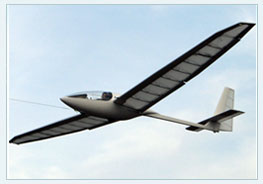
The AC-21 powered sailplane is an evolution of AL-12 design that was developed in Ukraine during 2000 – 2005 as a joint project by Aeros and Aerola. In 2006 it was decided to make a next step in the development of the sailplane, splitting the project and leaving production of AL-12 (now Alatus) in Aerola. AC-21 joins unique features of AL-12 incorporated in the new design.
The AC-21 is all about maximum enjoyment of free flight. Sweet handling, slow flight capabilities and low sink rate allows exploring “microlift” conditions, when most other gliders are unable to stay in the air. AC-21 can turn really tight.
AC-21 structural capacity has been increased keeping an aim to meet actual sailplane standards (+5.3 -2.65 G load factors). It gives us a chance of wider margin over current DULV and DAeC requirements for ultra light aircraft (+4/-2 G).
Specifically the wing leading edge D-spar had to get stronger by 25%; the ribs structural capacity and rigidity was greatly increased and the ribs are now made of carbon.
Powered by a Hirth F33 BS delivering 28 hp, it has a factory recommended TBO of 1000 hours at 75 % power.
A newly designed fuselage insures laminar flow over its front, makes room for the engine and allows full enclosure of the propeller when in glider mode. There has also been an increase in the transparent part of the canopy, improving forward visibility.

AC-21
Engine: Hirth F33 BS, 28 hp
Empty weight: 135 kg
Мах. takeoff weight: 264 kg
Wing span: 13.3 m
Sail area: 13.5 sq.m
Pilot weight: 60-110 kg
Stall speed: 52-56 km/h
Vne: 140 km/h
Best glide ratio: 27 at 70 km/h
Min. sink rate: 0.6 m/s at 67 km/h
Climb w. Engine: 2.5 m/s

Aeros AL-12

AL-12

In 2005 the Aeros team took part in designing an entirely new product: the AL-12 ultralight sailplane and its powered version AL-12 M with a retractable power-unit.
The idea of a sailplane that could have some of the positive features of hang gliders and rigid wing gliders, and the possibility of soaring flight while using narrow thermals and “microlift”, to takeoff from hang gliding sites, and the simplicity of quick rigging and ease of transportation appealed.
The sailplane offered by Aeros takes off by air towing or winch towing, andallows mounting a retractable engine for autonomous takeoff and climb. The cockpit is equipped with adjustable pedals and seat back that can be adjusted to the pilot’s height up to 195 cm. There is a space for a backpack parachute. The sailplane can come complete with an optional rescue system.
For transportation purposes all control and stabilizing surfaces are removed, the cabin is detached, the wing with the tail beam is put into a package 0,2 x 0,58 x 5,7 m. The 0,6 x 0,86 x 3 m cockpit can be transported either as a whole assembly or in parts (cockpit, fuselage spine fairing, cockpit enclosure). The rigging takes around 40 minutes.

AL12M -Powered version ultralight sailplane

On October, 8, 2005 the first flight of a powered sailplane AL-12M with a retractable power-unit took place. The sailplane was piloted by its chief design engineer and the Aerola company top-pilot Nikolay Kononenko. The AL-12M had been brought to the take-off field on a car roof rack and within an hour and a half the sailplane was rigged up and prepared for tests. The power-unit is based on Solo-210 engine (16 hp) and provides for self-taxiing, take-off and acceptable climb rate.During the first day six flights were performed and included air restarts.

AL-12
Empty weight: 80 kg
Мах. takeoff weight: 185 kg
Wing span: 13.3 m
Sail area: 13 sq.m
Pilot weight: 60-110 kg
Stall speed: 34-40 km/h
Мах. Airspeed: 140 km/h
Best glide ratio: 27 (at 60 km/h)
Min. sink rate: 0.5-0.6 m/s (at 45 km/h)

AL-12M
Engine: Corsair Solo-210, 16 hp
Empty weight: 120 kg
Мах. takeoff weight: 220 kg
Wing span: 13.3 m
Sail area: 13 sq.m
Pilot weight: 60-100 kg
Stall speed: 39-45 km/h
Мах. Airspeed: 140 km/h
Best glide ratio: 27 (at 65 km/h)
Min. sink rate: 0.8 m/s (at 45 km/h)