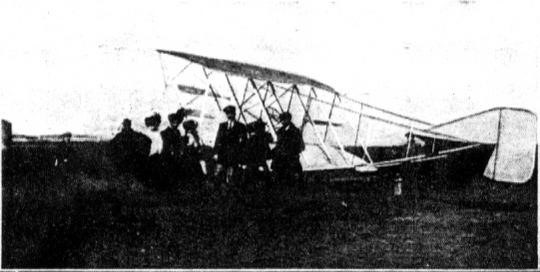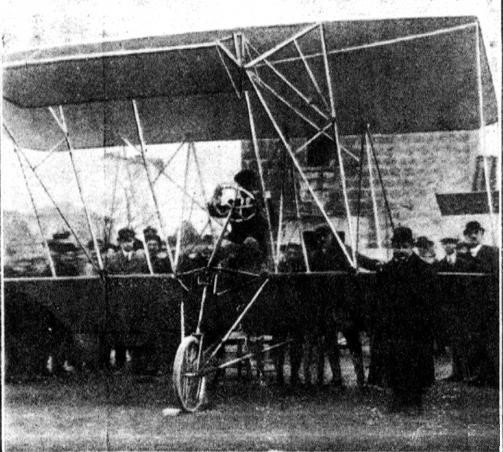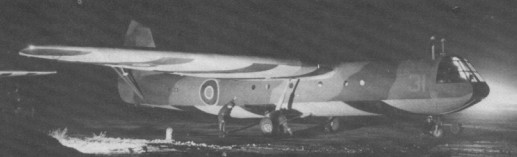
Airspeed AS.51 Horsa / AS.58 Horsa

A high-wing military transport glider with accommodation for 25 troops or freight, including vehicles, of wooden construction. Designed by A.H. Tiltman to Air Ministry Spec. X26/40 The AS.51 Horsa I featured tricycle undercarriage with jettisonable main wheels, main central skid. The cantilever wing was in three pieces. Airbrakes were on the lower surfaces of the wings and pneumatically-operated split flaps were fitted.

The prototype first flew on 12 September 1941 at Great West Aerodrome and the production AS.51 Horsa I entered service in late 1942.

The AS.58 Horsa II differed from the Mk I by having a hinged nose section to allow ease of loading. The prototype Horsa II first flew in 1943.

The first operational mission with Horsas was the invasion of Sicily in 1943, but they were also used during the D-day landings, when Horsa gliders were towed by Whitley and C-47 aircraft.
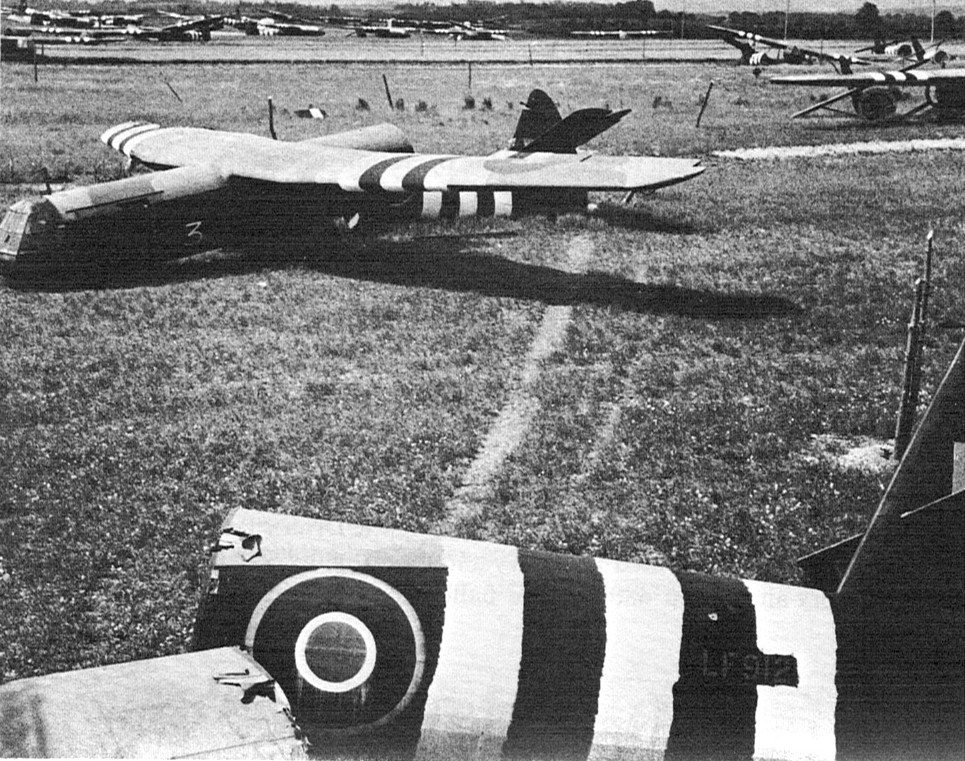
6 June 1944 Orne Estuary, Normandy

The US forces also received several hundred of these gliders.

Approximately 3,655 Horsas were built.

Gallery

AS.51 Horsa I
Wing span: 87.992 ft / 26.82 m
Wing area: 1104.386 sq.ft / 102.6 sq.m
Length: 67.028 ft / 20.43 m
Height: 19 ft 6 in / 5.95 m
Max take off weight: 15,500 lb / 7,045 kg
Empty weight: 8372.4 lb / 3797.0 kg
Max. payload: 7131.0 lb / 3234.0 kg
Max speed: 130 kts / 241 kph
Max tow speed: 150 mph / 242 km/h
Gliding speed: 87 kts / 161 kph / 100 mph
Wing load: 14.15 lb/sq.ft / 69.0 kg/sq.m
Crew: 2
Payload: 25 troops / 3234kg

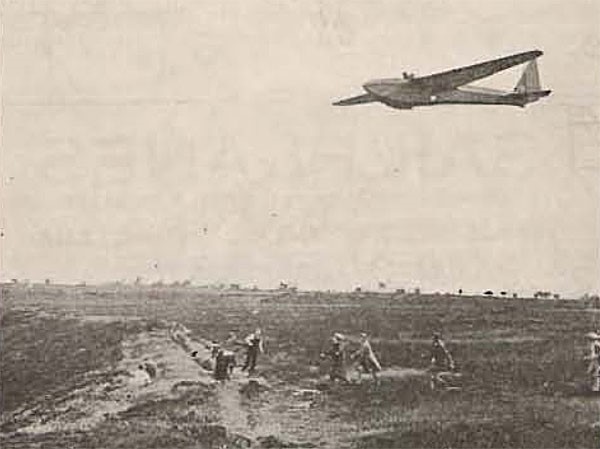
AS.58 Horsa II
Wing span: 87.992 ft / 26.82 m
Wing area: 1104.386 sq.ft / 102.6 sq.m
Length: 20.7 m / 67 ft 11 in
Height: 19 ft 6 in / 5.95 m
Loaded weight: 7144 lb / 15,750 lb
Max speed: 130 kts / 241 kph
Max tow speed: 150 mph / 242 km/h
Gliding speed: 87 kts / 161 kph / 100 mph
Wing load: 14.15 lb/sq.ft / 69.0 kg/sq.m
Crew: 2
Payload: 25 troops / 3234kg
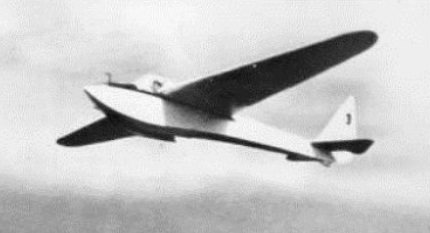
Airspeed AS.1 Tern

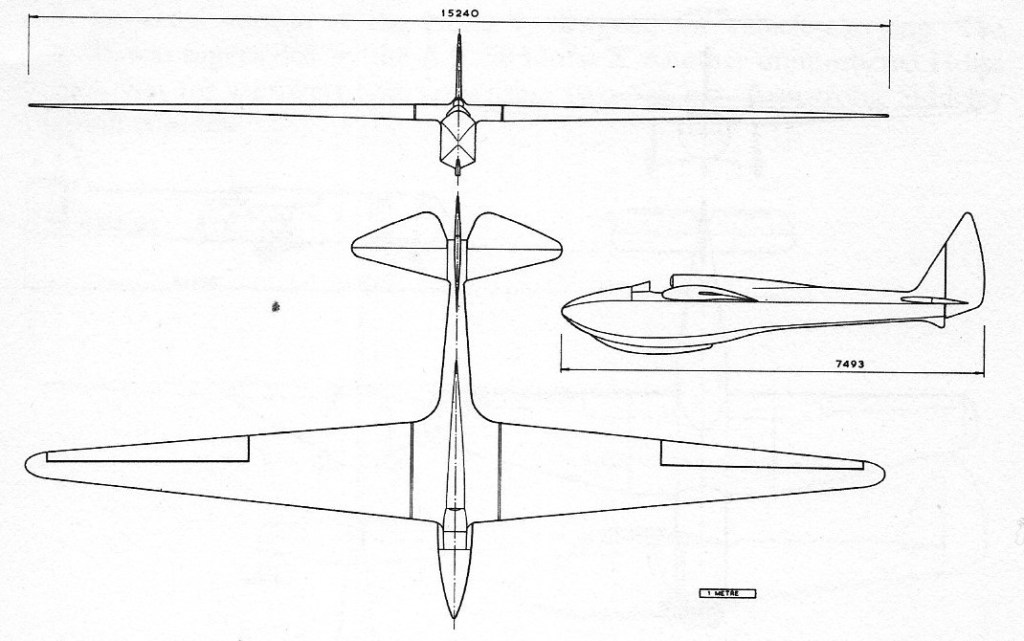
The Airspeed AS.1 Tern was designed by Hessell Tiltman & Nevil Shute Norway to gain records and publicity for the new Airspeed company, as well as to attract orders for new aircraft. Designed for hill- and cloud-soaring, the Tern was a wood-and-fabric cantilever monoplane. It was designed to be dismantled and was advertised for sale at £248. Two examples were built but only one, BGA0190, was originally assembled.

Airspeed AS.1 Tern Article

A single-seat sailplane of conventional spruce and ply construction, designed by A. Hessell Tiltman and Nevil Shute Norway.

The Tern was constructed of wood with a fabric-covered two-spar cantilevered tapered wing with no dihedral. A plywood leading edge was fitted but only as an aerodynamic fairing and not as primary structure. The trapezoidal-section fuselage had plywood lower sides and fabric-covered top decking as well as a cockpit in the leading edge of the centre-section.

The undercarriage was a main skid plus tail skid, with optional detachable wheels. No flaps or airbrakes were fitted.

The prototype first flew in August 1931, at Sherburn-in-Elmet, Yorkshire, and production models were priced at £248, ex-works.

On 24 August 1931 the Tern was flown by Carli Magersuppe from Stoupe Brow, Ravenscar to Scarborough to gain the first British distance record of 8.3 miles (13.4 km). The glider flew a total of 16 miles but only the straight-line distance counted towards the record.

The Tern had some success in establishing gliding records but only one was completed and parts for one more were produced. After languishing through the Second World War the Tern was re-built, using parts from both airframes, but did little flying.

Wingspan: 50 ft 0 in (15.24 m)
Wing area: 201 sq ft (18.7 m2)
Length: 24 ft 7 in (7.49 m)
Aspect ratio: 12.44
Empty weight: 223 lb (101 kg)
Gross weight: 415 lb (188.24 kg)
Maximum speed: 70 mph; 60 kn (112 km/h) (launch / tow)
Cruising speed: 40 mph; 35 kn (65 km/h)
Stall speed: 25 mph; 22 kn (40 km/h)
Lift-to-drag: 25 (theoretical)
Wing loading: 2.06 lb/sq ft (10.05 kg/m2)
Crew: 1

Airspeed

Following the collapse of the British airship programme after the crash of the R101 in France on 5 October 1930, two of the R100 design team based at Howden, near York, established a new company in York to produce light aircraft. They were A. Hessell Tiltman and Nevil Shute Norway and they named the ne company Airspeed Ltd. Tiltman and Norway spent much time seeking capital but with the small capital they had it was decided to build and fly an advanced sailplane to capture as many British gliding records as it could.

A factory was set up in an empty bus garage in Piccadilly, York, and the Tern sailplane was completed by August 1931. It was successful and captured all the available records of height and distance, flown by Carli Magersuppe, and the required capital began to flow into the company.

Airspeed then entered the light aircraft field, moved the factory to Portsmouth.

The Airspeed company was established in February 1931 in York to build the Ferry 3-engined low-performance biplane, designed specifically for short-range pleasure flying (“joy riding”). The prototype Ferry, built to Sir Alan Cobham’s specification, went on tour with his National Aviation Day Displays 1932 and 1933; joined by second example 1932. In 1933 two more Ferries (four only built) acquired by John Sword of Midland and Scottish Air Ferries Ltd.

CEO of the original Airspeed was novelist Neville Shute (real name of Neville Shute Norway), and by the end of 1933 Airspeed had built two Tern sailplanes, four Ferry short-range ten-seat airliners and five Couriers.
Airspeed Ltd moved to Portsmouth in 1934 following an adavantageous agreement for new, free premises in that town’s airport. The company Airspeed Ltd was established in 1934 at Portsmouth, Hants, in association with shipbuilding interests of Swan, Hunter and Wigham Richardson.

In 1940 a transport glider was designed to carry two pilots and 25 troops. This was put into production as the Horsa.

In June 1951, the final merger of Airspeed into de Havilland Enterprise was announced.

Air Est Services Goeland

This motorglider has fixed gear, pod/boom look with a T-tail, and utilizes wings from the German “Spatz” glider. The engine is a Konig SC 430/24 hp. Construction material is wood, fabric and fiberglass. There are altenative wings that can be utilized for performance improvement.
Plans were available circa 2010 for $200, and a basic kit (including two half shells of fuselage plus tail parts) is available for $4000. A finished fuselage kit without metal fittings or controls is available for $8400.

Engine: Konig SC 430, 24 hp
Wing span: 43.2 feet
Wing area: 125 square feet
Max gross weight: 660 lb
Empty weight: 410 lb

ADC Phi-Phi      

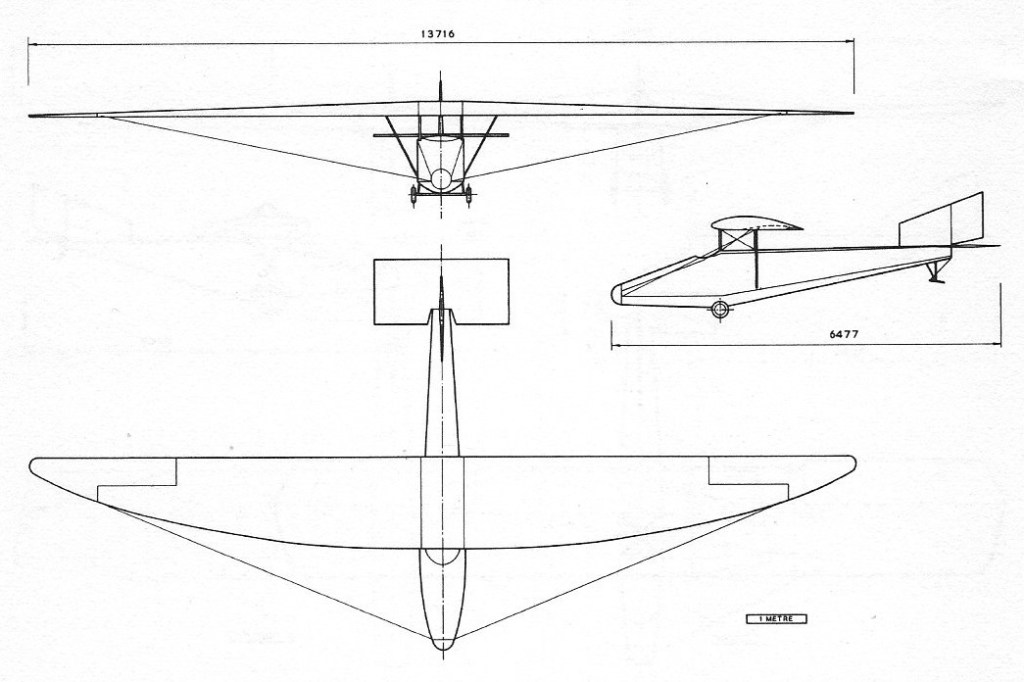
A single-seat glider built by the Aircraft Disposal Company Ltd. Of wooded construction, the parasol mounted wing used an Airdisco wing section. No brakes or flaps were fitted. Twin main wheels and a sprung and pivoted tailskid were fitted.

Only one was built, which crashed during competition. It was flown by Capt. R.H Stockton.

Wingspan: 13.72 m / 45 ft 0 in
Length: 6.48 m / 21 ft 3 in
Wing area: 13.94 sq.m / 150 sq.ft
Aspect ratio: 13.5

Aircraft Cooperative Mechta Russia AC-4 / Avia Stroitel AC4

A runner up in the OSTIV world class sailplane design contest in Oerlinghausen in 1993, the AC-4 went into production following modifications that had been recommended by the Organisation Scientifique du Vol a Voile (OSTIV). The Russia comes in the taildragger AC-4A model, and the AC-4B with main wheel set behind the center of gravity and a nose wheel. The latter has a slightly more spacious cockpit able to accept taller pilots. The AC-4 is offered with a ballistic emergency recovery parachute. It can be fitted with a 12 bhp / 9 kW McCulloch MC-101B 2 cycle sustainer engine.
Designed by Vladimir Federov.

Wing Span: 12.6 m / 41.3 ft
Wing Area: 7.7 sq.m / 82.9 sq.ft
Empty Weight: 130 kg /286 lb.
Payload: 120 kg /265 lb.
Gross Weight: 250 kg / 551 lb.
Wing Load: 32.46 kg/sq.m / 6.66 lb/sq.ft
Aspect ratio: 20.5
L/D Max: 31 @ 83 kph / 45 kt / 52 mph
MinSink: 0.66 m/s / 2.16 fps / 1.28 kt
Airfoil: Wortmann FX-60-157
Structure: GFRP/ epoxy
Seats: 1

AC-4A – Single seat, Mid wing, Composite, Tailwheel, Sailplane
AC-4B – Single seat, Mid wing, Composite, Nosewheel, Sailplane
AC-4C – Single seat, Mid wing, Composite, Retractable tailwheel, Sailplane

Ahrens AR-124

The AR 124 single-seater 13m (42ft 7.25in) span sailplane was designed and built by Ahrens Aircraft Corporation of Oxnard, California (the parent company of Ahrens Aircraft Inc), the main production and assembly plant, which was located at the former Ramey Air Force Base, Aguadilla, Puerto Rico.

The AR 124 is a cantilever mid-wing monoplane with a T-tail, an unusual feature being the all-aluminium construction with a flush-riveted skin employed both for the constant-chord wings and the fuselage, the latter being an elliptical-section flushriveted monocoque; the wings have upper surface spoilers as well as ailerons but no tabs or flaps. A constant-chord nonswept tailplane and one-piece elevator are mounted on the swept-back fin and rudder; constant-chord wings and tailplanes for ease of production are also a feature of the AR 404 utility transport. The AR 124 has a fixed and unsprung Gerdes monowheel with a hydraulic disc drake, and a tailwheel. Seating is for one pilot under a molded one-piece canopy.

Design of this single-seat sailplane began in 1974, and the first flight of the prototype was that same year. Three prototypes of the AR 124 were built, the third, or AR 124V3, making its first flight in August 1975, and this was representative of the intended production version.

Flight testing and certification trials have been proceeding to meet a target of first customer deliveries beginning late in 1979, although this has been affected by progress with the firm’s other major project, the four turboprop AR 404 30-passenger utility transport, and the AR 124 programme is currently dormant to give priority to the AR 404.

AR 124
Span: 42ft 7.75 in
Length: 20ft 0in
Height: 5ft 2in
Wing area: 135.0sqft
Aspect ratio: 13.5
Empty weight: 350lb
Max weight: 640lb
Max speed: 180mph (in smooth air)
Max aero-tow speed: 103mph
Best glide ratio: 26:1 at 69mph