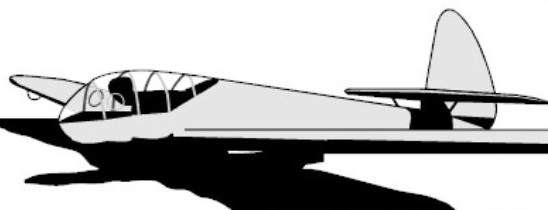
Aldasoro Glider

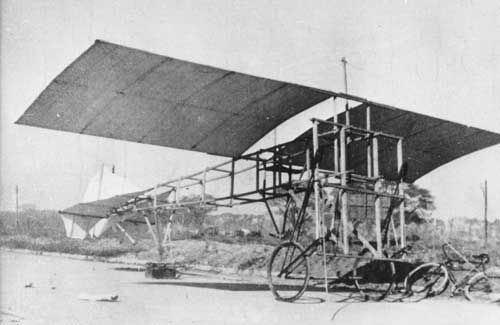
A monoplane glider built by brothers Juan Pablo (1893–1962) and Eduardo Aldasoro Suárez (1894-1968) of Mexico City. By 1908 they began to design and construct their first gliders, achieving flights of about one hundred meters. On March 9, 1909 they took the glider towards the outskirts of Mexico City and tied it to a White steam car, the fastest automobile of those days. Juan Pablo would be the pilot and Eduardo would drive the tow car. As they started moving, the glider slowly lifted the tail and finally emerged from the big dust cloud made by the car. The car continued moving for about 300 meters and then slowly decreased the speed to allow the glider to release the cable and continue flying. However, the cable did not release properly and Juan Pablo went flying above the car without being able to free himself. As the plane continued, the cable pulled it back and it somersaulted and crashed. The glider was destroyed but miraculously Juan Pablo was alive with only a fractured leg. He had managed to control the glider for more than 480 meters in stable flight at a height of 10 meters. This accident, and others undergone by Eduardo, did not discourage the brothers, since they both eventually qualified for pilot licenses in the USA.

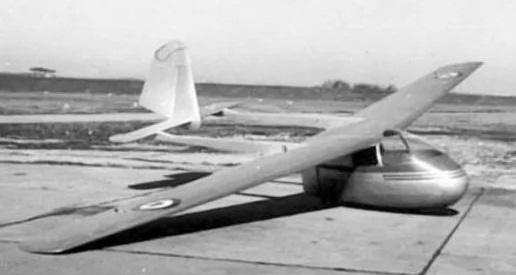
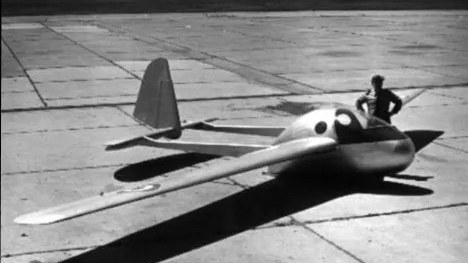
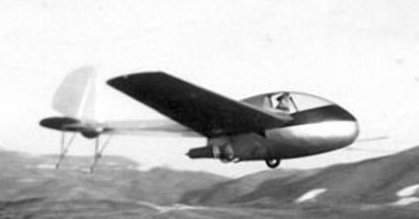
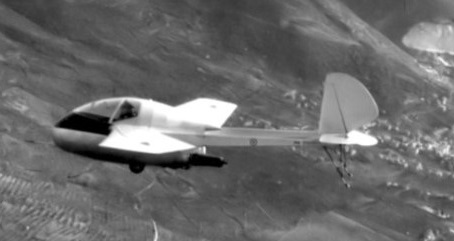
Alaparma AM.12

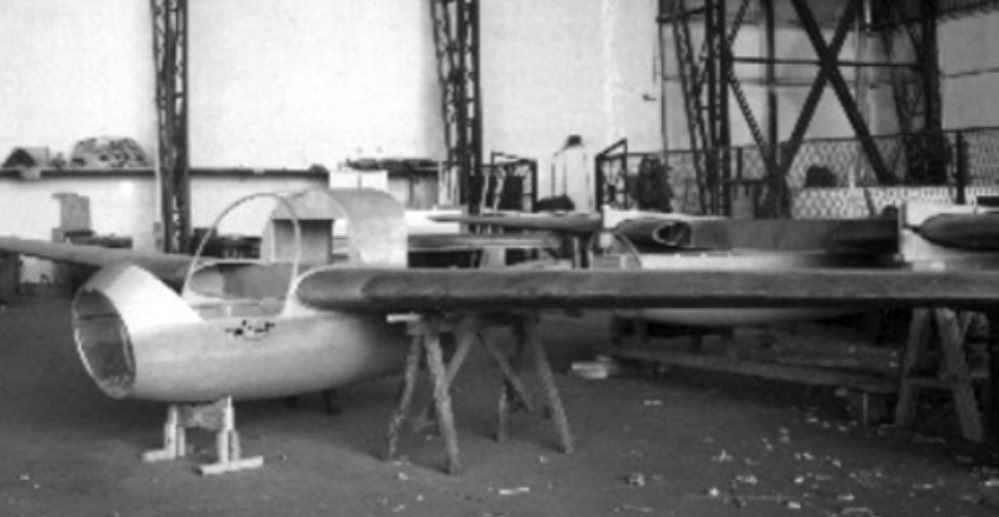
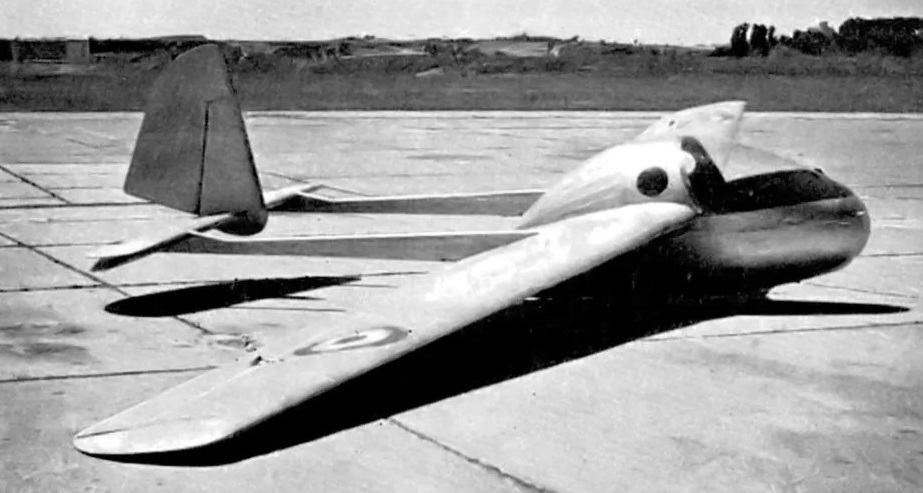
The Alaparma AM-12 was a two-seat aircraft derived from the Am-8/AM-10, but with a new and larger wing to make the type suitable as powered glider. Further changes compared to the AM-8 and AM-10 were a revised u/c arrangement with small tail wheels under the twin vertical tail instead of a single tail wheel under the rear fuselage.

It was first flown on 12 November 1954 as a glider.

Later it received one 75hp Praga D engine.

The aircraft was evaluated by the Italian AF and possibly up to three or four AM-12s were built.

One of the AM-12 after having been re-engined with one 350lb Turboméca Palas turbojet engine as the AM-12P and it was flown in this form in 1962.

AM-12P

Again, the aircraft was evaluated by the Italian AF. Further development of the AM-12 was halted.

AM-12P

The aircraft established several FAI altitude records attaining 28,661ft with Praga D75 engine and 21.981ft with Palas engine.

Wingspan: 39.375 ft
Length: 18.042 ft
Height: 4.667 ft

Akaflieg Stuttgart FS-33 Gavilán

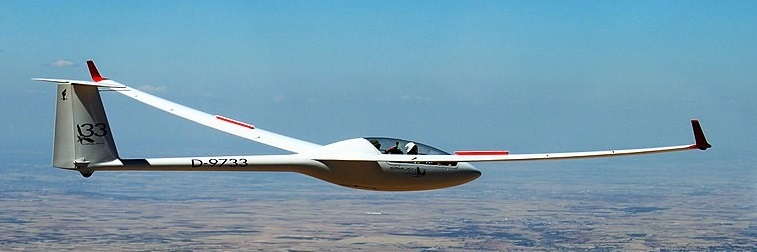
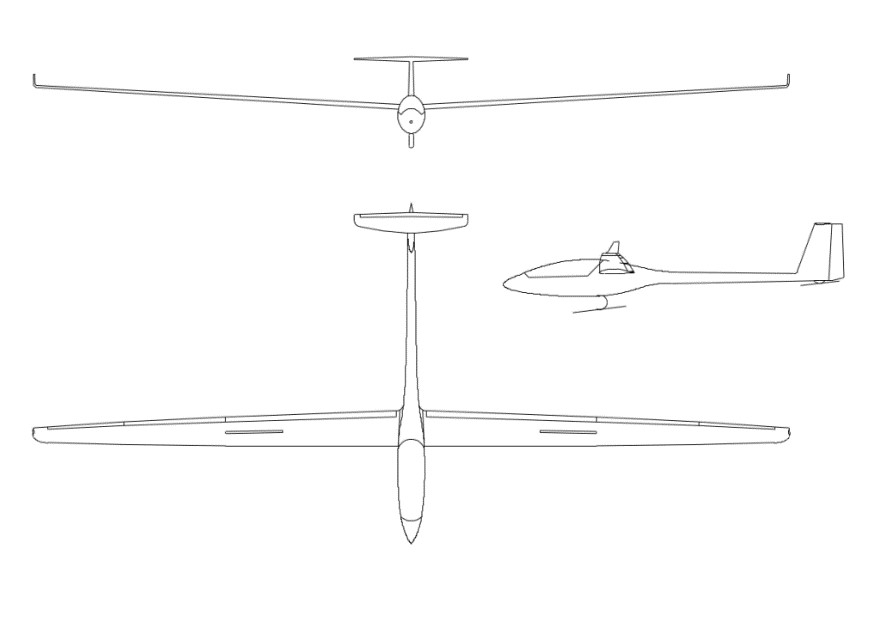
The fs33 is a high performance two-seat glider with a 20m wingspan, developed in reaction to the then newly created FAI Two Seater class in 1989. By the standards of an Akaflieg, the aircraft’s concept and design is relatively conventional. On the other hand, the optimization of the individual parts and the consequent implementation of lightweight construction were key aspects of the project. This led, among other things, to the use of carbon fiber reinforced composites for the entire structure. Only the cockpit was exempt from this, being made of a carbon-kevlar hybrid construction as with the fs31 for safety reasons. Additionally, the wing spars were made of carbon fiber scrims instead of fabric as specified by the Federal Aviation Office. The fs33 was designed to have pleasant flying characteristics to simplify operation of the aircraft.

A further consideration while planning the project was that during the 10-year long design and construction phase of the previous prototype, the fs32 “Aquila”, it was impossible for any member to actively work on the project for its entire duration. Furthermore, the demanding nature of studies with shorter periods led to the conclusion that a quick development of the aircraft had to be feasible.

To maintain the advantages of construction using negative moulds without having to spend a large amount of time to construct a master model, pre-existing moulds were used for all major components:
the fs31’s fuselage mould due to the former’s aerodynamic qualities
the fs32’s wing moulds, modified to remove the slotted flaps and extend the wingspan to 20 meters
the Schempp-Hirth Nimbus 4’s tail form

Due to the usage of lengthened fs32 wing moulds, the wings of the fs33 had a high aspect ratio. The skin of the wings are made from unidirectional scrims, which can be loaded even more than those from regular fabrics. The aileron and flap function of the 3-piece wing flaps are regulated by a mixer located at the wing root to maintain an elliptical lift distribution as much as possible and to allow for enough controllability and prevent spins.

Apart from the tail, the fs33’s fuselage form is identical to that of the fs31. The control system had to be totally overhauled to incorporate the flaps. To save time, as many parts from the glider manufacturer Alexander Schleicher as deemed feasible were used in the cockpit region. Adapting said parts for the fs33 was a simple operation as the ASH 25’s fuselage design was based on that of the fs31. Experience gained during the construction of the fs31 allowed for changes that made the fs33‘s cockpit somewhat roomier. The principle of splitting the fuselage into an upper and lower shell, as in the fs31, was preserved. When compared to the typical design which splits it into a left and right shell, the former allows for a higher degree of safety in the event of a crash as there is no seam under the pilot which can burst open on impact.

First public display of the aircraft was during the AERO Fair of 1997 in Friedrichshafen. The fs33 achieved its first flight on 28 May 1998 in Aalen-Elchingen. Flight tests in the following years showed that the airbrakes were prone to spontaneously deploying, though this could usually be rectified by simply retracting the airbrakes. There were however two cases in which the airbrakes spontaneously deployed and jammed. The first led to a cancellation of tests and a safe landing on the airfield. The second case of jamming, this time of both airbrakes, led to a crash landing on 11 June 2000, which heavily damaged the aircraft’s wings, fuselage, and undercarriage, though both pilot and passenger remained unhurt.

Repairs, which were almost cancelled due to the extensive amount of damage along with the start of the Akaflieg Stuttgart fs34 project, began in October 2000. Work on the wings was done with assistance from Rolf Schmid from Technoflug. Originally, the retractable undercarriage was made of carbon fiber composites with steel fittings to save weight. Due to the damage sustained during a crash landing however, which necessitated the construction of a new undercarriage, it was decided to replace it with a regular steel one instead. Repairs were finished by 2002, with the aircraft flying again on 15 May of that year. Damages were discovered on the aileron hinges in 2014, leading to a complete replacement of the ailerons. The aircraft was again taken out of service in 2016 due to damages to one of the wings.

The fs33 is commonly used by the Akaflieg Stuttgart for gliding competitions.

Construction: 1992 – 1998
Wingspan: 20 m
Wing area: 14,4 m²
Aspect ratio: 27,7
Profile: AH 81 K 4/20
Length: 8,98 m
Empty weight: 408,5 kg
MTOW: 640 kg
Vne: 280 km/h
Akaflieg Stuttgart fs-29

A variable geometry wing offers the prospect of being able to vary the wing’s area and geometry in flight to make the most of the soaring conditions encountered. A high aspect ratio could be selected for ascending in a thermal and a low aspect ratio (and hence a smaller area) for getting the maximum speed in cross-country flying.

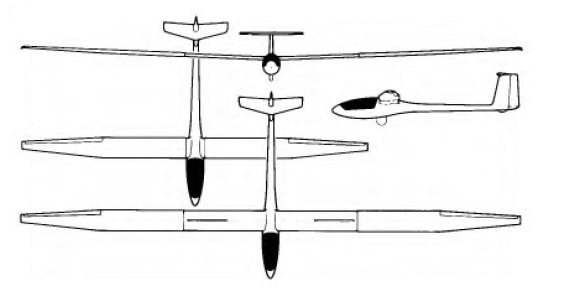
The Stuttgart Akaflieg’s solution to this problem in the high-performance single-seater FS-29 is a telescopic wing in which the span can be varied in flight from 43 ft 7.5 in to 62 ft 4in (13,3m – 19m) by outer telescopic wing sections sliding over fixed inner sections.

These outer wing sections are of glassfibre/foam/carbon-fibre sandwich construction and are extended and retracted manually by means of push-rods. A stub spar protrudes from each inner wing to provide a mounting for the guide rails on which the outer panels move. The inner wing is built up from a box spar of glassfibre/Conticell foam sandwich and is fitted with Schempp-Hirth air brakes on the upper surface which are only effective when the outer panels are extended. The plain ailerons are of similar construction to the outer wings. The fuselage is very similar to that of the Schempp-Hirth Nimbus 2, using the same landing gear and cockpit canopy, while the tail unit is the same as the Nimbus 2’s.

Design work on the FS-29 began in 1972 and the problem of devising a wing which could be varied in span solely by manual power, and yet keep to the required aerodynamic and structural safety factors, meant that the first flight was not made until June 1975.

Akaflieg Stuttgart FS-29

FS-29
Wing span: 43 ft 7.5 in to 62 ft 4 in / 13,3m – 19m
Length: 23 ft 5.75 in / 7.16 m
Height: 4ft 2in / 1.27m
Wing area: 92.2 to 136.2sq ft / 8.56-12.65 sq.m
Wing section: Wortmann FX-73-170 (inner); FX-73-170/22 (outer)
Aspect ratio: 20.67 to 28.54
Airfoil: FX 73-170
Empty weight: 787 lb / 365kg
Max weight: 992 lb / 450kg
Water ballast: None
Max speed: 155mph / 135 kt / 250 km/h
Stalling speed: 39 kt / 72 km/h
Max rough air speed: 135 kt / 250 km/h
Min sinking speed: 1.8ft/sec / 0.54 m/sec at 46mph / 40 kt / 74 km/h
MinSink: 0.56 m/s @ 81 kph
Best glide ratio: 44:1 at 62mph / 98 kph / 54 kt
No. of Seats: 1
No. Built: 1

Akaflieg Stuttgart fs-26 Moseppl

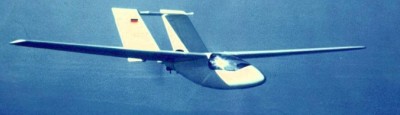
Designed and built by the Stuttgart Akademische Fliegergruppe (Akaflieg) in Germany, the FS-26 was an experimental single-seater, aimed at investigating the characteristics of a motorglider equipped with a reflex airfoil and a separate horizontal stabilizer. Made of fibreglass, the FS-26 re-used the cockpit of the Phoebus sailplane modified to include the engine controls and instruments, and the long retractable landing gear. The aircraft was powered by a Hirth F10A engine, located at the rear of the fuselage. In soaring configuration, the propeller blades could be folded and the engine cowling openings were closed.
The wing used an Eppler 515 airfoil, and could be divided into three parts for trailering on the road. The connections between the fuselage and the wing had been carefully studied, as well as the engine cooling.
The FS-26 made its first flight on September 25, 1970. After several tests, this aircraft was donated to the Wasserkuppe Soaring Museum.

Wing span: 12.60 m
Length: 3.94 m
Wing Area: 13.20 sq.m
Airfoil: Eppler 515
Empty weight: 250 kg
Max. weight: 360 kg

Akaflieg Stuttgart Phönix-T fs-24

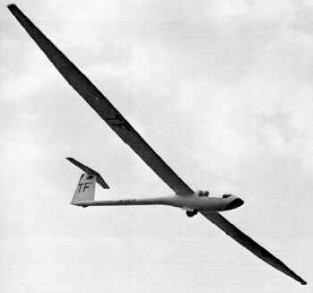
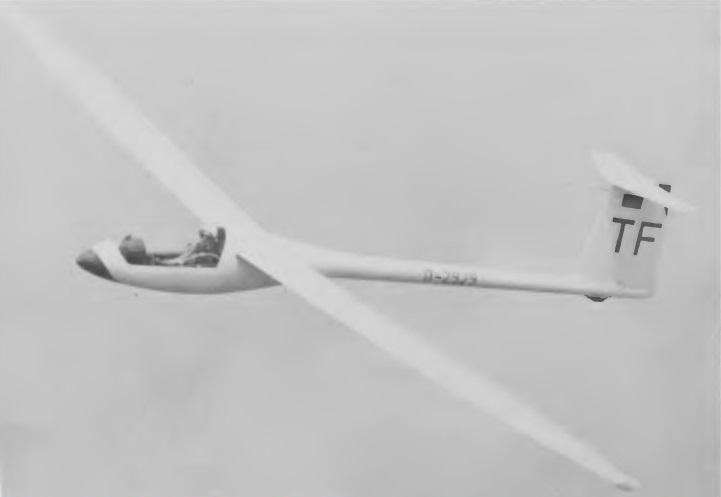
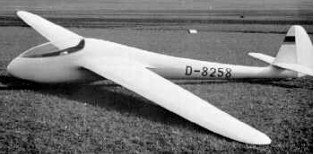
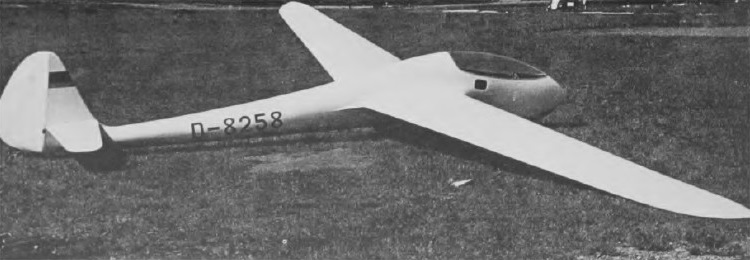
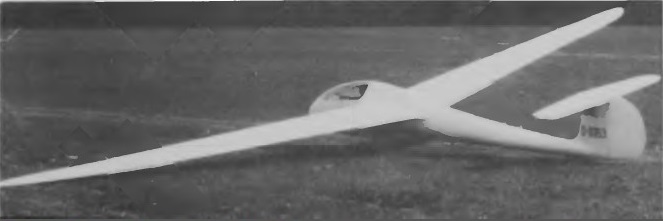
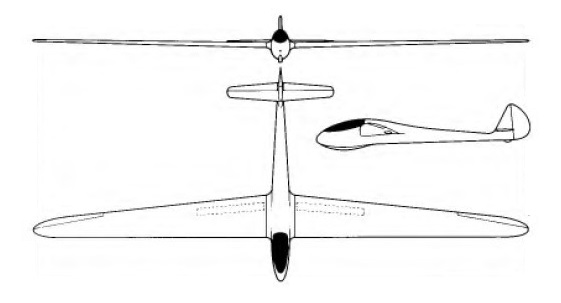
Notable as being the first sailplane to be built of glassfibre, design of the Phonix was started at the Stuttgart Akademische Fliegergruppe under R.Eppler and H. Na’gele in 1951. Originally balsa wood construction with a strengthened outer skin of paper-and-glue layers was decided upon with the idea of reducing weight, but the Phonix project had to be abandoned for a time. Work was continued when the Stuttgart Fliegergruppe was given a grant for further research, and by now the new glassfibre strengthened polyester resins were available as a constructional material. The Phonix was redesigned to a basically balsa wood/glassfibre sandwich form of construction. At first a conventional tail unit with low-set tailplane was featured, but this was later replaced by a T-tail; the landing gear is retractable.

The monocoque fuselage is built in two pieces with a sandwich skin with balsa wood filling and an outer skin of glassfibre. The wing attachment, controls and fittings are installed before the two pieces are glued together with the glassfibre skin overlapping; weight carrying points and the edge of the cockpit canopy are strengthened with plywood. The wings and tail unit are of similar balsa wood/glassfibre sandwich construction, the ailerons, flaps and rudder being cut out after the glueing process is completed.

The first made its first flight on 27 November 1957. Altogether eight Phonixes were built and all of them were still flying 21 years after the prototype first took to the air.

Akaflieg Stuttgart FS-24 Phonix

FS-24 Phonix
Wing span: 16m / 52 ft 6 in
Length: 22 ft 5.25 in
Wing area: 14.36 sq.m / 154.6 sq.ft
Empty Weight: 180kg / 362 lb
Gross Weight: 330kg / 584 lb
Wing Load: 22.9kg/sq.m
Aspect ratio: 17.83
Airfoil: Eppler 91
Max speed: 107 mph
L/DMax: 40 @ 79kph / 48 mph
MinSink: 0.59 m/s @ 68 kph / 1.7 ft/sec at 43 mph
No. of Seats: 1

FS-24 Phonix-T
Wing span: 16.0 m / 52 ft 6 in
Length: 6.84 m / 22 ft 5 in
Wing area: 14.36 sq.m / 154.6 sq ft
Wing section: EC86(-3)-914
Aspect ratio: 17.83
Empty weight: 164 kg / 362 lb
Max weight: 265 kg / 584 lb
Water ballast: None
Max wing loading: 18.5 kg/sq.m / 3.79 lb/sq ft
Max speed: 97 kt / 180 km/h
Stalling speed: 31 kt / 58 km/h
Min sinking speed: 0.51 m/sec / 1.7 ft/sec at 37 kt / 69 km/h
Max rough air speed: 54 kt / 100 km/h
Best glide ratio: 40 at 42 kt / 78 km/h)