2008:
Pfaffenwaldring 35
70569 Stuttgart
Vaihinfen
Germany
Glider
Akaflieg Munchen Mu-28
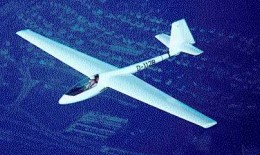
Wing span: 12m
Wing area: 13.2sq.m
Empty Weight: 315kg
Gross Weight: 425kg
Wing Load: 32.2kg/sq.m
Aspect ratio: 10.91
Airfoil: FX 71-L-15020
Structure: GFK
L/DMax: 27 @ 103 kph
MinSink: 1 m/s @ 89 kph
No. of Seats: 1
No. Built: 1
Akaflieg Munchen Mu-27
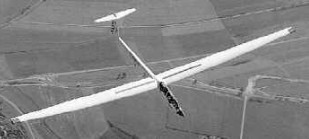
Some attention has been paid by designers to varying the wing geometry or area in flight to cater for different soaring conditions, and one approach to this problem is embodied in the Mu 27, which features slotted Fowler-type flaps enabling the wing area to be varied in flight. At high speeds a good gliding angle can be obtained by retracting the flaps while at low speeds or in a weakening thermal the flaps can be extened to give more lift, increasing the wing area by 36%.
The wings are a glassfibre/Conticell sandwich with aluminium spars and metal webs, and air brakes on the upper surface are at the 50% chord line. The ailerons are linked to the flaps. The semimonocoque fuselage is entirely of glassfibre with a large two-piece sideways-hingeing cockpit canopy, while the T-tail unit is of glassfibre/foam sandwich construction. The landing gear consists of a retractable monowheel and a fixed tailwheel.
The Mu 27 is a tandem two seater of largely glassfibre construction, and first flew on 24 February 1979 piloted by Thomas Fischer.
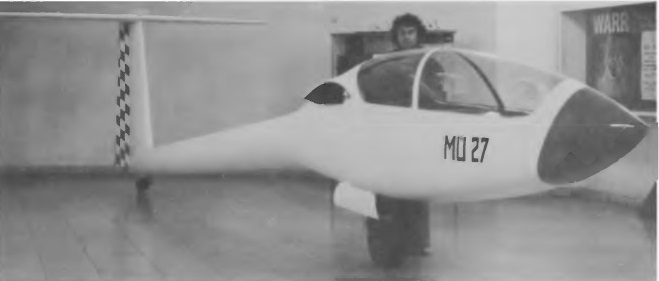
Mu 27
Span: 72 ft 2.25in / 22m
Length: 33 ft 9.5 in / 10.3 m
Height: 1.8m / 5 ft 11 in
Wing area: 189.5 sq.ft / 23.9 sq.m (flaps retracted)
Wing area 257.3 sq ft / 17.6 sq.m (flaps extended)
Aspect ratio: 20.2-27.5
Airfoil: FX 67-VC-170/136
Empty weight: 1,058 lb / 480 kg
Max weight: 1,543 1b / 700 kg
Water ballast: None
Wing Load: 8.19 lb/sq ft / 39.8 kg/sq.m
Max speed: 174 mph / 151 kt / 280 km/h
Min sinking speed: 1.8 ft/sec / 0.56 m/sec at 37 mph / 32.5 kt / 60 km/h
Best glide ratio: 47:1 at 63 mph / 54.5 kt / 101 km/h
L/DMax: 39 @ 88 kph
No. of Seats: 2
No. Built: 1
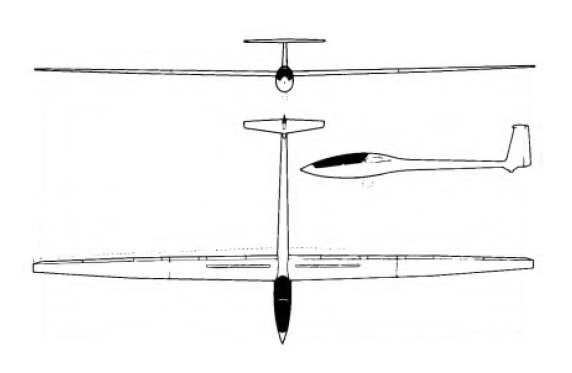
Akaflieg Munchen Mu-26 / Mu-22d
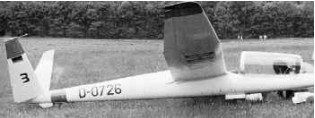
Wing span: 16.6m
Wing area: 15.3sq.m
Empty Weight: 276kg
Gross Weight: 382kg
Wing Load: 25kg/sq.m
Aspect ratio: 18.01
Airfoil: Eppler 348
Structure: GFK
L/DMax: 40 @ 97 kph
MinSink: 0.60 m/s @ 83 kph
No. of Seats: 1
No. Built: 1
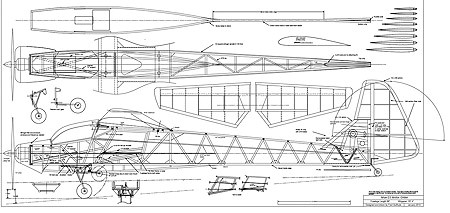
Akaflieg Munchen Mü-23 Saurier
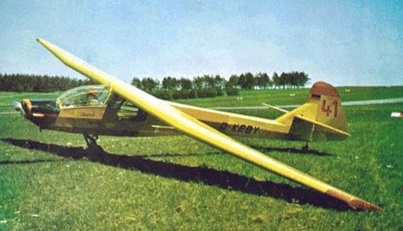
In 1957 the students at Akaflieg München began the design and construction of the Mü23 Saurier two-seat motor-glider. Using the classic ‘Munich School’ construction technique, the Mü23 was built using fabric covered welded steel tube for the fuselage and wooden wings and tail covered with plywood and fabric. The pilot sitting directly behind the engine under a built-up transparent canopy and the passenger sitting in a compartment under the centre section of the wing, similar to the seating arrangement of the Akaflieg München Mü10 Milan.
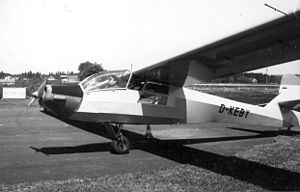
Using the Mü Scheibe aerofoil section imbued the Mü23 with excellent low speed characteristics and short landings and takeoffs, but development was slowed by problems with the chosen engines, initially a Volkswagen VW1200, later a Braendle ZB700 and finally a Volkswagen VW1500N which gave satisfactory performance.
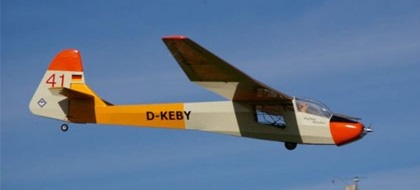
Once the performance of the aircraft could be guaranteed with the VW1500N engine, the Mü23 took part in sailplane and motor glider competitions with some success. In 2010 the Mü23 is undergoing restoration.
Mü23 Saurier
Engine: 1 × Volkswagen VW1500N, 33.5 kW (45 hp)
Wingspan: 20 m (65 ft 7 in)
Wing area: 24 m2 (258 ft2)
Aspect ratio: 16.7
Wing profile: Mü Scheibe
Empty weight: 477 kg (1,052 lb)
Gross weight: 700 kg (1,543 lb)
Crew: 1
Capacity: 1
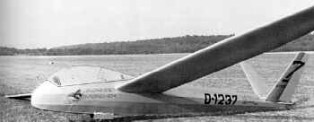
Akaflieg Munchen Mu-22
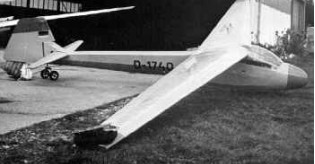
Mü-22 a
Mü-22 b
Wing span: 16.6m
Wing area: 13.54sq.m
Empty Weight: 280kg
Gross Weight: 360kg
Wing Load: 26.6kg/sq.m
Aspect ratio: 21.09
Airfoil: NACA 633-618
L/DMax: 36 @ 80 kph
MinSink: 0.56 m/s @ 69 kph
No. of Seats: 1
No. Built: 1
Akaflieg Munchen Mu-17 Merle
Wing span: 15m
Wing area: 13.3sq.m
Empty Weight: 194kg
Gross Weight: 310kg
Wing Load: 23.3kg/sq.m
Aspect ratio: 16.91
Airfoil: Mu-profil
L/DMax: 26 @ 75 kph
MinSink: 0.65 m/s @ 60 kph
No. of Seats: 1
No. Built: 2
Akaflieg Munchen Mü-13 Atalante / Merlin / Scheibe-Flugzeugbau Mü‑13E Bergfalke 1 / Schwarzwald Mü-13
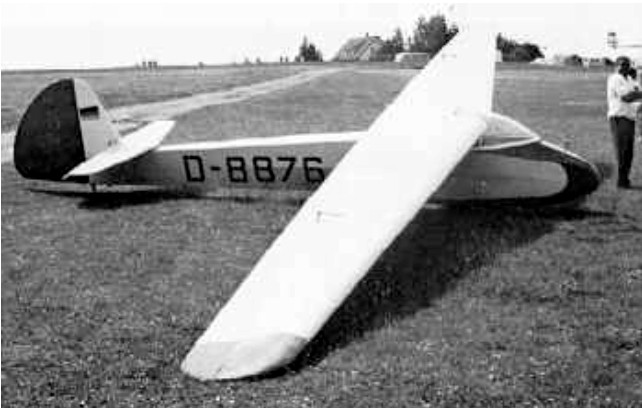
One of the principal prewar German high performance designs, the single-seater Mü 13 was developed at the Munich Akaflieg from the two-seat Mü 10 Milan, which had been built there under the direction of Dipl-lng Egon Scheibe, who later formed, at the end of 1951, the sailplane firm bearing his name. The first single-seat Mü 13 flew in 1936. It has an all moving tailplane and DFS airbrakes for approach control.
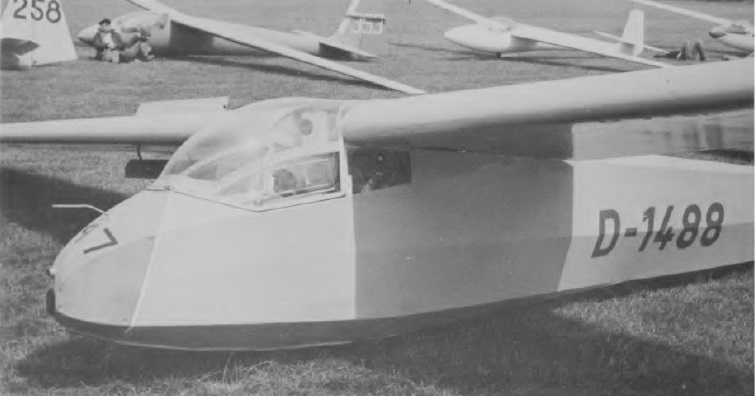
There were a number of variants, some later having air brakes instead of flaps while the rear fuselage cross section was later changed from a rectangular one to triangular. The Mü 13D-3 of 1943 had an increased wing span, longer fuselage and a modified fin and rudder. In May 1939, Schmidt set a new German record for a goal flight of 482km (299 miles) in an Atalante. Unlike most sailplanes of its size the Mu 13 was of mixed construction, using steel and chrome-molybdenum-tin alloy as well as wood. The wooden cantilever wing had steel tube flaps and fabric-covered steel-framed ailerons while the fuselage was a fabric-covered steel framework of basically square cross-section and the tail unit of conventional wooden construction. Particular attention was paid to good visibility, there being large window panels inset into the sides of the cockpit while a clear panel inset into the wing centre section leading edge gave the pilot a better view above and behind him; the cockpit canopy was detachable, and several different shapes were used. A monowheel landing gear and tailskid were featured.
Scheibe built a development of the Mü 13 in Austria known as the Mü 13E Bergfalke (Mountain Falcon), which first flew in prototype form on 6 August 1951 and this two-seat general purpose glider went into production as the Scheibe Bergfalke. The original Mü 13 made its first flight in 1936 and the two prototypes were named the Merlin and the Atalante, differing from each other principally in the fuselage structure and control arrangements. The Atalante with a number of modifications was built by Kurt Schmidt at the Black Forest factory and about 150 Mü 13s were built in all.
Akaflieg Munchen Mü 13 Merlin
Span: 52 ft 6 in
Length: 19 ft 9 in
Wing area: 174 sq.ft
Aspect ratio: 15.85
Empty weight: 375 lb
Max weight: 595 lb
Max speed: 124 mph
Min sinking speed: 2 ft/sec at 34 mph
Best glide ratio: 28:1 at 41 mph
Mȕ 13 Atalante
Wing span: 16.0 m / 52 ft 6 in
Length: 6.02 m / 19 ft 9 in
Wing area: 16.16 sq.m / 174 sq ft
Wing section: Mil
Aspect ratio: 15.85
Empty weight: 170 kg / 375 lb
Max weight: 270 kg / 595 lb
Water ballast: None
Max wing loading: 16.71 kg/sq.m / 3.42 lb/sq ft
Max speed: 108 kt / 200 km/h
Stalling speed: 27 kt / 50 km/h
Min sinking speed: 0.6 m/sec / 2 ft/sec at 29.5 kt / 55 km/h
Best glide ratio: 28 at 35.5 kt / 66 km/h
Akaflieg Munchen Mü 13 D Atalante
Length: 19.783 ft / 6.03 m
Wingspan: 52.428 ft / 15.98 m
Crew: 1
Schwarzwald Mu-13 D
Wing span: 16 m
Wing area: 16.16 sq.m
Aspect ratio: 15.84
Airfoil: Mu-profil 15%
Empty Weight: 185 kg
Gross Weight: 275 kg
Wing Load: 17 kg/sq.m
L/DMax: 28 66 kph
MinSink: 0.60 m/s 55 kph
Seats: 1
Schwarzwald Mu 13D3
Wing span: 16 m / 52.5 ft
Wing area: 16.16 sq.m / 174 sq.ft
Aspect ratio: 15.85
Airfoil: Mu
Empty Weight: 170 kg / 375 lb
Payload: 100 kg / 220 lb
Gross Weight: 270 kg / 595 lb
Wing Load: 16.71 kg/sq.m / 3.42 lb/sq.ft
L/DMax: 25 66 kph / 35 kt / 40 mph
MinSink: 0.62 m/s / 2.0 fps / 1.18 kt
Seats: 1
Scheibe-Flugzeugbau Mü 13E Bergfalke 1
Length: 51.837 ft / 15.8 m
Wingspan: 56.43 ft / 17.2 m
Max take off weight: 551.3 lb / 250.0 kg
Crew: 2
Akaflieg Munchen Mü-11 Papagei
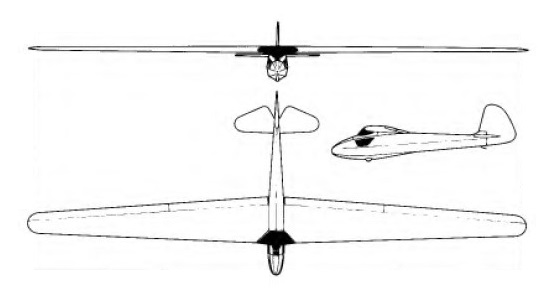
The Akaflieg München Mü11 Papagei is a primary glider that was designed and built at Akaflieg München in Germany in 1935.
The Mü11 Papagei, (Parrot), was a single-seat primary style training glider similar to the SG-38 but with a Mü Scheibe aerofoil section. Flight trials were carried out in 1935 but there is very little information available. Only one photograph and a contemporary model survive. The photograph shows the pilots seat surrounded by a plywood nacelle.
Akaflieg Munchen Mu-10 Milan
High Performance Glider, Germany, 1934
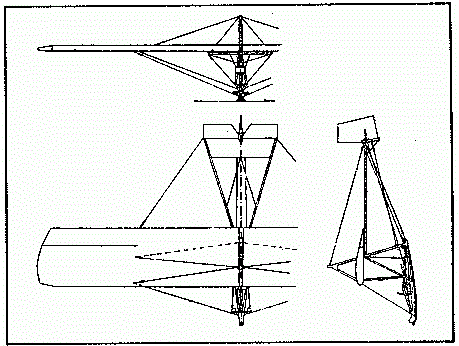
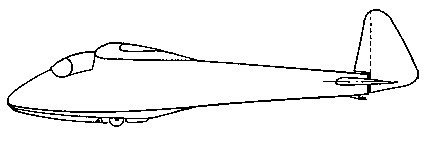
The Milan of 1934 was one of the first german, two-seater, high performance gliding airplanes. It had a steel tube frame and was developed by Egon Scheibe, who later became well known for glider design.
Length: 19.029 ft / 5.8 m
Wingspan: 58.399 ft / 17.8 m
Max take off weight: 407.9 lb / 185.0 kg
Max. speed: 65 kts / 120 km/h
Crew: 2

