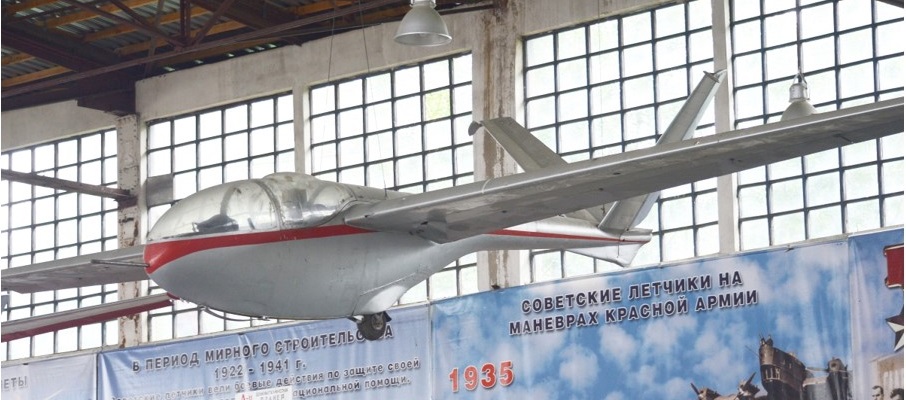
Antonov A–11

The A-11, which first flew in prototype form on 12 May 1958, is a high-performance single-seater which of all-metal construction. The steamlined forward fuselage, housing the pilot under a blown plastic canopy, tapers to a slim boom carrying the cantilever butterfly tail, with an included angle of 90 degrees between the tail surfaces.

The A-11 is aerobatic and suitable for both spinning and cloud flying, and the mid-set wing has a single spar in the root and two spars in the outer wings. The leading edge is metal-covered, with fabric covering aft of the main spar. The fabric covered slotted ailerons can be drooped through 8 degrees to supplement the slotted flaps, and there are also lift spoilers on the wing upper surfaces. The monocoque fuselage has a retractable sprung monowheel and a rubber-mounted tailskid.

Altogether about 350 examples of the A-11 and A-13 were built.

A- 11
Span: 54 ft 1.5 in
Length: 19 ft 8.5 in
Wing area: 130.8 sq.ft
Aspect ratio: 22.4
Empty weight: 648 lb
Max take-off weight: 882 1b
Max speed: 217 mph (in smooth air)
Max aero-tow speed: 124 mph
Min sinking speed: 2.43 ft/sec at 53.5 mph
Best glide ratio: 32:1 at 60 mph

Antonov Red Front 7

Oleg K. Antonov first became known as a glider and sailplane designer in 1930, and his best known prewar design was the high-performance single seater known as the Red Front 7, which was used by O. Klepikova to set up a women’s distance record on 6 July 1939 with a flight of 465.25 miles from Moscow to Otradnoie, near Stalingrad; this record stood for no less than 38 years.

Antonov A-2

Other Antonov designs were the A-1 single-seat elementary training glider, the A-2, a modernised version of the US-5 two-seat training glider, and the A-9 and A-10 single and two-seat high-performance sailplanes.

In September 1941 the Germans were approaching Voronezh, but even under these circumstances the aviation factory continued to deliver Il-2 assault aircraft to the front. At the beginning of September 1941, the decision was made to evacuate Factory No. 18 and OKB-31 led by Moscaliov.

The new production base was established in the Siberian village of Zavodoukovsk, located in the Tyumen Oblast, where a new factory was organized that was numbered 499. AS Moscaliov was selected as director and main constructor.

Some time later the factory began to deliver the Antonov A-7 7-seater landing glider productions and a little later the A-2 training gliders, from the same manufacturer.