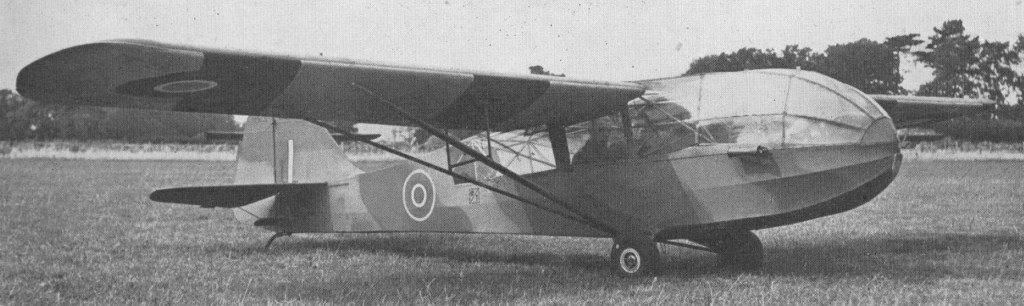
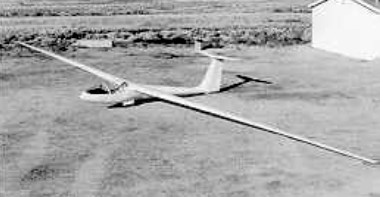
The Auster Model H three seat training glider was an Auster Mk.III converted by Taylorcraft Aeroplanes, Rearsby. This involved removal of the engine and mounts, and installing a third seat and set of controls. A lower and simpler landing gear was used.
The sole example built, X1091, first flew July 1943.
Georges Abrial’s 1932 AIR 5 2-seat training glider design was to be built by Ateliers Peyret but this plan ended with Louis Peyret’s death in 1933. It was eventually built by Arsenal as the AIR 50.
In the same category as the Grunau Baby, the SA 103 Emouchet (or Kestrel) single-seat elementary training glider and the very similar SA 104 was designed and built just after the war by Arsenal de I’Aeronautique and went into large-scale production at Chatillon-sous-Bagneux for the French National Gliding Centres and clubs; some were also built by Societe Roche-Aviation.
Of conventional wood and fabric construction, the Emouchet has a parasol wing with metal bracing struts and no air brakes or spoilers. The cockpit is an open one and landing gear consists of a landing skid under the forward fuselage and a tail bumper fairing. The fuselage itself is of hexagonal cross-section and the tailplane is set forward of the diminutive fin and large rudder.
SA103 Span: 41ft 2.5 in Length: 20ft 11 in Wing area: 178.6 sq.ft Empty weight: 260 lb Max weight: 385 lb Normal gliding speed: 36 mph
This French high performance single-seater was designed and produced just after the war by Arsenal de I’Aeronautique.
The Air 100 was designed for the French National Gliding Centres and clubs, and was a cantilever high wing monoplane of mainly spruce and plywood construction. The 18m span wing featured slotted ailerons and spoiler-type flaps, and the landing gear consisted of a central monowheel with a landing skid fore and aft of it, plus a tail skid.
An Air 100 flown by Eric Nessler set up a new French record for distance in a straight line of 311 miles (501 km) at Wichita Falls, USA, on 14 July 1947.
The final production version was the Air 102.
Air 100 Span: 59ft 0 in Length: 26ft 4 in Wing area: 194 sq.ft Aspect ratio: 18.0 Empty weight: 535 lb Max weight: 745 lb Normal gliding speed: 39.7 mph
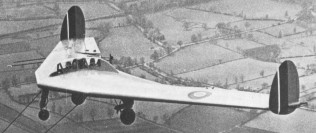
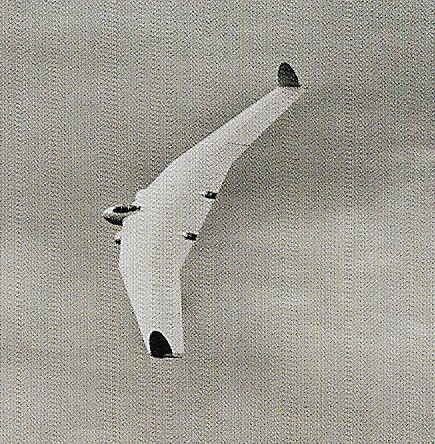
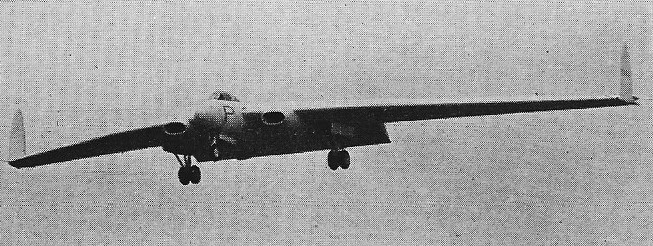
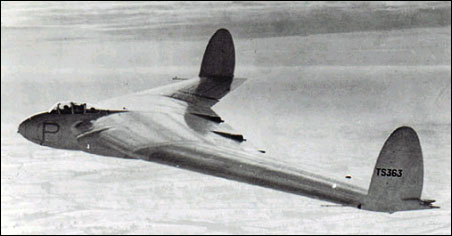
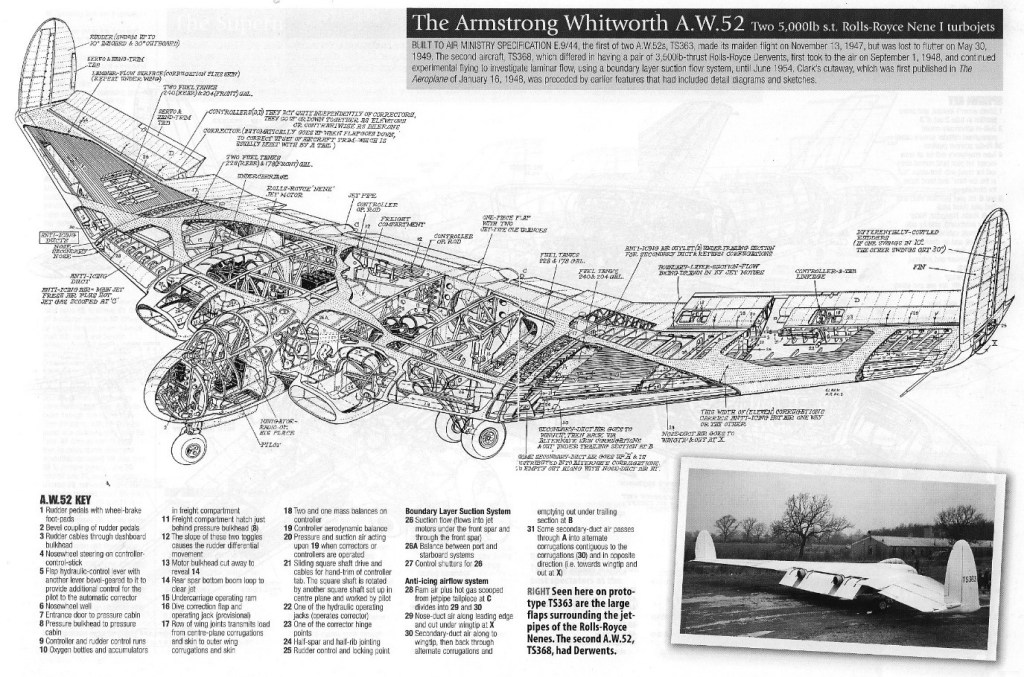
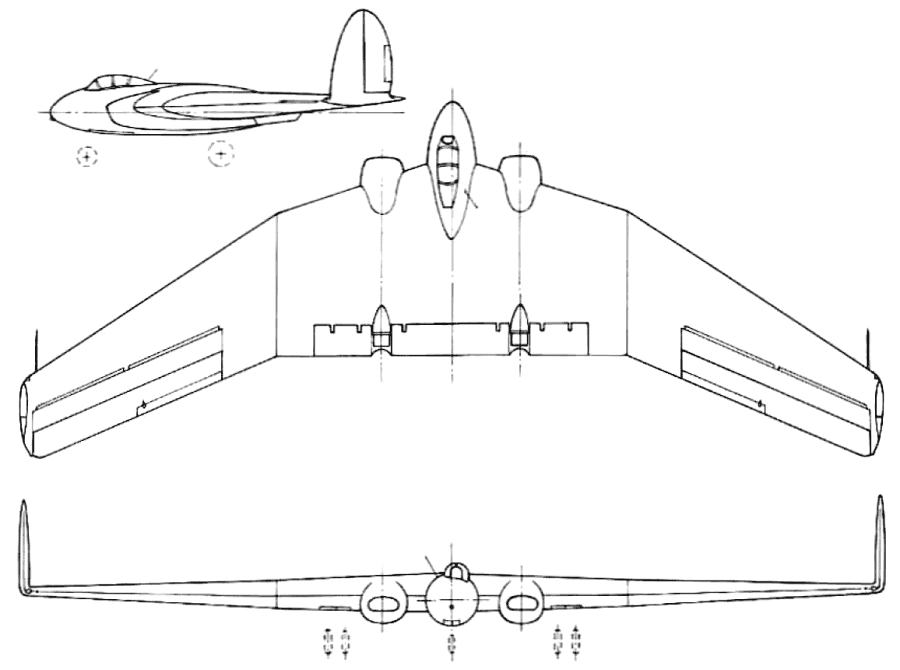
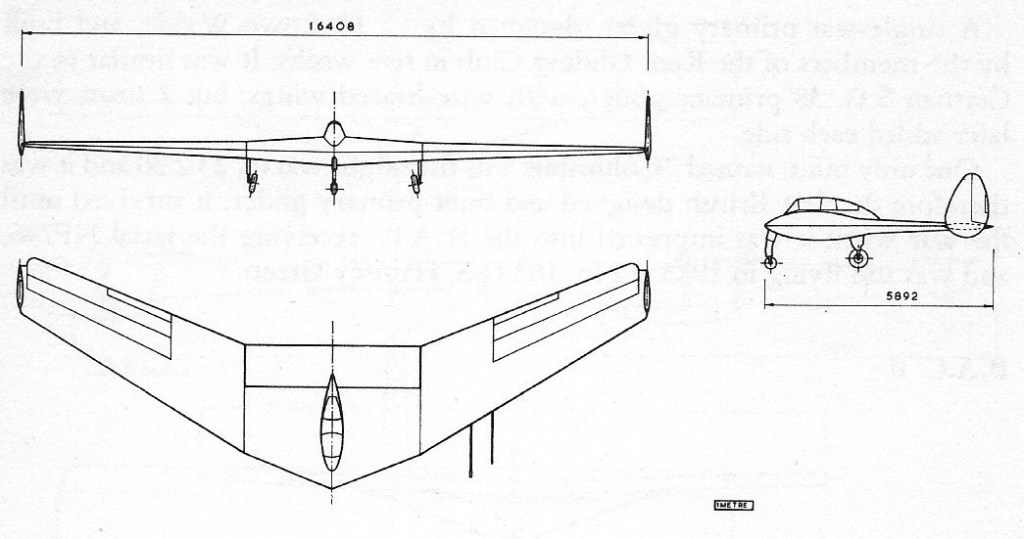
The Armstrong Whitworth A.W.52 was a flying wing type that was also intended to evaluate a configuration for a transport aeroplane with six jet engines. The basic design was validated in the A.W.52G glider.
The AW.52G was of conventional construction, but covered with “Plymax” material (1/16in ply and 22 SWG “Alclad” light alloy sheet). No airbrakes were fitted, but a central trailing-edge flap. The undercarriage was tricycle. Only one, RG324, was built. After testing was completed it remained at the company office until burnt in the mid-sixties.
The first of two A.W.52s with two 5000-lb (2268-kg) thrust Rolls-Royce Nene turbojets flew on 13 November 1947.
The first prototype, TS363, was lost in May 1949, its pilot being the first in the UK to use a Martin-Baker ejection seat in an emergency.
A.W.52 TS363, 1948 SBAC Display, Farnborough
A second prototype, powered by Rolls-Royce Derwents, was destroyed early in its flight test programme.
Although benefits were possible with such aircraft, financial problems finally curtailed the programme in 1950.
AW.52
Engines: 2 x 2270kg Rolls-Royce Nene Wingspan: 27.43 m / 90 ft 0 in Wing area: 122.07 sq.m / 1313.95 sq ft Length: 11.38 m / 37 ft 4 in Height: 4.39 m / 14 ft 5 in Take-off weight: 15490 kg / 34150 lb Empty weight: 8917 kg / 19659 lb Max. speed: 805 km/h / 500 mph Range: 2414 km / 1500 miles ROC: 4800 fpm
AW.52G Wingspan: 16.40 m / 53 ft 10 in Length: 5.89 m / 19 ft 4 in Wing area: 41.14 sq.m / 443 sq.ft Aspect ratio: 6.58 Wing section: NACA 2017 Empty weight: 2017 kg / 4451 lb AUW: 2720 kg / 6000 lb Max speed: 402 kph / 250 mph Landing speed: 104 kph / 65 mph
The Mescalero was designed by George Applebay in response to a 1970 sailplane design competition promoted by the Soaring Society of America and first flew in 1975. The controls are 100% mass balanced and connect automatically.