single-seat very light aircraft/motorglider, originally the Janowski J-5 and then offered by Alpha.
Glider
Aviation Farm Ltd
Markets through East European Markets Ltd. the J-5 Marco single-seat very light aircraft/motorglider, originally the Janowski J-5 and then offered by Alpha.
Aviation Enterprises
1998:
Membury Airfield
RG167TJ Lambourn
United Kingdom
LSA builder
Avia Stroitel AC5m Russia
Designed by Vladimir Federov, a motorised glider. The kit for this glider comes from the Penza factory via St Petersburg and Hamburg. First flown in December 1999.
The name “Russia” applies only in the UK and the USA; officially it is the AC5m.
The company behind the US entrant at the World Class Design Competition in Oerlinghausen in 1993 was so impressed by the simplicity and construction of the prototype Russian entry that they purchased it and offered to aid the Group Mechta to get established in the USA. Mechta Sailplanes LLC took over the distribution in 1994 and aggressively marketed the glider to the extent that a second assembly plant was established at Penza to supplement the Moscow unit. This raised the annual production to 48. Russia Sailplanes Inc of Bozeman. Montana was set up in 1997 to take the Russia to the next level in the USA. This relatively small glider, with a wingspan of only 12.6m, is powered by a 28 hp, carburetted, 313cc, single-cylinder, two-stroke, retractable Compact Radial MZ35 engine. Motori Zanzottera in Italy originally designed the engine, with manufactur¬ing rights acquired by Compact Radial Engines of Canada.
Engine: Compact Radial MZ35, 313cc, single-cylinder, two-stroke, retractable, 28 hp.
Wing span: 12.6m.
Avia Stroitel Russia II
Glider
Wing span: 12.6m
Avia Stroitel Russia 1
Glider
Wing span: 11m
Avia Stroitel
Avia Stroitel have been manufacturing gliders for over 30 years under their chief engineer Vladimir Federov. After several different models (including a twin-engine motor glider), the 11-m span ‘Russia 1” and the 12.6-in “Russia 11” became known to the “West” in 1992 through Group Mechta, who were contestants at the World Class Design Competition in Oerlinghausen in 1993.
Aviamilano A-2 Standard
The Aviamilano A-2 is a high performance Standard Class single-seater of 15m (49 ft 2.5 in) span, and this Italian design went back into production in 1966 after first flying in prototype form a few years earlier.
The mid-set wing has rectangular inner panels and tapered outer panels which can be replaced individually if damaged; the central torsion box and spar structure is all-metal. There are trailing edge air brakes on the inner wings.
The fuselage is of all-wood construction, with the forward part covered in glassfibre and the rear part with plywood.
The pilot’s seat is under a long flush transparent canopy, and the landing gear consists of a rubber-mounted skid and retractable monowheel. The cantilever T-type tail unit has all-moving horizontal surfaces with an anti-servo tab.
A-2 Standard
Span: 49 ft 2.5 in
Length: 23 ft 1 in
Wing area: 127.6 sq.ft
Aspect ratio: 19
Emptyweight: 419 lb
Max take-off weight: 683 lb
Max speed: 161 mph (in smooth air)
Min sinking speed: 2.03 ft/sec at 41mph
Best glide ratio: 34:1 at 54 mph
Aviafiber Canard-2 FL / Bucher Canard 2FL / Farner Canard 2 FL
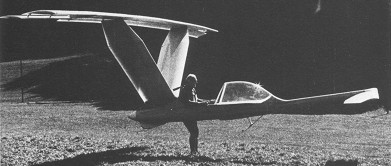
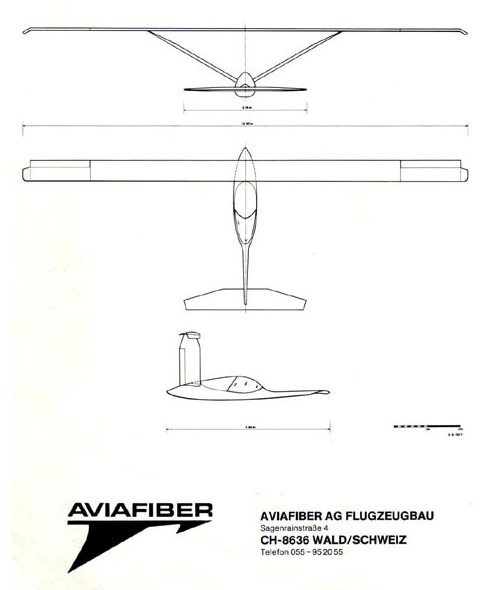
Variously described as a rigid-wing hang-glider or as a foot-launched sailplane, the Canard 2FL was designed by Swiss aero-dynamicist Hans Farner. Of fibreglass construction, it consisted of a small fuselage, big enough to accommodate the pilot in a prone position, provided with doors in the bottom through which the pilot’s legs could protrude for take-off and landing. A large canard was fitted at the nose, and the main lifting surfaces were supported atop tall, V-shaped pylons which both generated lift and acted as vertical fins. Wings, pylons and canard have Wortmann FX-67-170 airfoil section.
Construction is fiberglass to form in the matrix of the skin and spar fiberglass laminate, with extensive use of foam filler Styrofoam. To transport the wing unit disassembled into three sections of 4.8 meters (15.8 ft), to lay on the roof of a car or trailer.
Pylons (two “V” wings) attach a high wing at the mid-point of the span on both sides – positioning the main wing out of the flow of the canard. The vee-tail pylons have a core of solid hard foam unlike the styrofoam of the wings, while the ailerons have cores of hard foam cells. The wing has a Wortmann FX-63-137 section and is a single-spar structure with a vacuum-formed shell of laminated resin and glassfibre and a core of styrofoam plate. The canard did not hinge in the horizontal axis to produce pitching moments as convention dictates, but rather twisted about the glider’s longitudinal axis to control adverse yaw, thus stall was impossible (unacellerated), and Vne could not be exceeded even by deliberate pilot action. The canard was positioned out front of a fully canopied pilot pod via a slender extension. The one piece canopy/windscreen is open at the rear and for landing there is a retractable front skid and a nonretractable tailskid. A monowheel is optional for downhill rolling take-offs.
The control system is mixed. The longitudinal control, pitch, is changed by the pilot the shifting center of gravity. The pilot rotates prone on a stomach board that slides fore and aft 80 cm (32 inches). Pilot weight at launch is supported on shoulder straps. Ailerons and all-moving canards (each console can rotate (or warp) on 5 degrees relative to the longitudinal axis of the machine). On the vertical tail is mounted brakes, to control the rate of descent giving a sink rate of 0.6 m/s (120 fpm).
At first the claim of 35:1 seemed excessive but consider this, Farner had Lockhead as his client. The joined wing concept allowed an effective span of the main wing plus the pylons of around 65 feet, without the tip drag induced by the vortices of biwings.
At the start of the pilot runs on his feet, after the lift-off, pulls his legs inside the fuselage, rotated horizontally, the bottom hatch (and lantern above) is closed for the streamlining of the fuselage. Landing can take place either on the ski under the fuselage, or the pilot’s legs. After launch, doors under the pilot were closed, the pilot rotated prone and the rear canopy half was closed.
The construction and development of Canark 2FL began in August 1976 in a workshop in Hinwil, Switzerland, on the basis of a previous project by Hans Farner and Ernst Ruppert, the Colibri, dating back to 1972. The Canard-2 FL made its first flight on 7 September 1977.
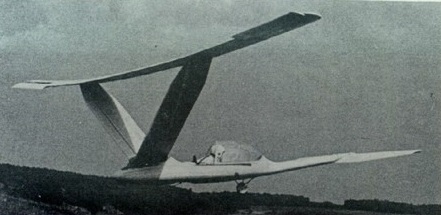
Results of flight testing with the engine running encouraged Farner and Bucher to designa dedicated motor-glider version as the Canard Aviation Canard SCM, powered by a 15–18 kW (20–24 hp) engine. Farner had previously designed a motor-glider using the FL concept as the Farner HF Colibri 1 SL, which first flew in 1979.
Test flights of the Canard took place in Vaduz. Hans Farner was killed test flying the Canard after a small number were sold. The 1980 accident that claimed the designer’s life was due to over-control of pitch. The pilot strapped into a dolly that pivoted flat after takeoff. The dolly slid forward and aft on rollers and changed the CG to control pitch. The designer slid off the dolly and ended up over-controlling and fell out of the final pull-up upside down.
The business promoter (H. Bucher) decided to withdraw the Canard 2FL, Canard SC and Canard SCM from sale, buying back all the remaining four gliders after the accident and then redesign and re-release the Canard as a sailplane. The moulds were in the small town of Wald not too far from Zurich. Another incident finally ruined the reputation of the Canard 2FL design.
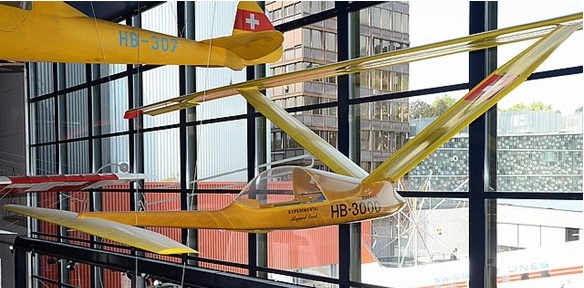
Airframes constructed by Ruppert Composites of Wald, Switzerland, were HB-3000 (Sept 1978), HB-3001 (Apr 1979, HB-3002 (Aug 1979), and HB-3003 (Aug 1981).
One of the glider remains in the Swiss Lucerne Transport Museum.
Variation:
Rochelt Solair I
Canard-2 FL
Length: 4.5 m (14 ft 9 in)
Wingspan: 13.5 m (44 ft 3 in)
Wing area: 13 sq.m (140 sq ft)
Airfoil: Wortmann FX-67-170
Height: 5 ft 11 in
Empty weight: 50 kg (110 lb)
Max weight: 372 lb
Aspect ratio: 20.0
Never exceed speed: 100 km/h (62 mph; 54 kn)
Stalling speed: 24 mph
Maximum glide ratio: 31 at 37.5 mph
Minimum sink: 0.6 m/s / 120 ft/min / 1.64 ft/sec at 31 mph
Crew: 1
Packed size: 4.8 m (15.8 ft.)
AVIAD Zigolo MG12
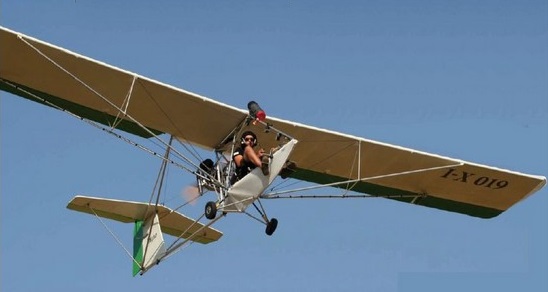
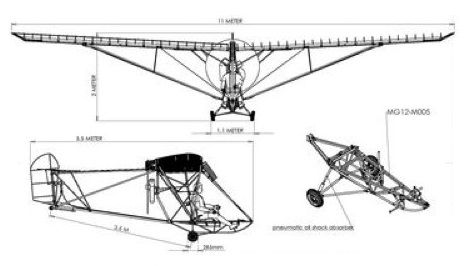
The AVIAD Zigolo MG12 is a SSDR (Single Seat De-Regulated) ultralight motor glider. This aircraft meets the USA FAA FAR Part 103 rules for UL (SSDR) aircraft in USA, China, and other countries. It is a conventional full 3-axis aircraft.
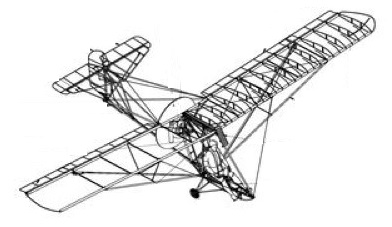
The AVIAD Zigolo MG12 is specifically designed for simple construction and low cost of ownership, it has a traditional tubular frame structure and simple bonded fabric covering. It has excellent slow flight characteristics and a short landing and take off distance of 130 feet.
The rear mounted pusher engine with propeller and the fuel tank are also contained within the airframe. The joy stick mounted engine throttle control further simplifies the aircraft’s three axis flight controls. It incorporates a forward pilot cockpit protected by the fuselage frame work and providing a wide field of view.
The Zigolo MG12 Kit does not require specialist knowledge or equipment for assembly. The drawings are very detailed and provide a step by step guide for assembly. The individual drawings contain a parts list of required components, which are easily identified by the initials engraved on them.
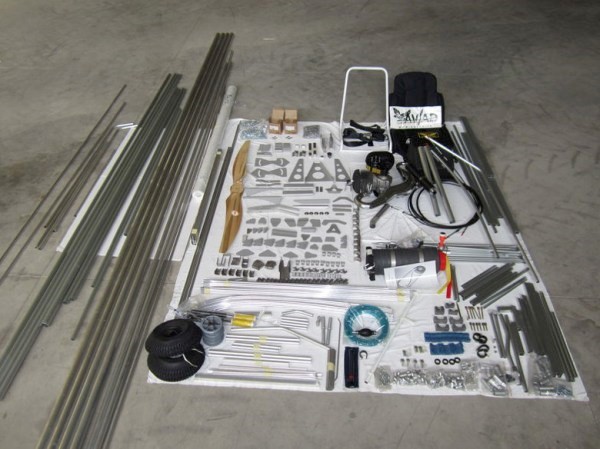
The Design Drawings are shared online and are made easily accessible for kit builders. All parts are accurately cut, perforated and folded. The assembly process only requires the correct part selection and correct positioning prior to fixing with either bolt or rivet to complete each sub-assembly / module. The complete aircraft’s final assembly can be undertaken either within the workshop or in the hangar and does not require any excessive space for construction.
The Zigolo MG12 kit requires less than 100 hours for assembly. The aircraft modules once completed can be rigged and ready to fly in 1 hour and offer easy transportation by truck, pick-up or trailer. The new wing remove system means the wings can be removed in just a couple minutes each.
It is a motor-glider. The glide ratio (L/D) is nowhere near that of a glider but due to its’ large wing and therefore very low wing loading the sink rate is reasonably low. The turn radius is so tight and slow it is easy for novice glider pilots to stay in thermals.
The Zigolo is available as a finished aircraft. Ultralights do not have any 51% build rule like the experimental class but can be offered ready to fly. Should a builder choose to fly outside the Part 103 rules the Zigolo has been inspected and approved as an E-AB kit and can be found on the FAA list of approved kits.
Base price was $12,000 (2017) and that includes EVERYTHING but finish paint. Engine & prop as well.
Engine: Vittorazi Moster 185, 25 hp at 7800 rpm
Wingspan: 11.1m / 36.4 ft
Wingarea: 15.8 sq.m / 170 sq.ft
Length: 5.5 m / 18 ft
Aspect ratio: 7.9
Dihedral: 3 deg
Empty weight: 102 kg / 225 lb
Max weight: 220 kg / 485 lb
Fuel burn: 6 lt/hr / 1.6 GPH
Fuel burn 30kg thrust: 3.5 lt/hr / 0.92 GPH
Stall: 35 kph / 22 mph
Cruise 6800 rpm: 68 kph / 42 mph
Vne: 95 kph / 58 mph
ROC: 2 m/s / 394 fpm
Sink rate: 1.4 m/s / 276 fpm
Glide ratio: 11-1
Manoeuvring speed: 65 kph / 40 mph
Range: 95 km / 59 miles
Load factor: +4 / -2 G
Safety factor: 1.5 G
Tailplan span: 3 m / 9.8 ft
Height at rudder: 1.3 m / 4.3 ft
Power loading: 7 kg/hp 15.4 lb/hp
Wing loading: 11 kg/sq.m / 2.23 lb/sq.ft
TO dist: 40m / 131 ft
TO dist to 50ft: 180m / 590 ft