The Berkshire company started out as a fiberglass aircraft repair shop founded by Arthur Zimmermann and Wolfgang Schaer, but quickly progressed to aircraft design and construction.
The Concept 70 was produced from 1971. Production ceased, when Zimmermann died in 1974, after 21 were built.
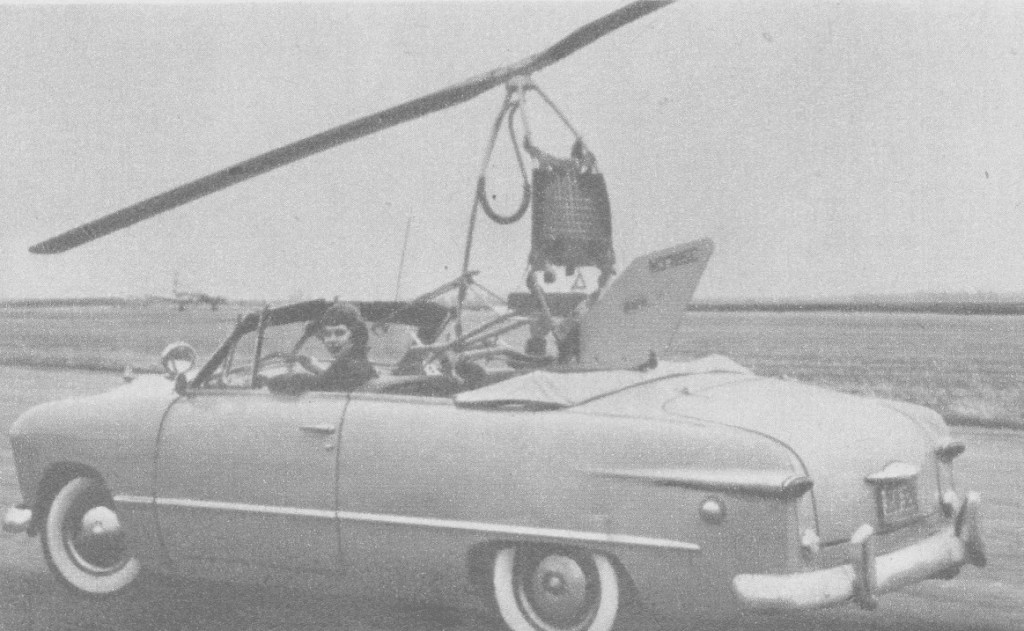
Towed by car, the B-19 becomes airborne at about 23 mph. Flight is completely pilot-controlled, limited only by the length of the tow cable. By adding a cable release, once airborne the pilot may free the craft for unrestricted soaring. The B-19 may easily be converted at any time to the powered B-20, as is fully detailed in the same Construction Plans.
Engine (original): McCulloch 4318 Horsepower Range: 45 to 70 Height: 6 ft Length: 10½ ft Width: 5½ ft Empty Weight (minus engine): 150 lbs Empty Weight (with engine): 230 lbs Gross Weight (max): 530 lbs Payload Weight: 300 lbs Rotor Diameter: 21 ft Rotor Chord: 7 in Disc Loading: 1.53 lbs/sq ft Maximum Speed: 90 mph Airframe construction: welded steel tubing Control System: joystick; rudder pedals Cruise Speed: 60 mph Take-off Speed: 30 mph Rate Of Climb: 1,000 fpm Maximum Altitude: 12,000 ft
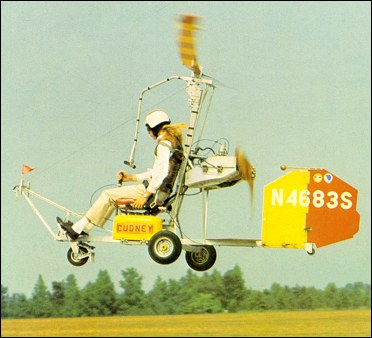
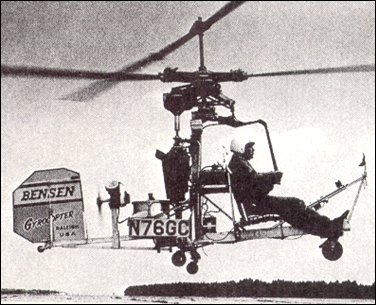
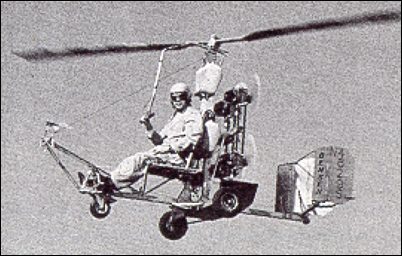
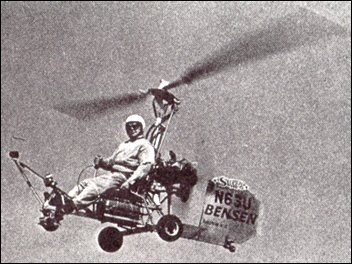
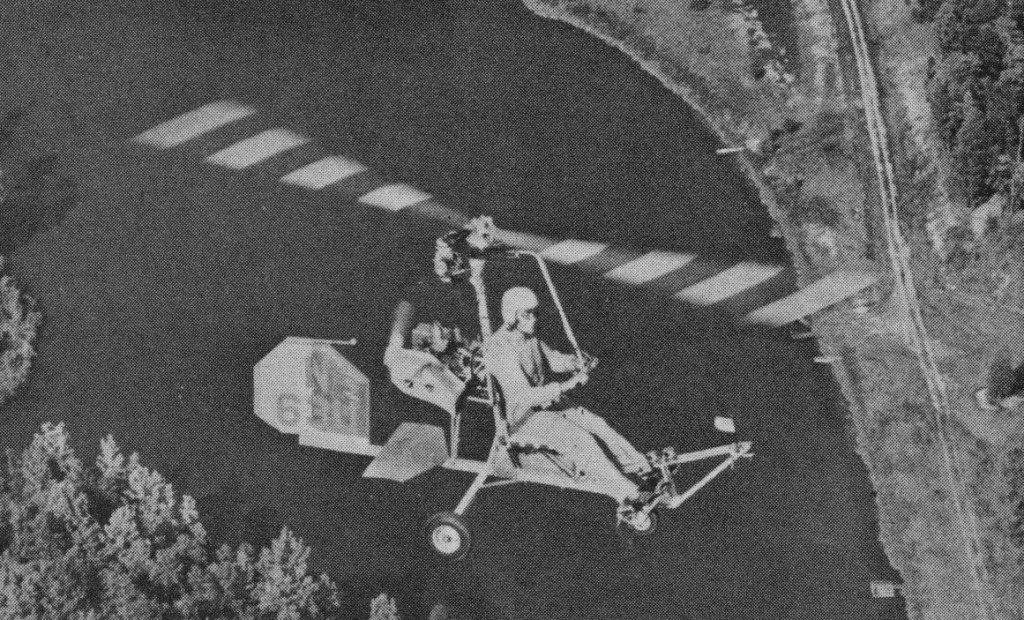
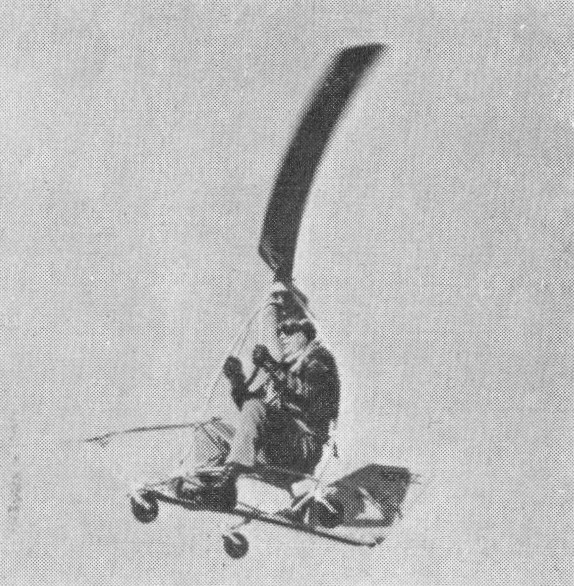
From the B-5 Gyro-Glider factory-built prototype of 1954, Bensen evolved the B-6 and B-7, and from these has come the standard production model the B-8. This has a more sturdy construction and was available as a factory-built machine or in kit form for amateur construction. Two water-borne versions of the B-8 were also available: the B-8B Gyro-Boat which has a boat-type hull and twin outrigged stabilising floats, and the B-8W Hydro-Glider mounted on twin floats. From the reworked B-7M came the B-8M variant, first flying on 8 July 1957 and by the first production B-8M on 9 October 1957. The B-8M is normally powered by a 72hp McCulloch piston engine. Optional features include a 90hp McCulloch engine and a mechanical rotor drive enabling the autogyro to make jump starts.
A float version of the B-8M is known as the Hydro-Copter.
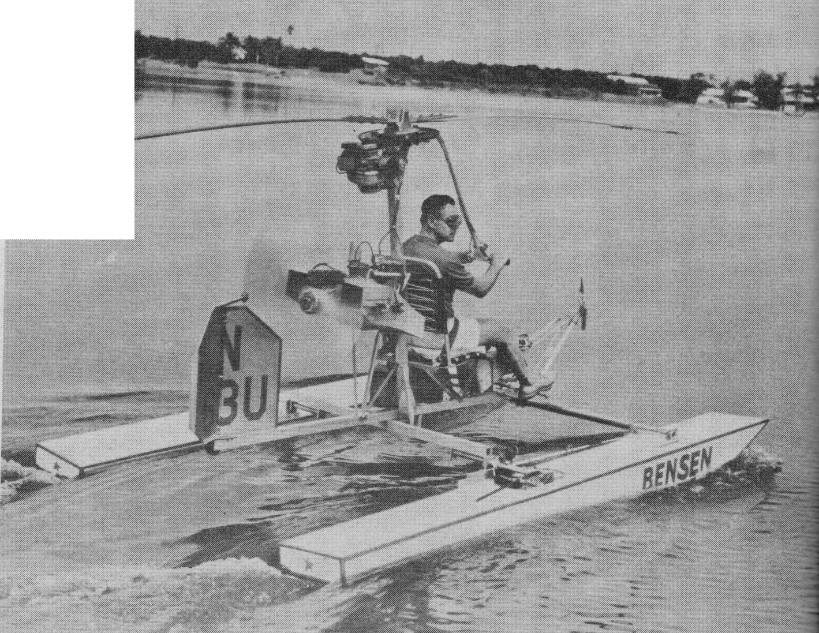
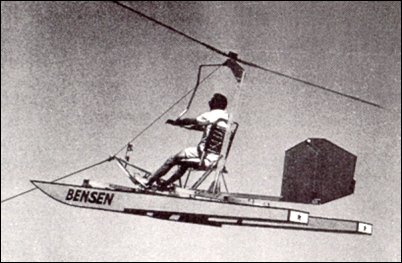
The Gyro-Boat is a variant of the Gyro-Glider, in which the basic free-turning rotor system, known as the Roto-sail, is mounted on any standard small dinghy. The result is literally a flying boat, intended to be towed above water by a motor boat. The two-blade steel and plywood rotor has a diameter of 6.10m and disc area of 29.2sq.m. Each blade has an area of 1.0sq.m. When fitted to a 3.66m aluminium dinghy weighing 45kg, the complete Gyro-boat has an empty weight of 68kg and a loaded weight of 147kg carrying one person or 227kg carrying two people. It takes off when towed at a forward speed of 37km/h, cruises at 55-110km/h and lands at 11km/h. The prototype Gyro-Boat flew for the first time on April 25, 1956, and the first production model on July 8, 1956. The 1959 version can be fitted with stabilizing pontoons on outriggers for rough water operation.
B-8B Gyro-Boat
Designed for home construction from kits or plans, captured a series of international records in 1967, including an altitude of 7,275 ft (2,717 m) and a speed of 79 mph (127.15 kph) over a 15 km course. In early 1968 the USAF ordered three as X-25 to test methods of improving the odds of a downed flyers escape. The X-25A had a more robust structure and a small engine. The two-seat X-25B was originally used un-powered but was later fitted with an engine.
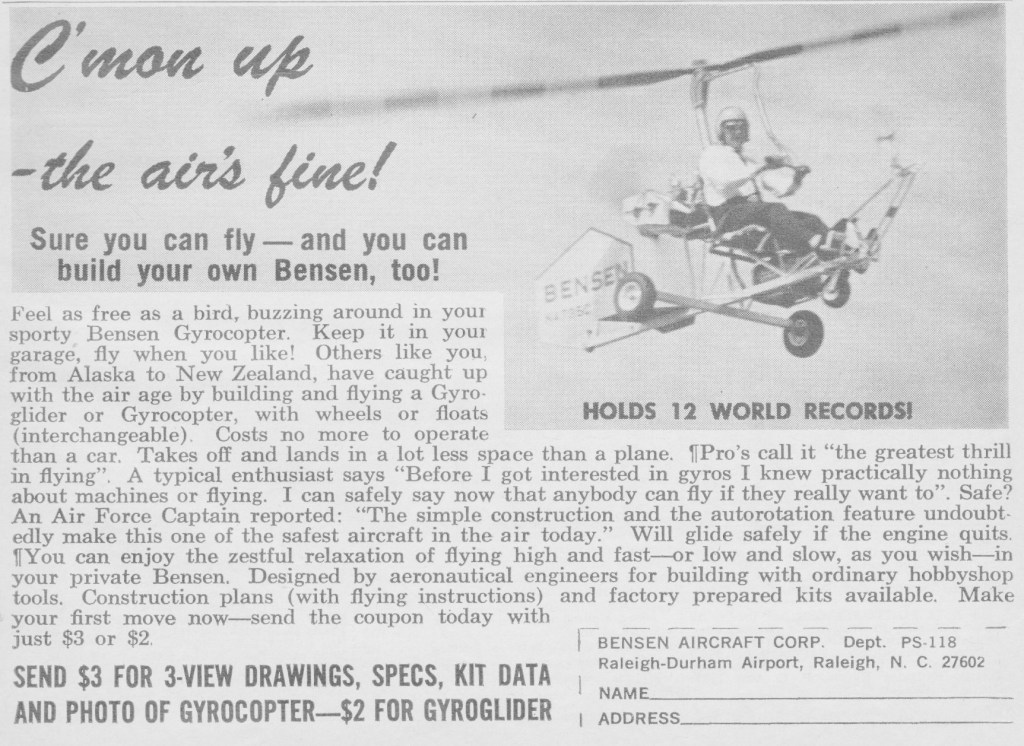
By 1984 there were more than 10,000 active rotorcraft fans in the United States. With purchase of their plans and component kits, it is possible to build a machine in a few weeks of spare time, with only a drill press and a few wrenches. Bensen Gyrocopters can be towed behind a car or boat or flown under their own power. The simple glider models are available as one or two seaters. The powered gyrocopters are available only as single seaters. The Gyrocopter is capable of climbing to 12,500 feet. The powerplant is a 72- to 90-hp McCulloch. Price in 1982: $4,850 (Excludes engine). Units delivered to June 1982: 4,000.
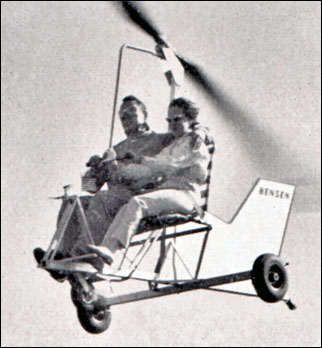
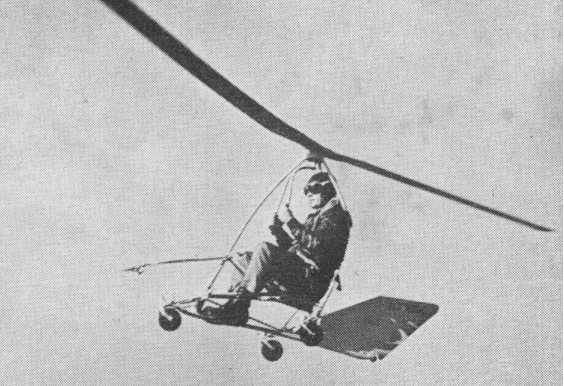
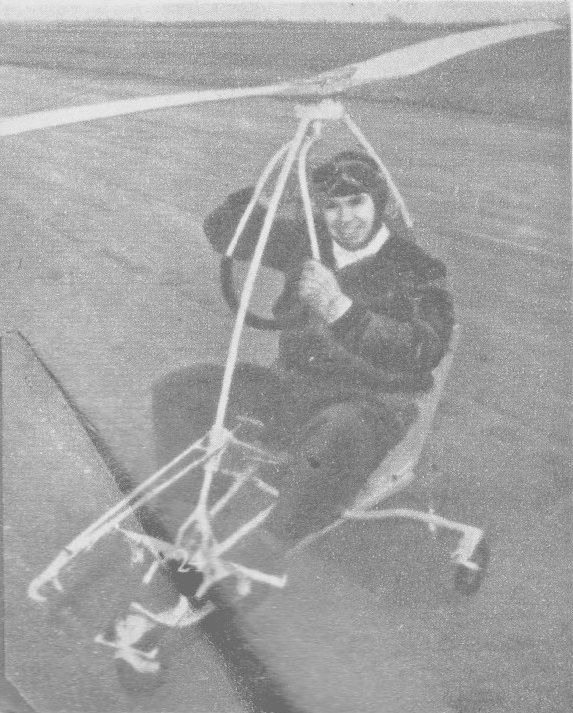
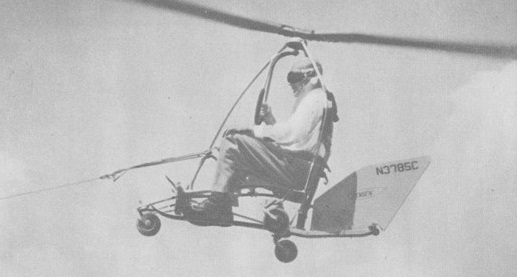
The B-8 Gyro-Glider is a simple unpowered rotor-kite which can be towed behind even a small motor car. It is available as either a completed aircraft or kit of parts for amateur construction. Alternatively, would-be constructors can purchase a set of plans, with building and flying instructions. No pilot’s licence is required to fly it in the United States and many hundreds of kits and plans have been sold. Application was been made for an Approved Type Certificate. The original Model B-7 Gyro-Glider was followed by the Model B-8, which is offered as either a single-seater or two-seater, the latter version being suitable for use as a pilot trainer. The Model B-8 consists basically of an inverted square-section tubular aluminium T-frame structure, of which the forward arm supports the lightweight seat, towing arm, rudder bar and landing gear nose-wheel. The rear arm supports a large stabilising fin and rudder, with the main landing gear wheels carried on a tubular axle near the junction of the T-frame. The free-turning two-bladed rotor is universally-mounted at the top of the T-frame and is operated directly by a hanging-stick control. It is claimed that the entire aircraft can be made from commercial tubing, wood and locally-available materials.
B-8 Gyro-Glider
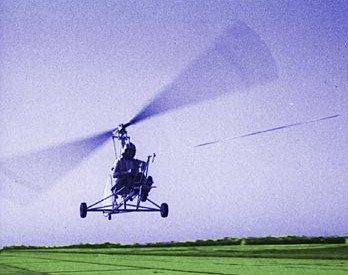
B-8MH Hover-Gyro
Demonstrated in public for the first time in 1976, the B-8MH Hover-Gyro is described as a ‘Hovering Gyro-Copter’. It was powered by a 70-110hp modified water-cooled outboard engine driving the lower of the two rotors; the upper rotor autorotates. One 14 hp modified air-cooled go-kart engine drives the pusher propeller mounted at rear.
B-8 Super Bug
The B-8 Super Bug was a B-8M modification with two engines installed to spin up the rotor prior to take-off.
B-8HD
The B-8HD was a 1979 Gyro-Copter was based on the Super Bug design. It uses hydraulic drive to feed about 4hp from the engine to the rotor, instead of having a separate engine for pre-rotation. This is reported to give the aircraft a take-off run of less than 61m.
In August/September 1964 the B-8M three-view drawings, photos and specification were available for $2, or the complete construction plans for $30.
B 8M Engine: McCulloch 4318E 4 cylinder, 72 hp Rotor dia: 20 ft 0 in (6.1 m) Fuselage length: 11 ft 4 in (3.45 m) Height: 6 ft 3 in (1.9 m) Max TO wt: 500 lb (227 kg) Empty Wt. 247 lbs / 112kg Fuel capaci¬ty 6 USG Max level speed: 85 mph (137 kph) Cruising speed: 72km/h Ceiling: 12,000 ft / 3810m Range: 161km
From the B-5 Gyro-Glider factory-built prototype of 1954, Bensen evolved the B-6 and B-7, and from these has come the standard production model the B-8. This has a somewhat more sturdy construction and is available as a factory-built machine or in kit form for amateur construction. Two water-borne versions of the B-8 are also available: the B-8B Gyro-Boat which has a boat-type hull and twin outrigged stabilising floats, and the B-8W Hydro-Glider mounted on twin floats. In 1955 Bensen placed an engine in the B-7 and renamed it the B-7M (“m” for motorised). The B-7M flew for the first time on 6 December 1955. Two years later, in 1957, the B-7M was upgraded to include, among other refinements, a McCulloch 72-hp pusher engine.
Bensen’s range of do-it-yourself helicopters and autogyros stem from the B-5 Gyro-Glider of 1954, which was a single-seat rotor-kite towed into the air at around 30km/h and obtained its lift by the flow of air over its autorotating rotor.
The 86 lb Bensen “Gyro-glider” which, towed behind a car, takes off at about 20 m.p.h. The B-6 Gyro-Glider could be built at home from household pipe, plywood and steel strip for about £30 in 1955. In still air, it lands in 10-15 ft. at 7 m.p.h.
From the B-5 factory-built prototype, Bensen evolved the B-6 and B-7. B-6 Engine: none Main rotor diameter: 6.0m Length: 3.45m Height: 1.91m Empty weight: 58kg
Founded by Dr. Igor B. Bensen, formerly chief research engineer of the Kaman Corporation, to develop a series of lightweight autogyros. Examples built and supplied to USAF for research purposes, but marketed primarily in kit form for amateur construction. Also attempted to develop Cargolifter as multi-helicopter lifting platform, with eight-rotor sub-scale prototype flown in early 1980s.
The Dottie S was begun as a high school project by George Bennet and Richard Carter and completed in 1957 at Mississippi State University with the help of Guy Storer of the Raspet Flight Research Center. The wings were based on the shorter ones of the Schultz-Midwest MU-1 while the horizontal tail was based on the Laister-Kaufmann LK-10A and the vertical tail was scaled down from that of a Schweizer SGS 2- 12 (TG-3A). No spoilers were fitted.
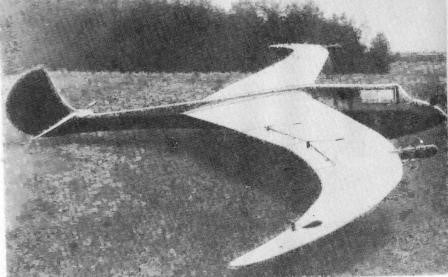
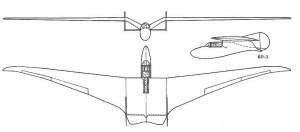
The Belyayev / Yemelyanov experimental sickle-wing glider (Russian: Беляев / Емельянов Планер с серповидным крылом) was developed at TsAGI in 1937 by VN Belyayev and VI Yemelyanov and never had a proper name, which is why it is known by its wing shape.
A new curved wing concept was tested on this glider, developed by Belyayev and tested on a Yemelyanov- built glider fuselage.
This glider was designed as a high-wing cantilever monoplane. The wing had a curved sickle shape, later be known as “Uprugoye Krylo” (elastic wing) or popularly as a “butterfly” wing. Long flaps were located on the trailing edge to improve the glider’s landing characteristics. The slim double-section ailerons were located along the entire span of the positive-taper section of the wing.
The elongated fuselage ended in a monoplane tail with stabilizers installed with a large angle of attack. The rudder featured a rounded trailing edge. The experimental glider was a two-seater with tandem enclosed cockpits.
This experimental model was completed in 1937 and during testing, when pulling out of a dive, the fore area was detached from the rest of the glider. The rupture occurred right by the second cabin, so that Alexandrov was suddenly in the air. Rastorguyev circled the falling cockpit several times before breaking free and launching himself into the void.
The pilot VL Rastorguyev and the experimenter VS Alexandrov, managed to save themselves by parachuting, but the glider was totally destroyed.
The Belyayev BP-3 (Russian: Беляев БП-3) glider of 1936 was developed by Victor Belyayev with forward-swept wing as a continuation of the BP-2 but in tandem configuration.
Success with the BP-2 led Belyayev to conceive of an improved model with larger dimensions and some changes. This two-seater capacity model appeared in 1935 as the BP-3 and had the wingspan increased to 20 meters.
The wing shape in the plane was generally similar to that of the previous BP-2, but in this case the wingspan had been significantly increased. Unlike the BP-2, the BP3 used a medium deployment wing with a gull-like curvature. This allowed to reduce the surface of the rudders and a more compact location of these. The hanging flaps located under the center plane disappeared.
The tail unit also received changes. Maintaining the double empennage structure, the horizontal plane on these was eliminated.
The BP-3 glider was designed as a two-seater and its crews were located in a closed cockpit.
The BP-3 was built in the TsAGI workshops and was flown for the first time on July 18, 1935. From the first flight, this aircraft presented excellent characteristics, with an aerodynamic quality that reached 33:1 glide, so it was decided to use it to establish a new record for gliding range.
The prototype was possibly followed by several copies built in the workshops of the Yeisk Naval Pilot School.
BP-3 Wingspan: 20 m Length: 5.6 m Height: 2.2 m Wing area: 3.54 m² Empty weight: 400 kg Glide ratio: 33: 1 Seats: 2