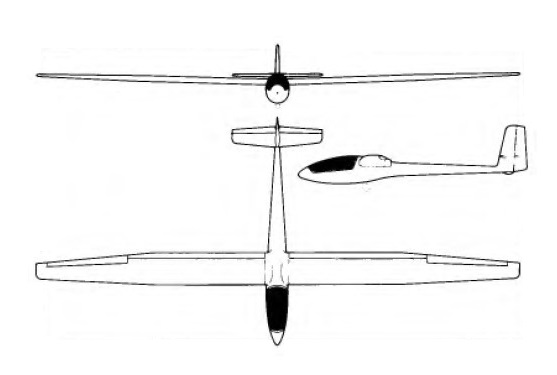
Blohm und Voss was a shipbuilding concern, based on the Elbe at Hamburg. Its aircraft division, Hamburger Flugzeugbau GmbH, turned to construction of maritime aircraft in the early 1930s. In 1937 Hamburger Flugzeugbau adopted the title of the parent company. Successful designs of Dr Ing Richard Vogt initiated under the Ha designation continued in production becoming designated, for example, Bv 138 instead of Ha 138. True Blohm und Voss developments included the Bv 222 Viking, the largest flying boat to attain operational status in the Second World War, and the even larger Bv 238, evolved too late to enter production before the war’s end. The only prototype Bv 238 was destroyed by air attack four days before VE-day.
Glider
Bley M-Condor
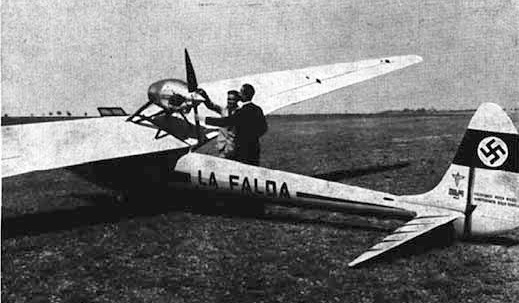
The 1935 Bley Flugzeugbau GmbH M-Condor was an experimental monoplane designed by Heini Dittmar at the request of the pilot Peter Riedel.
The 18 hp Kröber engine was mounted on six uprights and was possibly removable.
Based on a Dittmar Condor, (powered by Bley-Flugzeugbau, Namburg a. S.) the first flight was in mid-May 1935.
Engine: Kröber, 18 hp
Wingspan: 17.24 m
Wing area: 13.2 m2
Length: 7.6 m
Height: 2.6 m
Empty weight: 260 kg
MTOW: 350 kg
Seats: 1
Blessing Rebell
Designed and built by Herr Gerhard Blessing of Hamburg, this single-seat homebuilt motor glider has provision for carrying a second occupant, and the wings can, at the choice of the builder, be made in two, three or four parts. To assist the amateur constructor further, no component of the aircraft is more than 3.5m (11ft 5.75in) long, and the fuel tank and several other components are standard car items obtainable from the motor industry.
The Rebell is a mid-wing monoplane of basically steel tube construction with wood covering; the wings can be
folded for storage and the vertical tail surfaces are swept back, with a dorsal fin. Landing gear consists of a non-retractable semi-recessed monowheel supplemented by a balancer wheel under each wing about halfway along the semi-span, plus a tailwheel.
The prototype Rebell, registered D-KEBO, first flew on 3 June 1973 powered by a 54hp Hirth M28 two cylinder engine driving a Hoffman two-blade pusher propeller that could be feathered for soaring flight.
In 1975 a modified Volkswagen engine was fitted which had a slightly larger air intake.
The fuselage has been redesigned to take a 62hp Limbach SL 1700 engine in the nose, and the Rebell was expected to fly again in this form early in 1980.
Engine: Hirth M28
Span:49 ft 2.5 in
Length: 24 ft 7.25 in
Wing area: 182.0 sqft
Aspect ratio: 13.2
Empty weight: 926 lb
Max weight: 1,366 lb
Max speed: 124 mph
Economical cruising speed: 93 mph
Best glide ratio: 24:1
Bleriot III / Bleriot-Voisin
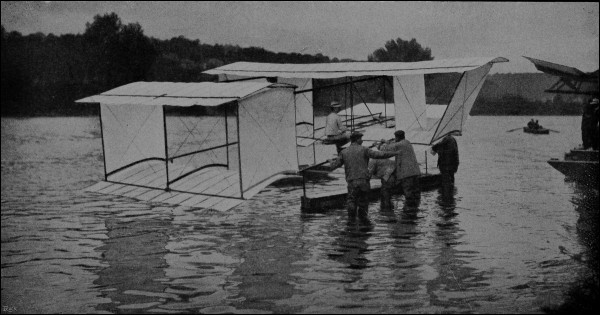
1905 Bleriot III / Blériot-Voisin Cellular Biplane with pontoons was hauled by a motor boat.
Bisnovat 302 / Kostikov KB-3 / Tijonrarov I-302
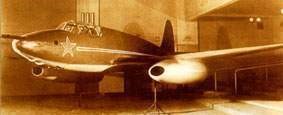
The “302” reactive interceptor fighter was designed in 1940. It was the world’s first fighter with combined reactive powerplant.
This fighter appears interchangeably in the specialized literature as a product of MK Tijonrarov (head of the project design brigade and specialist of aerodynamic calculations during the construction of the prototype), AG Kostikov (main engineer of the RNII (NII-3) during the design of the project and main constructor of the OKB-55 during the construction process or MR Bisnovat (head of the OKB-55 designated for the development and construction of the model. In some literature it has also been called Kostikov KB-3 and Tijonrarov I-302.
Between 1939 and 1940 in the USSR began to develop a design process for aircraft powered by reactive engines. Due to the short working time of these engines, their use was conceived in the form of interceptors of very high speed and short radius of action. The three most prominent developments in this line were the Tijonrarov “302”, the “Malyutka” and the Bereznyak / Isayev BI. The three projects were conceived to use liquid reactive engines using kerosene as fuel and nitric acid as oxidizing agent, with powers between 1,100 and 1,200 kg. Of these three projects, only the BI was further developed. The projects “302” and Malyutka were kept as Secret for many years and information about them is scarce and little known.
The “302” appeared in 1940 as a project for the world’s first fighter with a combined reactive powerplant. The project was developed by a group of specialists led by MK Tijonrarov under the general direction of AG Kostikov, who at that time was serving as the chief engineer of the RNII (NII-3). In the spring of 1941 the project was presented to the technical council of the institute, being approved. After the defense of the project before the commission of the VVS, AG Kostikov directed the request for approval to the NKAP, where between June 17 and 18, 1942 it was approved by a commission made up of SA Jristianovich, AV Chesalov, SN Shishkin, VI Polikovski.
In the second half of 1942 the project was presented to Kliment Efremovich Voroshilov and that same day, during a reception with Stalin, the “302” was approved and Kostikov was appointed principal constructor of the OKB-55 and director of the experimental factory of the same name. As head of the OKB was appointed MR Bisnovat and as his replacement AA Andreyev. VD Yarovitsky was selected for the resistance calculations and the aerodynamic calculations were carried out by MK Tijonrarov.
Structurally the “302” was conceived as a low-wing cantilever monoplane. The construction was of wood. The wing had a RAF-34 profile with 15% at the root and NACA-230 with 8% at the wingtips. The tail was made of wood with a plywood coating. The fuselage was designed with a monocoque structure.

The landing gear was designed as a traditional type with single wheels on all units. The retraction system was hydraulic.
The “302” was conceived as a fighter with a liquid reactive engine (ZhRD) RD-1400 produced by LS Dushkin and with 1400 kg of thrust located under the tail and two ramjets (PVRD according to its acronym in Russian and also known as Ramjets in English) designed by V.S. Zuyev, located under the wings.
The interceptor was armed with two ShVAK 20mm cannons located in the nose and two similar ones below the cockpit, all with 400 rounds. Under the wing were detachable mounts for unguided rockets (RS-82 and RS-132) or two FAB-125 bombs.
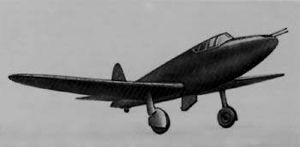
By the summer of 1943 it was found that the development schedule for Zuyev’s ramjet was seriously overdue. Only a 1: 2 scale model had been completed and the tests could not be executed. Dushkin’s 1100kg D-1 Liquid Reactive Engine, with an additional 450kg chamber, was not yet ready as testing had just begun. For this reason it was decided to equip the “302” with a RD-2M double chamber liquid reactive motor, which also presented problems.
Given the lack of availability of the engines, it was decided to finish the cell and test it in the form of a glider, which received the name ” 302P “. All the weapons and some of the equipment were removed from the plane in order to lighten it. In the tail section a model of a reactive single chamber engine was located, which was exposed, without the fairing.

At the end of August 1943 in this configuration the ” 302P ” was delivered to the LII. The tests showed excellent stability characteristics and the “302P” was sent to the TsAGI, where it was tested in the wind tunnel. During the “blows” in the T-104 tunnel of the TsAGI, it was possible to obtain an aerodynamic quality K = 15, which promised excellent results. Several dozen flights were carried out towed by a Tupolev Tu-2 and a North American B-25 Mitchell. The evaluation given by the USSR honorary test pilot S. N. Anojin on the “302P” was highly positive. Positive evaluations were also received from other experienced test pilots such as ML Galai, BN Kudrin and VN Yelagin. In the tests it was possible to calculate a landing speed of 115 – 120 km / h. The powered flights were not carried out due to the lack of completion of the reactive engines.
The first motorization variant with one ZhRD and two PVRDs yielded a possible speed of 900 km / h, a ceiling of 9000 meters and a time to reach this ceiling of 2 minutes.
The calculations obtained with the “302P” yielded a speed of 800 km / h, a ceiling of 18000 m and a reach time of a height of 5000 meters of 2.1 minutes and 2.8 minutes for the 9000 meters. The calculated range was 100 km. The only real data obtained were the take-off with a run of 16 – 18 seconds and a speed of 200 km / h. The empty weight of the plane was 1502 kg and with a military load of projectiles for the 4 guns, 505 kg of fuel and 1230 kg of oxidant, the takeoff weight reached 3358 kg.
In 1944 a government commission led by AS Yakovlev made the decision to stop all work related to “302”. The results obtained during development were not lost and many of the constructive decisions employed during the construction of the “302P” were later employed by SM Alexeyev during the construction of the I-211 and I-215 fighters.
Model 302
Powerplant: 1 x ZHRD RD-1400 with 1,400 kg thrust + 2 x PVRD
Wingspan: 11.4 m
Length: 8.708 m
Wing area: 17.8 m²
Takeoff weight: 3800 kg
Empty weight: 1856 kg
Maximum speed at height: 900 km / h
Time at 9000 m: 2 min.
Service ceiling: 9000 m
Armament: 4 x ShVAK 20 mm cannons
Bombload: unguided rockets (RS-82 and RS-132) or two FAB-125 bombs
Seats: 1
Model 302P
Wingspan: 9.55 m
Length: 8.708 m
Wing area: 14.8 m²
Takeoff weight: 3358 kg
Empty weight: 1856 kg
Total load weight: 1502 kg
Weight of fuel and oil: 1735 kg
Wing loading: 227 kg / m²
Reactive fuel weight: 505 kg
Oxidizer weight: 1230 kg
Speed at sea level: 800 km / h
Speed at altitude: 900 km / h
Take-off speed: 200 km / h
Time to 5000 m: 2.1 min
Time at 9000 m: 2.8 min
Service ceiling: 18,000 m
Range: 100 km
Armament: 4 x ShVAK 20 mm cannons
Bombload: unguided rockets (RS-82 and RS-132) or two FAB-125 bombs
Seats: 1

Biot-Massia Glider
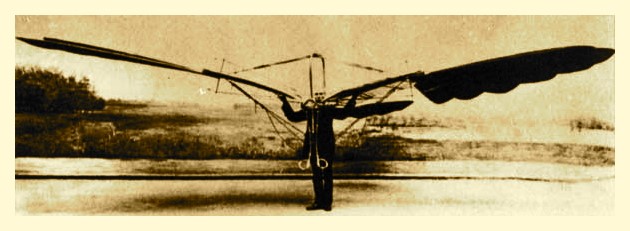
Designed and built by Comte de Massia in 1879, leading to flights made by Gaston Biot. Biot flew the glider several times at Clamart, a suburb of Paris approximately 3 km south-southwest of Issy-les-Moulineaux. Donated to the Musée de l’Air in 1925 and restored in 1960, the glider is currently on display at the Musée de l’Air et de l’Espace, and is said to be the oldest surviving heavier-than-air flying machine in the world.
Bikle T-6
Paul Bikle produced a modified HP Aircraft HP14 (the T-6) with a 17.37 m / 57 ft span wing and control system modifications.
B&F Technik Fk 2

Otto Funk worked in the training department in the Heinkelwerk Speyer, and also developed new airplanes and technologies. Thus developed the Fk 2, which was finished in the training workshop with Heinkel in 1962.
B&F Technik FK-1 Greif 1 / Funk Fk-1

Otto Funk became a student to the Heinkel company at Speyer, where he completed the glued metal Greif 1a (FK1), designed in 1959.
Funk used a completely new metal glue building method, which was developed further.
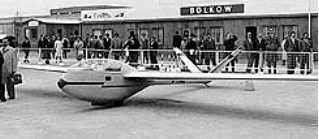
In 1960 a turbo-jet engine was built into the glider, which became the 1b.
Berkshire Concept C-70
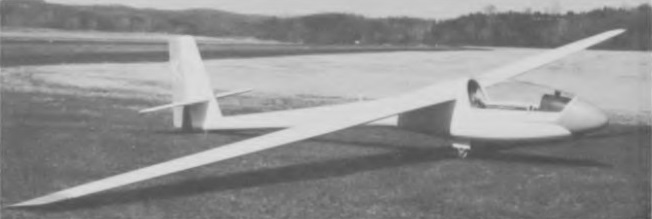
The Berkshire Concept 70, sometimes called simply the C-70, is an American, single seat, high-wing, 15 metre class competition glider that was designed by Arthur Zimmermann and produced by the Berkshire Manufacturing Corporation of Lake Swannanoa, New Jersey between 1971 and 1974.
The first US all-glassfibre sailplane, known as the Concept 70, did not make its first flight until 1970, some 13 years after the Akaflieg Stuttgart FS-24 Phonix had pioneered this material for sailplane structures. The single-seater Standard Class Concept 70 was the responsibility of Arthur Zimmerman and Wolfgang Schaer.
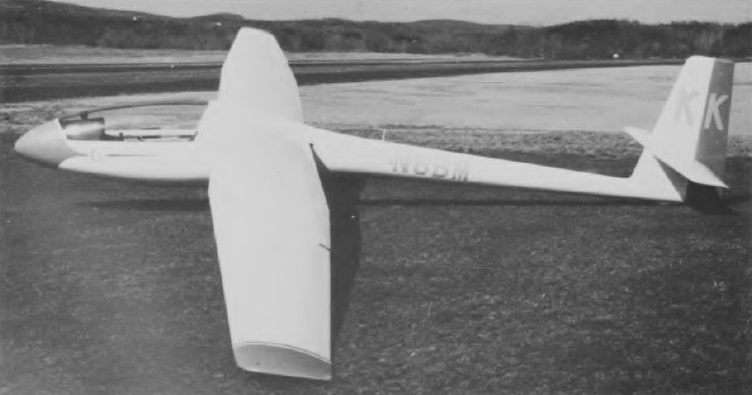
The Concept 70 was intended to be a domestic US fiberglass sailplane that would compete with the best European 15 metre aircraft being produced in the late 1960s.
The cantilever shoulder wings have a constant chord centre section and tapered outer panels, and are of glassfibre/PVC foam sandwich construction, with aluminium flaps lowering to 90°; up to 200lb (91 kg) of water ballast can be carried with optional water ballast tanks. The prototype has an Eppler airfoil and an all-flying horizontal stabilator. Production aircraft featured a Wortmann airfoil, a more conventional tail, and full-span flaps that deploy to 90° for glidepath control.
The glassfibre monocoque fuselage has a steel tube reinforcing frame connecting the retractable monowheel and wing fittings and continuing into the cockpit for greater strength and rigidity. The pilot sits in a semi-reclining seat, recessed for an American type parachute, under a one-piece flush Plexiglas canopy which is hinged and jettisonable. The manually-retractable Tost monowheel has a drum brake.
Differing in a number of respects from the prototype, the production version emerged with a Wortmann airfoil, full-span flaps, no brakes and a conventional horizontal tail.
Production by the Berkshire Manufacturing Corporation got under way in 1973, some 16 Concept 70s having been built by the spring of 1974. Production ceased, when Zimmermann died in 1974, after 21 were built.
The aircraft was never type certified and all aircraft were registered as experimental aircraft in the Racing/Exhibition category.
The Concept-70 molds and tooling were available for about US $35,000 including 40ft container.
ASC kits appear no longer to be in production.
Concept 70
Wingspan: 49 ft 3 in (15.0 m)
Wing area: 132 sq ft (12.3 sq.m)
Aspect ratio: 18.3
Airfoil: Wortmann
Empty weight: 550 lb (249 kg)
Gross weight: 875 lb (397 kg)
Maximum glide ratio: 39:1
Wing loading: 6.6 lb/sq ft (32 kg/sq.m)
Crew: one
Concept 70
Wing span: 15.0 m (49 ft 2.5 in)
Length: 7.31 m (24 ft 0 in)
Height: 1.83 m (6 ft 0 in)
Wing area: 11.52 sq.m (124 sq ft)
Wing section: Eppler/Wortmann
Aspect ratio: 20.0
Empty weight: 226 kg (500 lb)
Max weight: 396 kg (875 lb)
Water ballast: 91 kg (200 lb)
Max wing loading: 34.38 kg/sq.m (7.04 lb/sq.ft)
Max speed: 105 kt (195 km/h)
Stalling speed: 31 kt (58 km/h)
Min sinking speed at 43.5 kt (81 km/h): 0.62 m (2.03 ft)/sec
Max rough air speed: 105 kt (195 km/h)
Best glide ratio at 52 kt (96.5 km/h): 40