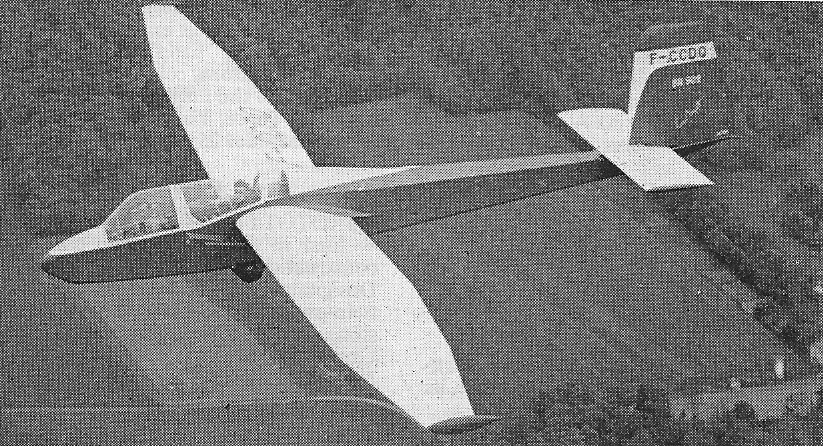
The Breguet 902-01 two-seat glider made its first flight on 14 May 1958.
The Breguet 902-01 two-seat glider made its first flight on 14 May 1958.
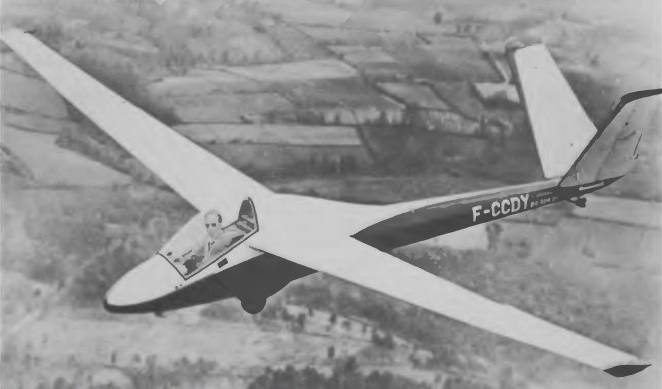
The Breguet 906 Choucas (Jackdaw) is a slightly larger two-seater trainer development of the Fauvette with a wing span of 18m (59 ft 0 in) instead of the latter’s 15m, and the prototype flew for the first time on 26 October 1959.
It was not until April 1964 that the French government announced that they had decided to put it into production with an initial order for three, and as Breguet had ceased making sailplanes in 1963 Choucas production was entrusted to CAARP – Cooperative des Ateliers Aeronautiques de la Region Parisienne – at Beynes aerodrome in the Seine-et-Oise department.
CAARP replaced all the plastic parts with wooden components on the production aircraft, but the prototype was very similar in construction to the Fauvette, with the same three-section fuselage structure, the moulded plastic foam nose section housing the pilot’s seat, the steel tube centre portion covered with polystyrene skin containing the rear seat with its transparent canopy, and the rear fuselage being of plywood/Klegecel sandwich construction. The tail surfaces were the same construction as the Fauvette’s, and the cantilever shoulder wing had a single wooden spar with a plywood/Klegecel leading edge torsion box and a fabric-covered trailing edge. Slotted ailerons covered 45% of the span and the air brakes were metal and Klegecel sandwich like the Fauvette’s. The non-retractable monowheel has a brake and there is a shock-absorbing tailskid. There is provision for a baggage compartment for the pilots, and other optional ‘extras’ include a turn-and-bank indicator, artificial horizon, VHF radio and oxygen systems.
Span: 59 ft 0 in
Length: 25 ft 11 in
Wing area: 183.5 sqft
Aspect ratio: 19.1
Empty weight: 640 lb
Max take-off weight: 1,146 lb
Max speed: 124 mph (in smooth air)
Min sinking speed: 2.13 ft/sec at 43.5mph
Best glide ratio: 30:1 at 43.5 mph
A postwar French sailplane designs, the Breguet 905 Fauvette (or Warbler) is a Standard Class single-seater with a V-tail and made its first flight in 1958. Like the Type 900 and 901 it was designed by J. Cayla.
Construction makes extensive use of Klegecel, the expanded plastic giving a very strong and light structure which was used before in the Type 901. The fuselage is built in three main parts, consisting of the nose section of moulded plastic foam including the pilot’s seat and flying controls; the centre fuselage, which is a steel tube framework covered with a moulded polystyrene skin and carries the wing, the cockpit attachment points and the towing hook; and the rear fuselage, which is of plywood/foam sandwich construction.
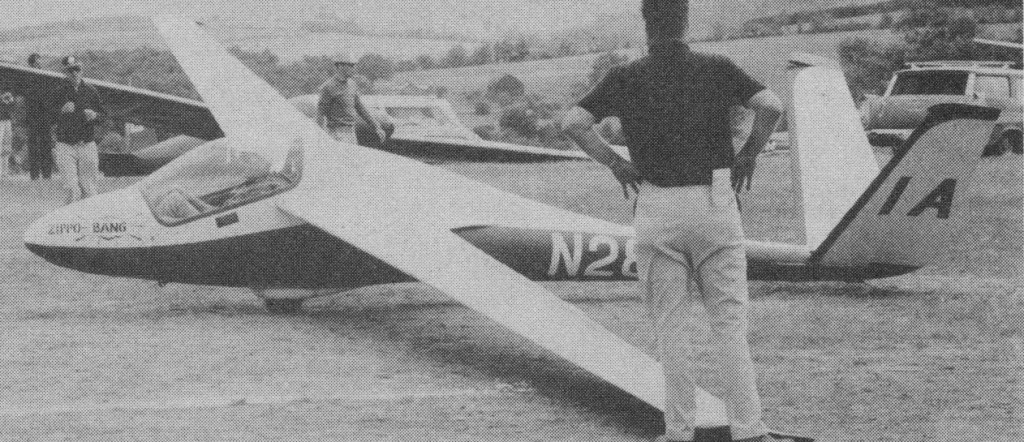
This sandwich is composed of 6mm plywood and 8mm of Klegecel, and the same sandwich construction is also used for the fixed tail surfaces, which can be folded to the vertical position for loading on a trailer; the movable surfaces are fabric covered. The cantilever single-spar shoulder wing is of similar plywood and Klegecel construction and has an NACA 63-series laminar flow section; the single spar is of wood and the air brakes are made up of a metal and Klegecel sandwich.
It was made available to customers either complete from the factory or in kit form for homebuilt assembly, and altogether 50 Fauvettes were built by Breguet.
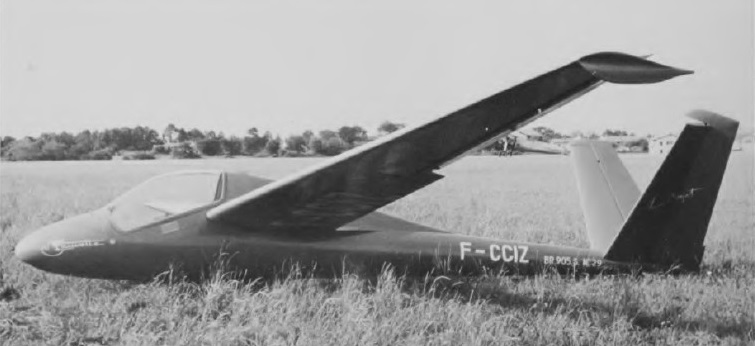
The Fauvette soon made its mark in contest flying, and among the records set up in it was the United Kingdom distance record broken by Rear Admiral H. C. N. Goodharton 12 June 1959 with a flight of 388 miles.
905 Fauvette
Span: 15.0 m / 49 ft 2.5 in
Length: 6.22 m / 20 ft 4.75 in
Wing area: 11.25 sq.m / 121.1 sq.ft
Aspect ratio: 20.0
Wing section: NACA 63420/63613
Empty weight: 155 kg / 342 lb
Max weight: 275 kg / 606 lb
Water ballast: None
Max wing loading: 24.5 kg/sq.m / 5.02 lb/sq.ft
Max speed: 124 mph / 108 kt / 200 km/h
Stalling speed: 29 kt / 54 km/h
Max rough air speed: 92 kt / 170 km/h
Min sinking speed: 0.65 m/sec / 2.13 ft/sec at 40 mph / 35 kt / 65 km/h
Best glide ratio: 30:1 at 48 mph / 42 kt / 78 km/h
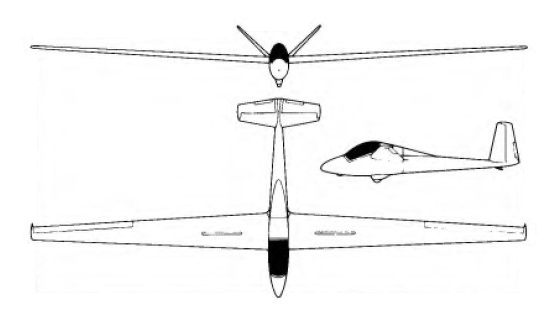
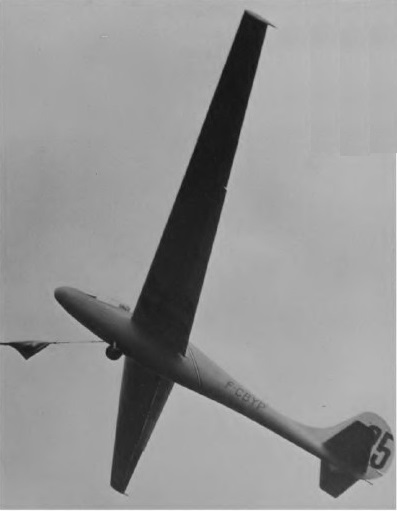
The Breguet 901 high-performance single-seat sailplane was developed in 1953 from the Type 900, Breguet’s first sailplane which, on its maiden flight on 13 May 1949, covered a distance of 292 miles at an average speed of 56mph which, had it been observed, would have set up a new French goal flight record.
The Type 900 was of all-wood construction with fabric covered wings of 46 ft 11 in span with slotted ailerons, slotted flaps and metal dive brakes, and a plywood-covered fuselage. The Type 901, designed by J. Cayla, incorporated several advanced features for its time and took first place in the single-seater class at the 1954 World Gliding Championships at Camphill, going onto repeat this success at the 1956 World Championships in France, by which time a production batch of 60 had been put in hand. The 901 differed from the 900 chiefly in having a longer span (56ft 10in) wing of higher aspect ratio and a more streamlined fuselage, with the large blown Plexiglas cockpit canopy flush with the fuselage top line, a practice since adopted by many other sailplane designers. Another unusual feature was the carriage of 165 lb of water ballast in the wings, which could be discharged through openings just beneath the wings in each side of the fuselage.
Construction was very similar to the Type 900 with slotted ailerons and multi-hinged slotted Fowler flaps on the laminar-flow wing, and metal dive brakes on the upper and lower surfaces. The leading edge torsion box is a sandwich of plywood and Klegecel, an expanded plastic pre-formed under heat to the required shape, giving very strong and light structure. The single spar is of spruce and plywood and wing covering is of plywood and fabric.
The tail unit is of very similar construction, and the tailplane and elevators can be folded horizontally for
transport. The fuselage is a plywood-covered monocoque with a single retractable monowheel with hydraulic brake for landing; a landing can be made with the wheel retracted without serious damage to the structure. The pilot is provided with radio, blind-flying equipment and oxygen.
The Type 901-S1, which first flew in 1956, differed from the 901 in having modified flaps, a slightly longer fuselage and larger tailplane. The Breguet 904 Nymphale is a two-seater version of the 901, the first of two prototypes making its maiden flight on 26 May 1956.
This featured a laminar-flow wing of 20m (65ft 7in) span and end-plate fairings called ‘salmons’ on the wing tips; the second seat increased the length to 29ft 6in.
901-S1
Span: 17.32 m / 56 ft 10 in
Length: 7.57 m / 24 ft 10 in
Wing area: 15.0 sq.m / 161.5sq.ft
Aspect ratio: 20
Wing section: NACA 63 series
Empty weight: 265 kg / 584 lb
Max weight: 430 kg / 948 lb
Water ballast: 75 kg / 165 lb
Max wing loading: 28.67 kg/sq.m / 5.87 lb/sq.ft
Max speed: 136 mph / 119 kt / 220 km/h
Stalling speed: 33.5 kt / 62 km/h
Max rough air speed: 97 kt / 180 km/h
Min sinking speed: 2.0 ft/sec / 0.60 m/sec at 45 mph / 39 kt / 72 km/h
Best glide ratio: 36:1 at 53 mph / 46 kt / 85 km/h
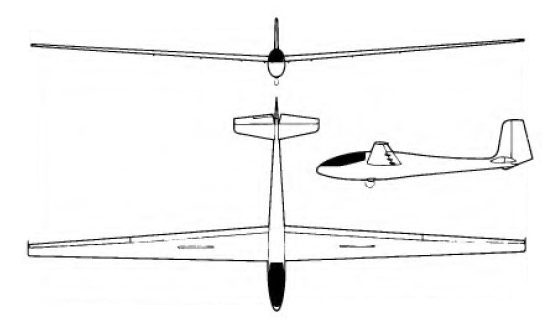
The Breeze Ooze Bird is a single-seat, tailless light glider designed and built by F. Breeze at Perranporth, Cornwell, UK.
It was first flown from the sand dunes at Perranporth, using an auto-tow launch, in 1961.
Remained still with the Cornish Gliding Club in 1970.
A single seat glider was designed by two members (both aged 16) of the Bramlingham Gliding Club, near Luton, Bedfordshire, in 1934.
The 9.14m / 40 ft span wing was parasol mounted, with two bracing struts each side, from half span to the fuselage. This, and the small tail unit, were similar in appearance to the Abbott-Baynes Scud 2.
Michael Bowlus used the tail of an HP-18 and the wings of an HP-11, reduced to 15 m., to develop his BZ-1, which first flew in 1984. This has an adapted North American F-86 Sabre drop tank for the front end of the fuselage, interconnected flaps and ailerons (the former extending to 90 degrees for approach control) and increased empty and gross weight of 249 kg/ 550 lb and 364 kg/ 780 lb respectively.
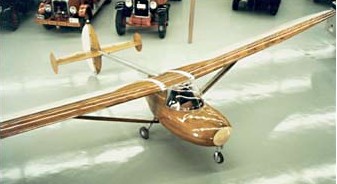
The Bumblebee was designed by William Hawley Bowlus and built in 1946. A powered sailplane with vertical tail and two small stabilizers mounted on a single boom, the Bumblebee was equipped with manually retracting undercarriage and 16 hp pusher engine.
The Dragonfly, NX1955, designed by Hawley Bowlus, was the first auxiliary-powered self-launching glider to be produced in the U.S.A. The designers nicknamed this design the Bumblebee but they sold the powered glider under the official moniker, Dragonfly. Rebuilt from Bumblebee and with tricycle gear, it featured 2-place, side-by-side seating, retractable tricycle landing gear and a Nelson engine. Some were powered by 48hp Nelson H-63CP engine. The marketing was sponsored by the Nelson Engine Company as a vehicle for their two- cycle four cylinder 25hp engine. The cockpit pod was molded plywood, aluminum boom, 2-spar wood wing with plywood D-tube, fabric cover aft of spar.
While the concept was good, the airplane never achieved real success, because it didn’t perform well, and because Nelson took his engine and left the partnership. The beautiful wooden fuselage pod made up of layers of mahogany was very labour intensive and thus very expensive. Some Dragonflys had the engine removed, converting them to pure sailplanes. The Dragonfly features a fully retractable tricycle landing gear with stearable nosewheel, dual control and a ratchet-wire pull starter in the cockpit for engine starts in flight or on the ground.
Of less than 10 built, 2 survived in 2008 at the National Soaring Museum. NX/NC34921 was restored in New York in 1964.
John Hess Auction Service Inc, Manheim, PA 17545, United States, consigned a Nelson-Bowlus BB-1 Dragonfly N33687 Glider and Culver Rigid Midge N215 jr. Racing Glider in May 2015.
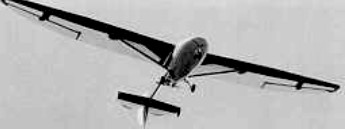
Bumblebee
Engine: 16hp pusher
Wingspan: 41’0″
Length: 23’5″
Useful load: 355 lb
Speed: 75 mph
Range: 110 mi
Seats: 1
Undercarriage: rg (manual)
Dragonfly
Engine: 25 hp Nelson 4 cylinder engine (retractable)
Wing span: 14.42m / 47.3ft
Wing area: 15.7sq.m / 169sq.ft
Empty Weight: 263kg / 580lb
Payload: 163kg / 360lb
Gross Weight: 426kg / 940lb
Wing Load: 27.13kg/sq.m / 5.56lb/sq.ft
Max speed: 50 mph (80 km/h) (originally 70 mph (113 km/h) with power)
Empty weight: 580 lb (263 kg)
Gross weight: 940 lb (426 kg)
Span: 47 ft 4 in (14.4 m)
Height: 6ft 10 in (2.1 m)
Length: 20 ft 4 in (6.2 m)
L/DMax: 18
Seats: 2
No. Built: 7
Aspect ratio: 13.25
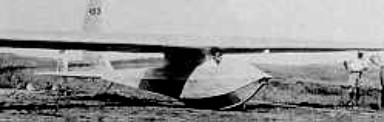
The wood and fabric Paper Wing, so called because it used paper webbed ribs, first flew in 1929. The wingspan was later increased to 14.33 m. / 47.0 ft principally by extending the ailerons. It was first U.S. built sailplane to fly for more than 1 hour. A replica of the Paper Wing belongs to the San Diego (CA) Museum of Flight.
Wing span: 13.4m / 44ft
Wing area: 16.63sq.m / 179sq.ft
Empty Weight: 73kg / 160lb
Payload: 66kg / 145lb
Gross Weight: 139kg / 305lb
Wing Load: 8.36kg/sq.m / 1.7lb/sq.ft
Aspect ratio: 11
Airfoil: 35-A
No. of Seats: 1
L/DMax: 20
A Bowlus design (or a copy), the Nighthawk, flown by William A. Cocke gained the world endurance record of 21 hr. 34 min in 1931. This glider is in the museum of flying, Santa Monica, CA

