Acme Sierra S-1 Sportplane / Beattie-Fellers S-1

Acme Sierra N12K at Edwards FTC

Designed by Ron Beattie and Walt Fellers, two North American Engineers who came to work for the Northrop Division, the 1948 Acme Sierra (a.k.a. “Sierra Sue”) N12K was built by the Acme Aircraft Co. at the Torrance Airport in late 1948. It was built by Acme’s Crawford and Keeney.

Designed and flown by Ron Beattie and Walt Fellers, the first flight took place on 23 November 1953. It was built according to Goodyear Racing Plane specifications. Although it was never entered in any races, extensive data was obtained during its many flights.

It was built to investigate the advantages of a pusher propeller configuration. It has a “Y” shaped tail incorporating ruddervators on the upper fins, an unswept wing mounted midway up the fuselage, an engine mounted directly behind the cockpit, and large air scoops mounted in the forward end of both wing roots. The aircraft, now designated as the Sierradyne S-1, was used by Sierradyne Inc. in the 1960’s to test and promote Northrop’s and Dr Werner Pfenninger’s boundary layer control concepts. Northrop used it as a flying technology demonstrator for the Air Force’s AX close-support aircraft design competition in 1972, but despite its being re-labeled as the Northrop Turbo-Pusher, the plane was never officially considered a Northrop aircraft.

It is reported displayed at the Los Angeles Science Museum.

Engine: Continental C-85, 85hp
Wing span: 20′ 2″
Length: 18′ 0″
Max speed: 200 mph
Empty weight: 590 lb
Seats: 1


ACME Anser Amphib

The Air Craft Marine Engineering Co was a four place cabin, mid-wing monoplane amphibian twin-jet prototype fighter was reported under construction in 1958, but never completed. Assigned RS-695B project number by the Army Air Forces Air Materiel Command. “Anser” was acronymic for “Analytical Service Inc,” involved in the project to an unknown degree. The COIN fighter selected at the time was North American OV-10A.

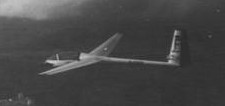
Aachen FVA-21 “Wölbklappenautomatik”

On the initiative of Prof. Dr. Ing. A.W. Quick, the FVA received a research assignment on an “automatic flaps for gliders,” which was financially supported by the German Research Foundation DFG in 1972.

Profiles with flaps bring higher soaring performance compared to profiles without flaps, only when the flaps are set correctly according to the needs of the aircraft. The pilot must therefore keep an optimum value depending on wing loading and flight speed.

During cross-country flights, it is necessary to vary the flight speed depends on the average rise in thermal updrafts and the instantaneous decrease or increase in air encountered. The so-conditional permanent adjustment of the flaps constituting an additional burden for the pilot. If the adjustment of the flaps was automatic, the pilot would be relieved or the work load as with a simple-to-fly glider without flaps.

The project was developed for the DFG under Heiner Oberdörster during 1973/73.

After extensive preliminary studies it was concluded to make the regulation of the flaps dependent of the angle of attack of the aircraft. At a point in the hull wall an outwardly wind flag was attached, which gave the respective angle of attack of the aircraft in flight.

Measured at the wind flag angle was converted by a field plate differential sensor into an electrical signal and supplied to a controller. This controlled by electric valves, the adjustment of the flaps by a hydraulic cylinder until the actual value is consistent with the preset value.

For manual adjustment of the flaps the control circuit switches, as well as with landing gear and during takeoff and landing, automatically.

A an LC-3 (an all-metal glider open class with 18 m span and flaps) testbed for the automatic flaps was purchased on highly concessional terms from VFW-Fokker in 1971.

The automatic flaps were installed in the spring of 1974, and on 22 August 1974, the first flight of the complete automatics. In the course of 1974, there were more than 50 flight hours, tested by 20 different pilots.

Flying with the LC-3A ( A = automatic ) was very impressive. The flap lever turned out, as if by magic, to the optimal value. The expectations were confirmed by a long series of measurements and to everyone’s surprise, they received for the curve Flight optimal values​​.

The entire system weighed approx 20kg in the LC-3A. In conversation with some manufacturers of hydraulic devices, however, was soon clear that in reducing the weight of a compromise would be concluded between the weight savings and the consequent increase in the cost of the system. Between 1976 and 1978, Liebherr developed a hydraulic unit which was built in the LS 3a of the FVA.

Thus, the automatic flaps corresponded fully to the demands placed on them and was successfully tested in other aircraft.

Project was Heiner Oberdörster, who took care of the work to the successful completion in 1975.

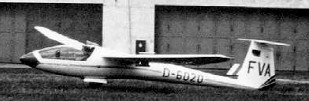
Aachen FVA 20

With the decision to build a standard class aircraft, the design was already outlined in broad terms: 15m span, no lift and flaps and minimum body height 0.8m.

For the wings , the rectangular trapezoidal shape was chosen , which offers significant manufacturing advantages. The minimum surface load of 26,8kg/m² promises satisfactory flight performance even in the European weather conditions. T-tail , retractable landing gear and the proven Schempp-Hirth airbrakes were features that were maintained from the beginning.

The hull construction was begun in 1967, but the half-finished hull was for a long time in a corner of the workshop without anything happening.

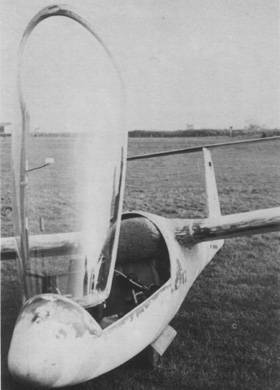
Construction was half-sandwich type. Balsa wood was used as a support material for a fiberglass shell. The vertical tail fin and tailplane used the same construction, as a full-sandwich in a negative mold.

The wings were originally similar to the hull, produced in positive construction. However, it turned out that with this construction, the required high profile accuracy was difficult to achieve. Aachen changed to the negative construction. The spar is designed as a box spar, and for the spar caps roving cloth was used in the form of narrow bands.

The FVA-20 was the first fiber reinforced plastic glider built by the FVA. The FVA initially lacked the designers and builders on experience with the new material. The FVA was not discouraged by setbacks and consistently worked on the project. Among many other designers especially Uwe Solies came forward, who was project manager of the FVA-20 many years and spent many a night in the factory before the drawing board.

Since 1973, every year you could read again in the annual report that “we expect the first flight over the next racing season.” In addition to a coarse underestimate the amount of work especially the “Details”. In contrast to previous FVA-aircraft designs, made with all available work force, in the seventies with only with one project: the maintenance of the aircraft fleet, design and construction of several trailer for the newly acquired gliders took at times most of the work capacity to complete.

When finally construction began on the wings, it was discovered that the negative forms already standing in the workshop for several years set themselves so that the required surface finish and profile accuracy could not be reached. The shapes were restored to the necessary condition in winter 1975/76 which proved to be very lengthy. In March 1976, they could finally begin on the upper and lower shells of both surfaces, laminated in the form of mass inserts.

In these shells the “guts” were inserted and then the respective upper and lower shells joined together. The profile accuracy in the wing leading edge was work in the following winter.

In 1978/79 the work was continued intensively. But again there were problems in the so-called details, which caused further delays. For example, the incorporation of control organs, control levers and the actuation of the retractable undercarriage saw some problems.

During the general development some improvements were also incorporated into the design of the FVA-20. For example, the control stick and the mating of the wings is done by Hänle fashion. The surfaces were drawn together by means of a lever assembly.

on 27 November 1979 the provisional airworthiness certification by the Luftfahrt-Bundesamt was picked up by Joachim Ewald (Cassius), who was selected for the first flight. On 28 November 1979 at 10:20 Ewald lifted the FVA-20 behind towplane still unpainted. Joachim Ewald unlatched from 2200m.

The FVA-20 made a total of three flights that day and was then immediately returned to the workshop where many details were still to finished and the aircraft painted. flight testing finished with a final flight in March 1980.

Wing span: 15m

Wing area: 12.8sq.m

Empty Weight: 280kg

Gross Weight: 400kg

Wing Load: 29.7kg/sq.m

Aspect ratio: 17.58

Airfoil: FX 61-168, FX 60-126

Seats: 1

No. Built: 1

Aachen FVA-19 “Auslegung eines Schleppflugzeugs”

The FVA-19 was a study of the efficiency and design of an efficient towplane. With the following consideration: Scale is the generally accepted winch launch operation, economy would be better with aerotow if the total expenses are equal to or less at the same efficiency. Capturing all the factors that make up the term economy as a whole, was by evaluating all the statistical material possible.

Statistical considerations included a comparison of the cost of the tow plane towing to height, which incurred expenses such as overhauls, usual minor repairs. et al and depreciation are included.

After extensive calculations, it was clear that the power requirement of the optimum towing aircraft must be well above 175 hp. For a comparison, the costs and benefits achievable in the winch towing operation had to be known. For this purpose , the fixed costs of a glider per year were collected , as well as that of the wind, and from the Annual Report of the National Association of North Rhine-Westphalia DAeC the years 1959 – 1961 taken from the middle tee times . This was followed by a gliding hourly rate of 90, – DM at 60 hours per glider and year down to 70, – DM at 80 hours per glider and year. The last statement (80 h / year) seemed the performance of the winds to be exhausted. Assuming a flight time of 25 minutes per start a drag start at the same annual total flight time of 80h year and the same hour flight price could cost 4.75 DM . That was the cost of the winch to let the glider fly 25 minutes. For this purpose, on average just over two winch launches were necessary). With sufficient utilization of the towing aircraft such start-up costs are possible.

This can be reached by aerotow, with more than 80h / year per glider, so even higher towing rates may still be economical. The glider hour is the same price for both types of launch when the glider has reached 60hr per year by winch, and 95hr year by aerotow, and this with a towing price of 15 , – DM (again, for an average flight time per launch 25 minutes according to a towing height of n = 750m) .

A summary of this study was published in the trade press which great interest in gliding circles. Since the construction and flight testing of the ” Crow ” the FVA still aero-towed until the end of the 60s and in 1963, a Piper Super Cub was purchased as a tow plane. Construction of FVA-19 began in 1965, but acquisition of the Super Cub made construction superfluous.

With the help of some old masters of the FVA this study went to Bremen where it was constructed by the flight Scientific Working Group Bremen, This single-seat aircraft was equipped with a 180 hp engine, and with the type designation ESS 641 was first flown on September 17, 1971.

Aachen FVA-18 “Primitivkrähe”

At the end of the fifties the FVA wanted each aviation student, after completing his studies, to have also private pilot’s license. It was decided to develop an inexpensive powered airplane, easy to fly, for training.

American engines were too expensive, so a Pollmann flight engine that was developed from the VW and gave a continuous output of 30PS at 3200 rpm was obtained. By selection of the propeller, it was possible to bring the propeller efficiency to 0.78%. It was necessary to give the propeller a comparatively large diameter of 2.15m.

It was necessary to reduce the speed of the engine to 1100 rev min. This was to be done by a V-belt reduction provided by the Pollmann, but this proved to be unusable. A transmission was developed by the FVA, with a reduction of 2.85 : l delivered by a helical spur.

Construction of the FVA18 “Primitive Krähe” (Primitive Crow, later Silver Crow) began in 1960. In the conventionally designed steel tube fuselage and one-piece wing was an extreme lightweight construction. It had a 250 kg empty weight for a two-seater powered aircraft with a wingspan of 10.50 m and a length of 6.70 m. The power plant took the flying weight to 430 kg. The plan was to only 400 kg.

The wings stems were examined at the Institute for Building Research on buckling strength.

The fuselage width of the FVA-18 was only 0.67 m. It turned out later that with this hull width a passenger, in tandem behind the pilot came in contact with the rudder pedals.

Aileron and elevator loading tests and suspension drop tests completed the test series.

The FVA-18 was built to CAR Part 3 Normal category. First flown in 1965, the flight tests were conducted under the provisions of “Civil Aeronaurics Manual (CAM)” and after “Flight Test Report Guide”. Here, every attitude and flight situation were subjected clearly defined requirements.

The self-designed gear had to be disassembled at fixed intervals to determine wear or replace bearings and oil seals leaking.

It soon became apparent that the propeller pitch was set too low. A new propeller was added at Hoffmann.

The first flights were destined to determine the normal behavior of the FVA-18. After a few minutes of flight, the oil temperature rose above the permissible level. Moreover, it was splashed on the front panel through the vent of the transmission oil.

The transmission made loud noises was at engine speeds below 1,800 rev / min, which, as it turned out, were also due to engine misfire. Metal shavings were found in the oil thrown out and the gearbox was disassembled after 20 minutes of flight time. The helical involute gears were shifting by 4 mm and beat against each other on a spacer. A newly designed additional spacer ring then prevented migration of the gears against each other, and the transmission was much quieter. Additional baffles enhanced oil cooling for level flight at a constant temperature of 90°C.

With a weight of 380 kg following flight performance were flown:
Cruising speed:
100 km / h at 3200 rev / min
90 km / h at 3000 rev / min

Lift-off distance:
40 m

Take-off distance 15m:
approximately 120 m

Rate of climb:
2.10 m / s

Altitude reached:
2500 m

Fuel consumption:
9 l / h

Range:
380 km

The first spin tests at medium gravity position could be recovered by normal control deflections and discharged again. The FVA -18 turned 1/4 to 1/2 turn. The spin was hardly different from a steep circle with minimum speed.

Flight testing was Dr. Mr. Professor. AW Quick performed the framework of the thesis of Freddy Schliewa at the Institute of Aerospace.

In 1971, she was presented in flight at the meeting of the Oskar Ursinus Vereinigung (OUV) in Egelsbach. where a lot of attention:

“The next day the representatives of the FVA Aachen presented their” primitive crow. “- Before FVA-18 from the flight characteristics of this bird that bears his name because of its simple construction with a right to all interested parties were able to convince themselves by relying on the stick translated and with the Crow Conclusion went into the air the idea of the aircraft from Aachen:… Everybody talks about the club aircraft to reproduction – we are only interested in (still) not sure “
(556 from German Aerokurier, Issue 8 71, p report on OUV-Meeting)

In particular, the low minimum speed of 55 km h and the harmless stall characteristics impressed. The simple construction aroused the interest of amateur aircraft builder. In the following years, numerous requests were answered and ten sets of drawings were delivered to interested parties.

At the end of 1971, a crashed Rf 5 Limbach engine was left. After some weighing, measuring and sketching it became clear that a transplant of the power plant was possible. Then the reconstruction was done in around 600 working hours in winter 1972/73 by Max Schörner and Erhard Schneider. The engine system and propeller had the first run-ups in April 1972.

The Crow flew for the first time on 17 May 1972. The old authorization expired, and now FVA-18b called Crow got a provisional airworthiness certification for testing. Acceleration at the start improved and short take-off run was now around 80 – 100 yards.

The following improvements and flight performance were achieved :

  • Electric start – before by hand
  • Vehicle electrical system 12 V, 240 W
  • Increased rate of climb of 1.6 m / s to 2.3 m / s at 450 kp
  • Increase the cruising speed of 108 km / h to 128 km / h
  • Less noise from the exhaust system
  • No gearbox, thereby simplified maintenance and less noise and vibration
  • Increased ground clearance of the propeller

The FVA fully met the technical target with an intermediate stage. Through the development of the two-seater motor glider and the procurement of one for the FVA saw no further need for a powered aircraft. The Crow was sold to an OUV member.