Akaflieg Berlin B-12

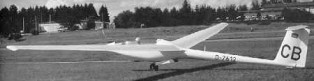
Design work on the B 12 began in October 1973. The students at Akaflieg Berlin set out to improve the performance of modern gliders by reducing drag. To reduce costs the group utilised production wings from a Schemp-Hirth Janus B, shortened to 18.2m, allowing the students to concentrate their efforts and budget on improving the fuselage.
The shape and profiles of the new fuselage were developed at the Institut für Luftfahrzeugbau (Institute for aircraft industry) and a new two-seat fuselage constructed using GFRP (Glass-fibre Re-inforced Plastic) techniques in a monocoque shell. The B12 uses monocoque construction, and the cockpit seats two in tandem under large plexiglas canopies with the instructors seat, in the rear, set at a higher level to improve the instructors view ahead.
The wings are standard ‘Janus B’ items built using identical construction methods. The wing has a sweep forward of 2° 18′ on the leading edge with glassfibre monocoque ailerons, flaps and Schempp-Hirth air brakes on the upper surfaces. The tail unit was originally built as a cruciform unit using an extremely thin NACA 0009-64 aerofoil section formed with ‘ Rohacell’/GFRP sandwich supported by CFRP (Carbon-Fibre Re-inforced Plastic) spars. After a trailer accident during road transport in 1986, which destroyed the rear fuselage and tail-unit, a T-tail was fitted during repairs. A specially developed Wortmann FX-71 L 150/30 profile was utilised for the fin and rudder.
The single retractable main undercarrriage wheel is supported on a tall leg assembly which was originally built with electric actuation, but after a field landing with a flat battery caused a wheels-up landing a manual system was fitted. A rubber tailskid, capped with hardened steel, under the rear fuselage completes the undercarriage. Pullup doors fair over the main undercarriage well when the gear is retracted. In the original fuselage a braking parachute, used for approach control, was housed at the extreme rear, but this feature was not carried through to the replacement rear fuselage during repairs.
After the first flight of the B12 on 27 July 1977, piloted by Jürgen Ehlers Thorbeck, the B12 was used for research, cross country and competition flying until the trailer accident in 1986, whilst being transported by road, destroyed the tail section and twisted the rear fuselage. Repairs were carried out and the B12 was flying again on 1 August 1987 at the IDAFLIEG (Interessengemeinschaft deutscher akademischer Fliegergruppen e.V. – interest group for academic flying groups) summer camp at Aalen-Elchingen, sporting a T-tail identical to that of the Akaflieg Berlin B13. The B12 continues to fly but rarely emerges from the hangar unless the soaring weather is good.
The measured glide-ratio (Idaflieg-summer-meeting 1978) is 40.5.

Wingspan: 18.2 m (59 ft 8.5 in)
Length: 8.7 m (28 ft 6.5 in)
Wing area: 16.58 sq.m (178.5 sq.ft)
Aspect ratio: 19.97
Wing profile: Root – Wortmann FX-67-K-170, Tip – Wortmann FX 67 K 150 [3]
Height: 6 ft 6 in
Empty weight: 446 kg (983 lb)
Gross weight: 620 kg (1,367 lb)
Wing Load: 37.4 kg /sq.m
Maximum speed: 200 km/h (124 mph)
Max aero-tow speed: 93 mph
Maximum glide ratio: 40.5 @ 110km/h (68mph)
Rate of sink: @90km/h (56mph) 0.68 m/s (133.9 ft/min)
No. of Seats: 2
No. Built: 1
L/DMax: 40.5 @ 110 kph
MinSink: 0.68 m/s @ 90 kph
Structure: GFRP

Air Tractor AT-300 / AT-301 / AT-302

Leland Snow moved to Wichita Falls, Texas, and started design work on a new cropduster, derived from the S2B he had designed and built in the fifties. In 1972 he obtained a small business loan, rented a building back in Olney and started to build jigs and tooling for what was to become the Air Tractor AT-300 – a conventional layout crop-duster powered by a Pratt and Whitney R-985-AN1 of 450hp. A 320 US gallon hopper was installed in a fuselage made of tube construction and included a sealed enclosed cockpit. The aircraft had a conventional tail but with fabric covered control surfaces. The vertical portion incorporated a dorsal fin giving the tail a round shape, unlike later aircraft. The cantilever 45 foot span wing is of all metal construction and incorporates large Fowler type trailing edge flaps. The prototype took seven months to build and Snow first flew the aircraft, N44200, in Septertiber 1973. FAA Certification took fifty-nine days and the first production Air Tractor was sold in March 1974. Seven more were delivered that year including the first Air Tractor AT-301, N4327S, the same aircraft but fitted with a P&W R-1340-AN1 of 600 hp and with an operating weight of 7300 lbs. Twenty aircraft were built during 1975 and, at the end of the year, a new hangar was erected to house the expanding company.
In June 1977, N44415, a turbine version of the AT-301, was flown. Known as the AT-302, it was powered by the then new Avco Lycoming LTP101-A1A of 600 hp. Fourteen were built, followed by the AT-302A in 1980 which had a 400 gallon hopper installed. With an operating weight of 7700 lbs, the aircraft had a wider hopper box and was designed for dry fertilisers.
By the end of 1979, some 229 AT-301 had been built. In 1986 the AT-301 design was improved, including redesigning the wing. Before being superseded by the 401 in 1988, 863 AT-301s were built.

AT-300
Engine: Pratt and Whitney R-985-AN1, 450 hp
Wing span: 45 ft
MAUW: 7300 lb
Hopper cap: 300 USG

AT-301
Engine: Pratt & Whitney R-1340, 600 hp

AT-302
Engine: LTP-101-A1A, 600 hp
Hopper cap: 320 USG

AT-302A
Engine: LTP-101-A1A, 600 hp
Hopper cap: 400 USG

Air Tractor

Founded 1958 in Wichita Falls, Texas, Leland Snow became Air Tractor president. Derived from the S2B he had designed and built in the fifties, Snow started design work on a new cropduster. In 1972 he obtained a small business loan, rented a building back in Olney and started to build jigs and tooling for what was to become the Air Tractor AT-300 – a conventional layout crop-duster powered by a Pratt and Whitney R-985-AN1 of 450hp.
Has built more than 1,650 Air Tractors, with radial pistonengined AT-401B (can be converted to turboprop power), turboprop-powered AT-402A (available since 1997), higher-powered AT-402B with 680 shp engine, heavier and 1,100 shp turboprop-engined AT-502A, 680 shp AT- 502B, AT-503A two-seater for agricultural work and training, AT-602 with 1,050 shp engine and the second largest Air Tractor model, AT-802 two-seater and the largest of all Air Tractors suited to agricultural and firefighting roles (first flown 1990), and AT-802 single-seat verson, available for purchase.

Airspeed AS.57 Ambassador

In 1943, the British government formed a committee under the chairmanship of Lord Brabazon of Tara to identify post-war civil aviation requirements. In its February 1943 report, they recommended a twin-engined, unpressurised design in the 14.5 tonnes gross weight class, short to medium-range piston-engined aircraft for British operators and for sale to European airlines.
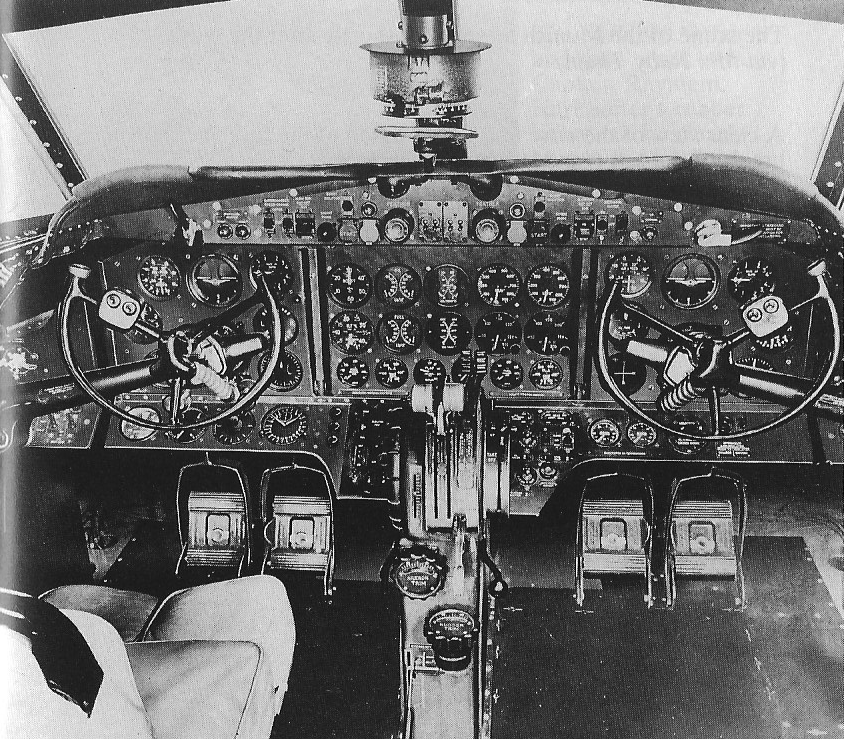
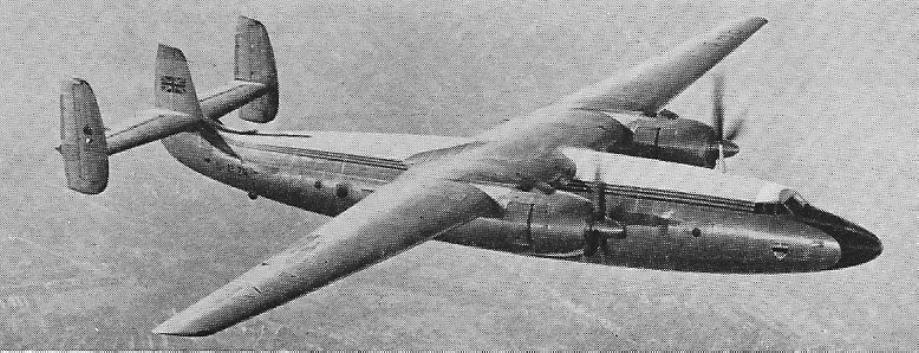
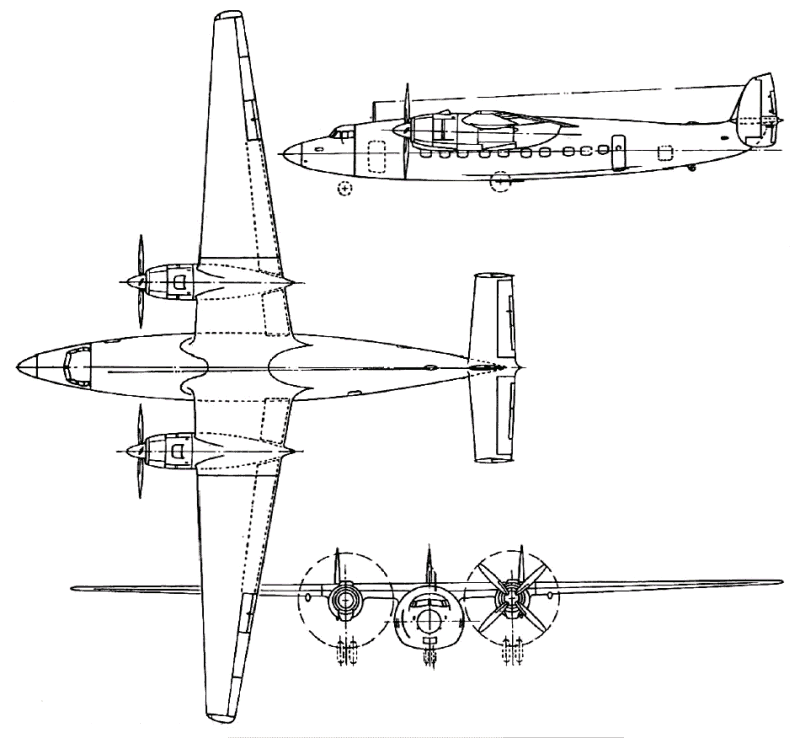
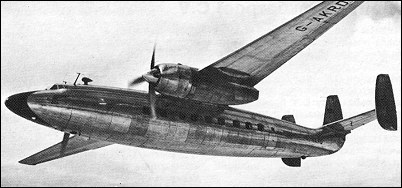
The Airspeed AS.57 Ambassador was designed by a team headed by Arthur Hagg, their work taking shape on the drawing-board while the UK was still at war. Spanning 115ft and 81ft long, the Ambassador had two Bristol Centaurus 661s, each developing 2,700 hp and driving a 16ft 6in diameter four bladed de Havilland propeller.
A normal capacity of 47 passengers was envisaged with an all up weight would be 52,500 lb, with ranges of 720 and 1,560 miles at cruising speeds of 280 and 220 mph respectively.

There was capacity for future “stretch”, and the wings were designed with strongpoints to accommodate a future powerplant change to four propeller turbines of the Rolls Royce Dart type.

By the time the British Ministry of Aircraft production ordered two prototypes from Airspeed Ltd., immediately after the end of the World War II, the design had grown. The Ambassador would be pressurised and have a maximum gross weight of almost 24 tonnes, offering seating for 47 passengers. The Ambassador was a high-wing monoplane with triple fins, retractable nosewheel.

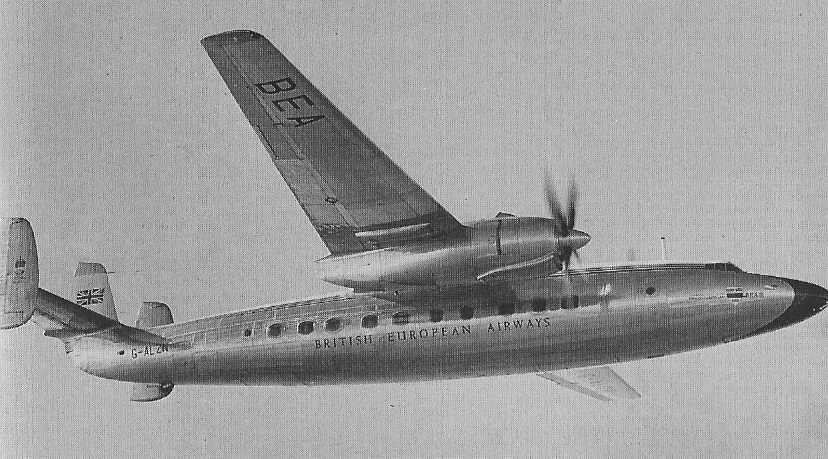
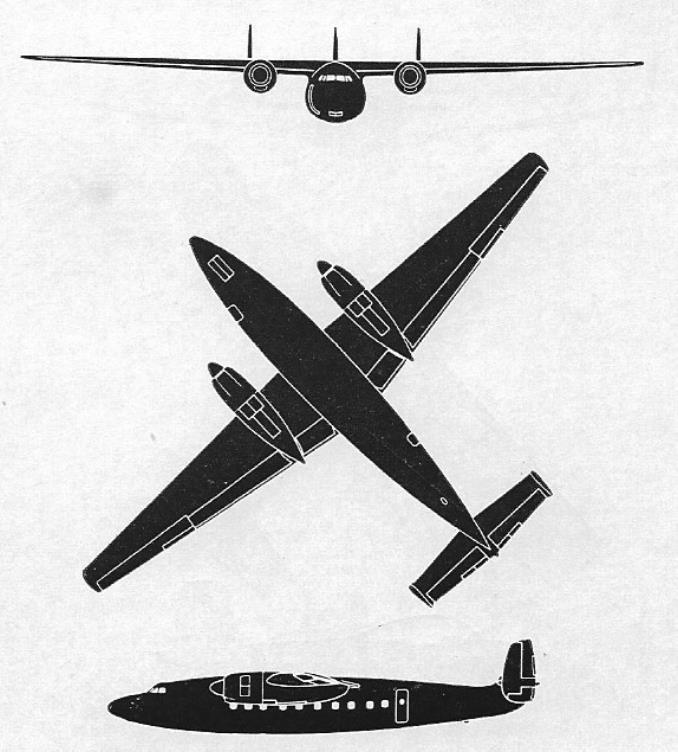
The Ambassador was of cantilever high-wing monoplane configuration of all-metal construction, with its fuselage stressed for cabin pressurisation. The three-finned tail unit was car¬ried high on an upswept aft fuselage, and the retractable tricycle landing gear incorporated twin wheels on each unit.

The prototype (G-AGUA) powered by two 2.600 hp Centaurus 631 radials, was first flown on 10 July 1947 from Christchurch. In 1948 the first (and also the only) order for 20 Ambassador 2s was received from British European Airways. The second prototype (G-AKRD) flew on 26 August 1948; two static-test airframes were built, followed by one pre-production Ambassador (G-ALFR) which was used to obtain the C of A and for route proving by BEA – British European Airways. Airspeed AS57 Ambassador G-ALFR had the definitive Centaurus 661 powerplant, and was flown first in May 1950.

British European Airways (BEA) ordered 20 pressurised Ambassadors on 20 September 1948. Problems with the engines, undercarriage and pressurisation system delayed service introduction until 13 March 1952.
The Ambassadors were called ‘Elizabethan’ class by BEA.

On 13 March 1952, the first British European Airways service London-Paris was inaugurated, with 47 seats and 2,012kW Centaurus 661. BEA called its fleet “Elizabethans” in honour of the newly crowned Queen Elizabeth 1, during their six years of operation. In 1954, after two years’ service, BEA requested clearance of an increased maximum take off weight from 52,500 lb to 55,000 lb. This was achieved.
After service with BEA the Ambassador passed to several independent airlines including BKS, Dan-Air and Globe Air of Switzerland – some serving as freighters and horse transports. Three were used for a time by Butler Air Transport in Australia, and one was owned by the King of Morocco.
The second AS.57 prototype (G-AKRD) was later used for development testing of the Bristol Proteus 705, Rolls¬Royce Tyne and Rolls-Royce Dart turboprops, and was still airworthy in 1969.
The third prototype (G-ALFR), was used for testing of the Napier Eland turboprop, but was later converted to airline standards and sold to Dan Air.
Only 23 Airspeed Ambassadors were produced.

Gallery

Engine: 2 x Bristol Centaurus 661 two-row sleeve-valve radial piston, 1939-kW (2,600-hp)
Wing span: 35.05m (115 ft 0 in)
Length: 24.69m (81 ft 0in)
Height: 5.59m (l8ft 4in)
Wing area: 111.48sq.m (1,200 sq.ft.)
Max take-off 23814 kg (52,500 lb) – 55000.0 lb / 24947.0 kg
Empty equipped weight: 16230 kg (35,781 lb)
Max. speed : 271 kts / 502 km/h
Maximum cruising speed: 438 km/h (272 mph)
Economic cruising speed: 399 km/h (248 mph)
Range with maximum payload: 1159 km (720 miles).
Range w/max.fuel: 1930 km / 1199 miles
Service ceiling : 36089 ft / 11000 m
Crew: 3
Pax cap: 47

Airspeed

Following the collapse of the British airship programme after the crash of the R101 in France on 5 October 1930, two of the R100 design team based at Howden, near York, established a new company in York to produce light aircraft. They were A. Hessell Tiltman and Nevil Shute Norway and they named the ne company Airspeed Ltd. Tiltman and Norway spent much time seeking capital but with the small capital they had it was decided to build and fly an advanced sailplane to capture as many British gliding records as it could.

A factory was set up in an empty bus garage in Piccadilly, York, and the Tern sailplane was completed by August 1931. It was successful and captured all the available records of height and distance, flown by Carli Magersuppe, and the required capital began to flow into the company.

Airspeed then entered the light aircraft field, moved the factory to Portsmouth.

The Airspeed company was established in February 1931 in York to build the Ferry 3-engined low-performance biplane, designed specifically for short-range pleasure flying (“joy riding”). The prototype Ferry, built to Sir Alan Cobham’s specification, went on tour with his National Aviation Day Displays 1932 and 1933; joined by second example 1932. In 1933 two more Ferries (four only built) acquired by John Sword of Midland and Scottish Air Ferries Ltd.

CEO of the original Airspeed was novelist Neville Shute (real name of Neville Shute Norway), and by the end of 1933 Airspeed had built two Tern sailplanes, four Ferry short-range ten-seat airliners and five Couriers.
Airspeed Ltd moved to Portsmouth in 1934 following an adavantageous agreement for new, free premises in that town’s airport. The company Airspeed Ltd was established in 1934 at Portsmouth, Hants, in association with shipbuilding interests of Swan, Hunter and Wigham Richardson.

In 1940 a transport glider was designed to carry two pilots and 25 troops. This was put into production as the Horsa.

In June 1951, the final merger of Airspeed into de Havilland Enterprise was announced.

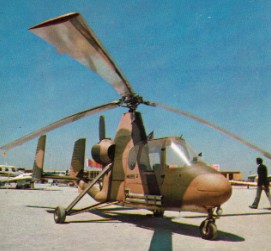
Air & Space America U-17 / Umbaugh A18A Flymobil / Farrington 18A FAC

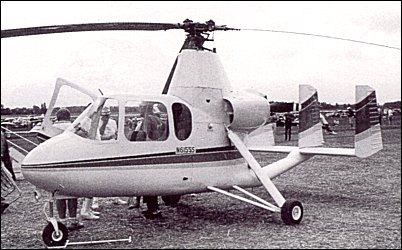
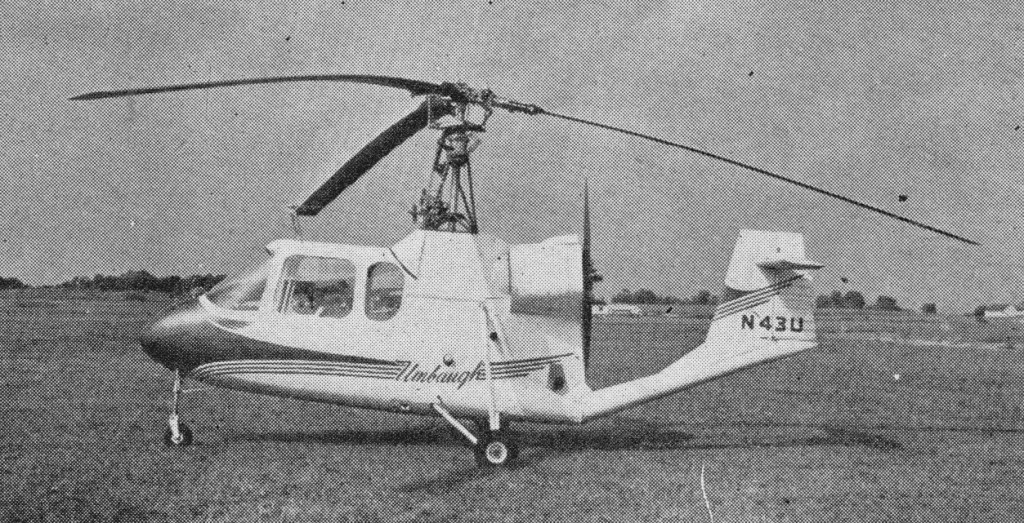
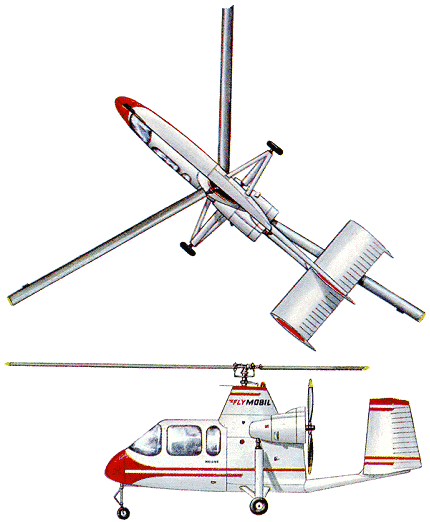
The U-17 gyrocopter was designed by Raymond E. Umbaugh with a 4130 welded tube centre section, aluminium forward fuselage and tail. His U-17 design was a tandem two-seat machine with a slim low-set tailboom and a single fin and T-tailplane. The prototype, N43U, was built for Umbaugh by the Fairchild Engine & Airplane Corporation at Hagerstown, Maryland. It made its first flight in mid-1959 and was powered by a 195kW Lycoming engine.

Umbaugh 18

The second prototype, designated U-18, was redesigned to eliminate the stability problems of the first prototype. This aircraft was fitted with a 135kW Lycoming 0-360 and, initially, with a V-tail. The stability problems were still not resolved and a new triple tail was installed with a low-set tailplane bearing two fixed fins and a third movable one in the centre. This improved the Umbaugh to the point where it was awarded its Type Certificate (1H 17) on 12 September 1961, and certification of the production version, the Model 18-A, was granted early in 1965.
Ray Umbaugh embarked on an ambitious plan to market the U-18, placing an order for 10000 units with Fairchild as the Flymobil. A large network of dealers and distributors was set up in the United States but Umbaugh started to run into trouble because the manufacturing output of the U-18 was too slow to meet the demands of dealers for demonstration aircraft.

Basic price of the Umbaugh 18 was quoted as $9,995 (£3,498), or $11,695 (£4,093) for the deluxe model 18A, in July 1962.

The dealers, who had paid large franchise fees took over Umbaugh, the agreement with Fairchild was terminated and manufacturing moved to Florida. Fairchild built only five development aircraft during 1960, all being tandem 2-seaters with 180hp Lycoming O-360-A1D engines. The company finally collapsed with just four aircraft completed and flown.
The design was then acquired by Air & Space Manufacturing of Muncie, Indiana in 1965, which made some modifications to the tail unit and commenced manufacture of the Air & Space 18A. Again, Air & Space was faced with dealer pressure for aircraft and set out to raise capital for expansion. This funds-raising exercise resulted in accusations from the Securities & Exchange Commission of irregularities in the commercial claims made to new investors and, though the company’s management was eventually cleared of wrongdoing, the costs and delay resulted in the company’s collapse. A total of 99 production aircraft had been registered though only 67 of these appear to have been actually completed by the end of 1965.
The assets of Air & Space then went into storage but were eventually reinstated by one of the dealers, Don Farrington of Paducah, Kentucky.

Farrington 18A FAC

The autogyro has an all-metal fuselage skin, and wooden rotor blades reinforced with glassfibre. The engine drive can be connected to the rotor for jump starts, after which it is disengaged and clutched to the pusher propeller for forward movement.
In 1972 Farrington Aircraft Corporation proposed a Forward Air Control version, with provision for air-to-ground rockets for target marking. Lacking the rights to the type certificate, Farrington Aircraft set up a programme to remanufacture existing aircraft with a modified collective pitch system, fibreglass engine cowlings and new composite blades.
Farrington Aircraft produced the tandem two-seat Model 20A Heliplane cabin autogyro as a modern development of the Air & Space Model 18-A.
Farrington has also developed an amateur-built kit gyrocopter with some features of the Umbaugh U-18 known as the Farrington “Twinstar”.

Air & Space 18A / Umbaugh A18A Flymobil
Engine: 180 hp Lycoming O-360-A1D, 180 hp / 135kW
Prop: Hartzell HC-C2YK-1BLF/FL7666A constant speed
Rotor blades: 3 blade composite
Rotor dia: 35 ft 0 in / 10.67 m
Width: 9 ft
Length: 19 ft 10 in / 6.04 m
Height: 9 ft 3 in / 2.82 m
Min speed: 25 mph
Cruise: 90 mph
Top speed: 112 mph / 177km/h
Empty wt: 1315 lb
Useful load: 485 lb
Max TO wt: 1800 lb / 816 kg
Ceiling: 3658m
Range: 483km

Air Parts (NZ)

In 1957 acquired Australasian sales rights for Fletcher FU-24, and in 1964 acquired manufacturing rights. FU-24 had been designed initially for top-dressing work in New Zealand, to which country initial series of 100 was delivered. Several variants developed, including two turboprop versions. On April 1,1973 the company was amalgamated with Aero Engine Services Ltd. (see AESL) to form New Zealand Aerospace Industries Ltd.