South Africa
Formed to make Reed Falcon single-seat aerobatic biplane, developed from Rooivalk of the late 1960s. Also sales and service centers for Beechcraft and Piper aircraft and manufacture of special spraying equipment.
Post WW2
Airmaster Helicopter Ltd
UK
Founded 1971 to develop very simple and low-cost two-seat helicopter, the resulting H2-B1 first flying 1972.
Airmark Ltd
Formed early 1969. Acquired all rights to T.S.R.3 ultralight monoplane designed by Tom Storey in 1967. Also undertook development of US Cassutt Special racing monoplane, building three modified examples under the designation Airmark Cassutt 111M and offering construction kits.
Aircraft Manufacturing Depot
Indian Air Force, Aircraft Manufacturing Depot Kanpur
In 1960, when the Avro 748 was chosen to replace Indian Air Force Dakotas, it was intended to assemble the first aircraft from major components supplied by A.V.Roe. After a time, the decision was taken to do far more of the work in India. Four empty hangars at Kanpur Air Force Base became the Aircraft Manufacturing Depot. The first set of jigs was ready by mid-1960 and the first Indian 748 (delivered unassembled from England) flew on November 1, 1961, just 18 months after the first rivet was inserted. Full production, on the scale necessary to re-equip IAF transport squadrons, and probably Indian Airlines Corporation, was unlikely to be achieved until 1964.
Production of type continued, in addition to other work, including sailplanes.
Meanwhile, personnel of Headquarters, Maintenance Command at Kanpur were developing a four-seat general-purpose light aircraft in 1961, designed by their A-O-C, Air Vice-Marshal Harjinder Singh. The prototype, built in 132 days and known as the Kanpur I, is a fabric-covered all-metal aircraft of conventional high-wing monoplane configuration and powered by a 190 h.p Lycoming engine.
It was followed by the more powerful Kanpur-II.
In June 1964 the Depot was incorporated in Aeronautics (India) Ltd. and later became Kanpur Division of Hindustan Aeronautics Ltd.
Aircraft Manufacturing Co Texas Bullet

In 1950, Aircraft Manufacturing Co. acquired the rights to produce a refined four-seat version of the Johnson Rocket, which it called the Texas Bullet. The original Rocket was powered by a 185-hp four cylinder Lycoming engine; the Texas Bullet changed over to a Continental of the same rating. Also, the fabric covering of the Rocket was traded for an all-metal, flush-riveted skin, and a redesigned tail was added. The Bullet sported a top speed of 210 mph, a cruise speed of 183 mph, and a climb rate of 900 fpm.
Overall, the new refinements added only 100 pounds to the empty weight, and 50 pounds were added to the fully loaded weight. Exhaust gasses from the engine of the Rocket and Bullet were led into a unique “jet assist” cylinder below the fuselage. It was claimed that the device converted engine exhaust into useful thrust at speeds faster than 40 mph. Also, both aircraft made use of a Hartzell hydro-selective two-blade variable-pitch propeller.
Don Gabriel
My wifes Aunt and Uncle died in Va after he had bought a used Texas Bullet….an airline pilot wanted to buy it, met the relatives, Aunt and Uncle (owners) let the Airline pilot fly it and they rode along in it…..shortly after takeoff something happened and it went down in the woods short of the runway…..all were killed after it crashed and burned…..
I forgot to mention that at that time I held a Commercial Pilots License and had asked to fly that plane several times…..the relative who owned it said it scared him and he had not flown it prior to the crash…..he had years of flying planes he had owned but this one killed him and his wife along with the airline pilot….FAA never came out with a reason for the crash……..
November 2025
Aircraft Designs (Bembridge) Ltd
UK
Formed 1978 to develop Sheriff two/four-seat light plane.
Airconcept VoWi 10 Airbuggy
Helmut Wilden designed the ultralight single-seat, very simple VoWi 10, which was being built under subcontract in 1977.
Airconcept Flugzeug und Geratebau GmbH und Co KG
Founded 1976 and marketed VoWi 10 Airbuggy two-seat ultralight.
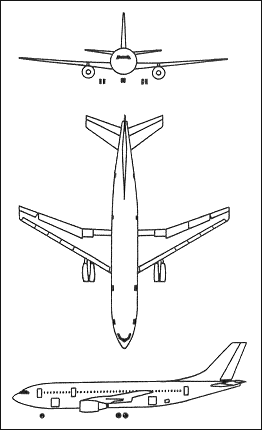
Airbus Industries A300
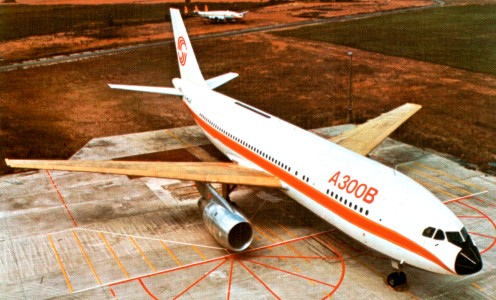
During 1965-66, various alignments of European manufacturers studied different designs with the most promising being the HBN-100 developed by Hawker Siddeley, Breguet and Nord. On 28 May 1969, France and West Germany decided to go ahead with the development of the European Airbus, as it had become, with Hawker Siddeley involved despite the lack of government support.
Airbus Industries A300 Article
Construction of the A300 began in September 1969, and in December 1970 Airbus Industrie was established to oversee the project. The General Electric CF6 turbo-fan was chosen as the initial powerplant and the fuselage could accommodate seating layouts from 220 to a maximum of 336 passengers. The wing was a Hawker Siddeley design, with a full suite of high-lift devices. The 28 degree sweep wing incorporates supercritical features that delay the onset of shockwaves up to high subsonic speeds. The wing took nearly 4,000,000 man-hours and almost 4,000 hours of wind-tunnel tests to perfect. The wing skin panels, approximately 51 feet long, are milled by computer-guided machines and preformed in presses. The two engines can be General Electric CF6-50C or Pratt & Whitney JT9D-59A turbofans.
The cockpit of A300 aircraft offer up a modernized approach to jetliner flight. The two-member crew that was introduced with the A300 series has become an industry standard arrangement. The cockpit is dominated by six CRT displays that provide real-time and crucial systems monitoring and work together to decrease pilot workload overall.
With Germany’s substantial investment in Airbus Industries Lufthansa was expected to provide strong support. Within two months of the first flight, Lufthansa placed a token order for three A300Bs and also took out four options on 20 December 1972. The order was modified on 7 May 1973 to the A300B2 version and Lufthansa put he type into service on 1 April 1976 on the high density Frankfort-London and Frankfort-Paris routes. This early version and the 1977 acquired A300B4 were replace by A310 from 10 April 1983.
The first of two A300B1 (F-WUAB), first flew on 28 October 1971, the second following on 5 February 1973. These were followed by the first pair of A300B2s, considered the production model. European certification was achieved in 549 hours and granted on 15 March 1974, US certification following on 30 May. Air France flew the first scheduled services of the Airbus, an A300B2, on 23 May 1974, and by mid-1978 production was speeding to four a month, with over 80 sales in the preceding 12 months.
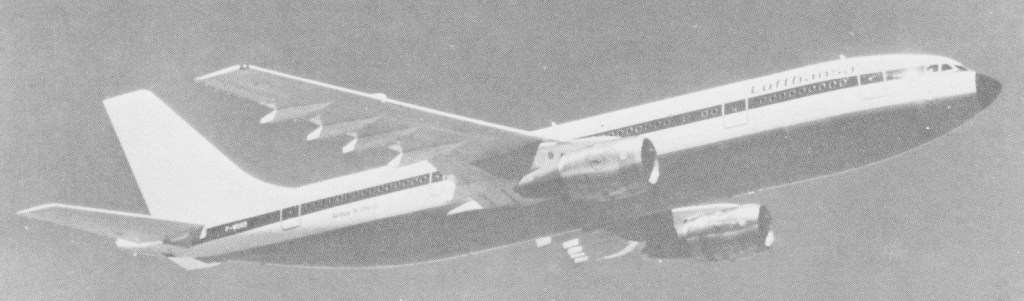
Airbus Industrie’s long range A300B4 100 entered service with the German charter airline Germanair on 1 June 1975, having been delivered on 23 May that year.
A300B seating configurations can be varied from 345 passengers maximum in charter layout, to a mixed passenger/freight, or all-cargo pay¬load. With an extra centre-section fuel tank, thicker wing roots and Kruger leading edge flaps for a sprightly takeoff at “hot and high” airports, and increased gross weight, the Airbus was converted from a short- to a medium-range airliner in the 1974 B4 version. Airbus Industrie flew the first example (F-WLGA) of the A300B4 on 26 December 1974.
On 6 April 1978 Eastern Air Lines ordered the first of 38 A300s. These were the A300B4 variant.
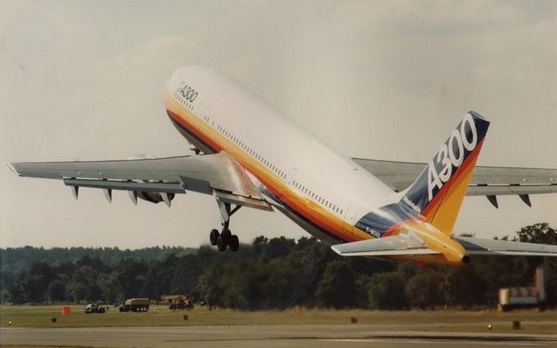
The last A300B4 was completed in late 1984. Airbus built 248 of the B2 and B4 model.
The A300C4 was introduced as a convertible freighter version with a cargo door in the port side.
On July 8 1983 the first A300 600 took off for a 4hr 35min maiden test flight. Apart from checking 600 behaviour, initial checks were made on the specific fuel consumption of the new 56,000 lb thrust Pratt & Whit¬ney JT9D 7R4H, since this is the first time it has been eval¬uated in flight. The 231-361 passenger A300-600 was delivered from 1984. The A300-600 incorporates an extra row of seats, a new two-man forward-facing cockpit and a number of small drag-reducing and weight-reducing items.
Versions include the A300-600R with increased take-off weight and tailplane trim tank for long-range operations, and the A300-600 Convertible passenger/cargo version.
Airbus indicates additional fuel cells with the abbreviation ACT (Additional Centre Tank), first used on the A300 600 and A310 300. This tank is installed in the forward part of the rear hold, aft of the main landing gear bay, and displaces two LD3 containers. (An additional tank may also be installed at the expense of more baggage/cargo space.)
After a total of 821 A300/A310s, Airbus delivered the last ever A300, a Freighter, to FedEx on 12 July 2007. At the time, FedEx had more than 120 A300 and A310s in service.
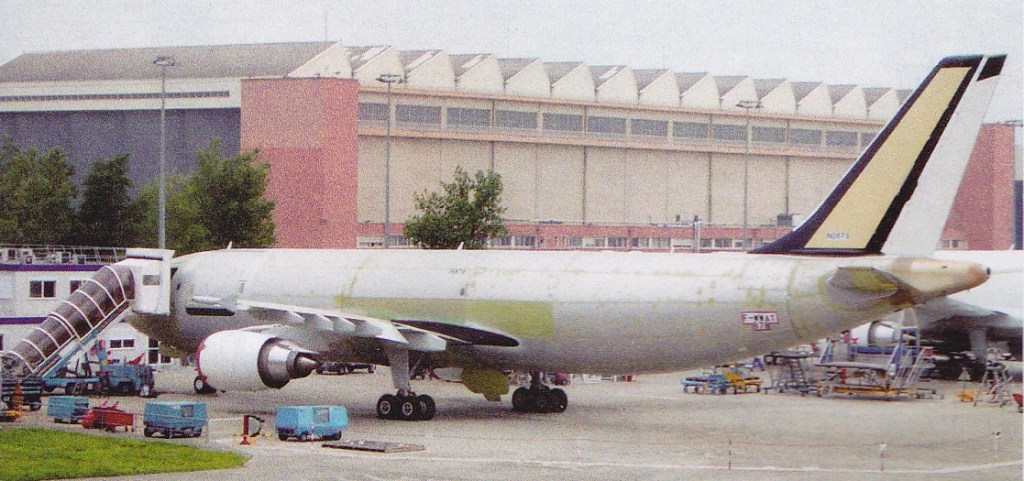
The 562nd and last A300, the A300F-605R for FedEx, recorded its first flight at Toulouse on 18 April 2007. The test registration was F-WWAT, and registered N692FE to FedEx.
A300B-2
Engine: 2 x General Electric CF6
Max cruise: 0.86M
Seats: 281
A300B4-203
Engine: 2 x General Electric CF6-50C2 turbofan, 233.5kN
Length: 54.08m
Height: 16.62m
Wingspan: 44.84m
Max speed: M0.82
Max range: 5375 km
Crew: 2
Pax cap: 244
A300-600
Engines: 2 x Pratt & Whitney PW4156 turbofans, 250kN
Take-off weight: 165000 kg / 363765 lb
Empty weight: 78200 kg / 172402 lb
Wingspan: 44.84 m / 147 ft 1 in
Length: 54.08 m / 177 ft 5 in
Height: 16.62 m / 54 ft 6 in
Wing area: 260 sq.m / 2798.61 sq ft
Cruise speed: 890 km/h / 553 mph
Range: 7000 km / 4350 miles
Passengers: 220-336
A300-600
Engines: 2 x General Electric CF6, 273.6 kN / 61,500 lb
Wingspan: 44.84 m / 147 ft 1 in
Length: 54.08 m / 177 ft 5 in
Height: 16.53 m / 54 ft 3 in
Empty operating weight: 899,813 kg / 198,003 lb
Max take-off weight: 170,500 kg / 3675,885 lb
Cruise speed: 875 km/h / 472 kt
Range: 7410 km / 4600 miles
Passengers: 250
A300-600R
A300-600 Freighter
Payload: 109,600 lb
Range: 2500 nm
A300-600ST Beluga – see seperate entry.
A300-601
Engines: 2 x General Electric CF6-80C2A1 turbofan, 262.4 kN
Wing span: 44.84m
Length: 54.08m
Height: 16.62m
Max speed: 0.82M
Max range: 6875 km
Crew: 2
Accommodation: 247 pax
Airbus Industries
Airbus Industries was first established on 29 May 1969, after the signing of a Franco-German agreement to go ahead with the Airbus 300. In December 1970, Airbus Industries was registered under French law as a GIE ( Groupement d’Intérêt Economique ) under the leadership of the ‘Airbus Founding Fathers’ – Franz-Josef Strauss, Henri Ziegler, Robert Bateille and Felix Kracht.
The first delivery of a production A300 was made in My 1974 to Air France.
The A300 programme, launched in May 1969, was initially a Franco-German venture, with the British aircraft industry participating on a private basis. Airbus Industrie, the organisation which was responsible for the management, marketing, sales and product support of the programme, was created in December 1970 as an equal partnership between Aerospatiale of France and Deutsche Airbus GmbH of Germany. The organisation was based at Toulouse, in the South of France, where it remains. Casa of Spain joined in 1971and in 1979 British Aerospace joined as a full partner. The consortium was owned by Aerospatiale of France (37.9 percent), DaimlerChrysler of Germany (37.9 percent), British Aerospace (20 percent) and CASA of Spain (4.2 percent), which are also the main industrial participants in design, development, and manufacture. Associate members of the consortium are Belairbus of Belgium and Fokker Aviation of the Netherlands.
Airbus Industrie was restructured into a limited-liability company in 1999, divisions included Airbus Industrie Asia, formed with Alenia of Italy to develop a new airliner in partnership with AVIC of China and ST Aero of Singapore; Airbus Military Company to develop the FLA military freighter (taking over from former Euroflag; and Large Aircraft, founded in 1996 to progress work on the ultra-large A3XX airliner.
On 11 July 2001, EADS and BAE Systems completed the final procedures to make the new integrated Airbus company a formal legal entity.


