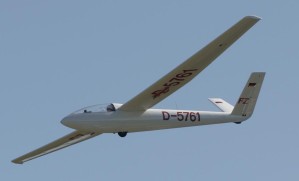
Akaflieg Darmstadt D-39

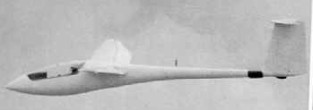
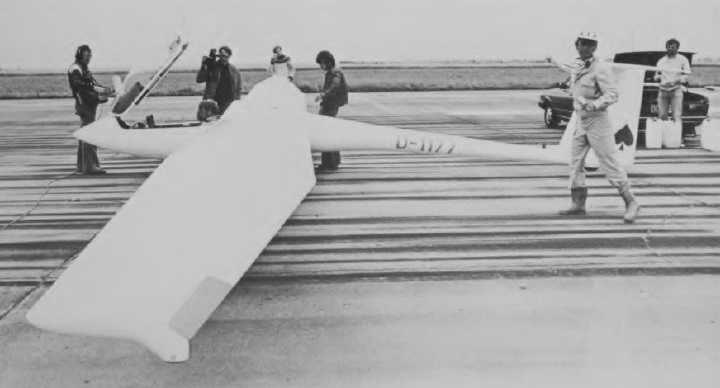
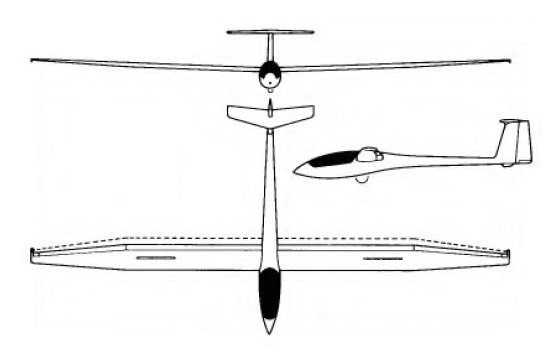
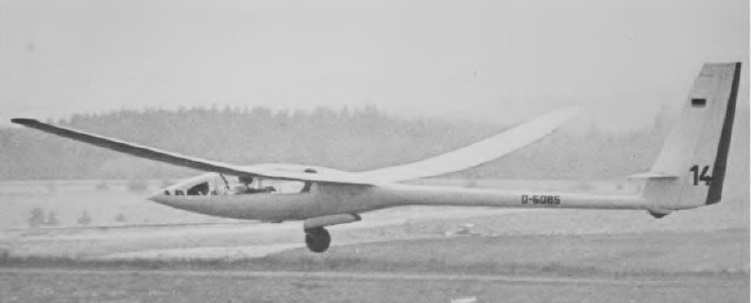
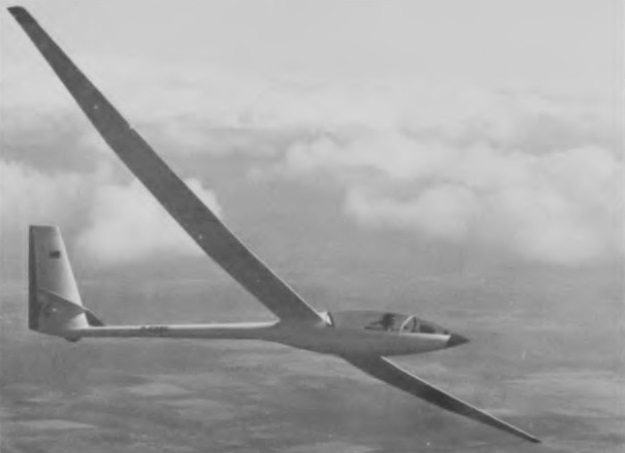
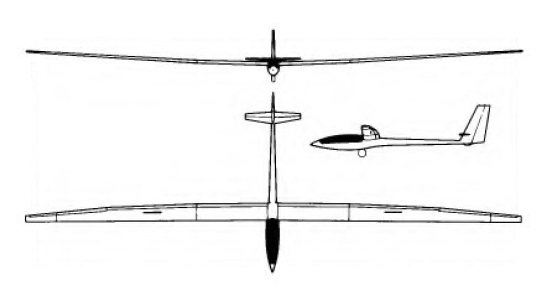
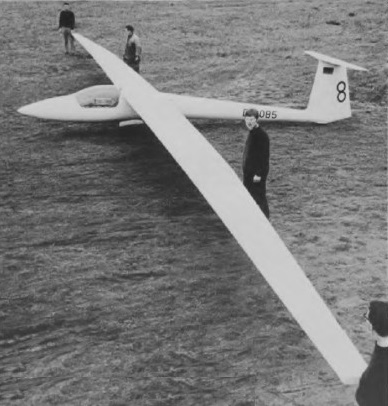
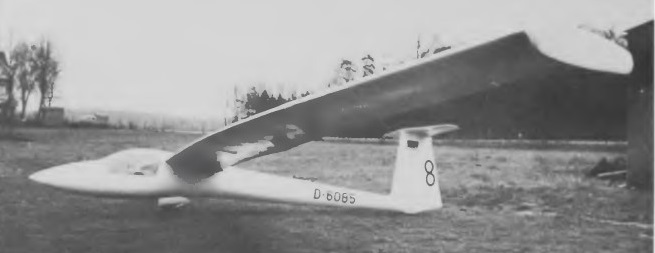
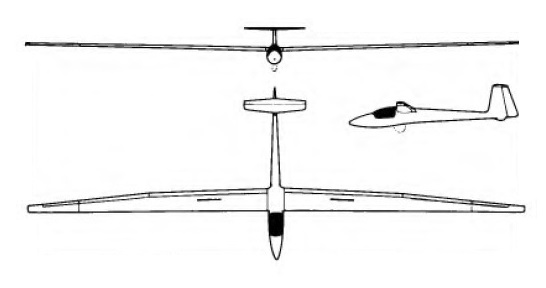
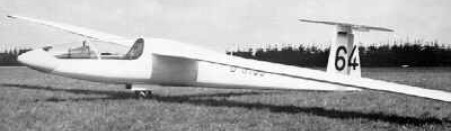
This unique single-seat powered sailplane, created by the Darmstadt Akaflieg, looks exactly like a Standard Class high-performance sailplane except for its low-mounted wing. It features a retractable two-blade folding propeller, driven by twin Fichtel & Sachs modified KM 914V engines situated in the nose cone.

The D-39 is an adaptation of the basic D-38 airframe, having the same glassfibre/balsa sandwich construction with ailerons of glassfibre/Klegecel foam sandwich, and Schempp-Hirth airbrakes on the upper wing surfaces. No flaps are fitted. It is equipped with a manually-retractable sprung monowheel, and accommodation comprises a semi-reclining seat under a flush canopy, the rear section of which is detachable.

The D-39 first flew on 28 June 1979.

Engine: Limbach 68 PS
Wing span: 17.5m
Wing area: 13.4sq.m
Empty Weight: 438kg
Gross Weight: 563kg
Wing Load: 40kg/sq.m
Aspect ratio: 22.9
Airfoil: FX 61-184
Structure: GFRP
L/DMax: 37 @ 100 kph
MinSink: 0.70 m/s @ 87 kph
No. of Seats: 1
No. Built: 1

D-39
Engines: 2 x Fichtel & Sachs KM 914V, 35 kW (47 hp)
Wing span: 15.0 m / 49 ft 2 in
Length: 7.15 m / 23 ft 5.5 in
Height: 1.02 m / 3 ft 4.5 in
Wing area: 11.0 sq.m / 118.4 sq ft
Wing section: Wortmann FX-61 -184/60-126
Aspect ratio: 20.5
Empty weight: 280 kg / 617 lb
Max weight: 400 kg / 882 lb
Water ballast: None
Max wing loading: 36.3 kg/sq.m / 7.43 lb/sq ft
Max speed: 135 kt / 250 km/h
Stalling speed: 39 kt / 72 km/h
Min sinking speed: 1.0 m/sec / 3.3 ft/sec
Best glide ratio: 36 at 56.5 kt / 105 km/h
T-O run: 200 m / 656 ft
Rate of climb at S/L: 240 m/min / 787 ft/min
Range: 500 km / 269 nm

Akaflieg Darmstadt D-36 Circe

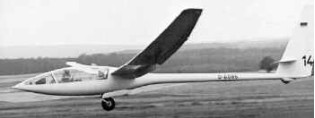
By 1961 members of the Akaflieg Darmstadt were investigating the possibilities of new materials such as reinforced glassfibre bonded resins and the D-36 Circe high performance single-seater, on which design work started in the spring of 1963, made extensive use of these. Designers included Lemke, Waibel, FrieB, Holighaus, & Schneider.

The monocoque fuselage is of balsa reinforced with glassfibre and epoxy resin, while the front section of the cockpit canopy is fixed and the rear part removable. The undercarriage consists of a large manually-retracted monowheel forward of the centre of gravity. The T-tail unit is of similar construction to the wings.

The first of two D-36s made its first flight in March 1964 and went on to win the German National championships that year. The D-36 also took second place in the 1965 World Championships at South Cerney. The wing torsion box shell is of balsa reinforced with glassfibre and epoxy resin; camber changing flaps and Schempp-Hirth air brakes are featured, although the second prototype differed from the first only in having these air brakes removed and replaced by a tail braking parachute.

The D-36 Circe was developed into the Schleicher AS-W 12 for advanced competition and long-distance flying.

D-36 Circe
Span: 58 ft 3.5 in / 17.8m
Length: 24 ft 0.5 in / 7.35 m
Height: 4 ft 11 in
Wing area: 137.8 sq.ft / 12.8 sq.m
Aspect ratio: 24.75
Wing section: Wortmann FX-62-K-131/60-126
Empty weight: 622 lb / 285 kg
Max weight: 904 lb 401 kg
Water ballast: None
Wing Load: 31.33 kg/sq.m / 6.55 lb/sq ft
Max rough air speed: 108 kt / 200 km/h
Stalling speed: 36 kt / 67 km/h
Min sinking speed: 1.83 ft/sec at 52 mph / 0.53 m/s @ 82 kph
Best glide ratio: 44:1 at 58 mph / 87 kph
No. of Seats: 1
No. Built: 2

Akaflieg Darmstadt D-34

After the war came the D-34a high performance single-seater, which first flew in 1955, followed by the improved D-34b, which first flew in the autumn of 1956, the D-34c, first flown in the spring of 1958, and the D-34d, which made its first flight in March 1961.

Wing span: 12.65m
Wing area: 8sq.m
Empty Weight: 145kg
Gross Weight: 250kg
Wing Load: 31.25kg/sq.m
Airfoil: NACA 644-621
Aspect ratio: 20
L/DMax: 28 @ 80kph
MinSink: 0.85 m/s @ 75kph
No. of Seats: 1
No. Built: 1

Akaflieg Braunschweig SB-11 Antares

The SB-11 Antares is a single-seat high performance research sailplane categorised in the FAI Unlimited Standard Class and intended to test a new variablegeometryflap system and to evaluate the use of carbon-fibre reinforced epoxy resin as a constructional material for all parts of a glider.

Design work on the SB-11 started in the spring of 1974 and construction of the sole prototype began in April 1976; this made its first flight in May 1978.

The constant-thickness Fowler flap system is designed to achieve a high average cross country speed without the operational and technical difficulties of a telescopic wing, as tried on the Akaflieg Stuttgart FS-29, a high aspect ratio giving a very long span wing or a slotless Fowler flap-type wing. To retain conventional sailplane handling characteristics a constant thickness Fowler flap was devised that avoided friction between wing and flap and the need for a flexible lip at the lower surface of the wing. A special Wortmann wing section was evolved for the SB-11 and this was flight-tested mounted on the nose of a DFS Kranich 3 sailplane; the results were sufficiently encouraging to believe that the SB-11, with flaps extended, could outclimb any other Standard Class sailplane and, with flaps in, it would perform as well as a conventional Standard Class type. The cantilever shoulder wing is of 15m (49ft 2.5 in) span and has an aspect ratio of 21.3 with flaps in or 17 with flaps out; in the former condition the best glide ratio is 41:1. There is a single carbonfibre spar with roving spar flanges; the outer shell is a carbon-fibre/plastics foam sandwich. Each wing trailing edge is made up entirely of a 25% chord slotless Fowler flap inboard and outboard a ‘flaperon’ of 22% chord when in and 17% when extended; both flaps and ‘flaperons’ are of carbonfibre/plastic foam sandwich construction. They are supplemented by Schempp-Hirth air brakes on the upper surfaces of carbon-fibre/balsa wood sandwich construction, and wing tanks provide for up to 100kg (220lb) of jettisonable water ballast. The fuselage is a carbon-fibre monocoque and the cantilever T-tail, which as an all-moving tailplane with spring trim, is a carbon-fibre/plastic foam sandwich except for the rudder, which is a glassfibre/plastic foam sandwich. There is a retractable unsprung monowheel with an internal drum brake, and a rubber-spring tailskid.

The carbon-fibre monocoque fuselage front was cast in Schleicher AS-W 20 moulds. The T-tailed rear fuselage was made on Schempp-Hirth Janus moulds.

The SB-11 made its international debut at the 1978 World Championships at Chateauroux, France, when it was flown into first place in the 15m class by Helmut Reichmann, and in November that year it was named Antares.

SB-11
Span: 49 ft 2.5 in / 15m
Length: 7.4 m / 24 ft 3.25 in
Height: 1.47 m / 4 ft 6.25 in
Wing area (flaps in): 10.56 sq.m / 113.7 sq.ft
Wing area (flaps out): 142.1 sq.ft
Aspect ratio (flaps in): 21.3
Aspect ratio (flaps out): 17.0
Airfoil: Wortmann FX-62K-144/21-VG-1.25
Empty weight: 573 lb / 265 kg
Max weight: 1,036 lb / 470 kg
Water ballast: 100 kg / 220 lb
Max wing loading: 44.5 kg/sq.m / 9.11 lb/sq ft
Max speed (flaps in; smooth air): 155 mph / 140 kt / 260 km/h
Max aero-tow speed (flaps in): 112 mph / 97 kt / 180 km/h
Stalling speed: 31.5 kt / 58 km/h
Min sinking speed (flaps in): 0.62 m/sec / 2.03 ft/sec at 50 mph / 43 kt / 80 km/h
Best glide ratio (flaps in): 41:1 at 64.5 mph / 56 kt / 104 km/h
Best glide ratio (flaps out): 36.1 at 53 mph
No. of Seats: 1
No. Built: 1

Akaflieg Braunschweig SB-10 Schirokko

The SB-10 Schirokko is an attempt to create a tandem two-seater sailplane of exceptional performance and aerodynamic refinement, and the choice of a high aspect ratio (36.6) wing of 29m (95ft 1.75in) span has enabled a best glide ratio of 53:1 and a minimum sinking speed of only 1.3ft/sec to be achieved.

Design of the SB-10 began in 1969 and it first flew in prototype form on 22 July 1972; it can also be flown with a wing of 26m (85ft 3.25 in) span instead of the 29m one. The wing structure is in five parts: the centre section is of plywood, balsa wood and carbon-fibre, while the outer wing panels and air brakes, as well as the wing tips, are the same as those of the SB-9 Nimbus, but of balsa wood and glassfibre construction with foam filling. Foam-filled carbon-fibre is used for the camber-changing flaps, which can be drooped in conjunction with ailerons; there are three of the latter each side on the 29m wing. The pod-and-boom type fuselage has a finely streamlined forward part, housing the pilots, tapering to a thin boom carrying the tail, and is a steel tube frame covered with a balsa/glassfibre sandwich shell and with light alloy at the rear. The tail unit is also of balsa/glassfibre sandwich construction and has a fixed incidence tailplane mounted low. The landing gear consists of an airassisted retractable monowheel with a hydraulic brake, and a tailskid. The landing gear, air brakes and rudder controls were later modified, and several other changes made, and in this form the SB-10 set up a German distance record of 577 miles on 16 April 1974.

The SB-10 was still used by the group for performance flights.

SB-10
Wing span: 29 m / 95 ft 1.75 in
Wing area: 22.95 sq.m / 247.1 sq.ft
Length: 10.36 m / 33 ft 11.75 in
Empty Weight: 608kg / 1,272 lb
Gross Weight: 889kg / 1,978 lb
Water ballast: 100 kg / 220 lb
Wing Load: 40.8 kg/sq.m / 7.98 lb/sq ft
Aspect ratio: 36.64
Airfoil: Wortmann FX 62-K-153/131 /60-126
Max speed: 124 mph / 108 kt / 200 km/h
Max rough air speed: 108 kt / 200 km/h
Stalling speed: 35 kt / 65 km/h
L/DMax: 48.5 @ 101 kph
Best glide ratio: 53:1 at 56 mph / 48.5 kt / 90 km/h
MinSink: 0.53 m/s / 1.3 ft/sec at 85 kph / 47mph
No. of Seats: 2
No. Built: 1

Akaflieg Braunschweig SB-9 Stratus

The SB-9 Stratus high-performance single-seater was developed by Akaflieg Braunschweig from the 18m (59ft 0in) span SB-8, and first flew in prototype form on 23 January 1969, making its debut at the German National championships that year. The SB-9 featured a higher aspect ratio (31.3) wing of 22m (72ft 2.5in) span, this giving a best glide ratio of 48:1 compared to 42:1 for the SB-8, a lower minimum sinking speed and otherwise improved performance.

But some problems were encountered with the wing geometry, especially aileron length, load distribution over the wing and rudder action, and as a result the maximum speed had to be limited to only 107mph. Later, wing span was reduced to 21m (68ft 11 in), this giving an improvement of 12mph in the maximum speed. The SB-9’s wing is of PVC foam construction for lightness, and has a glassfibre roving spar; the HKS type flaps are of elastic glassfibre construction with no hinge or gap.

The fuselage is of glassfibre construction with balsawood support, and the landing gear is an unsprung retractable monowheel with a drum-type brake. A T-tail is featured, the tail unit being of glassfibre and balsa construction.

SB-9
Wing span: 22 m / 72 ft 2.5 in
Length: 7.5 m / 24 ft 7 in
Height: 1.4 m / 4 ft 7 in
Wing area: 15.48 sq.m / 166.6 sq.ft
Aspect ratio: 31.27
Airfoil: Wortmann FX 62-K-153/131
Empty weight: 321 kg / 692 1b
Max weight: 412 kg / 917 lb
Water ballast: None
Wing Load: 26.6 kg/sq.m / 5.53 lb/sq ft
Max speed: 107 mph / 97 kt / 180 km/h
Stalling speed: 32 kt / 59 km/h
Max rough air speed: 97 kt / 180 km/h
Min sinking speed: 1.5 ft/sec at 45 mph / 39 kt / 72 km/h
MinSink: 0.51 m/s / 1.5ft/sec @ 81 kph
Best glide ratio: 48:1 at 53mph / 46 kt / 85 km/h
L/DMax: 46 @ 81 kph
No. of Seats: 1
No. Built: 1

Akaflieg Braunschweig SB-7 Nimbus

The SB-7 Nimbus is a development of the Akaflieg Braunschweig SB-6 Nixope, an ultra high aspect ratio high-performance single-seater with an 18m (59ft 0in) span wing, an aspect ratio of 25 and a best glide ratio of 42:1.

The SB-7 Nimbus, which first flew in October 1962, featured a 15m (49ft 2.5in) span wing for Standard
Class requirements with a lower aspect ratio, and a T-tail instead of the SB-6’s lower-mounted tailplane.

The SB-7’s shoulder wing has a box spar with glassfibre flanges and is covered with diagonally-laid glassfibre skin stabilised with balsa; the ailerons are of wooden construction and there are two Schempp-Hirth air brakes on each side at the 75% chord line. The fuselage, again like the SB-6’s, is a glassfibre monocoque stabilised with balsa. The tail unit is of similar construction to the wing, with the one-piece all-moving tailplane on top of the fin.

Landing gear is a retractable monowheel with friction brake and there is also a tailskid.

In Switzerland an SB-7 was modified by Paul Kummer and Oskar Wiesendanger of Zurich to have a completely new wing of increased span (54ft 2.5 in) and aspect ratio (20.85) and with an Eppler 417 aerofoil section; trailing edge air brakes replaced the Schempp-Hirth ones of the standard SB-7 and a tailbraking parachute was fitted. The first of two prototypes of this modified SB-7 made its maiden flight on 20 May 1967, and two more prototypes were built.

SB-7
Span: 17m / 49 ft 2.5 in
Length overall: 22 ft 11.5 in
Height over cockpit: 2 ft 8 in
Wing area: 12.66 sq.m / 127.6 sq.ft
Aspect ratio: 19 / 22.83
Airfoil: FX 61-163
Empty equipped weight: 283kg / 562 lb
Max take-off weight: 390 kg / 794 1b
Wing Load: 30.8 kg/sq.m
Max speed (smooth air): 158 mph
Min sinking speed: 0.60 m/s / 2.20 ft/sec at 56 mph
Best glide ratio: 37.5:1 at 85 kph / 56 mph
No. of Seats: 1
No. Built: 1

Akaflieg Braunschweig SB 6 Nixope

The SB-7 Nimbus is a development of the Akaflieg Braunschweig SB-6 Nixope, an ultra high aspect ratio high-performance single-seater with an 18m (59ft 0in) span wing, an aspect ratio of 25 and a best glide ratio of 42:1. The SB-6, which made extensive use of glassfibre in its structure, first flew on 2 February 1961 but was destroyed in August 1964.

The SB-6’s shoulder wing has a box spar with glassfibre flanges and is covered with diagonally-laid glassfibre skin stabilised with balsa; the ailerons are of wooden construction and there are two Schempp-Hirth air brakes on each side at the 75% chord line. The fuselage was a glassfibre monocoque stabilised with balsa. The tail unit is of similar construction to the wing, with the one-piece, low, all-moving tailplane.

Akaflieg Braunschweig SB-5 / Eichelsdorfer SB-5

The Akaflieg, or Akademische Fliegergruppe, of Brunswick (Braunschweig) University designed and built the SB-5 Danzig being a Standard Class (15m span) single-seater which first flew in prototype form on 3 June, 1959.

The type is of conventional all-wood construction, with a single spar shoulder wing with plywood covering and a butterfly tail; Schempp-Hirth air brakes are situated at the 50% chord line. The landing gear is a non-retractable unsprung monowheel with a friction brake, and there is also a tailskid. The plywood monocoque fuselage has an outer coating of glassfibre.

The SB-5C, which first flew in 1965, incorporated several design changes. The SB-5E, which entered production in 1974, had the wing span increased to 16m (52ft 6in) to comply with Club Class regulations. SB-5B or SB-5C Danzigs can be modified up to SB-5E standard.

Licence production was undertaken by Firma Eichelsdorfer at Bemberg, and over 100 SB-5s of all variants were built.

Wing span: 16.2m
Wing area: 13sq.m
Empty Weight: 250kg
Gross Weight: 350kg
Wing Load: 25kg/sq.m
No. of Seats: 1
No. Built: 50
L/DMax: 33 @ 85 kph
MinSink: 0.63 m/s @ 72 kph
Aspect ratio: 17.31
Airfoil: NACA 633-618
Structure: Wood

SB-5C Danzig
Span: 49 ft 2.5 in
Length overall: 21 ft 10 in
Wing area: 140 sq.ft
Aspect ratio: 17.3
Empty equipped weight: 485 lb
Max take-off weight. 716 lb
Max speed: 124 mph (in smooth air)
Min sinking speed: 2.07ft/sec at 41 mph
Best glide ratio: 32.5:1 at48 mph