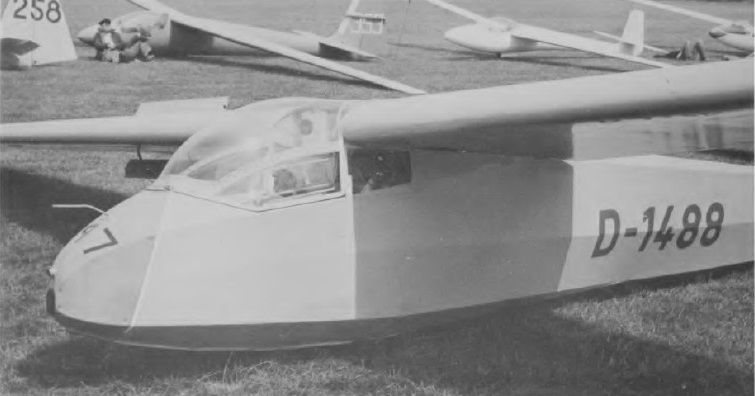
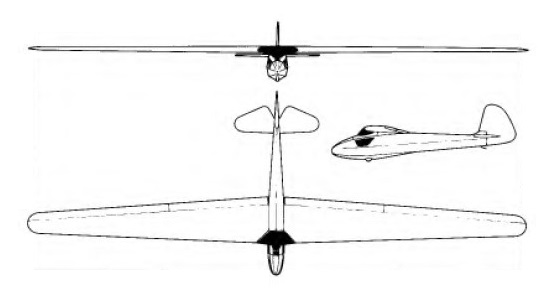
The Alaparma AM-11 Albatross was a single seat largely based on the AM-10.
The prototype was built by Alaparma with one 22hp SAI-Ambrosini P-25 engine.
The A-11 model was also built in Argentina under the name Albatross by OMA (Officina Meccanica Aeronautica) and this aircraft was a prototype only which first flew 28 March 1951 was reportedly powered by one McCulloch two stroke engine.
The AM-11s built in Italy used one Ambrosini P-25 or one 28hp Hirth F-10A engine.
The Alaparma AM.10 was a two-seater designed by Adriano Mantelli.
The AM-10 used the increased area wings as on the AM-9. The prototype was built by Alaparma with one 45hp Praga B-2 engine and was first flown in 1945 or 1946.
The engine was also reported as one 65hp Continental A65 and as CAN C-2 and the name Baldo was also reported for the AM-10.
At least one aircraft was built in Argentina by Mr. Mantelli with help from Mr. Robert Madsen with a Continental A65 engine and registered LV-X7.
This aircraft was referred to as the Trieste and featured twin fins rather than the usual single central fin.
Ultralight designed by Adriano Mantelli and derived from the AM-6, but with slightly larger wings, only 3 examples were built with one 39hp ABC Scorpion, one 38hp CNA C-2 and one 22 hp Macchi B-2 engine respectively.
A variable geometry wing offers the prospect of being able to vary the wing’s area and geometry in flight to make the most of the soaring conditions encountered. A high aspect ratio could be selected for ascending in a thermal and a low aspect ratio (and hence a smaller area) for getting the maximum speed in cross-country flying.
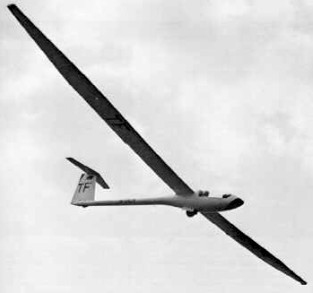
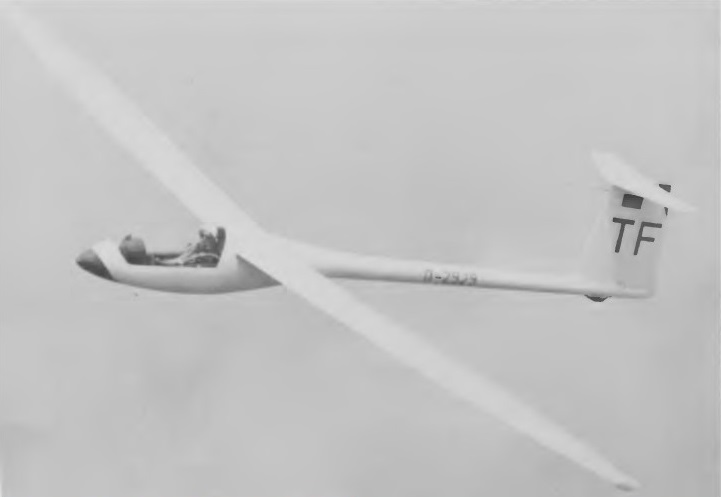
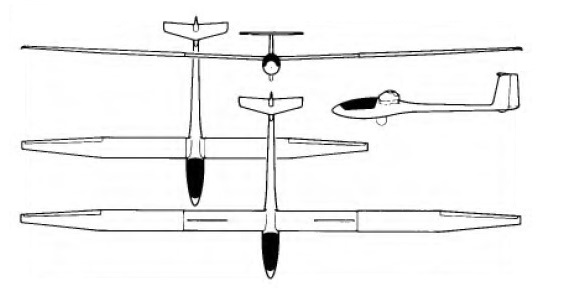
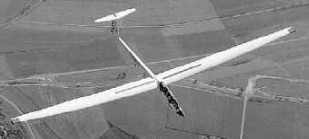
The Stuttgart Akaflieg’s solution to this problem in the high-performance single-seater FS-29 is a telescopic wing in which the span can be varied in flight from 43 ft 7.5 in to 62 ft 4in (13,3m – 19m) by outer telescopic wing sections sliding over fixed inner sections.
These outer wing sections are of glassfibre/foam/carbon-fibre sandwich construction and are extended and retracted manually by means of push-rods. A stub spar protrudes from each inner wing to provide a mounting for the guide rails on which the outer panels move. The inner wing is built up from a box spar of glassfibre/Conticell foam sandwich and is fitted with Schempp-Hirth air brakes on the upper surface which are only effective when the outer panels are extended. The plain ailerons are of similar construction to the outer wings. The fuselage is very similar to that of the Schempp-Hirth Nimbus 2, using the same landing gear and cockpit canopy, while the tail unit is the same as the Nimbus 2’s.
Design work on the FS-29 began in 1972 and the problem of devising a wing which could be varied in span solely by manual power, and yet keep to the required aerodynamic and structural safety factors, meant that the first flight was not made until June 1975.
Akaflieg Stuttgart FS-29
FS-29 Wing span: 43 ft 7.5 in to 62 ft 4 in / 13,3m – 19m Length: 23 ft 5.75 in / 7.16 m Height: 4ft 2in / 1.27m Wing area: 92.2 to 136.2sq ft / 8.56-12.65 sq.m Wing section: Wortmann FX-73-170 (inner); FX-73-170/22 (outer) Aspect ratio: 20.67 to 28.54 Airfoil: FX 73-170 Empty weight: 787 lb / 365kg Max weight: 992 lb / 450kg Water ballast: None Max speed: 155mph / 135 kt / 250 km/h Stalling speed: 39 kt / 72 km/h Max rough air speed: 135 kt / 250 km/h Min sinking speed: 1.8ft/sec / 0.54 m/sec at 46mph / 40 kt / 74 km/h MinSink: 0.56 m/s @ 81 kph Best glide ratio: 44:1 at 62mph / 98 kph / 54 kt No. of Seats: 1 No. Built: 1
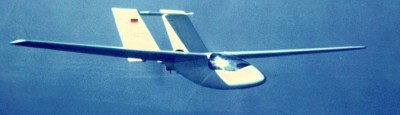
Designed by a group from the Akademische Fliergruppe Stuttgart, the Institute of Mechanics and Aircraft Design of Stuttgart University, and Wolf Hirth GmbH, the Fs-28 Avispa research aircraft was undergoing flight test in 1974.
The Fs-28 is constructed of resin-bonded honeycomb sandwich plastic and has a 115 hp Lycoming O-235E-2A installed in the rear. An inverted V tail is attached to twin booms. A special three-bladed propeller was developed with Hoffman to educe noise level.
The cockpit seats two side-by-side; the doors are two swing-up side panels. Fowler flaps are fitted.
Engine: 115 hp Lycoming O-235E-2A Cruise 75%: 155 mph Max speed: 167 mph Landing speed: 50 mph Range: 620 mi with 30 min res
Designed and built by the Stuttgart Akademische Fliegergruppe (Akaflieg) in Germany, the FS-26 was an experimental single-seater, aimed at investigating the characteristics of a motorglider equipped with a reflex airfoil and a separate horizontal stabilizer. Made of fibreglass, the FS-26 re-used the cockpit of the Phoebus sailplane modified to include the engine controls and instruments, and the long retractable landing gear. The aircraft was powered by a Hirth F10A engine, located at the rear of the fuselage. In soaring configuration, the propeller blades could be folded and the engine cowling openings were closed. The wing used an Eppler 515 airfoil, and could be divided into three parts for trailering on the road. The connections between the fuselage and the wing had been carefully studied, as well as the engine cooling. The FS-26 made its first flight on September 25, 1970. After several tests, this aircraft was donated to the Wasserkuppe Soaring Museum.
Wing span: 12.60 m Length: 3.94 m Wing Area: 13.20 sq.m Airfoil: Eppler 515 Empty weight: 250 kg Max. weight: 360 kg
Notable as being the first sailplane to be built of glassfibre, design of the Phonix was started at the Stuttgart Akademische Fliegergruppe under R.Eppler and H. Na’gele in 1951. Originally balsa wood construction with a strengthened outer skin of paper-and-glue layers was decided upon with the idea of reducing weight, but the Phonix project had to be abandoned for a time. Work was continued when the Stuttgart Fliegergruppe was given a grant for further research, and by now the new glassfibre strengthened polyester resins were available as a constructional material. The Phonix was redesigned to a basically balsa wood/glassfibre sandwich form of construction. At first a conventional tail unit with low-set tailplane was featured, but this was later replaced by a T-tail; the landing gear is retractable.
The monocoque fuselage is built in two pieces with a sandwich skin with balsa wood filling and an outer skin of glassfibre. The wing attachment, controls and fittings are installed before the two pieces are glued together with the glassfibre skin overlapping; weight carrying points and the edge of the cockpit canopy are strengthened with plywood. The wings and tail unit are of similar balsa wood/glassfibre sandwich construction, the ailerons, flaps and rudder being cut out after the glueing process is completed.
The first made its first flight on 27 November 1957. Altogether eight Phonixes were built and all of them were still flying 21 years after the prototype first took to the air.
Akaflieg Stuttgart FS-24 Phonix
FS-24 Phonix Wing span: 16m / 52 ft 6 in Length: 22 ft 5.25 in Wing area: 14.36 sq.m / 154.6 sq.ft Empty Weight: 180kg / 362 lb Gross Weight: 330kg / 584 lb Wing Load: 22.9kg/sq.m Aspect ratio: 17.83 Airfoil: Eppler 91 Max speed: 107 mph L/DMax: 40 @ 79kph / 48 mph MinSink: 0.59 m/s @ 68 kph / 1.7 ft/sec at 43 mph No. of Seats: 1
FS-24 Phonix-T Wing span: 16.0 m / 52 ft 6 in Length: 6.84 m / 22 ft 5 in Wing area: 14.36 sq.m / 154.6 sq ft Wing section: EC86(-3)-914 Aspect ratio: 17.83 Empty weight: 164 kg / 362 lb Max weight: 265 kg / 584 lb Water ballast: None Max wing loading: 18.5 kg/sq.m / 3.79 lb/sq ft Max speed: 97 kt / 180 km/h Stalling speed: 31 kt / 58 km/h Min sinking speed: 0.51 m/sec / 1.7 ft/sec at 37 kt / 69 km/h Max rough air speed: 54 kt / 100 km/h Best glide ratio: 40 at 42 kt / 78 km/h)
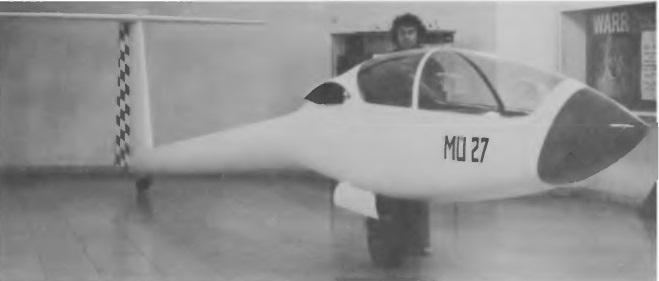
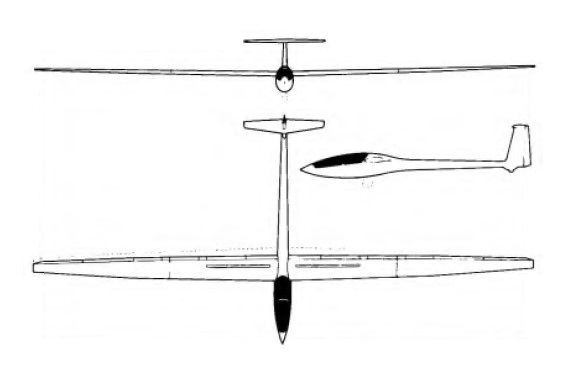
Some attention has been paid by designers to varying the wing geometry or area in flight to cater for different soaring conditions, and one approach to this problem is embodied in the Mu 27, which features slotted Fowler-type flaps enabling the wing area to be varied in flight. At high speeds a good gliding angle can be obtained by retracting the flaps while at low speeds or in a weakening thermal the flaps can be extened to give more lift, increasing the wing area by 36%.
The wings are a glassfibre/Conticell sandwich with aluminium spars and metal webs, and air brakes on the upper surface are at the 50% chord line. The ailerons are linked to the flaps. The semimonocoque fuselage is entirely of glassfibre with a large two-piece sideways-hingeing cockpit canopy, while the T-tail unit is of glassfibre/foam sandwich construction. The landing gear consists of a retractable monowheel and a fixed tailwheel.
The Mu 27 is a tandem two seater of largely glassfibre construction, and first flew on 24 February 1979 piloted by Thomas Fischer.
Mu 27 Span: 72 ft 2.25in / 22m Length: 33 ft 9.5 in / 10.3 m Height: 1.8m / 5 ft 11 in Wing area: 189.5 sq.ft / 23.9 sq.m (flaps retracted) Wing area 257.3 sq ft / 17.6 sq.m (flaps extended) Aspect ratio: 20.2-27.5 Airfoil: FX 67-VC-170/136 Empty weight: 1,058 lb / 480 kg Max weight: 1,543 1b / 700 kg Water ballast: None Wing Load: 8.19 lb/sq ft / 39.8 kg/sq.m Max speed: 174 mph / 151 kt / 280 km/h Min sinking speed: 1.8 ft/sec / 0.56 m/sec at 37 mph / 32.5 kt / 60 km/h Best glide ratio: 47:1 at 63 mph / 54.5 kt / 101 km/h L/DMax: 39 @ 88 kph No. of Seats: 2 No. Built: 1
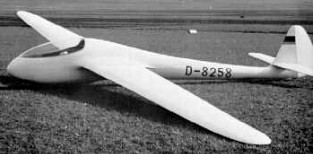
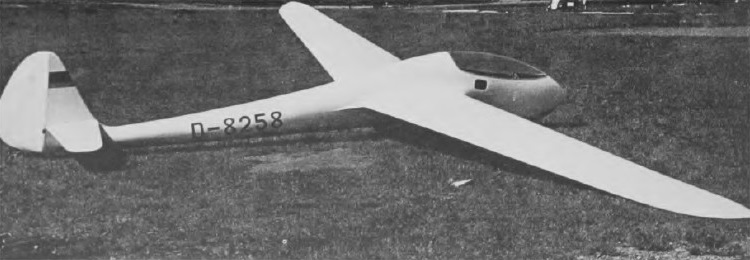
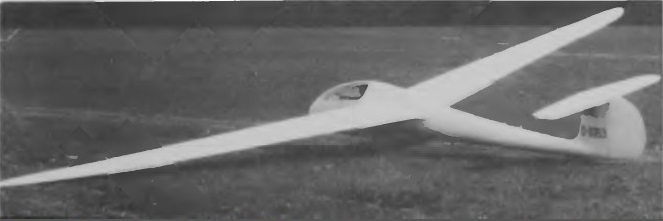
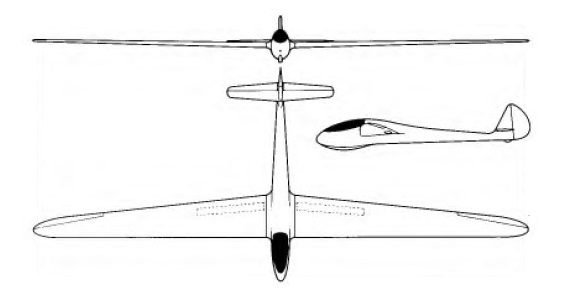
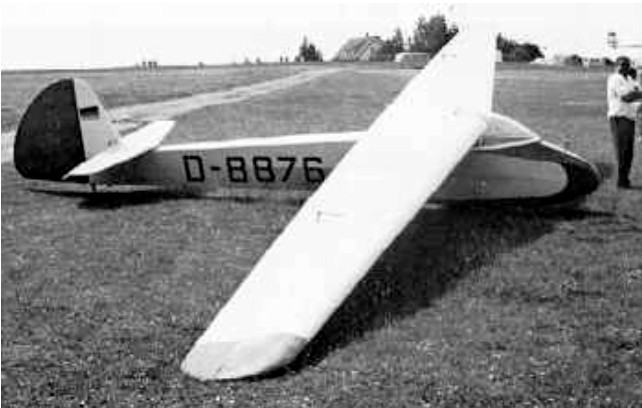
One of the principal prewar German high performance designs, the single-seater Mü 13 was developed at the Munich Akaflieg from the two-seat Mü 10 Milan, which had been built there under the direction of Dipl-lng Egon Scheibe, who later formed, at the end of 1951, the sailplane firm bearing his name. The first single-seat Mü 13 flew in 1936. It has an all moving tailplane and DFS airbrakes for approach control.
There were a number of variants, some later having air brakes instead of flaps while the rear fuselage cross section was later changed from a rectangular one to triangular. The Mü 13D-3 of 1943 had an increased wing span, longer fuselage and a modified fin and rudder. In May 1939, Schmidt set a new German record for a goal flight of 482km (299 miles) in an Atalante. Unlike most sailplanes of its size the Mu 13 was of mixed construction, using steel and chrome-molybdenum-tin alloy as well as wood. The wooden cantilever wing had steel tube flaps and fabric-covered steel-framed ailerons while the fuselage was a fabric-covered steel framework of basically square cross-section and the tail unit of conventional wooden construction. Particular attention was paid to good visibility, there being large window panels inset into the sides of the cockpit while a clear panel inset into the wing centre section leading edge gave the pilot a better view above and behind him; the cockpit canopy was detachable, and several different shapes were used. A monowheel landing gear and tailskid were featured.
Scheibe built a development of the Mü 13 in Austria known as the Mü 13E Bergfalke (Mountain Falcon), which first flew in prototype form on 6 August 1951 and this two-seat general purpose glider went into production as the Scheibe Bergfalke. The original Mü 13 made its first flight in 1936 and the two prototypes were named the Merlin and the Atalante, differing from each other principally in the fuselage structure and control arrangements. The Atalante with a number of modifications was built by Kurt Schmidt at the Black Forest factory and about 150 Mü 13s were built in all.
Akaflieg Munchen Mü 13 Merlin Span: 52 ft 6 in Length: 19 ft 9 in Wing area: 174 sq.ft Aspect ratio: 15.85 Empty weight: 375 lb Max weight: 595 lb Max speed: 124 mph Min sinking speed: 2 ft/sec at 34 mph Best glide ratio: 28:1 at 41 mph
Mȕ 13 Atalante Wing span: 16.0 m / 52 ft 6 in Length: 6.02 m / 19 ft 9 in Wing area: 16.16 sq.m / 174 sq ft Wing section: Mil Aspect ratio: 15.85 Empty weight: 170 kg / 375 lb Max weight: 270 kg / 595 lb Water ballast: None Max wing loading: 16.71 kg/sq.m / 3.42 lb/sq ft Max speed: 108 kt / 200 km/h Stalling speed: 27 kt / 50 km/h Min sinking speed: 0.6 m/sec / 2 ft/sec at 29.5 kt / 55 km/h Best glide ratio: 28 at 35.5 kt / 66 km/h
Akaflieg Munchen Mü 13 D Atalante Length: 19.783 ft / 6.03 m Wingspan: 52.428 ft / 15.98 m Crew: 1
Schwarzwald Mu-13 D Wing span: 16 m Wing area: 16.16 sq.m Aspect ratio: 15.84 Airfoil: Mu-profil 15% Empty Weight: 185 kg Gross Weight: 275 kg Wing Load: 17 kg/sq.m L/DMax: 28 66 kph MinSink: 0.60 m/s 55 kph Seats: 1
Schwarzwald Mu 13D3 Wing span: 16 m / 52.5 ft Wing area: 16.16 sq.m / 174 sq.ft Aspect ratio: 15.85 Airfoil: Mu Empty Weight: 170 kg / 375 lb Payload: 100 kg / 220 lb Gross Weight: 270 kg / 595 lb Wing Load: 16.71 kg/sq.m / 3.42 lb/sq.ft L/DMax: 25 66 kph / 35 kt / 40 mph MinSink: 0.62 m/s / 2.0 fps / 1.18 kt Seats: 1
Scheibe-Flugzeugbau Mü 13E Bergfalke 1 Length: 51.837 ft / 15.8 m Wingspan: 56.43 ft / 17.2 m Max take off weight: 551.3 lb / 250.0 kg Crew: 2