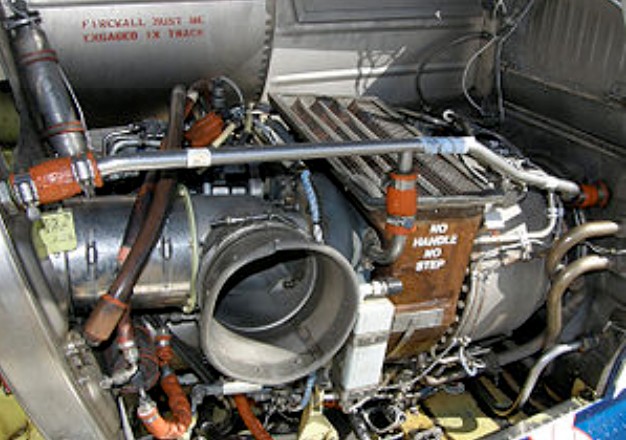
First run in 1960, the Lycoming (now Honeywell) LTS101 is a turboshaft engine family ranging from 650 to 850 shaft horsepower, used in a number of popular helicopters, and, as the LTP101 turboprop, light aircraft. Both models carry the US military designation T702. The engine was originally designed at the Lycoming Turbine Engine Division in Stratford, Connecticut, but is now produced by Honeywell Aerospace.
Applications: Bell 222A, B and UT Eurocopter AS350 AStar HH-65A/B Dolphin MBB/Kawasaki BK 117 Air Tractor AT-302 Piaggio P166 EcoJet concept car built under the direction of General Motors and Jay Leno
Goodyear racer number #95 the ‘Californian’ was built by Ed F. Allenbaugh, and flown by Dwight Dempster, both from North Hollywood, in the 1947 Goodyear races. Registered NX67893, it featured a fiberglass fuselage shell.
The All American Aircraft 10-A Ensign (ATC 792) is an all-metal side-by-side two seat cabin monoplane with a large Plexiglas canopy enclosing the engine. Power is provided by an 85 hp Continental C85-12 engine, and the nosewheel of the fixed tri-gear is steerable.
Designed by Ernest Adler as an all-metal design with side-by-side cockpit under a bubble canopy, and knee-action tricycle gear, was a victim of the post-war slump.
All American 10-A NX14281
First flown towards the end of 1945, the Model 10-A Ensign was designed and built by All American Aircraft Inc, a company previously specialising in sub-contract work for other manufacturers.
Priced at $3,495, at least four were built; NX14281, NX8003H, NC8004H, and NX90648.
A proposed production version was to have offered dual controls as optional.
Planned retractable-gear 125hp Model 10-D was canceled in the design stage.
Engine: Continental C85-12, 85 hp Wingspan: 33 ft 0 in Wing area: 138 sq.ft Length: 21 ft 0 in Height: 8 ft 6 in Empty weight: 1000 lb Loaded weight: 1550 lb Max speed: 120 mph Cruise: 110 mph ROC: 700 fpm Service ceiling: 12,000 ft Range: 400 mi Seats: 2
After working as Lavochkin’s right hand man during World War II, Semyon Mikhailovich Alekseyev was appointed as Chief Designer of OKB-21 at Gor’kiy. The Council of the People’s Commissars directed Alekseyev (among others) to develop jet fighters using more powerful engines than the captured German examples and their Soviet-built copies. The result of Alekseyev’s efforts was the I-21 (istrebitel, fighter) which was planned to be produced in several variants.
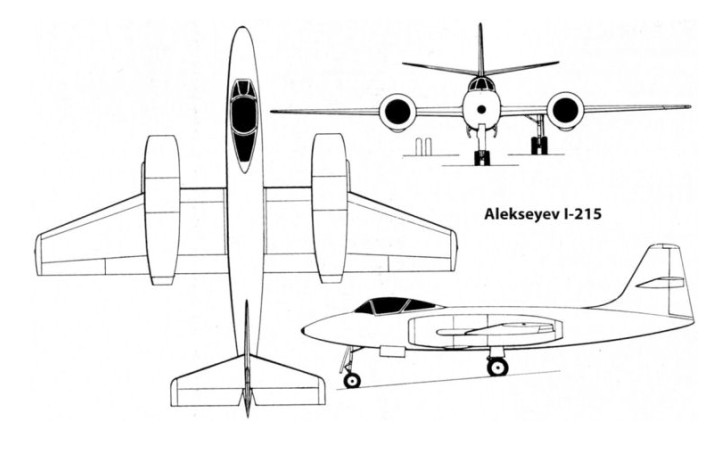
The I-21 was a twin-engined all metal single seat jet fighter, with straight wings, mid-set on a round streamlined fuselage, and engines mounted in front of the wings at about one third span. The slightly swept tail unit was cruciform in layout with the tailplane set at approximately half-fin span with slight dihedral. The aircraft’s structure was constructed from high strength B-95 aluminium alloy, high strength steel for highly loaded parts and “Elektron” magnesium alloy for cast fittings. A hydraulically retractable tricycle undercarriage was fitted, using twin wheels for nose and main undercarriages. Hydraullically actuated airbrakes were fitted either side of the rear fuselage.
Construction of the first two airframes began at the end of 1946, with pressure from the Ministry of Aircraft Production to complete initial flight testing by 1 August 1947, to enable the aircraft to take part in the Aviation Day Flypast at Tushino on 18 August 1947. While one of the two airframes initially produced was used for static testing, the other was completed as the I-211 (I-21 version 1) with Lyul’ka TR-1 turbojet engines. (The Lyul’ka TR-2 was the intended powerplant, but was not available). Despite pressure, the I-211 was unable to participate in the Tushino display.
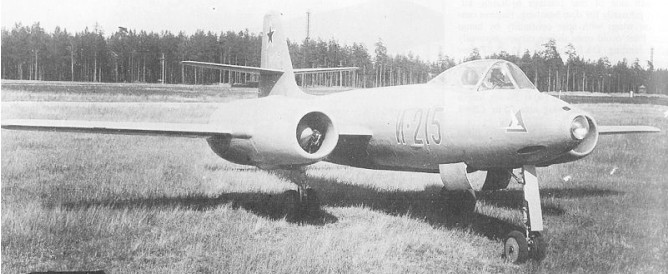
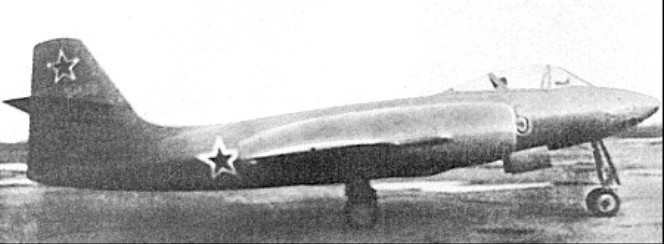
Flight testing started in the Autumn of 1947, but only six test flights had been carried out before the I-211 struck a pothole on landing, which collapsed the undercarriage. Repairs were carried out and the opprtunity taken to replace the TR-1 engines with Rolls-Royce Derwent V engines. The result was the I-215 which had been in development before the first flight of the I-211. Other minor modifications were carried out, the most noticeable being the larger engine nacelles. Despite good results from flight testing the I-215 lost out in production orders to the newer generation of swept winged fighters.
A third I-21 was built as the I-215D (dooblyor, second prototype), with a bicycle undercarriage, using wider-diameter paired wheels in a bicycle arrangement, retracting into the fuselage, along with small outrigger wheels under the engine nacelles which retracted into fairings, to order from OKB-1. This was used to test this arrangement for “Aircraft 150” and other projects (OKB-1 was supervised by Dr. Brunolf Baade, who later designed the VEB type 152 airliner, in the DDR, as a direct descendent of “Aircraft 150”, and indirectly of the I-215D). The main undercarriage of the I-215D also incorporated a kneeling feature which could increase the incidence of the aircraft by 3 degrees to assist take-off. Trials with this undercarriage arrangement proved successful and paved the way for its use in many other Soviet aircraft.
Armament of the I-211 comprised two, three, four, or six cannon in the chin, depending on variant.
Variants: I-210 – The initial version with Tumanskii RD-20 (BMW 003 copy) engines. Not proceeded with due to availability of Lyul’ka TR-1 engines.
I-211 – The first flyable example completed as the I-211 with Lyul’ka TR-1 engines, rebuilt as the I-215.
I-211S – I-211 with swept wing and tail.
I-215 – The re-built I-211 with Rolls-Royce Derwent V engines and other minor modifications.
I-215D – Bi-cycle undercarriage I-215 built to order of OKB-1.
I-216 – Proposed “Heavy” fighter version of the I-215 with two 75mm cannon and modified outer wings.
I-215
Specifications:
I-211 Engines: 2 × Lyul’ka TR-1 jet, 1,300kgp (2,866 lb st) Wingspan: 12.25 m (40 ft 2.28 in) Wing area: 25 sq.m (268.8 sq.ft) Length: 11.54 m (37 ft 11.9 in) Loaded weight: 6.890 kg (15,189 lb) Maximum speed: 970 K/h (524.32 mph) Ferry range: 1,550 km(962 miles) Service ceiling: 13,600 m (44,619 ft) Rate of climb: 27.78 m/s (5416 ft/min) Armament: 2 x 23mm cannon Crew: 1
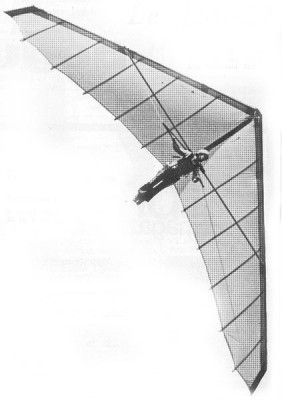
The ASG-23 was a conventional glider with crossbar, preformed ribs, and fiberglass leading edge tips to tension the trailing edge at the tips.
It went out of production in the winter of 1977-1978, when Tom Price closed his own sail loft and went to work for Electra Flyer.
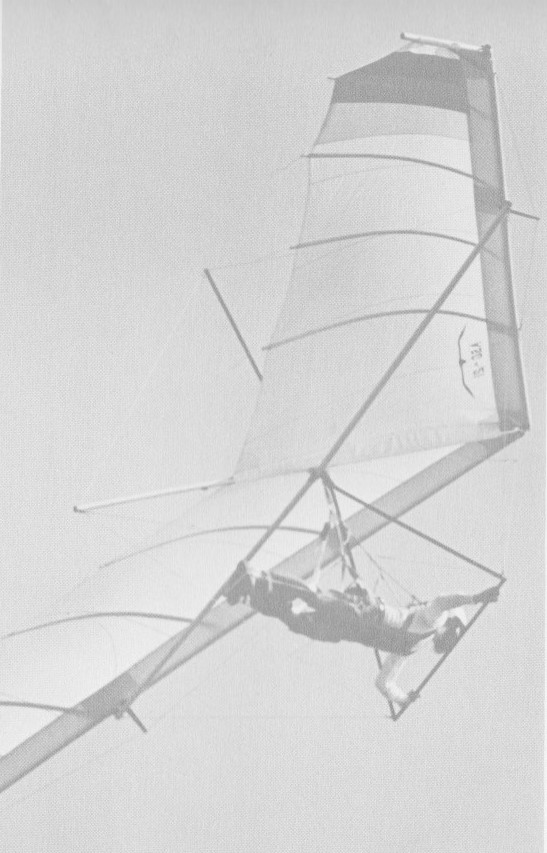
The photo was taken at the American Cup in 1980. Randy Rauck and Larry Croome were flying the only two production topless models ever in existance, with the Canadian Team. Tom Price brought the ASG 23 up to Canada with its preliminary build done -it needed some shape refinements as well as new spars. The ASG 23 design needed more mods and tests to be competative with the just released and well finished, Comet 1 by UP. Tom got rid of crossbar drag by eliminating it and UP (Roy Hagard) covered it up to achieve similar results and a lot less cost.
The ASG 23 version 1 was small and very efficient at speed. They built a whole new sail for the rocket on the old spars with the dubious extra 1/2″ holes in them that Tom assured us were in the nuetral axis. Larry Croome flew the new prototype in the 1980 Canadian Nationals Gaspe, Quebec. The wind virtually stopped on the last day and it turned into a sink rate contest. He went from 1st to 7th.
After the nationals they built two new ASG23’s with two new sets of spars and nose units starting in the second week of September. Only four weeks later they had two new gliders very much redesigned. The new ASG’s had more span and better wing tip.
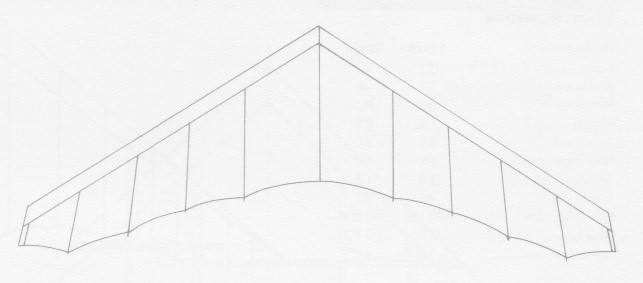
The 1976 ASG-21 was a high performance, truncated tip glider. It uses a 1 deg cambered, fully battened sail to lower the stall speed. The battens let it fly faster without fluttering, thus reducing high-speed drag. This glider requires an experienced pilot.
The ASG21 used a curved, cantilevered tip that is fully enveloped within the sail sleeve, reducing tip inertia and drag. A reinforced kingpost and an extra winpost for turbulent thermal flying were optional. The sail is cambered throughout the body to assume a specific airfoil shape in flight and a cambered keel pocket is applied to match the camber of the sail, rather thn the bend of the keel tube. Leading edge sleeves are applied to minimise any diagonal wrinkles.
All spars and sleeving are 2024-T3 aluminium and all holes are internally sleeved and use compression bushings. The sleeves are stress releved at both ends. 1.75in tubing is used for the leading edge and crossbar and 1 5/8in for the keel. The 5ft x 5ft control bar and the kingpost are both 6062-T6 1in x .083.
All cable is 3/32in 7×7 vinyl coated stainless steel aircraft quality and all wire ends are double nico pressed around stainless steel thimbles. The tangs and shackles are stainless steel, nose plates 7075-T6 aluminium, and all bolts, nuts and turnbuckles are aircraft quality.
The sail is made from Howe & Bainbridge 3.8oz stabilised dacron, all white for constant stretch characteristics. All seams are double zig-zag stitched with reinforced stress points. Applied leading edge sleeves and keel pockets eliminate wrinkles. The sail is fully cambered. Battens by Roy Searman are of fibreglass, polyurethane foam sandwich constructin. They have a constant taper ratio to allow them to curve to the airfoil shape of the sail.
Options were for any type or make of harness.
ASG-21AA Leading edge: 16 ft Keel length: 7.2 ft Wing span: 28.8 ft / 9.4 m Wing area: 130 sq,ft / 12.1 m² Aspect ratio: 6.4 Nose angle: 116˚ Sail billow: 1˚ Weight: 44 lb / 20 kg Pilot weight: 110-135 lb / 50-61 kg Packed length: 4.88 m
ASG-21A Leading edge: 17 ft Keel length: 7.6 ft Wing span: 30.5 ft / 8.8 m Wing area: 145 sq,ft / 13.5 m² Aspect ratio: 6.4 Nose angle: 116˚ Sail billow: 1˚ Weight: 45 lb / 20 kg Pilot weight: 130-155 lb / 59-70 kg Packed length: 5.18 m
ASG-21B Leading edge: 18 ft Keel length: 8 ft Wing span: 32 ft / 9.76 m Wing area: 160 sq,ft / 14.9 m² Aspect ratio: 6.4 Nose angle: 116˚ Sail billow: 1˚ Weight: 46 lb / 21 kg Pilot weight: 150-175 lb / 68-79 kg Packed length: 5.41 m
ASG-21C Leading edge: 18.8 ft Keel length: 8.5 ft Wing span: 33.9 ft / 10.35 m Wing area: 180 sq,ft / 16.7 m² Aspect ratio: 6.4 Nose angle: 116˚ Sail billow: 1˚ Weight: 47 lb / 21 kg Pilot weight: 170-195 lb / 77-88 kg Packed length: 5.74 m
ASG-21D Leading edge: 18.7 ft Keel length: 9 ft Wing span: 33.2 ft / 10.12 m Wing area: 195 sq,ft / 18.1 m² Aspect ratio: 5.7 Nose angle: 116˚ Sail billow: 1˚ Weight: 48 lb / 22 kg Pilot weight: 190-215 lb / 86-97 kg Packed length: 5.72 m
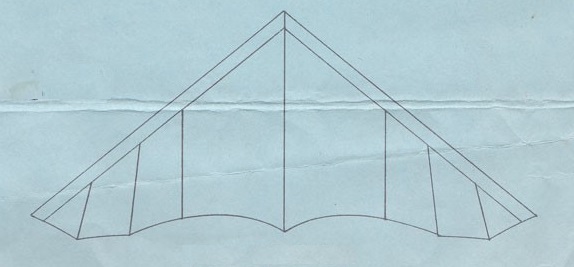
The ASG-20 was originally designed in 1975 to fill the need for a safer, more docile, beginner/intermediate glider. The final design meeting the criteria. The ASG-20 was available with an optional modification kit, which essentially soups up the -20, noticeably increasing the L/D while not adversely affecting the slow speed or stall characteristics. The modification kit includes a triple wing strut assembly to provide the negative load strength of the ASG-21.
With or without the mod kit, the -20 fits the Standard Class for competition.
Because the sail is not cambered like the ASG-21, a wide choice of colours was available, although Albatros recommends white cloth. Standard with the sail were applied leading edge sleeves and an applied keel pocket in the pilot’s choice of colour.
Options such as colour, split panels, and insert work were also available, as well as the modification kit.
It was an (at the time) intermediate glider with remarkably high performance. David Dilworth gained a 2nd place in Bodo Midnight Sol Cup in 1977 – and set a Scandanavian distance record with the ASG 20 (15+ km along the front of Kaiservarden).
ASG-20 AA Span: 24.00 ft Leading edge: 15.43 ft Area: 130 sq.ft Aspect ratio: 4.47 Sweep: 31.7 deg Nose angle: 102 deg Sail billow: 2.25 deg Keel: 10.41 ft Pilot weight: 90-125 lb Optimum wing loading: 1.1 lb/sq.ft
ASG-20 A Span: 26.32 ft Leading edge: 17.00 ft Area: 155 sq.ft Aspect ratio: 4.47 Sweep: 31.7 deg Nose angle: 102 deg Sail billow: 2.25 deg Keel: 11.46 ft Pilot weight: 120-150 lb Optimum wing loading: 1.1 lb/sq.ft
ASG-20 B Span: 27.57 ft Leading edge: 17.79 ft Area: 170 sq.ft Aspect ratio: 4.47 Sweep: 31.7 deg Nose angle: 102 deg Sail billow: 2.25 deg Keel: 12.00 ft Pilot weight: 145-175 lb Optimum wing loading: 1.1 lb/sq.ft
ASG-20 C Span: 28.75 ft Leading edge: 18.50 ft Area: 185 sq.ft Aspect ratio: 4.47 Sweep: 31.7 deg Nose angle: 102 deg Sail billow: 2.25 deg Keel: 12.50 ft Pilot weight: 170-190 lb Optimum wing loading: 1.1 lb/sq.ft
ASG-20 D Span: 29.90 ft Leading edge: 19.29 ft Area: 200 sq.ft Aspect ratio: 4.47 Sweep: 31.7 deg Nose angle: 102 deg Sail billow: 2.25 deg Keel: 13.00 ft Pilot weight: 185-205 lb Optimum wing loading: 1.1 lb/sq.ft
ASG-20 E Span: 31.00 ft Leading edge: 20.00 ft Area: 215 sq.ft Aspect ratio: 4.47 Sweep: 31.7 deg Nose angle: 102 deg Sail billow: 2.25 deg Keel: 13.65 ft Pilot weight: 200-225 lb Optimum wing loading: 1.1 lb/sq.ft
The Alaparma Baldo was a two-seat light monoplane produced in Italy shortly after World War II. Designed by Adriano Mantelli, it featured an egg-shaped fuselage with cabin doors that hinged upwards and to the back. The conventional tailplane with single fin and rudder was carried on twin booms, either side of a pusher engine installation. The undercarriage consisted of a single mainwheel under the fuselage pod, a small tailwheel not far behind it, and outrigger wheels on the wingtips.
AM.65 Baldo
Produced 1949-51, approximately 35 were built in two versions: the AM.65 with Walter Mikron engine and AM.75 with Praga D engine.
The Italian Air Force operated 10 aircraft until 1951.
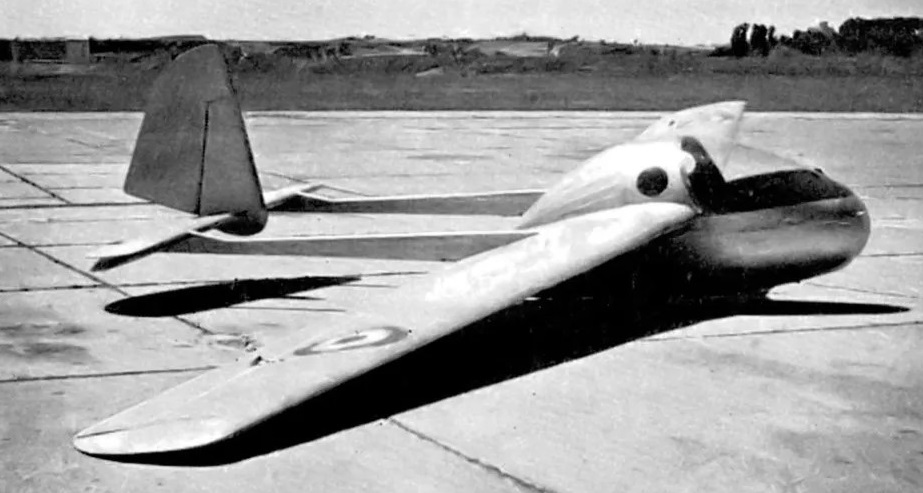
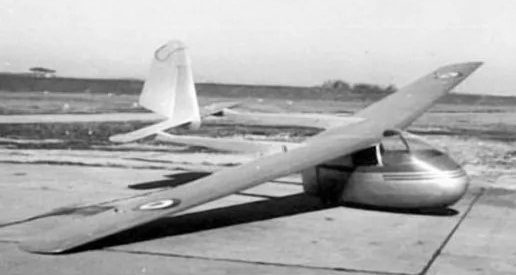
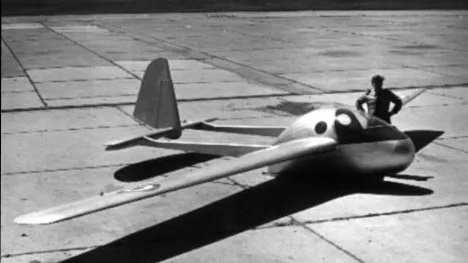
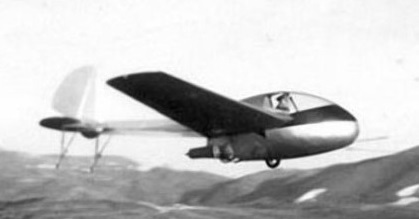
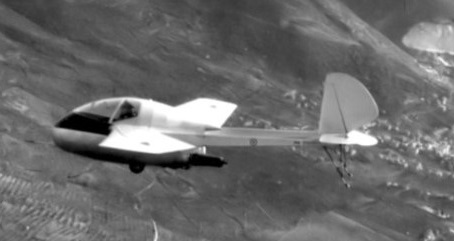
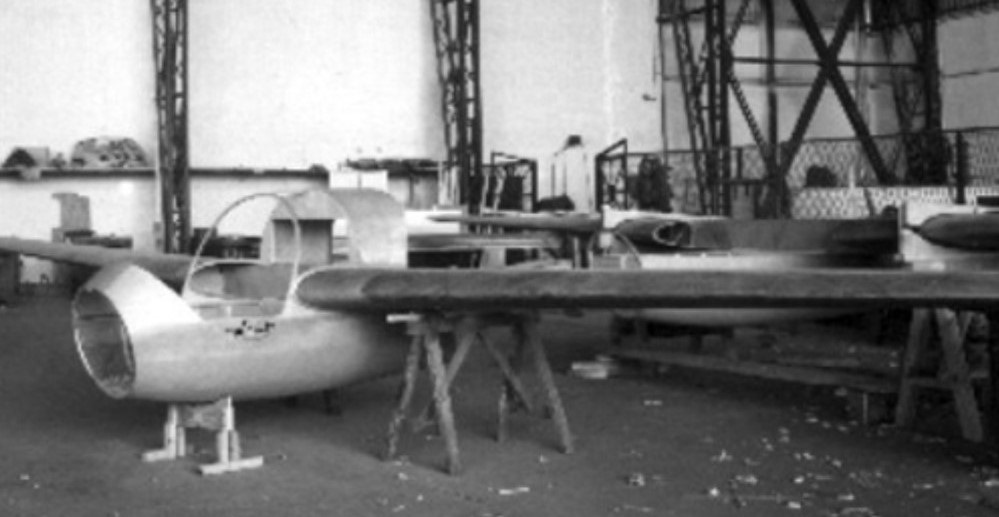
The Alaparma AM-12 was a two-seat aircraft derived from the Am-8/AM-10, but with a new and larger wing to make the type suitable as powered glider. Further changes compared to the AM-8 and AM-10 were a revised u/c arrangement with small tail wheels under the twin vertical tail instead of a single tail wheel under the rear fuselage.
It was first flown on 12 November 1954 as a glider.
Later it received one 75hp Praga D engine.
The aircraft was evaluated by the Italian AF and possibly up to three or four AM-12s were built.
One of the AM-12 after having been re-engined with one 350lb Turboméca Palas turbojet engine as the AM-12P and it was flown in this form in 1962.
AM-12P
Again, the aircraft was evaluated by the Italian AF. Further development of the AM-12 was halted.
AM-12P
The aircraft established several FAI altitude records attaining 28,661ft with Praga D75 engine and 21.981ft with Palas engine.
Wingspan: 39.375 ft Length: 18.042 ft Height: 4.667 ft