Alpavia sa

Founded 1958 by Mm d’Assche and Noin. Made slightly modified Jodel D-117-A (two per month from January 1959). In 1962 partnership with Rene Fournier resulted in Avion-Planeur RF3 with Volkswagen engine.

1964
Alpavia S. A.
Aerodrome de Gap-Tallard (Htes-Alpes),
France.

Alon

Alon was formed in December 1963 by two former Beech officials, John Allen Jr & Lee O Higdon. They acquired all assets, jigs, tools, and engineering of the Aircoupe two-seater from former owners (Carlsbad, New Mexico) promoting an improved version as Alon AirCoupe.

They expect to deliver the first of 30-50 Aircoupes to be built next year for about $8,000.

Alon, of McPherson, Kansas, merged with Mooney Aircraft Corporation in October 1967.

Allison TF41

Allison TF41-A-1B turbofan

The Allison TF41 (Company designations RB. 168-62 and Model 912) is a low-bypass turbofan engine jointly developed by Allison Engine Company and Rolls-Royce from the latter’s RB.168-25R Spey. First run in 1967, Allison manufactured the TF41 under license, while Rolls-Royce supplied parts common to existing Speys. The TF41 was developed for use in the LTV A-7D Corsair II for the USAF, and the US Navy’s A-7E. Between 1968 and 1983, a total of 1,440 TF41s were delivered.

TF41 of a U.S. Navy A-7E-4-CV

Applications
LTV A-7 Corsair II (USAF -D and US Navy -E models)

Specifications:
TF41-A-1
Type: Turbofan
Compressor: Three-stage LP compressor, two-stage IP compressor (both driven by LP turbine),11-stage HP compressor
Combustors: Cannular combustor with ten flame tubes
Turbine: Two-stage LP, Two-stage HP
Maximum thrust: 14,250 lb
Overall pressure ratio: 20:1
Bypass ratio: 0.77:1

Allison J71

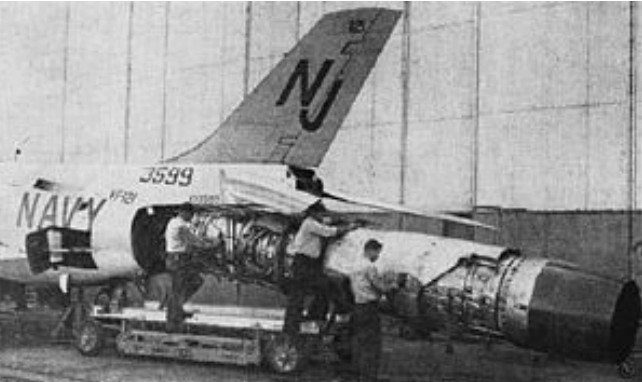
J71 engine in a F3H-2 Demon

The Allison J71 was a turbojet engine, designed and built in the United States. It began development in 1948 as a modified J35 and was originally designated the J35-A-23.

The Allison J71 turbojet powered the Douglas B-66 Destroyer and the McDonnell F3H-2 Demon after the failed Westinghouse J40 proved unworkable. The prototype P6M SeaMasters were also fitted with the engine.

Variants:
J71-A-2E: 9,700 lb (43.1 kN) thrust (14,000 lb (62.3 kN) thrust with afterburner)
J71-A-11: 10,200 lb (45.4 kN) thrust

Specifications:

Allison J71-A-2B
Type: Afterburning turbojet
Compressor: 16-stage axial compressor
Combustors: Cannular, 10 chambers
Turbine: 3-stage
Overall pressure ratio: 8:1

Allison T40 / Model 500

T40-A-10

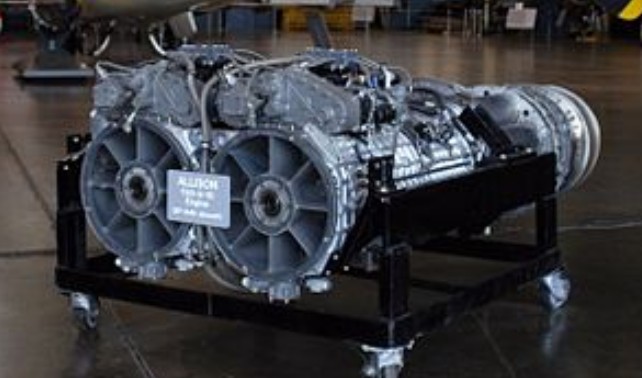
The Allison T40, company designation Allison Model 500, was an early American turboprop engine composed of two Allison T38 power sections driving a contra-rotating propeller via a common gearbox.

The T40 concept originated at Allison in 1944, where design studies were carried out on a 4,000 shp (2,983 kW) turboprop engine. Taking advantage of this effort, the US Navy awarded Allison a contract for the design and development of a 4,100 shp (3,057 kW) turboprop engine. The resulting T40 combined two Allison T38-A-1 power sections side-by-side with a common reduction gearbox powering a contra-rotating propeller. Similar in layout to the Armstrong Siddeley Double Mamba, the T40 differed in that each engine drove both the forward and the rear propellers, unlike the Double Mamba, where each Mamba power section drove either the front or the rear propeller separately.
The T38-A-1 power sections each contained 17-stage compressors giving a pressure ratio of 6.3:1, eight combustion chambers, and four-stage turbines. A combining reduction gearbox was driven via extension shafts from the power sections. Each transmission shaft incorporated a clutch to allow the power sections to be run independently.

Accessories included a Master Control Unit, mounted above the compressors; and an air driven starter on the gearbox. The compound reduction gear had an overall reduction ratio of 15.75:1 and incorporated an airscrew brake to prevent windmilling when the engine was stopped. Anti-icing for the air intakes was supplied by compressor bleed air. The contra-rotating propeller consisted of two 14 ft (4.3 m) three-bladed Aeroproducts propellers fitted to concentric shafts.

Testing of the XT40 began on 4 June 1948, revealing some major vibration problems from the reduction gearbox due to mis-matched noise frequencies caused by poorly designed gear teeth. The de-coupling system, designed to disconnect a power section in the event of failure worked successfully. During a run in a test cell one power section developed a major oil leak and an attempt to shut it down failed because the engine carried on running on the leaking oil. After many attempts to shut it down the offending power section could only be shut down by destroying the compressor with buckets of nuts and bolts thrown down the intake, proving the de-coupling system.

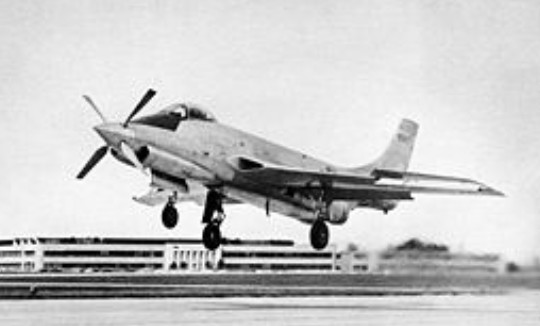
First flight test of the T40 was in the Convair XP5Y flying boat on 18 April 1950 fitted with four T40-A-4 developing 5,250 shp (3,915 kW). Service use of the T40 revealed problems with integrity of the propellers and gearboxes with at least one instance each of a propeller breaking free and a gearbox separation. One unusual problem was discovered during ground running of the Republic XF-84H Thunderscreech turboprop powered fighter; the special transonic 3-bladed single propeller set up harmonics that proved to be harmful to humans within a certain distance from the aircraft.

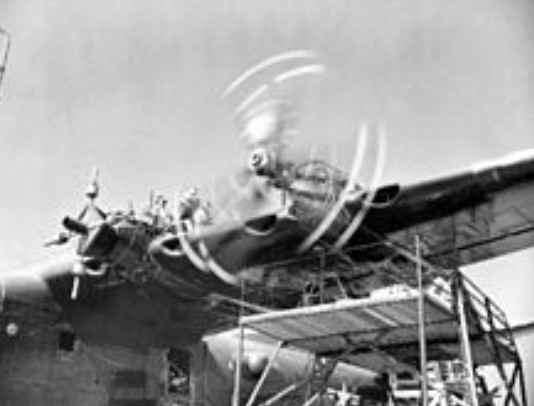
T40 engines on the XP5Y-1 prototype in 1950

The major problems of the T40 were its fragile gearbox, and the propeller control system which used 25 vacuum tubes, and was far from reliable. As the individual power plants were clutched into the gearbox, it was intended in most instances that the aircraft could cruise on one half of the engine and only engage the second power-section when there was need. In practice the system did not work well. Failure to recognize that one of the T38s had failed, and its compressor was devouring power produced by the other section, led to the loss of the first prototype Douglas XA2D-1 and its pilot on 14 December 1950.

The first aircraft to fly with the T40 was the Convair XP5Y-1 patrol aircraft prototype. As flying boat patrol aircraft became redundant, the US Navy changed the role of the aircraft from Anti-Submarine Warfare to Transport. Modifications to the XP5Y-1 (such as provision of air conditioning and pressurisation) produced the Convair R3Y Tradewind, which was to become the only aircraft using the T40 to actually enter service. These large four-engined flying boats served primarily between NAS Alameda and Hawaii during the mid-1950s, (replacing the Martin Mars flying boats). There were numerous problems with the T40s. One resulted in near disaster in 1956, when an R3Y managed to land with a runaway engine, resulting in a collision with a seawall. This event gave the US Navy one more reason to ground the R3Y, which it did soon after.

The only other aircraft to be produced in any quantity to be powered by the T40 was the Douglas A2D-1 Skyshark. Of the sixteen examples built, the twelve used for evaluation suffered similar problems to the R3Y. Propeller control problems and gearbox failures were among the more common problems.

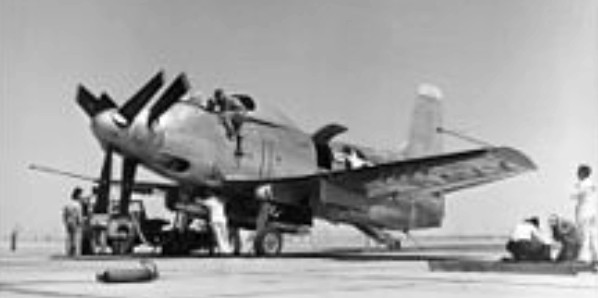
Second Douglas A2D being prepared for its first flight in April 1952.

The T40 was also fitted to the North American A2J-1 Super Savage but the poor performance of the aircraft and continuing difficulties with the engines forced cancellation in favour of the Douglas A3D Skywarrior.

The most notable successes of the T40 were in the field of vertical take-off aircraft, being used to power three different types, the Convair XFY-1 Pogo, Lockheed XFV-1 and the Hiller X-18 tilt-wing research aircraft. Fitted with the more powerful 7,100shp YT40-A-6 the XFV-1 flew the first full flight from vertical take-off to horizontal flight and back to vertical flight for landing, of a fixed wing aircraft, in November 1954. Continuing concerns over propellers and the poor payload and performance precluded further development.

Some flying was carried out with the Hiller X-18 but most research was carried out with the aircraft attached firmly to a force measuring platform, that could be raised hydraulically, to gather data on ground cushion effects.

Limited flying was carried out by the two Republic XF-84H Thunderscreech turboprop fighter aircraft, but the continuing difficulties with the T40 engine, supersonic propeller, not to mention performance completely overshadowed by contemporary rivals led to cancellation of production plans.

Applications:

Douglas A2D Skyshark
(1 × XT40-A-2)
North American A2J Super Savage
(2 × XT40-A-6)
Convair P5Y
(4 × XT40-A-5)
Convair R3Y Tradewind
(4 × XT40-A-10)
Hiller X-18
(2 × T40-A-4)
Lockheed XFV
(1 × YT40-A-14)
Convair XFY
(1 × YT40-A-14)
Republic XF-84H Thunderscreech
(1 × XT40-A-1 driving a single three-bladed transonic propeller)

Specifications:

XT40
Type: Turboprop
Length: 13 ft 11 in (4,240 mm)
Diameter: 3 ft 3 in (990 mm)
Dry weight: 2,500 lb (1,100 kg)
Compressor: 17-stage axial flow (2 of)
Combustors: 8 can-type per power-section
Turbine: 4-stage axial flow (2 of)
Fuel type: Kerosene based jet fuel
Oil system: pressure spray scavenged
Maximum power output: 4,000 shp
Overall pressure ratio: 6.3:1
Specific fuel consumption: 0.6

Allison Model 501 / T38

McDonnell XF-88B with a T38 turboprop in the nose

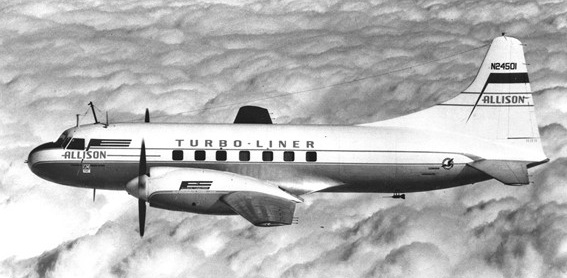
The Allison T38 (company Model 501) was an early large turboprop engine developed by Allison Engine Company during the late 1940s. Starting with a 19-stage axial compressor, eight can type combustion chambers, a 4-stage turbine driving the compressor and the extension shaft to the reduction gearbox, and initially rated at 2,000 shp (1,491.40 kW), the T38 first ran in 1947 and flew in the nose of a Boeing B-17 Flying Fortress test-bed on 19 April 1949, rated at 2,250 shp (1,677.82 kW). Problems with gearbox vibration and combustion were dealt with during the test programme and were mirrored by problems in the T40 programme. The engines fitted to the Convair CV-240-21 Turboliner were rated to 2,750shp.

Convair CV-240-21 Turboliner, December 1952 (Courtesy Pat Ford)

Although the only aircraft slated to receive the T38 as a production engine, the Convair T-29E, was cancelled, the T38 did power a converted Convair CV-240 (the CV-240-21 Turboliner, a project that would be abandoned due to engine problems), and was fitted in the nose of the McDonnell XF-88B to drive experimental supersonic propellers. Further development of the T38 provided the power sections for the Allison T40 as well as forming the basis for the Allison T56/Model 501 and the projected Allison T39.

Derivatives:

T39
A projected 9,000 shp (6,711.30 kW) development of the T38 which was cancelled before hardware had been produced.

T40
A 4,100 shp (3,057.37 kW) turboprop derivative composed of two T38s driving a common gearbox.

Applications:
CV-240-21 Turboliner
Convair T-29E (cancelled)
McDonnell XF-88B

Allison Engine Company

The Allison Engine Company has its roots in September 1904, when the Concentrated Acetylene Company was founded by James Allison, Percy C. ‘Fred’ Avery and Carl G. Fisher. Avery was the holder of the patent for the product. This company was the predecessor of the Prest-O-Lite Company, a manufacturer of acetylene headlights. An explosion at the acetylene gas works in downtown Indianapolis caused the company to relocate out of town, near the race track in Speedway, Indiana. Allison and Fisher raced automobiles at that track, each owning a race car team. This hobby resulted in Allison building a shop at the track in Speedway where he maintained his fleet of race cars. This shop became the site for Allison Plant #1. Fisher and Allison sold their interest in Prest-O-Lite to Union Carbide for $9,000,000.

Allison started as an engine and car “hot rodding” company servicing the Indianapolis Motor Speedway in Indianapolis. James Allison was the owner of the Indianapolis Speedway Team Company, a race car business in Indianapolis, Indiana. While it was originally known as the Indianapolis Speedway Team Company, its name changed numerous times, first to the Allison Speedway Team Company, then the Allison Experimental Company and last as the Allison Engineering Company before becoming a division of General Motors.

The company’s only regular production item was a patented steel-backed lead bearing which was used in various high performance engines. It also built various drive shafts, extensions and gear chains for high power engines, on demand. Later its main business was the conversion of older Liberty engines to more powerful models, both for aircraft and marine use.

Allison needed a place where his race car engines could be modified and repaired. On January 1, 1917 Allison moved into a building at what in later years was to become the Indianapolis Motor Speedway. Along with the move, Allison hired engineer Norman H. Gillman, from a competing race team as his Chief Engineer.

Allison moved to Florida to invest in real estate after the war, leaving Gillman in charge. Allison did not want the company to wither, so he asked Gillman to build a V-12 marine engine worthy of the Allison name. Gillman then proceeded to build an engine that relied on what was learned from building and modifying the Liberty engine.

Allison’s company was sold to Captain Eddie Rickenbacker in 1927 for $700,000 after Allison moved to Florida. In 1929, shortly after the death of James Allison, the company was purchased by the Fisher brothers, who instructed it to use the cylinder design for a six-cylinder engine for a “family aircraft”. Before work on this design had progressed very far, Fisher sold the company to General Motors, who owned it for most of its history, which ended development due to financial pressures of the Great Depression. Nevertheless Gilman pressed ahead with the cylinder design, building a “paper project” V-12 engine. The Army was once again uninterested, but instead suggested Allison try selling it to the United States Navy. The Navy agreed to fund development of A and B models to a very limited degree for its airships, until the crash of the USS Macon in 1935, when the Navy’s need for a 1,000 hp (750 kW) engine disappeared.

The very first V-1710 was purchased by the US Navy as their GV-1710-2, and appears to have had an Allison serial of number 1, suggesting that they restarted numbering for the V-1710. The first V-1710 engine purchased by the USAAC was AAC 33-42, Allison SN 2, the XV-1710-1, while SN’s 3, 4, 5 were V-1710-4 engines for USN airships, followed by a batch of 11 Air Corps engines purchased with FY-1934 funds (34-4 through 34-14) that covered Allison serials 6 through 16. After these the production totaled over 70,000 V-1710s.

By this point the Army had become more interested in the design, and asked Allison to continue with a new “C” model. They had few funds of their own to invest, and Allison supported much of the development out of their own pocket. The V-1710-C first flew on 14 December 1936 in the Consolidated A-11A testbed. The V-1710-C6 successfully completed the Army 150 hour Type Test on 23 April 1937, at 1,000 hp (750 kW), the first engine of any type to do so. By this point all of the other Army engine projects had been cancelled or withdrawn, leaving the V-1710 as the only modern design available. It was soon found as the primary powerplant of the new generation of United States Army Air Corps (USAAC) fighters, the P-38 Lightning, P-39 Airacobra and P-40 Warhawk.

The Army had been leaning heavily towards exhaust-driven turbochargers instead of the more common mechanically driven superchargers, feeling that their added performance more than made up for the added complexity. Thus little effort was invested in equipping the V-1710 with a reasonable supercharger, and when placed in aircraft designs like the P-39 or P-40 which lacked the room for a turbo the engine suffered tremendously at higher altitudes. It was for this reason in particular that the V-1710 was later removed from the P-51 Mustang and replaced with the Rolls-Royce Merlin.

With the need for the V-1710 winding down at the end of the war, Allison found itself with a massive production infrastructure that was no longer needed. For this reason, in 1947, the Army decided to take General Electric’s versions of Frank Whittle’s jet engines and give them to Allison to produce instead. The main production model was GE’s 4,000 lbf (18 kN) I-40, produced as the Allison J33. By the time production ended in 1955, Allison had produced over 7,000 J33s.

Allison also took over GE’s axial flow engine design, becoming the Allison J35. The J35 was the primary powerplant for the F-84 Thunderjet and F-89 Scorpion, as well as appearing on numerous prototype designs. The J35 also finished production in 1955, by which point over 14,000 had been delivered.

Allison also started the development of a series of turboprop engines for the U.S. Navy, starting with the T38 and a “twinned” version as the T40. The Navy was interested only in the T40, but the complexities of the driveshaft arrangement doomed the engine and the project was eventually cancelled. Allison tried again with the T56, basically an enlarged T38 with the power of the T40, and was eventually rewarded when this engine was selected to power the C-130 Hercules.

Over the years a family of engines, based on the T56 basic configuration has been developed, culminating in the T406/Allison AE1107 turboshaft for the V-22 Osprey, the Allison AE2100 turboprop, used on newer models of the C-130 and the Allison/Rolls-Royce AE 3007 turbofan which propels many commuter aircraft, such as the Embraer ERJ 135 family.

One of Allison’s most successful projects is the Model 250 turboshaft/turboprop engine family, which was started by the company in the early 60s, when helicopters started to be powered by turbine, rather than reciprocating, engines.

In the mid-1970s the Allison Division of General Motors Corporation in Detroit designed ceramic components into the Allison GT 404-4 truck engine. Allison continued to work with General Motors on development of ceramic-turbine powered engines until the early 1990s. During their work they were able to engineer fairly stable automobile engines that were capable of burning a variety of fuels including (but not limited to) gasoline, diesel, kerosene, alcohol, vegetable oil, and coal powder.

In the 1980s Allison collaborated with Pratt & Whitney on demonstrating the 578-DX propfan. Unlike the competing General Electric GE-36 UDF, the 578-DX was fairly conventional, having a reduction gearbox between the LP turbine and the propfan blades. Noise considerations, plus a significant reduction in the real cost of aviation fuel, brought the NASA funded program to a halt.

LHTEC (Light Helicopter Turbine Engine Company) is a joint venture between Rolls-Royce and Honeywell founded in 1985. The company was originally a partnership between the Allison Engine Company and AlliedSignal Aerospace. In 1995 Rolls-Royce acquired Allison, and AlliedSignal merged with Honeywell in 1999, and adopted its name.

In 1995, Allison tested a prototype lift fan for the Joint Strike Fighter Program and a LiftFan nozzle was tested in 1997 at NASA’s Lewis facility. By 1997, a complete prototype had been demonstratedby the Rolls-Royce owned but American controlled Allison Advanced Development Company.

In 1992 GM tried to sell Allison to concentrate on repairing automobile market share. Rolls-Royce attempted to buy the company in 1993, but GM opted for a management buyout instead for $370 million.

In 1995 authorities approved (with restrictions on JSF) the purchase of Allison by Rolls-Royce to become a subsidiary. The price was $525 million. In the year 2000, some of these restrictions were alleviated, and in 2001 the US government chose the F-35 with Allison/RR technology.

Allis-Chalmers

Allis-Chalmers was a U.S. manufacturer of machinery for various industries. Its business lines included agricultural equipment, construction equipment, power generation and power transmission equipment, and machinery for use in industrial settings such as factories, flour mills, sawmills, textile mills, steel mills, refineries, mines, and ore mills. The first Allis-Chalmers Company was formed in 1901 as an amalgamation of the Edward P. Allis Company (steam engines and mill equipment), Fraser & Chalmers (mining and ore milling equipment), the Gates Iron Works (rock and cement milling equipment), and the industrial business line of the Dickson Manufacturing Company (engines and compressors). It was reorganized in 1912 as the Allis-Chalmers Manufacturing Company.

Immediately at the war’s end, in 1945–1946, Allis-Chalmers endured a crippling 11-month labor strike.

During the next 70 years its industrial machinery filled countless mills, mines, and factories around the world, and its brand gained fame among consumers mostly from its farm equipment business’s orange tractors. In the 1980s and 1990s a series of divestitures transformed the firm and eventually dissolved it. Its successors today are Allis-Chalmers Energy and AGCO.