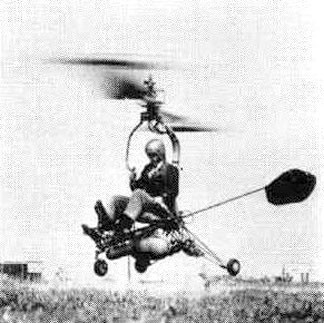
The XA-5 was followed by the single-seat XA-6 “Buck Private” circa 1950, with the same pulse-jet propulsion and a simple open frame structure.
One XA-6 was built.
The XA-5 was followed by the single-seat XA-6 “Buck Private” circa 1950, with the same pulse-jet propulsion and a simple open frame structure.
One XA-6 was built.
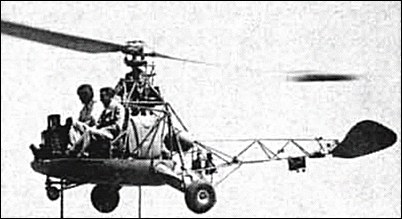
The first project of the American Helicopter company was the two-seat open-cockpit XA-5 “Top Sergeant”, which was based on the lower fuselage and undercarriage of a Sikorsky R-6 with an open rear boom and small rudder. It was driven by two tip-mounted 43kg AJ 8.75 pulse-jet engines driven by a fuselage-mounted compressor, and made its first flight in January 1949.
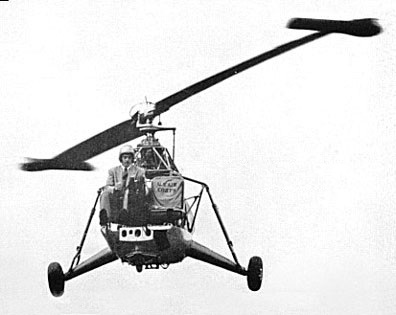
Engines: 2 x 43kg AJ 8.75 pulse-jets
Seats: 2
The American Helicopter Company was first formed in 1947 for research and development on XA-5 pulsejet-powered helicopter and later acquired by the Fairchild Engine and Airplane Corporation in April 1954.
Eugene M. Gluhareff was born in St. Petersburg, Russia in 1916 immigrating to the United States with his family via Finland in the early 1920’s.
An Aeronautical Engineer graduate of Rensselaer Polytechnic Institute in Troy, New York, he was a jet engine and helicopter designer and inventor. His extensive experience was acquired over many years of association with leading companies in the fields of design, research and development.
He has been a part of helicopter development since its beginning in 1940 with Sikorsky Aircraft Corporation in Bridgeport, Connecticut as a primary design engineer and project engineer. He worked directly under Mr. Igor I. Sikorsky and Mr. Igor A. Sikorsky, Chief of Aerodynamics. It was there he invented and developed the Pulse Jet Engine, a one-man single bladed jet helicopter which he test flew himself and also a Delta Wing Convertiplane for the United States Airforce.
In 1950 he moved to California and joined the American Helicopter Company in Manhattan Beach as a project engineer on a pulse jet powered helicopter (Top Sergeant). He was promoted to Chief of Preliminary Design and there designed the XH-26 One-Man-Jet Helicopter for the U.S.A.F.. Following this term with American Helicopter, he worked with Rotorcraft Corporation in Glendale, California as Design Engineer and was engaged in the redesign of a rocket powered one-man-helicopter for the U.S. Navy.
In 1942 revived American Eaglet light monoplane by building a new prototype. Tests postponed until after war. By end of February 1960 had built one Eaglet and was supplying plans for amateur builders. Company later sold to John Spach.
A light parasol monoplane, first two-seat light airplane to be granted Approval Type Certificate by US Department of Commerce. Several hundred Eaglets built before company suspended operations in 1930 Depression.
Victor H. Roos Aircraft Co. succeeded American Eagle-Lincoln Aircraft Corporation in mid-1930s, and continued to produce American Eaglet light monoplane with 45hp Szekely engine.
In 1942 American Eaglecraft Co revived the American Eaglet light monoplane by building a new prototype. Tests postponed until after war. By end of February 1960 had built one Eaglet and was supplying plans for amateur builders. Company later sold to John Spach.
American Aviation Corporation; formed in 1964 to develop and manufacture the AA-1 Yankee side-by-side two-seat monoplane (formerly called Bede BD-1) using aluminum honeycomb fuselage construction and metal-to-metal bonding throughout. Also produced a trainer version (American Trainer) and a four-seater (American Traveler). Became part of Grumman American Aviation Corporation in January 1973.
Agricultural aircraft, a development of Stearman Model 75 (Boeing Kaydet). Alternatively offered new high-lift wings and special modification kits. In eight years more than 200 Stearmans were fitted with new wings, permitting loads of over 2,000 Ib (907 kg).
In the late 1950s built in quantity NA-75 agricultural aircraft, a development of Stearman Model 75 (Boeing Kaydet). Alternatively offered new high-lift wings and special modification kits. In eight years more than 200 Stearmans were fitted with new wings, permitting loads of over 2,000 Ib (907 kg).
1968: American Airmotive Corp
pres: John D MacArthur
Miami FL.
USA
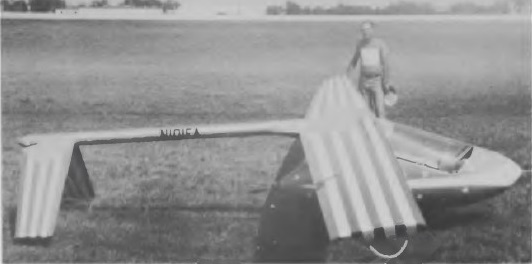
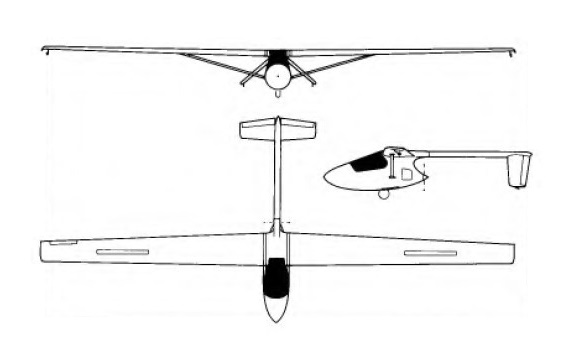
Designed by Larry Haig of Muskegon, Michigan, beginning in September 1974, the American Eaglet is a self-launching sailplane. The type is a high wing monoplane with a pod-and-boom type fuselage with the 12 hp(8.95kW) McCulloch 101B engine mounted aft of the cockpit and driving a 2 ft (60.96 cm)-diameter pusher propeller. The nylon propeller blades fold aft automatically when the engine stops. The cantilever inverted-Vee tailplane and elevators are carried on a tail boom that is a thin-walled 5 in (12.7 cm)-diameter aluminium tube with a moulded glassfibre tailcone. The compact cockpit includes a side-mounted control stick and aft-hinged, single-curved canopy. Construction is largely of glassfibre and urethane foam cores, with some components of aluminium.
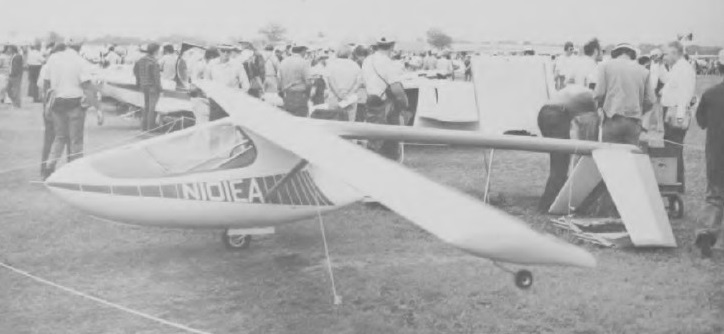
The wings are stressed skin structures with spruce load-bearing spars and a single aluminium tube bracing strut on each side; the spars are surrounded by a urethane foam core, the leading edges and wing tips being of moulded glassfibre, and the urethane core portions are covered with epoxy-bonded precure glassfibre skin. There are no ailerons or flaps, but the functions of these two (ie roll and glide path control) are combined in two spoiler-like surfaces called ‘spoilerons’ at 30% chord on each upper surface towards the wing tip. The forward portion of the fuselage consists of two pre-formed glassfibre half shells pop-riveted to tubular aluminium longerons, the main load-bearing member in the fuselage being the bulkhead which carries the pilot’s seat on one side and the engine mounting on the other. This also carries the tail boom at the top rear, the monowheel at the bottom and the wing spar carry-through at the top, and this bulkhead is an aluminium-skinned urethane foam composite structure. There is a combined pitot tube/lifting handle in the fuselage nose. The inverted-Vee tailplane is very similar to the wings structurally, with an epoxy/glassfibre skin over urethane foam cores, and this V-tail greatly improves control in pitch and yaw, as the prop wash ‘blows’ directly over the tail surfaces; the V-tail also makes spins impossible. The manually-retractable monowheel has an external friction-pad brake, and is supplemented by a tailwheel under the tip of each tailplane.
The American Eaglet can be completed and flown as a pure sailplane, without the engine; the powerplant fitted is a McCulloch 101B single cylinder two-stroke engine developing 12.2hp at 8,000rpm, and drives a two-blade fixed-pitch pusher propeller with nylon plastic blades that fold backwards through 90° when the engine is stopped. The engine is intended only for take-off and self recovery, and is not designed for continuous cross country operation; it can be restarted in flight. A fuel tank of 2 litres (0.5 US gallons) capacity is provided. Fuel tank capacity is generally sufficient for one takeoff and climb to 2,000 feet AGL and three airborne restarts and climbs from 500 feet back up to 2,000 feet. The McCulloch 101B engine was available in only limited quantities, and the West Bend 820 engine will be fitted when availability of the 101B becomes a problem.
The Eaglet was designed for kit building and Larry Haig formed the AmEAGLE Corporation to market it.
Construction of the prototype, registered N101EA, started in June 1975 and this made its first flight on 19 November that year; a second prototype was later flown. A total of 400 kits had been ordered by early 1980, of which 20 had been completed.
Engine: McCulloch 10IB, 8.95 kW / 12 hp
Wing span: 36 ft 0 in /10.97 m
Length: 16 ft 0 in / 4.88 m
Height: 0.91 m / 3 ft 0 in
Wing area: 72 sq.ft / 6.69 sq.m
Empty Weight: 160 lb / 72.5 kg
Payload: 200 lb / 90.5 kg
Gross Weight: 360 lb /163 kg
Water ballast: None
Fuel capacity 2 lt / 0.5 US gal
Wing Load: 5 lb/sq.ft / 41.04 kg/sq.m
Max speed: 115 mph / 100 kt / 185 km/h (in smooth air, power off)
Aspect ratio: 18
Airfoil: Wortmann FX-61-184
Stall speed: 33 kt / 61 km/h
MinSink: 0.76 m/s / 2.50 fps / 1.48 kt at 40 mph / 35 kt / 65 km/h
L/DMax: 27 @ 84 kph/ 45 kt /52 mph
Max rate of climb at sea level: 400 ft/min / 122 m/min
Take-off run: 1,000 ft
No. of Seats: 1
Originally, The Kangaroo is a wooden glider, two-seater, high-wing, and about 20m wingspan. It was designed in 1939 by the Gliding Institute Polytechnic of Milan (Centro Volo a Vela del Politecnico Di Milano) under the direction of the Engineer Ermenegildo Preti. In addition to the prototype, the Italian air force has ordered 32 copies. The first flew in 1940, only two copies will be built during the duration of the war. Others, built in 2 lots by two different companies were produced between 1953 and 1955. It was at this time, a significant number of aircraft.
The “Palas” version corresponds to a transformation seater glider with a Turbomeca Palas jet engine.
The jet version was created by Adrianno Mantelli, from one that had crashed. It was rebuilt with a shortened wing, and with the addition of a Turbomeca Palas engine of 150kg thrust. This came from the prototype Caproni Trento F-5 jet. The air inlet is a removable scoop on the top of the fuselage.
In this configuration, Adrianno broke the world record for altitude jet less than 800 kg, with a flight to 9366 m, 24 September 1964.
A high-wing cantilever monoplane built completely in wood, the CVV6 had a fixed, single wheel undercarriage.
Wingspan: 19.20 m (63 ft 3 in)
Length: 8.00 m (26 ft 2 in)
Wing area: 21.60 m² (235.5 sq.ft)
Empty weight: 280 kg (616 lb)
Payload: 180 kg (396 lb)
MTOW: 460 kg (1012 lb)