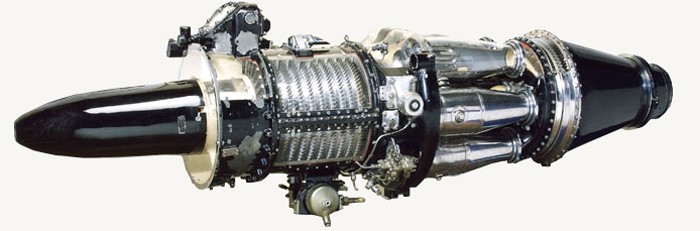
Armstrong Siddeley Adder

The Adder, a pure-jet derivative of the Armstrong Siddeley Mamba ASM3 airscrew gas-turbine, was originally developed as an expendable engine to power the Jindivik 1 target drone. The engine, first run in November 1948, was then developed into a longer-life engine before evolving into the more-powerful Armstrong Siddeley Viper.

The ASA.1 Adder was flight tested in the rear-turret position of the Avro Lancaster III SW342, the aircraft also having been previously modified and used for icing trials of the Mamba by Armstrong Siddeley’s Flight Test Department at Bitteswell.

Applications:

GAF Pika
Saab 210
Folland Midge

Specifications:
Type: Turbojet
Compressor: Axial Flow
Maximum thrust: 1,050 lb
Max continuous power: 900 lb / 409 kg
Diameter: 28 in / 71,12 cm
Length: 73.3 in / 1,84 m
Net dry Weight: 580 lb / 263 kg
Take-off power: 1,100 lb / 500 kg
Fuel burn max continuous: 1.2 lb/lb th/h

Armstrong Siddeley Viper / Bristol Siddeley Viper / Rolls-Royce Viper

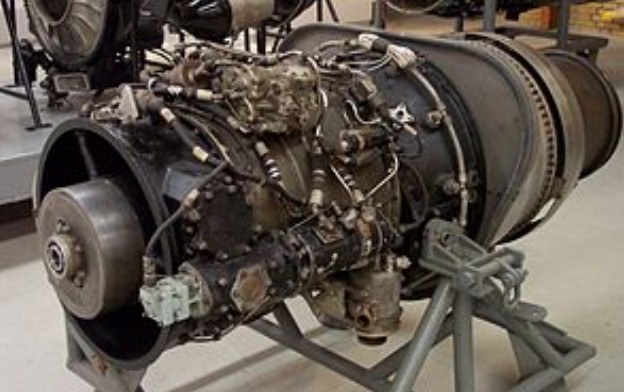
The Viper turbojet engine was developed and produced by Armstrong Siddeley and then by its successor companies Bristol Siddeley and Rolls-Royce Limited. First run in April 1951 it entered service in 1953 and remained in use with the Royal Air Force, powering its Dominie T1 navigation training aircraft until January 2011.
The design originally featured a seven-stage compressor based on their Adder engine — the Viper is in effect a large-scale Adder.
The Viper was developed as an expendable engine for powering production versions of the Jindivik target drone, but the limited-life materials and total-loss oil systems were replaced with standard systems for use in manned aircraft.
Because it was initially developed as an expendable engine, the Viper was subject to many recurring maintenance issues. This led to the development of the first Power by the Hour program in which operators would pay a fixed hourly rate to Bristol Siddeley for the continual maintenance of the engines.
A production Armstrong Siddeley Viper ASV.5 turbojet, of the type specified for the Percival P.84 trainer, was to undergo high-altitude trials mounted on the tip of one wing of Armstrong Siddeley’s Sapphire – Canberra WD933 in 1954. The other wing-tip can either carry a similar turbo-jet or, as in the case of the Canberra, a counterbalancing weight. The Canberra should be able to test the Viper at altitudes up to about 50,000 ft.

Variants:
Viper 8
(Mk.102 / Mk.104): Engines for the Hunting-Percival Jet Provost TMk.3 (Mk.102} and GAF Jindivik Mk.102B target drone (Mk.104).
Viper 9
(Mk.103): Powered the Bell X-14 and Handley Page HP 115 among others.
Viper 11
(Mk.200): Powered the Hunting-Percival Jet Provost TMk.4 and GAF Jindivik Mk.3 among others.
Viper 20
(Mk.500 series): Powered the Hawker Siddeley HS.125 and Piaggio-Douglas PD.808 among others.
Viper 22
Built under licence by Piaggio for the Aermacchi MB.326
Mk.102
Mk.103
Mk.104
Mk.200
Mk.201
Mk.301
Mk.500 series
Mk.520
Mk.601

Applications:
Aermacchi MB-339
Aermacchi MB-326
Atlas Aircraft Impala
Avro Shackleton
BAC Jet Provost
BAC Strikemaster
Bell X-14
Dassault M.D.550 Mystere-Delta
Embraer AT-26 Xavante
Folland Midge
GAF Jindivik
Hawker Siddeley Dominie
Handley Page HP.115
IAR 99
Piaggio PD.808
Saunders-Roe SR.53
Soko J-22 Orao/IAR-93
Soko G-2 Galeb
Soko G-4 Super Galeb

Specifications:

Viper ASV.12
Type: Turbojet
Length: 64.0 in (1,625 mm)
Diameter: 24.55 in (624 mm)
Dry weight: 549 lb (249 kg)
Compressor: Seven stage axial
Combustors: Annular, 24 burners
Turbine: Single stage
Fuel type: AVTUR, AVTAG
Oil system: scavenge, metered
Maximum thrust: 2,700 lb (12 kN) at 13,800 rpm
Overall pressure ratio: 4.3:1
Specific fuel consumption: 1.09 lb/hr/lb oil consumption=1.25 pints/hr (0.7l/h)
Thrust-to-weight ratio: 4.9:1

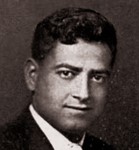
Armstrong Siddeley

In April 1919 Siddeley-Deasy was bought out by Armstrong Whitworth Development Company of Newcastle upon Tyne and in May 1919 became Armstrong Siddeley Motors Ltd a subsidiary with J. D. Siddeley as Managing Director. In 1927, Armstrong Whitworth merged its heavy engineering interests with Vickers to form Vickers-Armstrongs. At this point, J. D. Siddeley bought Armstrong Siddeley and Armstrong Whitworth Aircraft into his control. In 1928, Armstrong Siddeley Holdings bought Avro from Crossley Motors.

Armstrong Siddeley manufactured luxury cars, aircraft engines, and later, aircraft. In 1935, J. D. Siddeley’s interests were purchased for £2 million by Tommy Sopwith owner of Hawker Aircraft to form Hawker Siddeley, a famous name in British aircraft production. Armstrong Whitworth Aircraft became a subsidiary of Hawker. The aviation pioneer Thomas Octave Murdoch Sopwith – Tommy, later Sir Thomas, Sopwith – became chairman of Armstrong Siddeley Motors, a Hawker Siddeley subsidiary.

Armstrong Siddeley was merged with the aircraft engine business of Bristol Aero Engines that had developed the Olympus engines for the TSR 2 (that engine was subsequently developed for used in Concorde) to form Bristol Siddeley as part of an ongoing rationalisation of the British aerospace sector. Armstrong Siddeley produced their last cars in 1960. Bristol Siddeley and Rolls-Royce merged in 1966, the latter name subsuming the former.

In June 1972, Rolls-Royce (1972) Ltd. sold all the stock of spares plus all patents, specifications, drawings, catalogues and the name of Armstrong Siddeley Motors Ltd to the Armstrong Siddeley Owners Club Ltd.

However, the name survived with Hawker Siddeley Aviation and Hawker Siddeley Dynamics joining with others to become BAe – British Aerospace, and with further mergers has now become BAE Systems the premier defence contractor, which among other things builds Aircraft Engines, Aircraft, and Aircraft carriers.

Throughout the 1920s and 1930s, Armstrong Siddeley produced a range of low- and mid-power aircraft radial engines, all named after big cats. They also produced a tiny 2-cylinder engine called the Ounce, another name for the snow leopard, for ultralight aircraft.

The company started work on their first gas turbine engine in 1939, following the design pioneered at the Royal Aircraft Establishment by Alan Arnold Griffith. Known as the “ASX” for “Armstrong Siddeley eXperimental”, the original pure-turbojet design was later adapted to drive a propeller, resulting in the “ASP”. From then on, AS turbine engines were named after snakes. The Mamba and Double Mamba were turboprop engines, the latter being a complex piece of engineering with two side-by-side Mambas driving through a common gearbox, and could be found on the Fairey Gannet. The Python turboprop powered the Westland Wyvern strike aircraft. Further development of the Mamba removed the reduction gearbox to give the Adder turbojet.

Another pioneer in the production of the RAE engine design was Metrovick, who started with a design known as the Metrovick F.2. This engine never entered production, and Metrovick turned to a larger design, the Beryl, and then to an even larger design, the Sapphire. Armstrong Siddeley later took over the Sapphire design, and it went on to be one of the most successful 2nd generation jet engines, competing with the better-known Rolls-Royce Avon.

The company went on to develop an engine – originally for unmanned Jindivik target drones – called the Viper. This product was further developed by Bristol Siddeley and, later, Rolls-Royce and was sold in great numbers over many years. A range of rocket motors were also produced, including the Snarler and Stentor. The rocket development complemented that of Bristol, and Bristol Siddeley would become the leading British manufacturer of rocket engines for missiles.
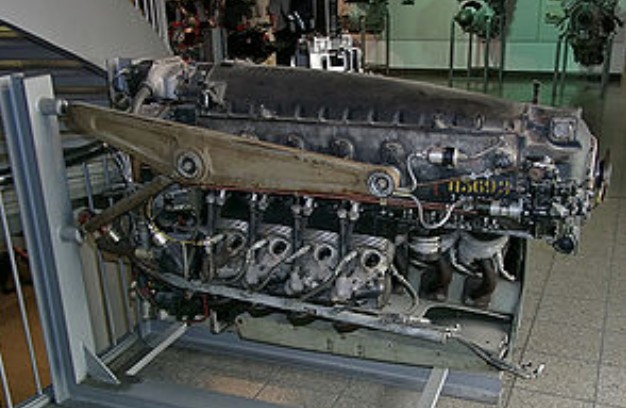
Agus As 411 / Renault 12 / SNECMA 12

Argus As 411

A twelve-cylinder, air-cooled, inverted-V aircraft engine developed by Argus Motoren in Germany during World War II , the As 411 was a refined and more powerful version of the Argus As 410. Most 411 production was undertaken by Renault in occupied Paris, these engines were used to power the Siebel Si 204 and the post war Dassault MD 315 Flamant. It developed 600 PS (592 hp, 441 kW) at 3,300 rpm.

Following the end of World War II, Renault continued to manufacture the engine as the Renault 12S. After merging the French aircraft engine manufacturers into SNECMA in 1945, production continued under the new designation SNECMA 12.

Approximately 2,600 were built.

Variants:

As 411
A refined and more powerful version of the Argus As 410.

Renault 12S
Production of the As 411 after WWII in France.

SNECMA 12S; (a.k.a. SNECMA Renault 12T) Designation change on the formation of SNECMA.

SNECMA 12T
(a.k.a. SNECMA Renault 12T) Refined version of the 12T with new pistons and cylinders, with a revised induction system.

Applications:

Arado Ar 96
Breguet 892 Mercure (4 × 12S)
Dassault MD 315 Flamant
Focke-Wulf Fw 189
Pilatus P-2
Siebel Si 204
Sud Ouest S.O.93

Specifications:

As 411
Type: 12-cylinder inverted 60-degree Vee
Dry weight: 385 kg (849 lb)
Cooling system: Air-cooled
Power output: 600 PS (592 hp, 441 kW) at 3,300 rpm
Compression ratio: 6.4:1

Argandar, Miguel (Mike) 

Miguel “Mike Argandar” was born July 25, 1917 at Fracc. Romita, Mexico City, Federal District, Mexico, the son of Dr. Luis Argandar Tello and Josefina Macias

“Mike Argandar” built a midget racer circa 1947 but at age 31, on July 25, 1948 was killed Rosemead Airfield, Rosemead, Los Angeles County, California, United States, in a crash of that plane. He was buried at Glendale, Los Angeles, California, United States.

Arctic Aircraft S2B2

In 1969, production of the Interstate Cadet was resurrected by Bill and Jan Diehl, owners of Arctic Aircraft Co. in Anchorage, Alaska. The one family operation has modified the Cadet to become a lightweight bush plane. Installation of a 150-hp Lycoming engine has markedly increased performance and useful load. Large, high flotation tires permit safe landings on beaches or riverbeds. Construction is of chromoly tubing covered with Dacron. All control cables, brake cables, fuel lines, are completely exposed. The revived Cadet, now dubbed the S2B2, has been certificated for aerobatics, and even snap maneuvers are approved.

Engine: Lycoming 150 hp
Gross wt. 1,900 lb
Empty wt. 1,100 lb
Fuel capacity 40 USG
Top speed: 115 mph
Cruise speed: 110 mph
Stall: 39 mph
Range: 650 mi
Initial climb rate: 1,000 fpm
Takeoff run: 350 ft