Switzerland
Attempted to design series of single-seat lightweight combat aircraft of low cost from 1977, under the name Piranha, with single or twin turbojet engines.
Post WW2
Arado Ar.396 / SIPA S 10 / S 11 / S 12

A development of the Ar 96. A tandem two-seat advanced trainer of wooden construction, with a monoplane low wing cantilever, and retractable main landing gear. First flown on 29 December 1944.
Thr Ar.396 A1 single-seat version was armed and the Ar.396 A2 two-seater version was not armed.
Three prototypes were built but not delivered to Luftwaffe because of the end of the hostilities.
Production continued in France by SIPA after WWII as the SIPA S 10, S 11, and S 12.
Arado Ar.396 / SIPA S 11
Engine: Argus As 411 MY, 580 hp
Propeller: metal three-blade variable pitch
Wingspan: 11,00 m
Length: 9,30 m
Height: 2,45 m
Wing area: 18,30 m²
Empty weight:: 1643 kg
MTOW: 2060 kg
Max speed: 355 Kmh at 2400 m
Cruise: 275 Kmh
Ceiling: 6900 m
Range: 600 Km
Arab Organization For Industrialization
EGYPT
Established in November 1975. Has assembled Gazelle helicopters, and Tucano and Alpha Jet trainers. Also produced aircraft of original design, including the Gomhouria primary trainer and Helwan 2 and 3 lightplanes. Its engine factory assembles the Larzac and PT6A, and overhauls these and other engines. Further work includes manufacture of components for the Mirage 2000 and other aircraft, modification of aircraft for special missions, and weapons production. Work at the electronic factory, one of nine factories in the group, includes avionics and electronic subassemblies for French radars and missiles.
Aquafugh Aqua / W-6
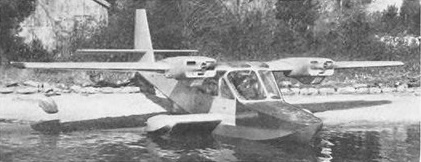
The Aqua was an original design developed by Aquaflight, Inc, a company founded in 1946 by Meredith C. Wardle. The type was only produced in prototype form and possibly the prototype was flown in two versions.
The W-6 Aqua I was the first version, a 4-6 seat utility flying boat which had two 125 hp Lycoming O-290-A series engines. Registered NX74141 it made the first flight during 1946 and was extensively tested at the Philadelphia Seaplane Base. Aqua I had an all metal fuselage, with a wooden hull and had a claimed cruise of 125 mph.
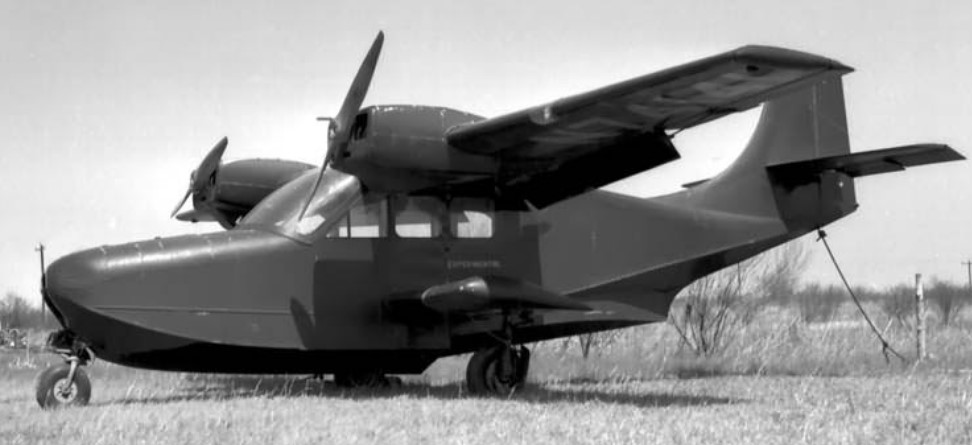
The W-6A Aqua II was possibly modified from the Aqua I, and had several major changes such as re-contoured nose section, a modified vertical tail and fin assembly and a tricycle landing gear, making it an amphibious flying boat. The Aqua II was powered by two 225 hp Lycoming O-435 engines and it made the first flight in 1949. No further work on either the Aqua I or II was undertaken.
Reports that later the boat hull of the Aqua II was used in the homebuilt Collins W-7 Dipper are incorrect.
The Aqua II was tested as landplane also.
W-6 Aqua I
Engines: 2 x Lycoming O-290, 125 hp (93 kW)
Wingspan: 36 ft 6 in (11.13 m)
Wing area: 215 sq ft (20.0 m2)
Airfoil: NACA 23012-16
Height (on land): 12 ft 0 in (3.66 m)
Length: 29 ft 6 in (8.99 m)
Empty weight: 2,200 lb (998 kg)
Gross weight: 3,600 lb (1,633 kg)
Fuel capacity: 100 US gal (83 imp gal; 380 L)
Max speed: 135 mph (217 kmh)
Cruise speed: 125 mph (201 km/h, 109 kn)
Stall speed: 40 mph (64 km/h, 35 kn) (half load)
Rate of climb: 1,250 ft/min (6.4 m/s)
Crew: one pilot
Capacity: 5 passengers
W-6A Aqua II
Engines: 2 x Lycoming O-360, 125 hp (93 kW)
Aquafugh Inc
Aquafugh inc was formed in 1946 by Meredith C. Wardle to build Aqua twin-engined amphibian. Aqua I prototype tested in Philadelphia as a pure flyingboat; Aqua II tested as landplane also. As W-6 the type was developed for small-scale production.
Applebay Mescalero
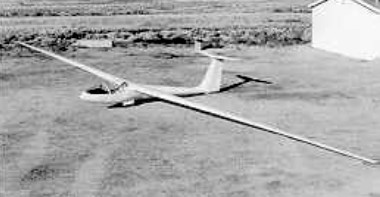
The Mescalero was designed by George Applebay in response to a 1970 sailplane design competition promoted by the Soaring Society of America and first flew in 1975. The controls are 100% mass balanced and connect automatically.
Wing span: 21.9m / 72ft
Wing area: 13.56sq.m / 146sq.ft
Empty Weight: 454kg / 1000lb
Payload: 227 kg / 500 lb
Gross Weight: 680 kg / 1500 lb
Wing Load: 50.15 kg/sq.m / 10.27 lb/sq.ft
Aspect ratio: 36
Airfoil: Wortmann
L/DMax: 44
No. of Seats: 1
Structure: fuselage and tail assembly, glass monocoque ; wing, composite metal-fiberglass.
Applebay Chiricahua GA-11
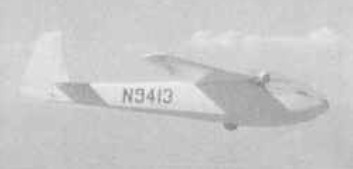
The Chiricahua was designed by George Applebay to comply with the Standard Class rules existing at the time construcion started, 1959, the first flew in 1970. It has a fixed main wheel and top surface Schempp-Hirth type airbrakes for approach control.
Wing span: 15m / 49.2ft
Wing area: 13.77sq.m / 148.2sq.ft
Empty Weight: 268kg / 590lb
Payload: 100kg / 220lb
Gross Weight: 368kg / 819lb
Wing Load: 26.73kg/sq.m / 5.47lb/sq.ft
No. of Seats: 1
Aspect ratio: 16.2
Airfoil: Gottingen 549
Structure: wood, plywood, ceconite
Apple Trail Air
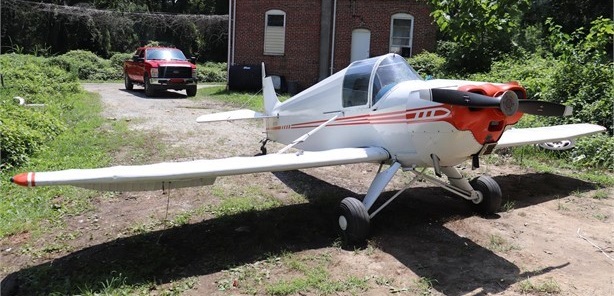
The 1964 Apple Trail Air single seater is an experimental aircraft powered by a Continental A65-8 engine and McCauley prop.
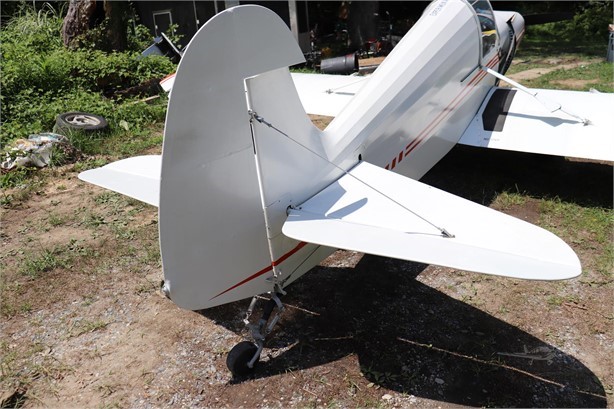
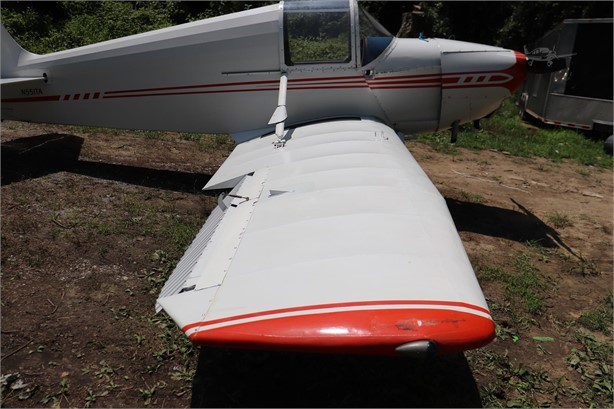
The wings fold up and in for compact storage. There are 4 total front wing struts, 2 on each wing, only 1 each in pictures.
Antonov An-32
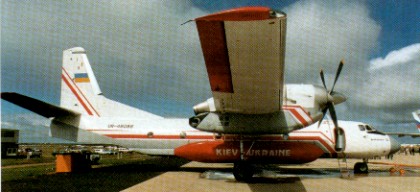
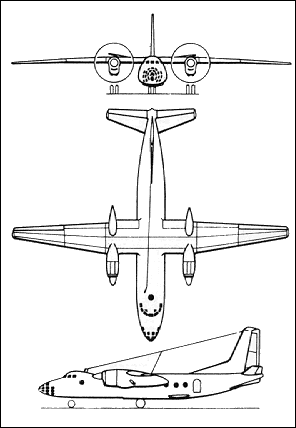
The An-24 was developed into the An-26 (freighter), the An-30 (survey/photo) and the An-32 (hot and high version). A short/medium-range twin-turboprop transport first flown July 1976, the An-32 has almost twice the installed power of the An-24.
Delivery of 95 An-32s to India, where it is known as the Sutlej, began in July 1984, to replace C-47 Dakotas and C-119 Packets. Peru became the third customer for the An-32, placing an order for 22 to replace its fleet of An-26s. Deliveries began with the first five aircraft in May 1987.

Engine: 2 x Ivchenko AI-20DM turboprop.
Installed pwr: 7720 kW.
Span: 29.2 m.
Length: 23.7 m.
Wing area: 75 sq.m.
MTOW: 27,000 kg.
Payload: 6700 kg.
Cruise speed: 530 kph.
Ceiling: 9000 m.
T/O run: 760 m.
Ldg run: 470 m.
Fuel internal: 5500 lt.
Range/payload: 800 km with 6700 kg.
Capacity: 39 pax.
Engine: 2 x Iwtshenko AI-20M, 4133 shp
Length: 78.084 ft / 23.8 m
Height: 28.15 ft / 8.58 m
Wingspan: 95.801 ft / 29.2 m
Wing area: 807.3 sqft / 75.0 sq.m
Max take off weight: 57330.0 lb / 26000.0 kg
Cruising speed: 275 kts / 510 km/h
Service ceiling: 31168 ft / 9500 m
Wing load: 71.14 lb/sq.ft / 347.00 kg/sq.m
Range: 1188 nm / 2200 km
Range (max. weight): 432 nm / 800 km
Crew: 5
Payload: 39 Pax
Antonov An-30
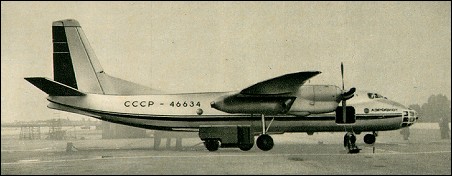
The Antonov An-24 was developed into the An-26 (freighter), the An-30 (survey/photo) and the An-32 (hot and high version). First flown 1974 with distinctive glazing around the nose, the An-30 Clank was built specifically for aerial survey work. The An-30 is essentially an Ant-24RT or an An-26 with mission related equipment fitted.
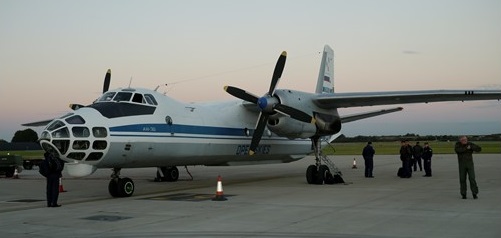
Aside from the dozen or so in service with Aeroflot, examples of the An-30 have been bought by Balkan Bulgarian Airlines, CAAC of China and the Romanian Air Force.
Engine: 2 x turbo prop AI-24VT, 2075 kW and turbo-jet RU-19A, 7.8kN
Take-Off Weight: 23000 kg / 50707 lb
Empty Weight: 15950 kg / 35164 lb
Wingspan: 29.2 m / 95 ft 10 in
Length: 24.3 m / 79 ft 9 in
Height: 8.3 m / 27 ft 3 in
Wing Area: 75.0 sq.m / 807.29 sq ft
Max. Speed: 540 km/h / 336 mph
Cruise Speed: 430 km/h / 267 mph
Range: 2600 km / 1616 miles
Crew: 6-7