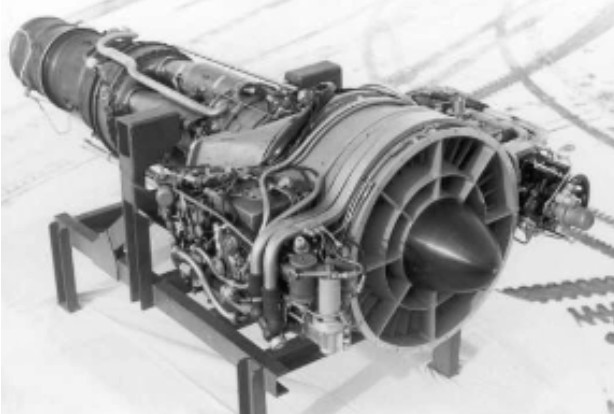
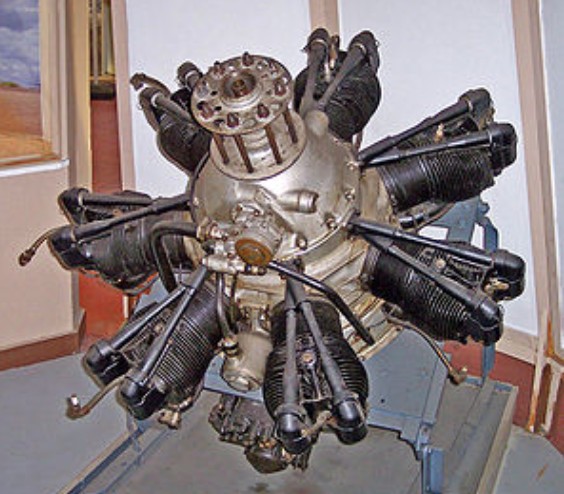
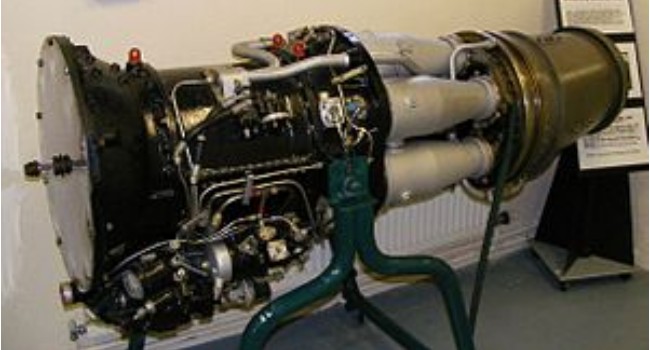
The Armstrong Siddeley Cougar was an aero engine developed by Armstrong Siddeley in 1945. The design was a departure from earlier Armstrong Siddeley engines in many ways, it was the company’s only nine-cylinder radial design. Although the engine was tested it did not find an aircraft application and was not produced.
Cougar Type: 9-cylinder single-row air-cooled radial engine Bore: 5.5 in (140 mm) Stroke: 5.5 in (140 mm) Displacement: 1,176 cu in (19 l) Length: 51.5 in (1,308 mm) Diameter: 49.5 in (1,257 mm) Dry weight: 1,020 lb (463 kg) Valvetrain: Overhead valve operated by pushrods Supercharger: 1 stage gear driven 8.17:1 supercharger Fuel system: R.A.E.-Hobson AS/C2 fuel injection to supercharger with automatic boost control Fuel type: 100/130 aviation gasoline (D.E.D. 2475) Oil system: pressure fed at 80 psi (551,580.58 Pa), dry sump, 100 S.U. (20.5 cs) grade oil (D. E.D. 2472B) Cooling system: Air-cooled Power output: (Take-off) 850 hp (634 kW) at 2,800 rpm at 46.0 inHg / +8.0Lb boost for 15 minutes (Maximum) 730 hp (544 kW) at 2,700 rpm at 7,500 ft (2,286 m) (Normal) 690 hp (515 kW) at 2,500 rpm at 6,000 ft (1,829 m) (Cruising) 500 hp (373 kW) at 2,300 rpm at 10,500 ft (3,200 m) Specific power: 0.76 hp/cu in (34.6 kW/l) Compression ratio: 6.3:1 Specific fuel consumption: 0.46 lb/hp/hr (0.011 kg/kW/hr) Oil consumption: 0.012 lb/hp/hr (0.005 kg/kW/hr) Power-to-weight ratio: 0.83 hp/lb (1.362 kW/kg)
The full scaled F+W N-20 aircraft was estimated to have a maximum speed of 1,095 km (680 mph), but the initial converted Mamba, the SM-1, which was test-flown under a de Havilland Mosquito in 1948 and was the first turbofan to fly, did not generate adequate thrust. Considerable further work was required for the definitive two-shaft SM-5 engine, which was meant to generate 14.7 kN (3,300 lbf) thrust. The prototype N-20 was completed in 1952 and, fitted with four SM-1 engines, flew briefly during a taxi test on 8 April 1952, but the development of the engine and the N-20 aircraft was cancelled soon afterwards.
The Armstrong Siddeley Screamer was a liquid oxygen (LOX) / methanol rocket engine intended to power the Avro 720 manned interceptor aircraft (Avro’s competitor to the Saunders-Roe SR.53 for a rocket-powered interceptor). Thrust was variable, up to a maximum of 8,000 lbf.
Work on the Screamer started in 1946, with the first static test at Armstrong Siddeley’s rocket plant at Ansty in March 1954. The programme was cancelled, as was the Avro 720, before flight testing.
In 1951, a Gloster Meteor F.8 was experimentally fitted with a Screamer mounted below the fuselage. The Screamer project was cancelled in March 1956, at a reported total cost of £ 650,000.
The Armstrong Siddeley ASSn. Snarler was a small rocket engine used for combined-power experiments with an early turbojet engine and was the first British liquid-fuelled rocket engine to fly. The Armstrong Siddeley’s used liquid oxygen (75 imperial gallons / 340 lt) and water-methanol (120 imperial gallons / 550 lt). The rocket engine is described as having a dry weight of 215 lbf (960 N) thrust of 2,000 lbf (8.9 kN) and a specific fuel consumption of 20 (lb/h)/lbf thrust. Work began in 1947 and the final configuration was first tested on 29 March 1950. The prototype of the Hawker P.1040 Sea Hawk, VP 401, had a Snarler rocket of 2,000 lbf (8.9 kN) thrust added in its tail. The Rolls-Royce Nene turbojet, of 5,200 lbf thrust, had a split tailpipe which exhausted either side of the fuselage. The combination was termed the Hawker P.1072. This gave approximately 50% greater thrust, although at a fuel consumption of around 20×. It was first used in flight on 20 November 1950, by Hawker’s test pilot Trevor “Wimpy” Wade. Half a dozen flights were made using the rocket motor before a minor explosion damaged the aircraft. Although methanol was used in the P.1072, jet fuel could be used for the Snarler. It was decided that reheat was a more practical proposition for boosting jet thrust than rockets. An unusual feature of the engine was that the turbopump was externally driven, by a drive from the gearbox of the P.1072’s turbojet engine.
Variants:
ASSn.1 Snarler The prototype and test engines, (given the Ministry of Supply designation ASSn.).
The Armstrong Siddeley Cheetah is a seven-cylinder British air-cooled aircraft radial engine of 834 cu in (13.65 lt) capacity first run in 1935 and produced until 1948. Early variants of the Cheetah were initially known as the Lynx Major. The Cheetah was used to power many British trainer aircraft during World War II including the Avro Anson and Airspeed Oxford.
The Cheetah was developed from the earlier Lynx using the increased bore cylinders from the Armstrong Siddeley Panther but the engine retained the stroke of the Lynx. Initially only direct-drive variants were produced with later engines being made available with propeller reduction gear of various ratios. Superchargers were also available for later variants, both geared and directly driven by the crankshaft.
The basic design of the Cheetah remained unchanged from its introduction in 1935 to the last examples built in 1948. It was the first engine of its type to be certified for 1,200 hours of operational time between overhauls, with over 37,200 examples built.
Variants:
Lynx V (Lynx Major) 1930, 230 hp (171 kW).
Cheetah V 1935, 270 hp (201 kW) at 2,100 rpm.
Cheetah VA 1935, 285 hp (212 kW) at 2,425 rpm.
Cheetah VI 1935, 307 hp (229 kW) at 2,425 rpm.
Cheetah VIA 1936, as Mk VI but with Mk IX cylinders.
Cheetah IX 1937, 345 hp (257 kW) at 2,425 rpm.
Cheetah X 1938, 375 hp (280 kW) at 2,300 rpm.
Cheetah XI 345 hp (257 kW) at 2,425 rpm, geared version of Cheetah X.
Cheetah XII Similar to Mk X, adapted for target drone aircraft.
Cheetah XV 420 hp (313 kW) at 2,425 rpm.
Cheetah XVII 1948, 385 hp (287 kW) at 2,425 rpm.
Cheetah XVIII 385 hp (287 kW) at 2,425 rpm, carburettor modified for aerobatics.
Cheetah XIX 355 hp (265 kW) at 2,425 rpm
Cheetah 25 345 hp (257 kW) at 2,425 rpm, Cheetah XV uprated to 475 hp (355 kW) at 2,700 rpm, modified constant-speed unit.
Cheetah 26 385 hp (287 kW).
Cheetah 27 1948, 385 hp (287 kW).
Applications: Airspeed Consul Airspeed Courier Airspeed Envoy Airspeed Oxford Airspeed Queen Wasp Airspeed Viceroy Avro 626 Avro 652 Avro Anson Blackburn Lincock Bristol Bulldog 626 Prefect CASA C-201 Alcotán de Havilland Hawk Moth Edgar Percival Prospector Handley Page H.P.R.2 Hispano HS-42 IAe.22 DL Kingsford Smith PL.7 Koolhoven F.K.51 Marinens Flyvebaatfabrikk M.F.8 Marinens Flyvebaatfabrikk M.F.10 Percival Provost (prototype) VEF JDA-10M
Specifications:
Cheetah IX Type: Seven-cylinder single-row supercharged air-cooled radial engine Bore: 5.25 in (133 mm) Stroke: 5.5 in (140 mm) Displacement: 834 cu in (13.65 L) Length: 52.8 in (1,342 mm) Diameter: 47.6 in (1,210 mm) Dry weight: 637 lb (289 kg) Valvetrain: Two pushrod-actuated valves per cylinder Supercharger: Centrifugal, 5.4:1 reduction Fuel system: Claudel-Hobson carburettor Fuel type: 87 octane rating petrol Cooling system: Air-cooled Reduction gear: No Power output: 338 hp (252 kW) at 2,100 rpm for takeoff
345 hp (257 kW) at 2,425 rpm at 7,875 ft (2,400 m) Specific power: 0.41 hp/cu in (18.83 kW/L) Compression ratio: 6.35:1 Specific fuel consumption: 0.45 lb/hp/hr (271 g/kW/hr) Oil consumption: 0.24–0.45 oz/hp/hr (9–17 g/kW/hr) Power-to-weight ratio: 0.54 hp/lb (0.89 kW/kg)
The design started as an experimental pure-turbojet known as the ASX, which commenced testing in 1943. By this point other engine designs were already entering pre-production, and it seemed there was little need for the ASX in its existing form. The design was then modified into the turboprop layout with the addition of a second turbine stage, which was geared to the propeller and was named ASP at that stage.
Early flight-testing of the Python was carried out using the Lancaster B.1 (FE) TW911 and the Lincoln B.2 RE339/G, each aircraft having the two outboard Rolls-Royce Merlins replaced by Pythons. Lincoln B.2 RF403 also had two Pythons similarly installed and was used for high-altitude bombing trials at Woomera, South Australia, the Pythons being used to increase the height from which tests could be carried out. These trials were principally of the ballistic casings for the Blue Danube atomic weapon, there being at the time no other suitable aircraft available that could accommodate the large weapon casing measuring 62 inches diameter x 24 feet (7.3 m) in length, and carry it to the height required. Maximum release height and speed for the first eleven tests was 275 mph and 34,783 ft (10,602 m) with a bombing error of 61 ft.
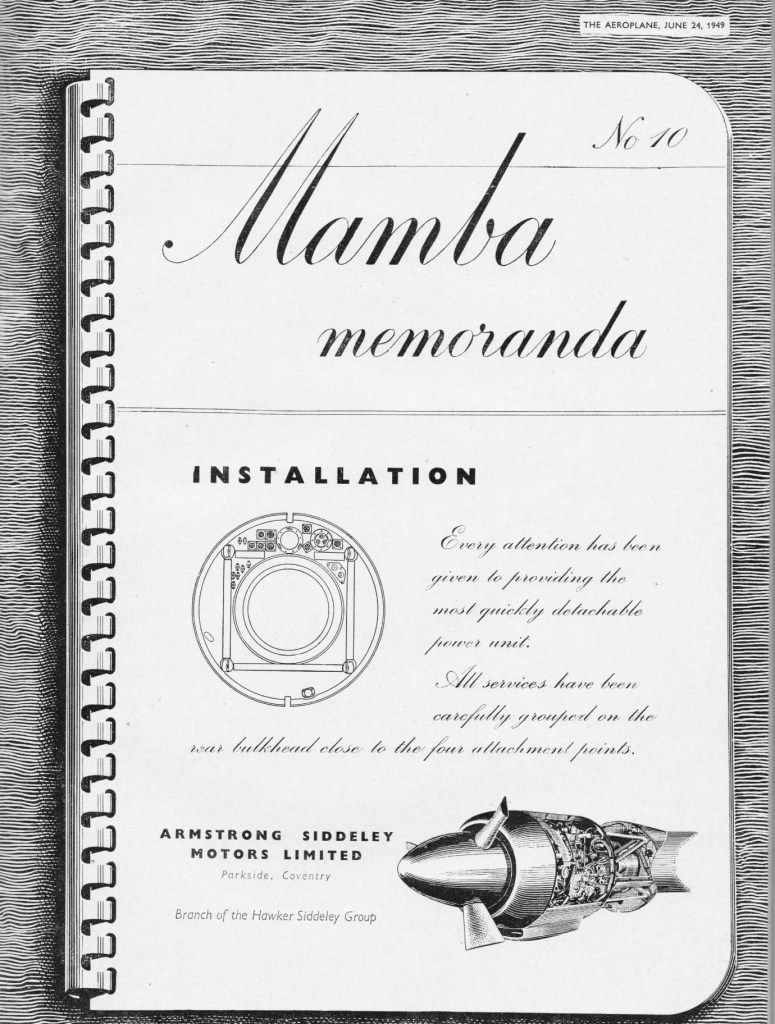
The Mamba was a compact engine with a 10-stage axial compressor, six combustion chambers and a two-stage power turbine. The epicyclic reduction gearbox was incorporated in the propeller spinner. Engine starting was by cartridge. The Ministry of Supply designation was ASM (Armstrong Siddeley Mamba). First run in April 1946, the ASM.3 gave 1,475 ehp and the ASM.6 was rated at 1,770 ehp. A 500-hour test was undertaken in 1948 and the Mamba was the first turboprop engine to power the Douglas DC-3, when in 1949, a Dakota testbed was converted to take two Mambas.
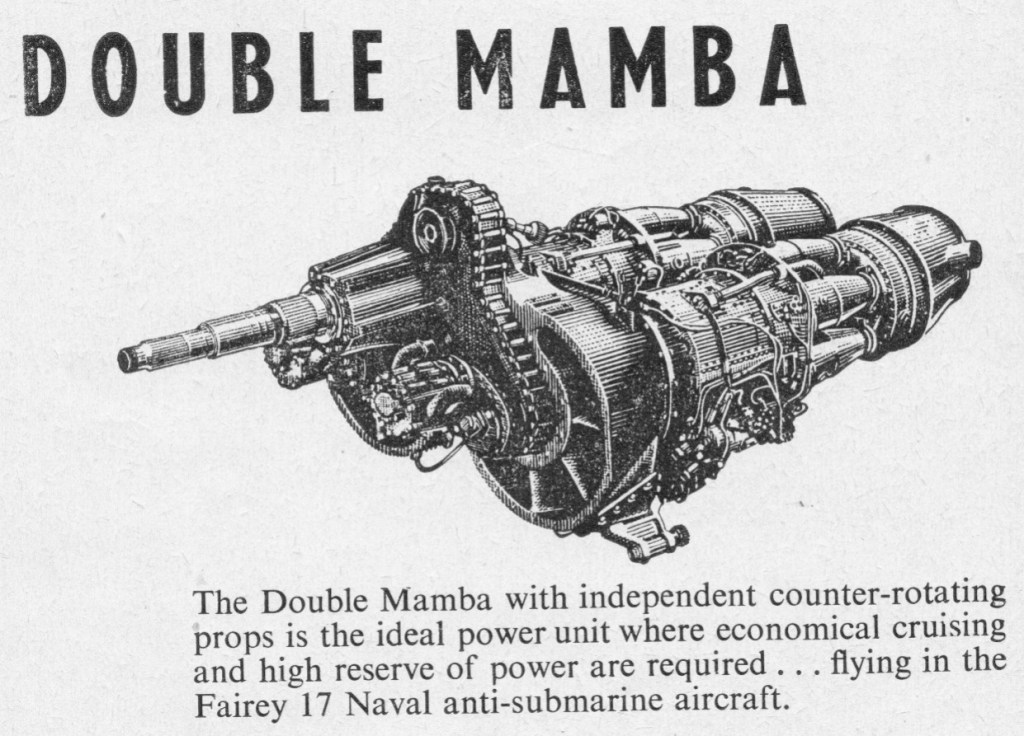
The Mamba was also developed into the form of the Double Mamba, which was used to power the Fairey Gannet anti-submarine aircraft for the Royal Navy. This was essentially two Mambas lying side-by-side and driving contra-rotating propellers separately through a common gearbox.
A turbojet version of the Mamba was developed as the Armstrong Siddeley Adder, by removing the reduction gearbox.
Variants and applications:
ASM.3 Mamba Armstrong Whitworth Apollo Avro Athena Boulton Paul Balliol Breguet Vultur Miles M.69 Marathon II Douglas C-47 Dakota
ASM.6 Mamba Short Seamew
Specifications:
ASM.3 Type: Turboprop Length: 87.3 in (2217.4 mm) Diameter: 29 in (737 mm) Dry weight: 780 lb (354 kg) Compressor: 10 stage axial flow Combustors: 6 combustion chambers Turbine: 2 stage Maximum power output: 1,320 shp plus 405 lbf (1.80 kN) thrust (1,475 eshp) Overall pressure ratio: 5.35:1 Specific fuel consumption: 0.8 lb/h/eshp Power-to-weight ratio: 1.9 eshp/lb
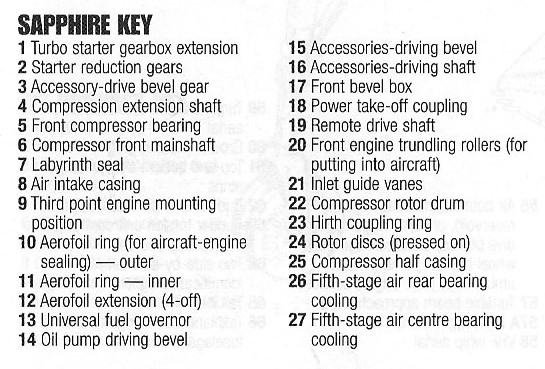
Design evolution of the Sapphire started at Metropolitan-Vickers (Metrovick) in 1943 as an offshoot of the F.2 project. With the F.2 reaching flight quality at about 1,600 lbf (7,100 N), the Metrovick engineers turned to producing larger designs, both an enlarged F.2 known as the Beryl, as well as the much larger F.9 Sapphire, the names being chosen after they decided to use gemstones for future engine names. The Beryl was soon running and eventually developed 4,000 lbf (18 kN) thrust, but the only project to select it, the Saunders-Roe SR.A/1, was cancelled.
By this point the F.9 MVSa.1 was developing about 7,500 lbf (33 kN), more than its competitor from Rolls-Royce, the Avon. A number of companies expressed interest in the F.9, and it was considered as either the main or backup powerplant for most late-40s/early-50s British designs.
At about the same time, Metrovick exited the jet engine industry, with their design team being quickly acquired by Armstrong Siddeley. Although Armstrong Siddeley already had a turbine development of their own, the ASX, they were primarily focused on turboprops and the Metrovick team was a welcome addition.
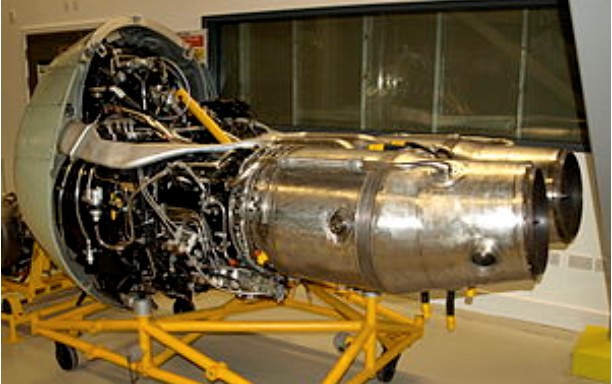
Work on the F.9 continued, now renamed the ASSa.5, and was delivered at 7,500 lbf (33,000 N) ratings. First run on 1 October 1948. This early engine was used only on the English Electric P.1.A, prototype for the famed Lightning. The fit was not entirely a happy one, and the afterburning ASSa.5R did little to address this, delivering an improved 9,200 lbf (41,000 N) “wet”, but doing so in an unreliable fashion that demanded a short period of “no use” while the problems were addressed. Future versions of the Lightning would be powered by the Avon instead.
The engine was soon passing tests at ever-increasing power settings. The ASSa.6 increased power to 8,300 lbf (37,000 N), and powered the Gloster Javelin FAW Mk.1, Hawker Hunter F.Mk.2 and F.Mk.5, and the prototype Sud Ouest SO 4050 Vautour. The dramatically more powerful ASSa.7 at 11,000 lbf (49 kN) was the first British engine to be rated above 10,000 lbf (44 kN), powering the Gloster Javelin FAW Mk.7, Handley Page Victor B.Mk.1 and a prototype Swiss fighter-bomber, the FFA P-16.
Afterburners of limited pergormance, (given the colloquialism “weeheat”, were also added to the ASSa.7, producing the 12,390 lbf (55,100 N) wet ASSa.7LR, used on some Gloster Javelin FAW Mk.8’s. An improved model produced 15,000 lbf (67 kN) above 20,000 ft (6,100 m), appearing on other FAW Mk.8’s and all FAW Mk.9’s.
Curtiss-Wright purchased a license for the Sapphire in 1950, with plans to have the production lines running in 1951. However a series of delays led to its service introduction slipping a full two years, by which point the Pratt & Whitney J57 was on the market and took many of the J65’s potential sales.
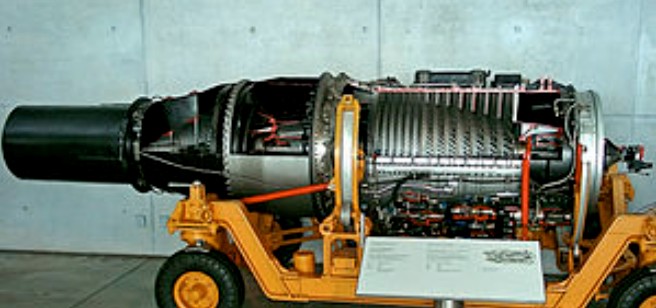
Sectioned Wright J65
Nevertheless, once it entered production it proved to be as good as the British versions, and along with the Martin B-57, its original target, the J65 went on to power versions of the North American FJ Fury, Douglas A-4 Skyhawk, Republic F-84F Thunderstreak, and the two Lockheed XF-104 Starfighter prototypes.
A 6,500-10,380ehp turboprop version of the J65 (Sapphire) was developed by Curtiss-Wright as the Wright T49.
Variants:
MVSa.1 Ministry of supply designation of the original Metropolitan-Vickers F.9 Sapphire, derived from the Metropolitan-Vickers F.2/4 Beryl, design work on this much larger engine started in 1943.
Metropolitan-Vickers F.9 Sapphire Company designation for the MVSa.1
ASSa.5 Early Armstrong Siddeley developed Sapphire engines.
ASSa.5R Reheated engines fitted to the English Electric P.1A with limited success.
ASSa.6 Later engines developed for the Gloster Javelin FAW Mk.1, Hawker Hunter F.Mk.2, F.Mk.5 and the prototype Sud Ouest SO 4050 Vautour
ASSa.7 Rated at 11,000 lbf (49 kN), powering the Gloster Javelin FAW Mk.7, Handley Page Victor B.Mk.1 and the prototype FFA P-16.
ASSa.7LR Engines with a 12% augmentation reheat system for use above 20,000 ft (6,100 m) for use at altitude, powering the Gloster Javelin FAW Mk.8.
Wright J65 Licence production in the United States by Wright Aeronautical
Applications: Sapphire English Electric P.1.A FFA P-16 Gloster Javelin Handley Page Victor Hawker Hunter
Wright J65 Douglas A-4 Skyhawk Grumman F-11 Tiger Martin B-57 Canberra Lockheed XF-104 North American FJ-3 Fury North American FJ-4 Fury Republic F-84F Thunderstreak
Specifications:
ASSa.7 / 7LR Type: ASSa.7 Turbojet, ASSa.7LR Augmented turbojet Length: ASSa.7 125.2 in (3,180 mm), ASSa.7LR 293 in (7,442 mm) Diameter: 37.55 in (954 mm) Dry weight: ASSa.7 3,050 lb (1,383 kg), ASSa.7LR 3,180 lb (1,442 kg) Compressor: 13 stage axial flow Combustors: Annular with 24 hockey-stick vaporisers Turbine: Two stage Fuel type: Avaition kerosene to DERD 2482 or DERD 2486 Oil system: Flood feed, minimum oil pressure 12 psi (83 kPa), tank capacity 18 imp pt (10 l), oil grade to DERD 2487. Maximum thrust: ASSa.7 11,000 lbf (49 kN) at sea level at 8,000 rpm, ASSa.7LR 12,390 lbf (55 kN) above 20,000 ft (6,096 m). Specific fuel consumption: 0.885 lb/hr/lb (90.214 kg/kN/hr) at Take-off rating Thrust-to-weight ratio: 3.607 lbf/lb (0.035 kN/kg)
The Armstrong Siddeley Double Mamba was a turboprop engine design developed in the late 1940s of around 3,000–4,000 hp (2,500–3,000 kW). It was used mostly on the Fairey Gannet (First flight 29 September 1949) anti-submarine aircraft developed for the Fleet Air Arm of the Royal Navy.
The Double Mamba (rarely known as the Twin Mamba) was a development of the Armstrong Siddeley Mamba with two Mambas driving contra-rotating propellers through a combining gearbox. Engine starting was by cartridge, however, forced air restart was achieved in flight. One engine could be shut down in flight to conserve fuel.
Ministry of Supply designation system: AS = Armstrong Siddeley M = Mamba D = Double num = model
Variants and applications:
ASMD.1 Type: Turboprop engine Component engines: 2 x ASM.3 Maximum power output: 2950 eshp Aircraft fitted: Fairy Gannet A.S. Mk.1 Blackburn B88 (prototype)
ASMD.3 Type: Turboprop engine Component engines: 2 x ASM.5 Compressor: 10 stage axial (x2) Combustors: Six combustion chambers (x2) Length: 102.25 in (2,597 mm) Diameter: 52.8 in (1,341 mm) Dry weight: 2,170 lb (984 kg) Maximum power output: 2,960 eshp (2,207 kW) Overall pressure ratio: 5.35:1 Power-to-weight ratio: 1.36 eshp/lb Aircraft fitted: Fairy Gannet A.S. Mk.4
ASMD.4 Type: Turboprop engine Component engines: 2 x ASM.6 Maximum power output: 3875 eshp Aircraft fitted: Fairy Gannet AEW Mk.3
The ASX was an early axial flow jet engine built by Armstrong Siddeley that first ran in April 1943. Very little information on the engine is available, and it appears it was never put into production. A turboprop version as the ASP was somewhat more successful, and as the Armstrong Siddeley Python saw use in the Westland Wyvern. The ASX was unique in layout. The inlet to the 14-stage compressor was placed near the middle of the engine, the air flowing forward as it was compressed. From there it fed into 11 flame cans arranged around the outside of the compressor, flowing back past the inlet, and finally through the turbine. This layout allowed the compressor and combustion areas to be “folded” together to make the engine shorter, although the overall reduction in the case of the ASX appears to be fairly limited. Additionally this makes it more difficult to service the compressor, although in modern designs it is the “hot section” that generally requires most servicing. The ASX was flight tested fitted to the bomb bay of a modified Avro Lancaster, ND784, the first flight taking place on 28 September 1945. At full power the engine ran at 8,000 rpm and developed 2,600 lbf (12 kN) of thrust at sea level. For cruise the engine ran at 7,500 rpm and developed 2,050 lbf (9.1 kN). It weighed 1,900 lb (865 kg). The ASP conversion used a second turbine stage to drive the propeller through a gearbox, producing 3,600 shp, as well as 1,100 lbf (4.9 kN) of leftover jet thrust. Beyond this, little has been published about this engine. Armstrong Siddeley appears to have given up on the design just after the war, and took over the Metrovick F.9 Sapphire design instead.
Components: Compressor: 14-stage axial reverse-flow compressor Combustors: 11 stainless steel can combustion chambers arranged around the compressor Turbine: 2-stage axial Fuel type: Kerosene (R.D.E. / F / KER) Oil system: pressure feed to bearings, dry sump, 80 S.U. secs (10.2 cs) (D.E.D. 2472D) grade oil
ASX Type: Axial flow turbojet Length: 167 in (4,241.8 mm) Diameter: 42 in (1,066.8 mm) Dry weight: 1,900 lb (861.8 kg) Maximum thrust: 2,600 lbf (11.57 kN) at 8,000 rpm at sea level Overall pressure ratio: 5:1 Turbine inlet temperature: 1,220 °F (660 °C) Specific fuel consumption: 1.03lb/lbf/hr (104.98 kg/kN/hr) Thrust-to-weight ratio: 1.37 lbf/lb (0.0134 kN/kg) Military thrust, static: 26,000 lbf (115.65 kN) at 8,000 rpm at sea level Cruising, static: 2,050 lbf (9.12 kN) at 7,500 rpm at sea level Idling, static: 130 lbf (0.58 kN) at 3,000 rpm at sea level