Designed by Maurice Delanne, the Arsenal-Delanne 10-C2 two-seat fighter was built by the Arsenal de l’Aeronautique. Of so-called Nenadovich biplane configuration, the tandem-mounted wings provided a continuous slot effect and offered a large C of G range. Of metal stressed-skin construction and powered by an 860hp Hispano-Suiza 12Ycrs 12-cylinder liquid-cooled engine, the Arsenal-Delanne 10-C2 prototype was virtually complete at Villacoublay when German forces occupied the factory in June 1940, work on the aircraft continued and the first flight test was made in October 1941. After completion of the initial test programme, the aircraft was ferried to Germany for further trials. The intended armament comprised an engine-mounted 20mm Hispano-Suiza cannon, two wing-mounted 7.5mm MAC 1934 machine guns and two further 7.5mm weapons on a flexible mounting.
Arsenal-Delanne 10-C2 Engine: 860hp Hispano-Suiza 12Ycrs 12-cylinder liquid-cooled Take-off weight: 2880 kg / 6349 lb Wingspan: 10.11 m / 33 ft 2 in Length: 7.33 m / 24 ft 1 in Height: 3.06 m / 10 ft 0 in Wing area: 22.5 sq.m / 242.19 sq ft Max. speed: 550 km/h / 342 mph
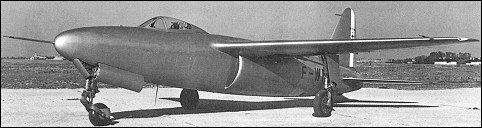
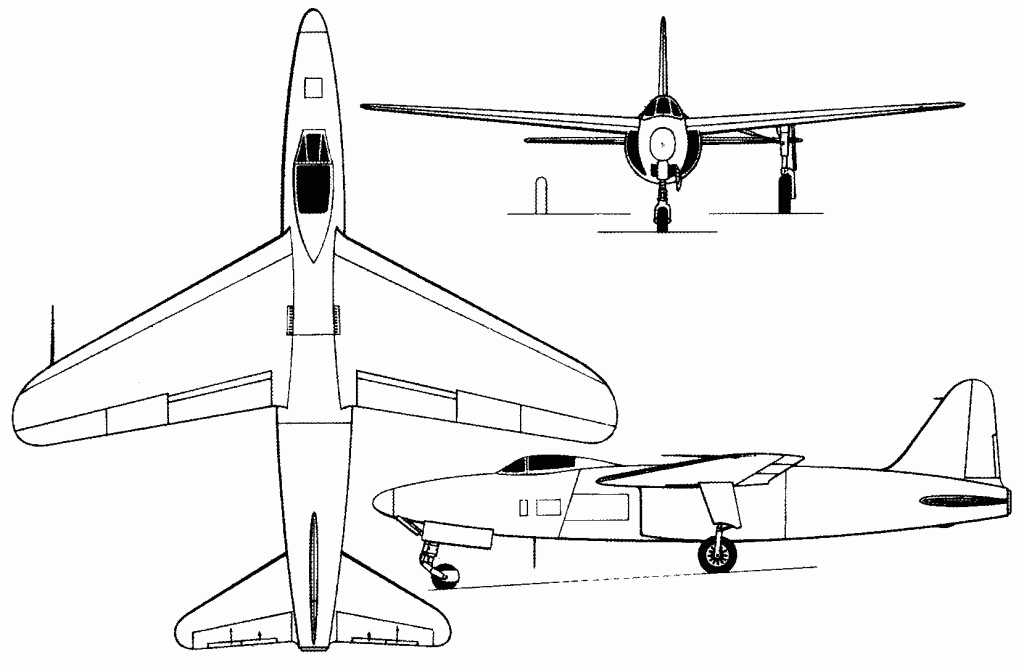
The VG.90 naval prototype was developed from the VG.70 as part of a single-seat shipboard interceptor and strike fighter development programme in competition with the Aerocentre NC 1080 and the Nord 2200. Designed by Vernisse and Galtier, the first two VG.90 prototypes were built of wood, and the first of these made its maiden flight on 27 September 1949 and the second in June 1951: both aircraft were lost in accidends. Powered by a 2268kg Rolls-Royce Nene turbojet, the VG 90 had an all-metal fuselage, and the wing and tail surfaces were metal structures with plywood skinning. Planned armament comprised three 30mm Hispano-Suiza cannon and provision was made for underwing ordnance loads, such as two 500kg bombs. The second prototype had provision for two 20mm cannon, two 7.7mm machine guns and 36 RAC 50 rockets internally, plus 16 T10 or 80 RAC 50 rockets on wing racks. A third all-metal prototype, which was to be powered by a 4000kg SNECMA Atar 101F turbojet, never flew and was abandoned. Full performance trials were not completed and the following data are manufacturer’s estimates for the VG 90 with a 2850kg version of the Hispano-Suiza-built Nene.
Take-off weight: 8090 kg / 17835 lb Empty weight: 5100 kg / 11244 lb Wingspan: 12.60 m / 41 ft 4 in Length: 13.44 m / 44 ft 1 in Height: 3.55 m / 11 ft 8 in Wing area: 30.7 sq.m / 330.45 sq ft Max. speed: 920 km/h / 572 mph Range: 1550 km / 963 miles
This French high performance single-seater was designed and produced just after the war by Arsenal de I’Aeronautique.
The Air 100 was designed for the French National Gliding Centres and clubs, and was a cantilever high wing monoplane of mainly spruce and plywood construction. The 18m span wing featured slotted ailerons and spoiler-type flaps, and the landing gear consisted of a central monowheel with a landing skid fore and aft of it, plus a tail skid.
An Air 100 flown by Eric Nessler set up a new French record for distance in a straight line of 311 miles (501 km) at Wichita Falls, USA, on 14 July 1947.
The final production version was the Air 102.
Air 100 Span: 59ft 0 in Length: 26ft 4 in Wing area: 194 sq.ft Aspect ratio: 18.0 Empty weight: 535 lb Max weight: 745 lb Normal gliding speed: 39.7 mph
Established in 1936 in old Breguet factory at Villacoublay. Products were generally designated by initials of Vernisse (director) and Galtier (designer). VG 30 was lightweight fighter; VG 33 a more powerful development (200 ordered and many being assembled by June 1940). Arsenal-Delanne 10 was unorthodox tandem monoplane two-seater, flown 1941. Experimental work on fast and unorthodox aircraft resumed after war, when VB 10 fighter with tandem piston engines and contrarotating propellers was flown. VG 70 had German Junkers Jumo 004 turbojet; VG 90 was naval jet fighter; 5.501 a pilotless aircraft; 0.101 a research monoplane for testing aerofoil sections, spoilers, etc. After 1954 became SFECMAS (Societe Frangaise de Construction de Materiaux Speciaux). Arsenal joined SNCAN in 1955.
This single-seat amphibian/flying boat N69966 was designed and built by Mr. Fred N. Arnoldi (hence Frenard) and several colleagues of the Curtiss-Wright company. The aircraft was intended as flying scale for a planned (unbuilt) 4-seat aircraft and it was completed in 1948/1949 and then powered by a 50hp Continental A50.
Many years later (in the 1970s) the aircraft was advertised for sale as the Bohmer Canard and it had been re-engined with a 65hp Continental A65.
The aircraft is still on the FAA register as the Frenard Experimental. The Duck was claimed to be easy to convert for land or water use and the wing floats and landing gear were removable.
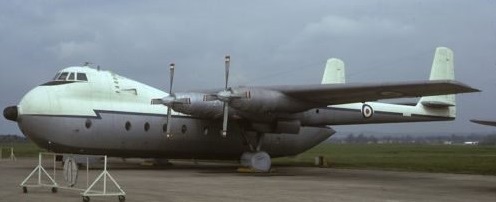
Designed by Armstrong Whitworth later incorporated into Hawker Siddeley Group, the first prototype flew on January 8, 1959.
In order to shorten development time, Armstrong Whitworth put in hand a batch of ten of their Argosy Freighters, without waiting for firm orders. The second of these flew on 8 January 1959. Orders were received from Riddle Airlines and for a military version by RAF Transport Command.
The private venture Argosy completed flight trials during 1960. The first operators were to be Trans-Arabia Airlines and Riddle Airlines.
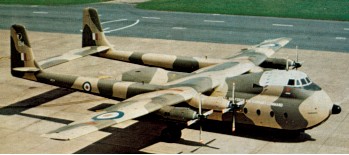
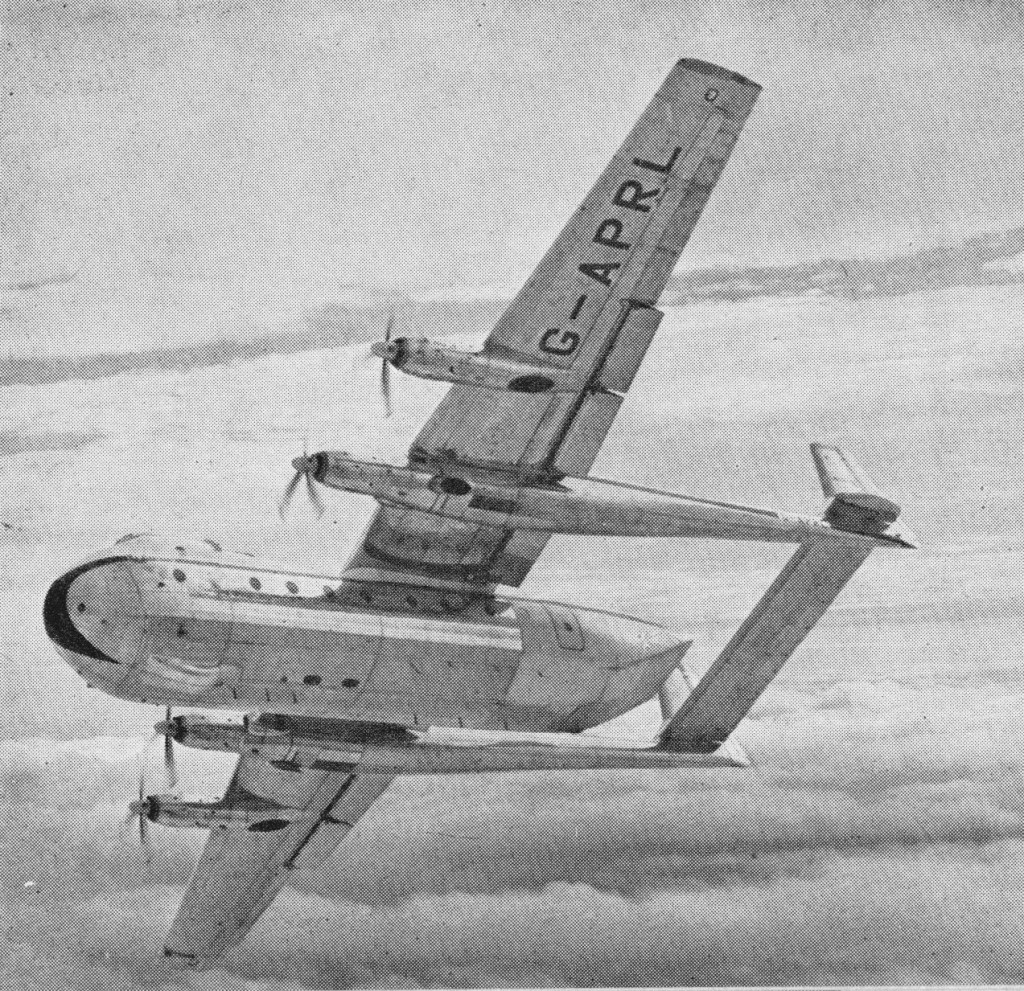
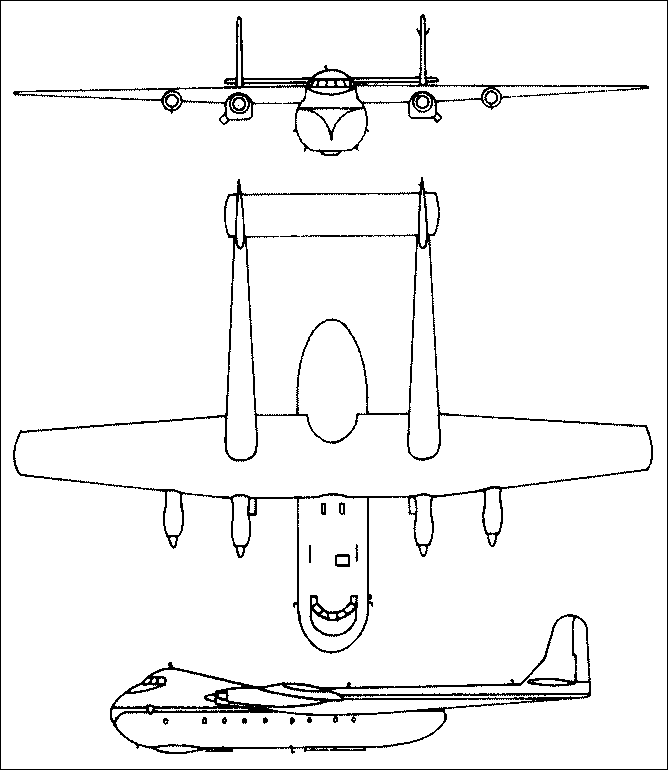
The series 100 led to the military Armstrong-Whitworth (later WhitworthGloster and Hawker-Siddeley) AW660 Argosy derived from the civil AW650, major design changes involving a “beaver tail” for air para-dropping, fixed nose doors, heavier and strengthened floor, Smith’s military flight system, Ekco weather radar-the scanner housing providing the characteristic bump on the nose and other internal equipment changes. Twenty aircraft (XN814-821, XN847-858) were ordered in January 1959 to replace the last of the Valettas, and a manufacturer’s prototype, G-APRL, was first flown on July 28, 1960, with some of the military modifications including the beaver tail doors. Follow-on production orders were placed for a further 36 aircraft (XP408-413, XP437-450, XR105-109, XR133-143), while the first RAF Argosy C1 (XN814) was flown for the first time on March 4, 1961. Together with the second aircraft it soon passed to the A&AEE at Boscombe Down for service trials prior to entry into service.
AW.660 prototype G-APRL
The variety of roles adopted by the Argosy are very wide-it can carry 54 fully-equipped paratroops (with two despatchers and one additional loadmaster); or two Ferret scout cars/ Land Rovers plus 20 troops in the air-transport role; or 64 passengers (with two air quartermasters); or 48 stretcher patients (with four attendants and two AQMs) for casevac. As a tactical support aircraft it can deliver nine x one ton containers or two medium-stressed platforms (12 0001b each). In the photographic role F-117B cameras can be installed, and for air-sea rescue Lindholme containers and flares are carried.
In the mid-1960s the first four operational squadrons (105, 114, 215 and 267) were active in the Far East, Gulf and European theatres.
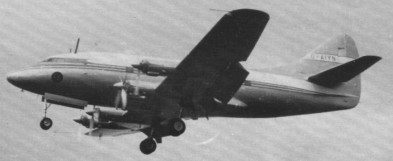
RAF Argosy XP409
An early attempt to offset the problems of short range was tried with XN819 early in 1962 when in-flight refuelling equipment was fitted. However, after trials at the A&AEE Boscombe Down, it was decided not to proceed with the modification programme. In the internal-security fit in 1963 XN814 was modified to accommodate external bomb racks (for 14 bombs) on each side of the lower fuselage; the nose window was equipped as a bomb aimer’s position. After successful trials with the “Argi-bomber” the aircraft used in Aden and the Far East were given this modification. There is no evidence that they were operationally used in this offensive role. The C and E Mk.1 aircraft had higher gross weights and more powerful engines than the 222. Fifty six were used by the RAF. With the delivery to the RAF of the Hercules it was announced in 1968 that the Argosy would be withdrawn from tactical transport duties by 1970. However the fuel tank corrosion problems encountered by the Hercules and the subsequent withdrawal of aircraft for modification meant that this target date could not be reached. The 660 had the ‘Shackleton Wing’ and had ‘clam-shell’ doors at the rear of the fuselage to allow air-dropping of stores. Unlike the civil 650, the nose was fixed. The early versions of the civil AW 650 also had the ‘safe life’ Shackleton wing. It was main spar failure that curtailed the fatigue life of the AW 650/660 aircraft. However later versions known as AW 650 200 were manufactured with a ‘fail safe’ wing of much more modern structural philosophy. The series 200 can be recognised as it is fitted with large wing fences. The 222 model was designed to the specifications of British European Airways, and began service in 1965. The 200 Series featured a redesigned box-spar increasing the MAUW and fuel capacity. Only 17 civilian Argoseys were built.
Argosy series 100 Engines: 4 x Rolls-Royce Dart 526 turbo-prop, 1506kW Take-off weight: 39916 kg / 88000 lb Empty weight: 20865 kg / 46000 lb Max payload: 28,000 lbs. Wingspan: 35.05 m / 114 ft 12 in Length: 26.44 m / 86 ft 9 in Height: 8.23 m / 27 ft 0 in Wing area: 15.45 sq.m / 166.30 sq ft Cruise speed: 451 km/h / 280 mph Ceiling: 6100 m / 20000 ft Range: 3219 km / 2000 miles Crew: 2-3 Passengers: 84
AW650-222 Cruise: 240 kts. No built: 7. Max payload: 31,000 lbs. MAUW: 93,000 lbs. Max range: 1600 nm. Approach speed: 108 kts.
Hawker Siddeley / Armstrong Whitworth AW 650 Argosy C Heavy transport aircraft, United Kingdom, 1961 Length: 89.173 ft / 27.18 m Wingspan : 114.993 ft / 35.05 m Max take off weight : 103017.6 lb / 46720.0 kg Max. speed : 233 kts / 431 km/h Service ceiling : 20013 ft / 6100 m Range : 300 nm / 555 km Engine : 4 x RollsRoyce Dart RDa 8 Mk 101, 2680 shp Crew : 3+69
Argosy C1 Engines: 4 x Rolls-Royce Dart RDa8 Mk102 turboprops, 2210 shp (dry) or 2470 shp (with water-methanol injection). MAUW: 97 000 lb. Cruise: 220kt @ 10000-20000ft. Max payload / range: 24600 lb over 180 nm. Max range/payload: 1700nm with 3500 lb. Radius of action/payload: 750nm with 5000 lb.
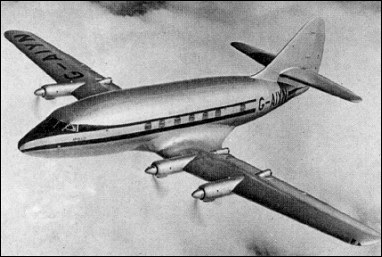
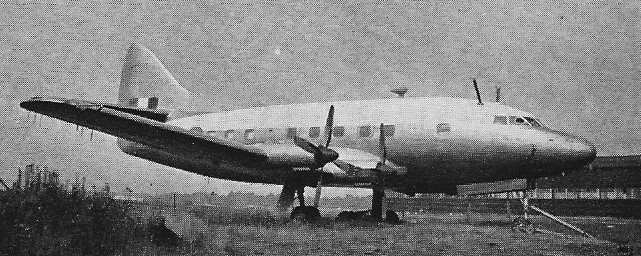
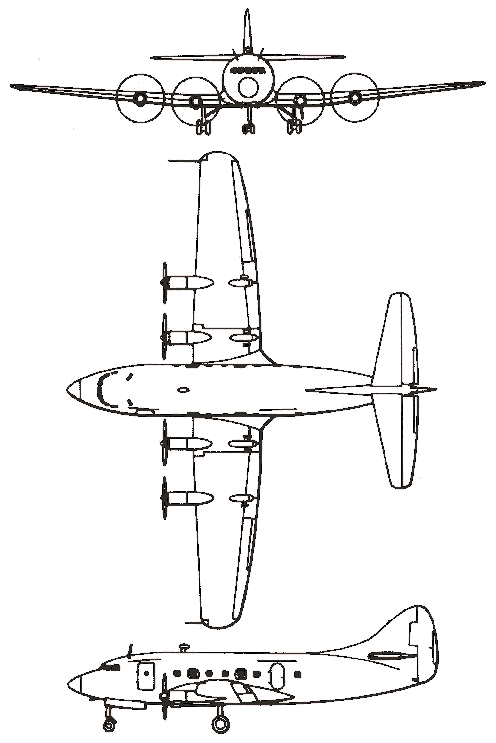
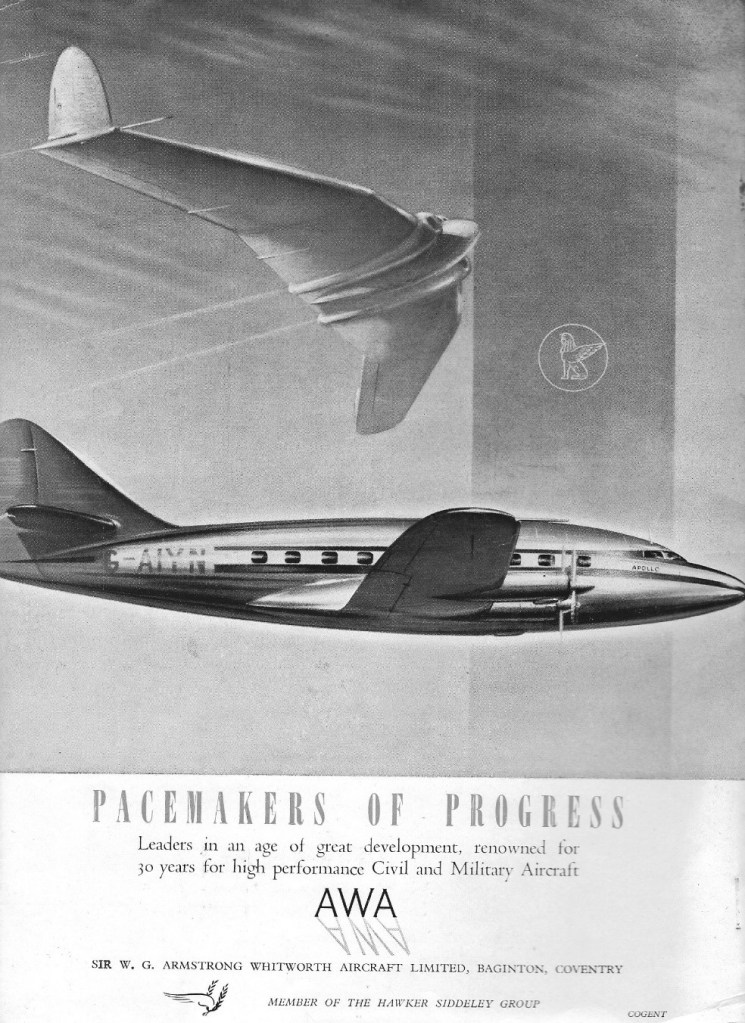
The Armstrong Whitworth AW.55 Apollo was designed as a competitor to the Vickers Viscount in response to the requirement outlined in the wartime Brabazon Committee’s Type II civil transport. It was a short- and medium-range airliner intended for operations in Europe. Specification C.16/46 to which the Apollo was designed, called for a turboprop-powered airliner to carry between 24 and 30 passengers over a range of 1609km at 483km/h.
The engine selected was the axial-flow Armstrong Siddeley Mamba centrifugal-flow turboprops but it was prone to teething problems. In the form first used on the Apollo, the engine should have developed 1010hp plus 139kg thrust, whereas it developed only 800hp.
Right from the beginning of the design, the AW.55 (first named Achilles and Avon before finally becoming Apollo) had a span of 28.04m, but length was increased from 19.66m to 20.73m and at the production stage to 21.79m, providing accommodation for between 26 and 31 passengers seated two-abreast on each side of a central aisle.
Construction began in 1948 of two flying prototypes and a fuselage for static testing. The first prototype was given the Ministry of Supply serial VX220, and made its initial flight on April 10, 1949, powered by four 1135shp A.S.Mamba A.S. Ma.1 turboprops. Control problems were remedied and the first prototype, re-registered G-AIYN, was available from October 30, 1950 for proving flights, starting with a successful flight to Paris on March 12, 1951.
In July 1951 the Mamba Mk 504 engines became available, but even these had severe limitations and problems and in June 1952 further development was halted.
The second prototype was completed with detail modifications and flew on 12 December 1952, powered by four 1475 hp Mamba A.S. Ma.3 turboprops, and both aircraft were used for a variety of experimental work for the Ministry of Supply, which had funded them. Both aircraft became structural-test airframes in December 1954.
2nd Prototype Engines: 4 x Mamba A.S. M3.3, 1475 hp Wingspan: 92 ft Wing area: 986 sq.ft Length: 71 ft 5.5 in Height: 26 ft Loaded weight: 47,000 lb Max cruise: 310 mph at 25,000 ft Range: 1130 mi at 280 mph at 25,000 ft w/payload 7500 lb
Engines: 4 x Armstrong Siddeley Mamba Mk 504 turboprops, 750kW Take-off weight: 20412 kg / 45001 lb Empty weight: 13791 kg / 30404 lb Payload: 3402 kg / 7500 lb Wingspan: 28.04 m / 91 ft 12 in Length: 21.79 m / 71 ft 6 in Height: 7.92 m / 25 ft 12 in Wing area: 91.6 sq.m / 985.97 sq ft Cruise speed: 444 km/h / 276 mph Range: 1513 km / 940 miles Crew: 3 Passengers: 31
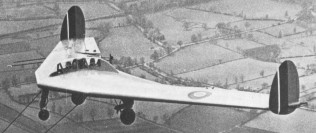
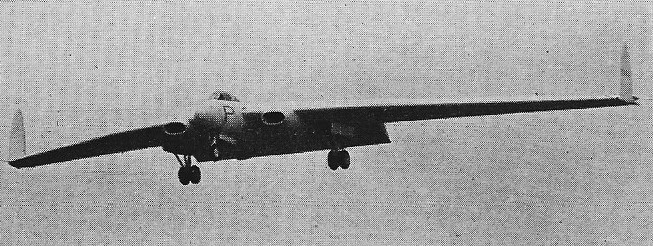
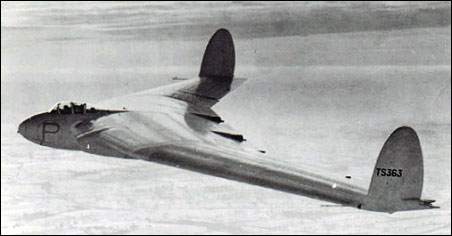
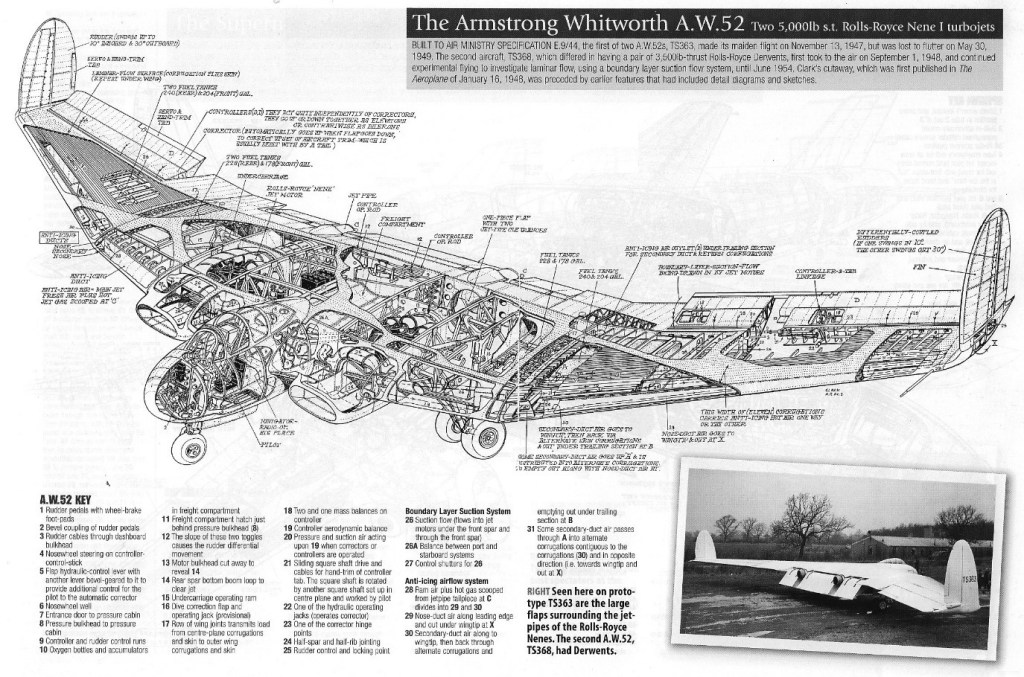
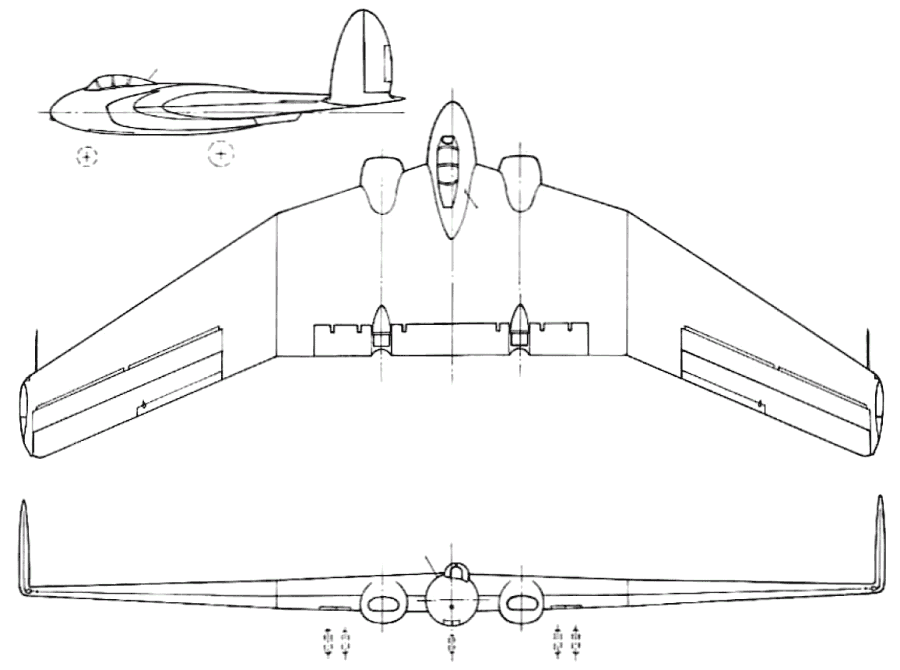
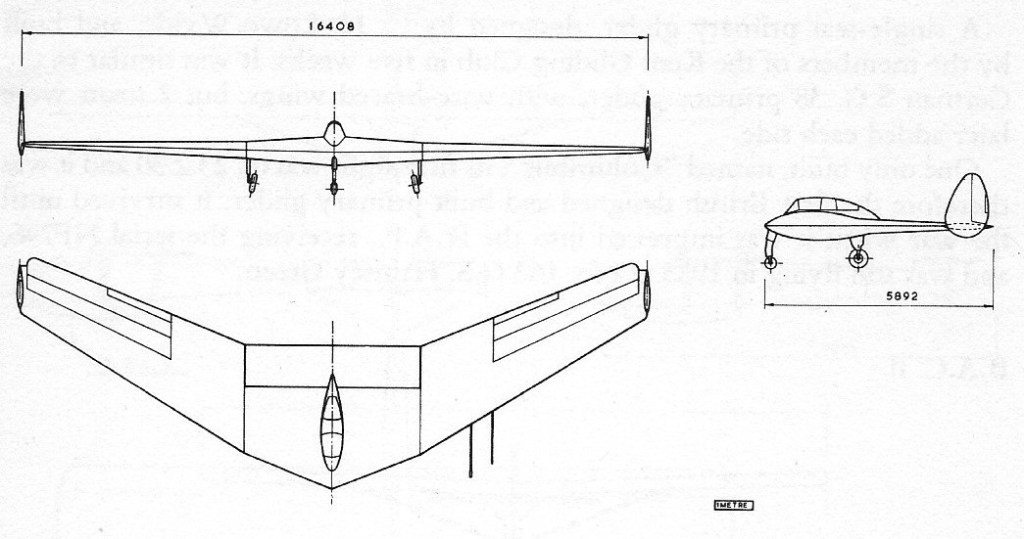
The Armstrong Whitworth A.W.52 was a flying wing type that was also intended to evaluate a configuration for a transport aeroplane with six jet engines. The basic design was validated in the A.W.52G glider.
The AW.52G was of conventional construction, but covered with “Plymax” material (1/16in ply and 22 SWG “Alclad” light alloy sheet). No airbrakes were fitted, but a central trailing-edge flap. The undercarriage was tricycle. Only one, RG324, was built. After testing was completed it remained at the company office until burnt in the mid-sixties.
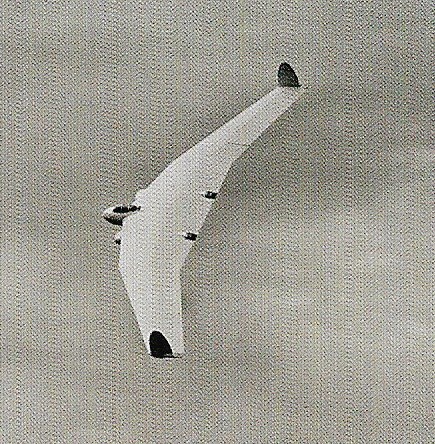
The first of two A.W.52s with two 5000-lb (2268-kg) thrust Rolls-Royce Nene turbojets flew on 13 November 1947.
The first prototype, TS363, was lost in May 1949, its pilot being the first in the UK to use a Martin-Baker ejection seat in an emergency.
A.W.52 TS363, 1948 SBAC Display, Farnborough
A second prototype, powered by Rolls-Royce Derwents, was destroyed early in its flight test programme.
Although benefits were possible with such aircraft, financial problems finally curtailed the programme in 1950.
AW.52
Engines: 2 x 2270kg Rolls-Royce Nene Wingspan: 27.43 m / 90 ft 0 in Wing area: 122.07 sq.m / 1313.95 sq ft Length: 11.38 m / 37 ft 4 in Height: 4.39 m / 14 ft 5 in Take-off weight: 15490 kg / 34150 lb Empty weight: 8917 kg / 19659 lb Max. speed: 805 km/h / 500 mph Range: 2414 km / 1500 miles ROC: 4800 fpm
AW.52G Wingspan: 16.40 m / 53 ft 10 in Length: 5.89 m / 19 ft 4 in Wing area: 41.14 sq.m / 443 sq.ft Aspect ratio: 6.58 Wing section: NACA 2017 Empty weight: 2017 kg / 4451 lb AUW: 2720 kg / 6000 lb Max speed: 402 kph / 250 mph Landing speed: 104 kph / 65 mph
Sir W G Armstrong Whitworth & Co Ltd was a major British manufacturing company of the early years of the 20th century. With headquarters in Elswick, Newcastle upon Tyne, Armstrong Whitworth engaged in the construction of armaments, ships, locomotives, automobiles, and aircraft.
In 1847, engineer William George Armstrong founded the Elswick works at Newcastle, to produce hydraulic machinery, cranes and bridges, soon to be followed by artillery, notably the Armstrong breech-loading gun, which re-equipped the British Army after the Crimean War. In 1882, it merged with the shipbuilding firm of Charles Mitchell to form Armstrong Mitchell & Company and at the time its works extended for over a mile (about 2 km) along the bank of the River Tyne. Armstrong Mitchell merged again with the engineering firm of Joseph Whitworth in 1897. The company expanded into the manufacture of cars and trucks in 1902, and created an “aerial department” in 1913, which became the Armstrong Whitworth Aircraft subsidiary in 1920.
In September 1914 built the unsuccessful F.K.1 single-seater. Later (during the war) the F.K.3 and F.K.8 two-seat observation aircraft were delivered in quantity, as improvements on the Government designed B.E.2c.
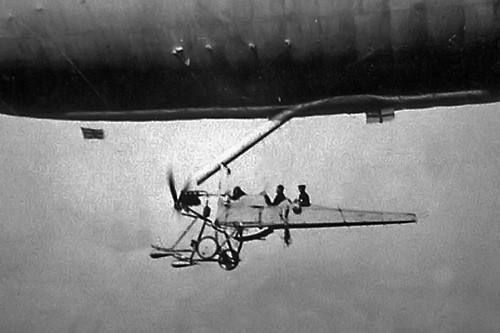
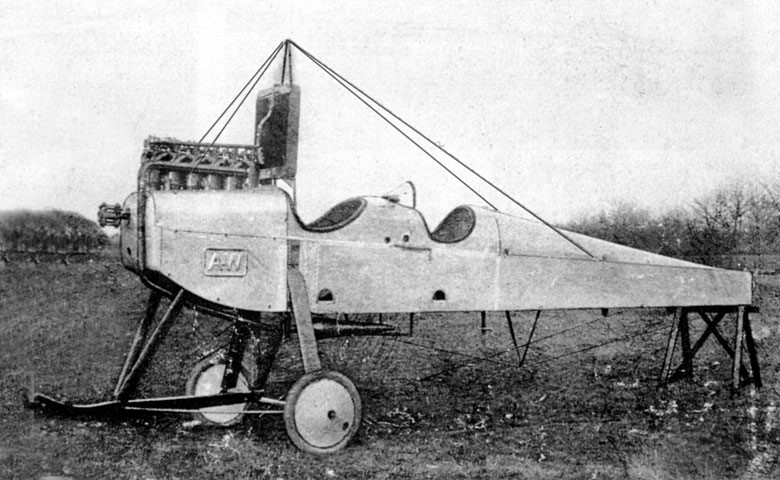
Armstrong-Whitworth built in 1914 a gondola for non-rigid naval airship HMA No.2 “Willows IV”. This was followed by gondolas for SS.40-49 airships in 1915, developed from F.K.3 fuselage, with 100 hp Green (probably 20 built as spares required), a gondola for SS.27 (also from an F.K.3 fuselage) but with a Renault engine.
SS Airships (B.E.2c car)
The F.K.15 is described as an airship gondola design for the Beta II, F.K.16 and F.K.17 as an airship gondola design for North Sea airships based on the F.K.3 fuselage.
F.K.4
Experimental First World War types included quadruplanes and Armadillo and Ara biplane single-seat fighters. The Airplane Department closed in late 1919, but a new company, named Armstrong Whitworth, was formed in 1920. Products between the wars were the Siskin single-seat fighter and Atlas army cooperaton aircraft for the RAF, both introducing some steel construction. The Scimitar fighter (1934) was among the world’s fastest with a radial engine, partly due to company’s associations with engine-builder Armstrong Siddeley.
By the end of 1924 Armstrong’s was virtually bankrupt. The bank of England discreetly moved in, and eventually brought pressure to force a merger with Vickers, using the Sun Insurance Company as their front to guarantee the new company, now called Vickers Armstrong. It was a condition of the rescue that the new company would restrict themselves to ship building, heavy engineering, and predominantly armaments.
In 1927, it merged with Vickers Limited to form Vickers-Armstrongs.
Notable airliners were the three-engined Argosy biplane (1926), four-engined Atalanta monoplane (1932), and the much larger Ensign (1938). The company’s most famous product was the Whitley twin-engined bomber of 1936, in which year Hawker Siddeley Group was formed, with Armstrong Whitworth as a member company. In July 1943 the 1,824th Whitley left the assembly line at Baginton, Coventry, the type having achieved several historic “firsts” in RAF service. The Albemarle (600 built) was used as glider-tug and transport, and Avro Lancaster bombers were built in dispersed factories. After the war, from the basic Gloster design, the company developed and produced in quantity Meteor two-seat nightfighters. When this type was well advanced they undertook development of the Hawker Sea Hawk naval fighter. Avro Lincolns, Hawker Hunters, and Gloster Javelins also produced. Experiments made with flying-wing aircraft and prone-pilot position were undertaken. The Apollo turboprop airliner (1949) had no commercial success, though the Argosy twin-boom four-turboprop freighter (1959) gained limited civil and military orders.
January 1951
Gloster, Armstrong Whitworth and Avro joined Hawker Siddeley Aviation in 1965.