Auster / Taylorcraft Aeroplanes (England)

In 1936 the Taylorcraft Aviation Company was established in the USA to design and built light planes for civil use. In 1938 the company established its Taylorcraft Aeroplanes (England) Ltd as its British subsidiary. British production was mainly of the Plus C and Plus D models, and in 1939 the Royal Air Force impressed 24 of the 32 aircraft for evaluation as observation and artillery spotter aircraft. The evaluation confirmed the soundness of the concept, and a derivative of the Plus D was ordered into production as the Auster Mk 1. This entered service in August 1942.
Taylorcraft Aeroplanes (England), in March 1946, was changed to Auster and the factory transferred from Thurmaston, Leicester, to Rearsby, Leicester.
Became Auster Aircraft Ltd on March 7,1946, by which time it had built more than 1,600 Taylorcraft C, Plus C, Plus D and Auster I, II, III, IV, and V, as well as early Auster J-1 Autocrats and prototype of J-2 Arrow.
Auster name was well established in Second World War by light observation (AOP) monoplanes known as Taylorcraft Austers, and many of these made an important contribution to the development of postwar light aviation. The type mainly concerned was the Auster 5, or Model J, three-seater with Lycoming engine. As war neared its end Taylorcraft designers were already looking to the civil market, and the outcome was the Autocrat, often British-powered and widely used not only for ordinary tasks but also, for instance, to test the Rover TP.90 gas turbine. In the 1950s came the Aiglet and the Autocar, one of the latter being used to test the Saunders- Roe hydro-ski landing gear. The Aiglet Trainer differed greatly from the Aiglet, and the Agricola was an entirely new low-wing agricultural aircraft, first flown December 1955. To supersede the AOP6 the entirely new military AOP9 was tested in March 1954, by which time the British Army and RAF had received nearly 2,000 Austers.
After the war, Auster Aircraft Ltd was formed and commenced a series of variations on the basic theme until 1960 when it was absorbed into Beagle Aircraft Ltd. Production of the basic Auster type continued until the low-wing Pup emerged.
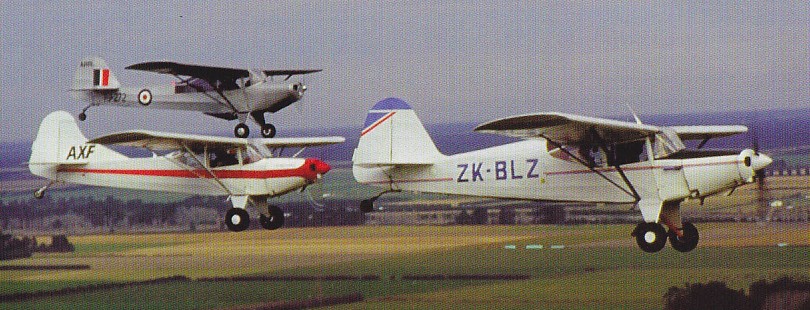
Auster Mk.V on the outer with a J/1 in the middle

All production work on Auster designs finally ceased in 1967 when Beagle sold all rights to Hants and Sussex Aviation. Although there is some conflict in the official records, it is believed that around 3868 Austers (not including licence-built aircraft) had been built.

The Pup evolved into the Bulldog basic military trainer that was taken up by Scottish Aviation Ltd after Beagle went into receivership in 1970 and finally found its last home with British Aerospace.

Aubert PA-20 / PA-201 / PA-204 Cigale / Cigale Major PA-204 / PA-205 Super Cigale

Aubert Cigale – Major

Designed by Paul Aubert, the Aubert PA-20 Cigale (English: Cicada), PA-204 Cigale Major and PA-205 Super Cigale were a family of high-wing cabin monoplanes built in France in the years immediately before and immediately after World War II. The original Cigale was shown at the 1938 Paris Salon but its development was interrupted by the War. The Cigale was a high-wing cantilever monoplane of conventional configuration with fixed, tailwheel undercarriage.

PA-20

The original two-seat PA-20 Cigale first flew on 25 February 1938, piloted by Maurice Bruneteau, powered by a Train 6T. Various refinements were made, including a change to a Renault 4Pei engine, and the aircraft was redesignated PA-201 Cigale. This original aircraft was destroyed during the course of World War II, but in 1945, Paul Aubert returned to the design, building another aircraft to the PA-201 standard. This went on to prove highly successful when flown competitively in 1945 and 1946.

PA-201

Aubert further modified his design into a four-seater, flying the PA-204 Cigale Major on 21 April 1947, and soon building a second example to this standard. The aircraft was equipped with a Renault 4 Pei engine (manufactured by SNECMA), and four people could be accommodated in a closed cockpit. The Cigale Major PA-204 was certificated in 1951.

PA-204

The second prototype PA-204 was subsequently re-engined first with a SNECMA-Regnier 4LO-2 in June 1955 (PA-204S), and then with a Lycoming O-290-D2B (PA-204L), tested on July 27, 1955, and a Lycoming O-320 in 1956 (PA-205 Super Cigale). The 204L has a wider cabin and better forward view than the earlier machine fitted with the SNECMA engine. With this engine, Aubert was finally satisfied with the design and built around thirty production examples, eight of which went to Aéroclub Air France.

A version equipped to carry a doctor and one stretcher patient, in addition to the pilot, was built in 1956.

Gallery

Variants:

PA-20 Cigale
Pre-war prototype two-seat trainer.

PA-201 Cigale
Post-war development.

PA-204 Cigale-Major
Improved four-seat variant with a Renault 4Pei inverted inline engine. Prototype flew in 1949, with production from 1954.

PA-204S Super Cigale
Further developed with a Régnier 4L02 engine.

PA-204L Super Cigale
Final production variant with an Avro Lycoming engine with a range of power output between 135 to 180 hp.

Specifications:

PA-20 Cicada
Engine: Train 6T, 60 hp
Span: 9.50 m
Wing area: 12.84 m²
Length: 7.15 m
Empty weight: 334 kg
Max weight: 580 kg
Cruising speed: 186 kph
Range: 500 km
Crew: 2

PA-204L
Engine: 1 × Lycoming O-320, 110 kW (150 hp)
Propellers: 2-bladed
Length: 7.50 m (24 ft 7 in)
Wingspan: 10.00 m (32 ft 10 in)
Height: 2.40 m (7 ft 10 in)
Wing area: 12.90 m2 (138.9 sq ft)
Empty weight: 640 kg (1,411 lb)
Max takeoff weight: 1,250 kg (2,756 lb)
Maximum speed: 255 km/h (158 mph; 138 kn)
Cruising speed: 230 km/h (143 mph; 124 kn)
Range: 1,880 km (1,168 mi; 1,015 nmi)
Service ceiling: 4,500 m (14,764 ft)
Crew: 1
Capacity: 3 passengers

PA-204S Super-Cigale
Engine: 170 hp SNECMA-Regnier 4LO-2
Wingspan: 32 ft 9 in
Length: 25 ft 3 in
Empty weight: 1499 lb
Loaded weight: 2645 lb
Max speed: 155 mph
Cruise: 141 mph

PA-20

Atlas Aviation C4M Kudu

In South Africa, Atlas Aircraft Corporation flew the prototype (ZS IZF) of the newly developed Atlas C4M Kudu on 16 June 1975, suitable for six to eight passengers or light cargo. The C4M STOL aircraft uses major components of the AM.3C. Large double doors are fitted on the left side for cargo.
It was in service with the South African air force under the name Kudu.

Wing span: 43 ft (13.1m).

Atlas Aviation

Registered as a private company at Kempton Park, Transvaal, in 1964 to establish an aircraft industry in South Africa, jointly with the Industrial Development Corporation. Completed manufacture of Impala (M.B.326M) under Aermacchi license. Developed C4M Kudu utility STOL light transport, first flown February 1974. First flew in 1986 its Cheetah multirole fighter, fighter-bomber, and reconnaissance aircraft conversion of the Mirage III for the SAAF, allowing initial operational capability in 1987. ACE all-composite turboprop trainer first flew April 1991 but later canceled. Developed Rooivalk attack helicopter, Puma gunship, and Oryx. Company also held marketing rights for several foreign aircraft and undertook extensive maintenance and overhaul work for SAAF. Merged with Simera in April 1996 under new Denel Aviation name, having been a division of Denel (Pty) Ltd. within the latter’s Aerospace Group.
1995: A division of Denel (Pty) Ltd, PO Box 11, Atlas Rd, Kempton Park 1620, South Africa.
Earlier Denel (Pty.) Ltd. encompassed Atlas Aviation and Simera as divisions of its Aerospace Group. Took the Denel name in April 1996 after merging Atlas and Simera, with new subdivisions created as Tactical Aircraft Support, Transport Aircraft Support, Aircraft Manufacturing and Airmotive. Cooperating with DaimlerChrysler of Germany on AT-2000 Mako program. Cooperates with Aerospatiale of France on aircraft and missiles. Full range of maintenance, repair, and modification facilities, plus component manufacturing. Continuing programs of former Atlas include Cheetah C and D fighter conversion of Mirage III, development and production of AH-2A Rooivalk antiarmour/ attack helicopter (first flown February 1990 and for delivery from 1999), development of the Cirstel (Combined Infra-Red Suppression and Tail rotor Elimination system) tail-rotorless conversion of an Alouette helicopter as a technology demonstrator (first flown 1998), development and production of a variant of the SA 330 Puma helicopter as the Oryx, and development of a modular weapon suite for the Puma helicopter to convert it into a gunship.

Atlas Aircraft Co H-10

Designed by Max Harlow and based on his Harlow PJC-2, the 1948 H-10 was a four-seat cabin monoplane of all-metal stressed-skin construction. It featured retractable undercarriage and two 145hp Continental O-300 mounted in tandem driving two counter-rotating props. It was priced at $2,995 in 1939.

Atlas H-10 N37463

The plane, N37463, was soon converted to a single 215hp Harlow-modified Franklin 6AB, and was active into the 1990s with a 400hp Lycoming IO-720.

Atlas H-10 N37463

Wingspan: 35’9″
Length: 28’4″
Max speed: 170 mph
Cruise: 150 mph
Stall: 55 mph
Range: 800 mi
Seats: 4

Arsenal VB.10

Designed by Ingenieur-General Vernisse and M Badie, the VB 10 was an all-metal single-seat fighter powered by engines mounted in tandem fore and aft of the pilot’s cockpit and driving contra-rotating co-axial propellers. Thirty VG 10s were ordered off the drawing board in May 1940, and work continued under the Vichy government. The first prototype with two 860hp Hispano- Suiza 12Y31 12-cylinder liquid-cooled engines was flown on 7 July 1945. The second prototype with 1150hp HS 12Z12/13 engines and an armament of four 20mm Hispano-Suiza cannon and six 12.7mm Browning machine guns flew on 21 September 1946. A contract for 200 aircraft had been placed on 22 December 1945 (this later being cut back to 50 aircraft), and the first production VB 10 flew on 3 November 1947 with 1150hp HS 12Z Ars 15/16 engines and an armament of four 20mm cannon. Production was cancelled on 21 September 1948 after completion and testing of four series aircraft.

VB 10
Take-off weight: 8860 kg / 19533 lb
Empty weight: 6230 kg / 13735 lb
Wingspan: 15.49 m / 50 ft 10 in
Length: 12.98 m / 42 ft 7 in
Height: 5.20 m / 17 ft 1 in
Wing area: 35.50 sq.m / 382.12 sq ft
Max. speed: 700 km/h / 435 mph
Range: 1700 km / 1056 miles