The Bacon Super T-6 was a North American AT-6F Texan that was modified during the mid-1950s by the Erle L. Bacon Corporation in an attempt to interest foreign air forces in an upgrade for their T-6 fleets.
Produced in 1944 and operated by the United States Army Air Forces alongside its brethren, following the end of World War II AT-6F Texan 44-82028 was sold on the civilian market, operating in Iceland for a time before being acquired by Bacon for conversion.
Described as appearing “like an illicit hangar affair between a T-33 and a T-6”, the conversion consisted of adding the tip tanks ex-Cessna 310, canopy, and tricycle landing gear from a Lockheed T-33 Shooting Star; streamlining of the cowl and wings including jet stack exhaust, augmenter cooling, and a 4-foot (1.2 m) reduction in wingspan compared to the standard T-6; in addition, the cockpit was upgraded with a revised instrument panel and modernized avionics, and the aircraft’s brakes were upgraded.
LAX March 1957
Bacon hoped to sell the conversion to foreign air forces, many of which operated large fleets of T-6 aircraft; after taxi trials at the end of 1956, it first flew in April 1957, and flight testing was considered generally successful. No interest from its intended customers materialized and the aircraft was sold on the civilian market; it eventually received a paint scheme, believed to have been intended for a role in a movie, resembling that of a Russian fighter aircraft.
It was stored at Whiteman Air Park in California, and allowed to deteriorate in the elements, with its registration being cancelled in 2013.
Powerplant: 1 × Pratt & Whitney R-1340-AN-1 Wasp, 600 hp (450 kW) Propeller: 2-bladed variable-pitch Wingspan: 38 ft 6 in (11.73 m) Length: 29 ft 6 in (8.99 m) Height: 11 ft 8.5 in (3.569 m) Fuel capacity: 100 US gal (83 imp gal; 379 L) in two tip tanks Maximum speed: 225 mph (362 km/h, 196 kn) Cruise speed: 215 mph (346 km/h, 187 kn) at 64% power Rate of climb: 1,750 ft/min (8.9 m/s) at sea level Crew: 2 Armament: .30-inch (7.6 mm) machine guns, underwing bomb racks or rocket launchers optional
USA Erie L. Bacon Corporation established at Santa Monica, California, to build an extensively updated version of the North American T-6 tandem two-seat advanced trainer. Known as the Bacon Super T-6, the prototype first flew in April 1957.
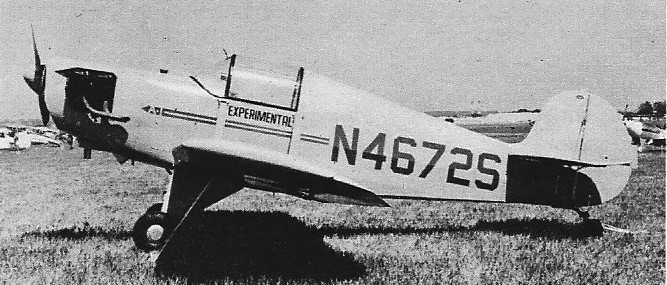
Donald E Aydlett began construction of the sole A-1 in 1963, flying it on 6 July 1965. It was a low wing monoplane of mixed wood and steel construction. The wing was a fabric covered wood structure, with streamlined lift struts from the upper fuselage longerons. The fuselage and tail unit were steel, again fabric covered, and the tail unit was wire braced. The tailplane was on top of the fuselage; the rounded fin carried a generous, unbalanced rudder. The cockpit, over the wing, was enclosed by a canopy which merged at the rear with the raised fuselage decking. Power came from a 125 hp (93 kW) flat four Lycoming O-290-G, mounted with cylinder heads and exhaust pipes exposed. The A-1 had a fixed, conventional undercarriage, with mainwheels mounted on faired V-struts and a tailwheel.
Only one [N4672S, C/N 1001] was ever built.
Engine: 1 × Lycoming O-290-G, 125 hp (93 kW) Propellers: 2-bladed fixed pitch Wingspan: 22 ft 3 in (6.78 m) Length: 17 ft 0 in (5.18 m) Height: 6 ft 0 in (1.83 m) Empty weight: 690 lb (313 kg) Max takeoff weight: 1,200 lb (544 kg) Maximum speed: 185 mph (298 km/h; 161 kn) Cruise speed: 115 mph (100 kn; 185 km/h) Service ceiling: 15,000 ft (4,572 m) Rate of climb at sea level: 1,000 ft/min (5.1 m/s) Seats: 1
The Avro Canada TR.4 Chinook was Canada’s first turbojet engine, designed by Turbo Research and manufactured by A.V. Roe Canada Ltd. Named for the warm Chinook wind that blows in the Rocky Mountains, only three Chinooks were built and none were used operationally. The Chinook was a successful design in terms of introducing new concepts and materials, and after being scaled up from 2,600 lbf (12 kN) to 6,500 lbf (29 kN), would go on to become the Orenda.
In late 1942 the National Research Council of Canada (NRC) sent Dr. J.J. Greene and Malcolm Kuhring to England to report on the various advanced research projects and to see if Canada could play a role in them. One of the team’s many topics in the resulting report was an introduction to the work on jet engines being carried out by Frank Whittle at Power Jets. The Department of Munitions and Supply (DMS) thought this was a wonderful opportunity to get in at the “ground floor” of a newly developing field, one that the country could enter with relative ease and thereby reduce their dependence on foreign suppliers for aircraft engines.
In early 1943 a new mission, including Dr. Ken Tupper and Paul Dilworth from the NRC and C.A. Banks of the DMS, left for England specifically to study the jet engine and report on ways that Canada could contribute to the jet effort. The resulting report, known today as the Banks Report, suggested two lines of research. One led from the realization that no one in the nascent industry really understood the effects of real-world weather on the operations of jet engines, especially in icing conditions. The report suggested forming a research center specifically to study this problem. The report went on to suggest the formation of a private jet engine company.
Almost immediately after they returned to Canada, Dilworth started work on what became the Cold Weather Testing Station in Winnipeg. They were supplied with an original Whittle W.1, and later a captured Junkers Jumo 004. Their research demonstrated that water ingestion reduced power by about 20%, not entirely unexpected, but at the same time doubled fuel use, which was a surprise. Further work on the problem led to a number of design elements that would be used on future Canadian jet designs.
While the CWTS was being set up, the government also worked on the second part of the Banks Report, and on 1 July 1944 formally incorporated Turbo Research in Leaside, Toronto. Dilworth returned from CWTS to lead a series of design studies based on the Whittle-style centrifugal compressor design, known as TR-1, TR-2 and TR-3. However, these designs were abandoned in favor of a new axial compressor-based design, the TR.4, likely due to their exposure to the Jumo 004. Over the next year the team was built out as more engineers joined the effort, including Winnett Boyd, Joe Purvis, Burt Avery and Harry Keast from Power Jets. Detailed design was completed in early 1947, and the engine first ran on 17 March 1948.
At the time the Chinook was being designed, Avro had little production capacity and no engine fabrication experience. They farmed out parts manufacture to 1,200 different companies, providing everything from gears and ball bearings, to the compressor and turbine blades. Many of the techniques for fabrication had never been needed in Canada before, and led to a small industrial revolution as they were developed for the project. Among the many advances brought to Canadian industry as part of the Chinook program, Light Alloys Ltd. invested in their first aluminum casting, while Shawinigan Chemicals did the same for stainless steels.
Although the team had already turned to the design of the Chinook’s successor, the Orenda, work on the engines continued in order to gain experience in construction and operation. Frank Whittle personally viewed the engine in 1948. Only six sets of engine parts were made, from these three complete engines and one compressor section were completed. By October 1949 the engines had run over 1,000 hours and had improved to over 3,000 lbf (1,360 kg) thrust.
Designing on the basis of a theoretical twin-engine fighter aircraft, seemingly similar to the Messerschmitt Me 262, the TR-4 design was in many ways an analog of the Jumo 004. The primary difference in design was the use of six separate flame cans instead of the singular annular combustor of the Jumo. Compared to the Jumo the Chinook was smaller and lighter; it was about the same diameter, 20 inches shorter, and over 300 lb (140 kg) lighter. In spite of this it produced almost double the thrust, largely due to the improved materials, especially in the turbine, which allowed for higher operating temperatures.
The Chinook’s compressor consisted of nine axial stages. The first two were made of stainless steel to help with debris but the remaining seven stages were made of aluminum alloy. These were attached to hubs that were also primarily made of aluminum, except the ninth disk, which was steel. Behind the compressor were the six straight-through flame cans, exiting onto a single-stage steel turbine. The final exhaust gas temperature was 650 degrees Celsius. Air cooling for the turbine was provided by a series of six tubes running from the middle of the compressor to the turbine, lying between the flame cans, which exited in front of the turbine face. An accessories section was powered off a shaft at the front of the engine at the main bearing. The front main bearing was located under a prominent nose cone that extended well out in front of the engine. An oil tank was “wrapped” around the engine at about the 4 o’clock position, as viewed from the front.
Specifications Type: Turbojet Length: 10 ft 10.5 in (3.3 m) Diameter: 2 ft 8 in (81 cm) Dry weight: 1,250 lb (570 kg) Compressor: Axial flow
The first stages of development of a new two-seat all-weather long-range interceptor for the RCAF began in early 1953, at the time when the RCAF was busy forming its first CF-100 squadron. By April 1954 Avro’s design team was involved in the manufacture of the first five Arrow 1 prototypes.
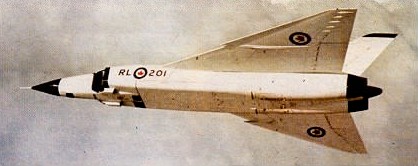
The CF-105 featured a true delta-wing design fitted with twin turbojet engines. The aircraft would be piloted by a crew of two, made up of a pilot and his radar operator. Avro made the decision to design the CF-105 as a pure delta wing platform. The aircraft’s single-minded interceptor purpose was to travel in straight lines, finding the fastest way to get to its target in the shortest amount of time. The increase in drag was offset by the added fuel that could be stored in the wings as the CF-105 system would be expected to feed two thirsty turbojet engines, each with afterburner capability. The Orenda Iroquois – a highly advanced engine for its time – was selected as the powerplant that would propel the CF-105 Arrow for decades to come. This had a needle-nose, widening just aft of the cockpit, where intakes on each side of the fuselage fed air to two turbojet engines mounted side by side within the fuselage. The Arrow 1s were powered by two Pratt & Whitney J75s, but it was intended that the following Arrow 2s would have engines of indigenous design and manufacture, in the form of PS-13 Iroquois turbojets, developed by Avro’s Orenda engine division, each of which promised a thrust of 12700kg with maximum reheat.
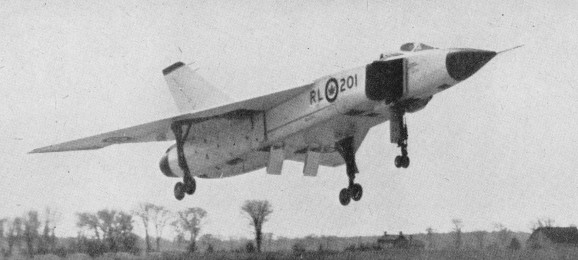
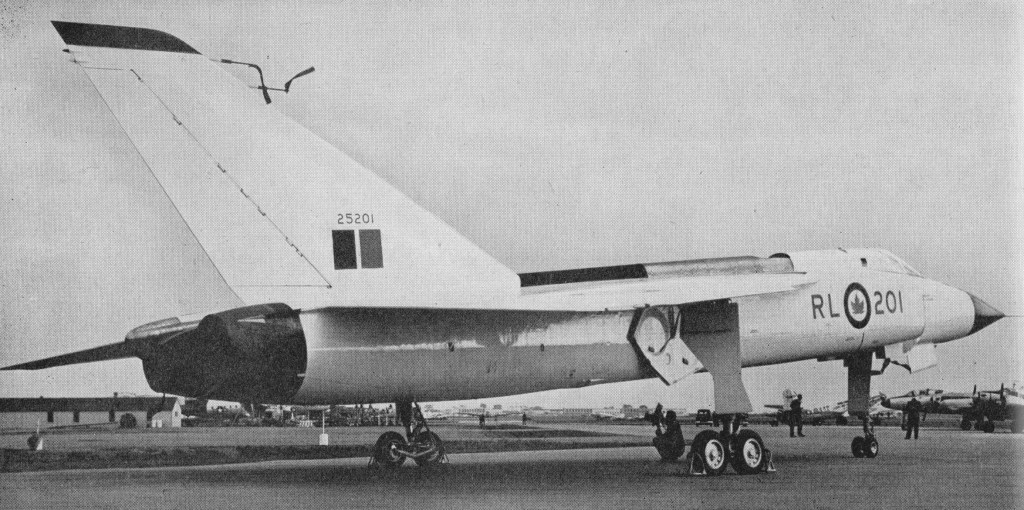
The two-man cockpit was held well-forward in the design, protruding between the two rectangular intakes to either side. The intakes ran the length of the fuselage and the delta wings extended from the installations as high shoulder-mounted assemblies. The aircraft’s layout ended with the twin engine outtakes at rear capped by a single vertical tail fin set between the two engine compartments. The main landing gear extended from the wings (another benefit of the delta wing concept) as opposed to the fuselage body with two wheels to a gear (in single file arrangement). The nose landing gear leg retracted into the fuselage just behind and below the cockpit.
The Arrow appeared in its first form as the Mark 1 with production approved by 1955. The first Arrow completed October 1957, became model RL-201 and this aircraft was fitted with lower-powered Pratt & Whitney J75 series engines while the Orenda brand series were completing development. The unveiling was intended to be a huge affair but the successful launch of the Soviet satellite Sputnik destroyed any hope of that and in many ways forecasted the future of the CF-105 program itself. Several other delays of the internal systems added to the already bumpy curtain-raising event.
The Royal Canadian Mounted Police were monitoring an illegal agent working for the Russians on the Avro Arrow project.
The first was first flown by Jan Zurakowski on 25 March 1958, this Mach 2 all weather fighter had a continental radius of action and could operate up to 70,000ft. It achieved 1,000 mph on its seventh flight. The two underfuselage speed brakes could be held open during Mach 1 flights. Four more Mark 1 soon followed. Over the months of testing, a major issue arose with the complex main landing gear arrangement. The design relied upon the two main single-file landing gear wheels to fit into the wing. This necessitated that the gear rotate before settling fully into the thin delta wing design. After addressing several of these key issues, the five CF-105’s were moved out of the A.V. Roe internal company test program and forwarded to official military trials beginning 1959.
By this time, the future of the CF-105 was already highly in doubt. 1957 saw a political turn in Canada which the new conservative-leaning party began targeting the spending projects of the former liberal party. The CF-105 was not immune to the discourse and when the Americans came calling with their NORAD (NORth American Air Defense) initiative and its thousands of available aircraft for use across Canadian air defense. It was seen fit to cancel the CF-105 Arrow project altogether on 20 February 1959 by John Diefenbaker, a Prime Minister of Canada, after expenditure of about $400 million. It is estimated that an astounding 50,000 jobs were lost with the cancellation of the program – or about 80% of Avro Canada altogether – permanently damaging the Canadian aerospace industry.
The prototype and six more airframes were sliced up, crushed and burned. Three years later Canada had to buy McDonnell F-101 Voodoo fighters from the USA.
Engines: 2 x Pratt & Whitney J75-P-3, 47,000lbs thrust. Wingspan: 15.24 m / 50 ft 0 in Length: 23.72 m / 78 ft 10 in Height: 6.48 m / 21 ft 3 in Wing area: 113.8 sq.m / 1224.93 sq ft Empty Weight: 49,042lbs (22,245kg) Maximum Take-Off Weight: 68,608lbs (31,120kg) Maximum Speed: 1,307mph (2,104kmh; 1,136kts; M 2.3) Maximum Range: 410miles (660km) Service Ceiling: 58,563ft (17,850m) Crew: 2 Armament: 1 internal weapons bay Hardpoints: 8
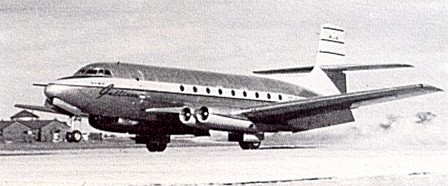
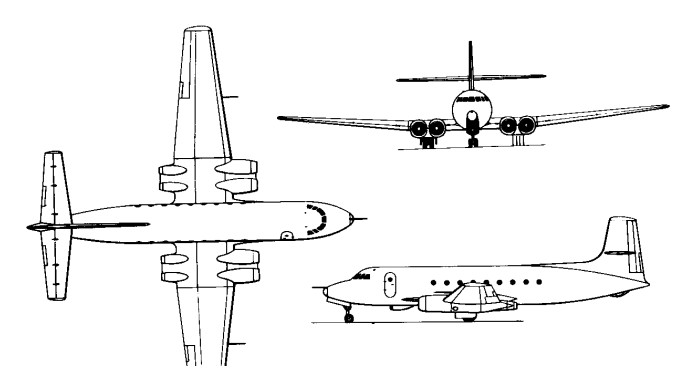
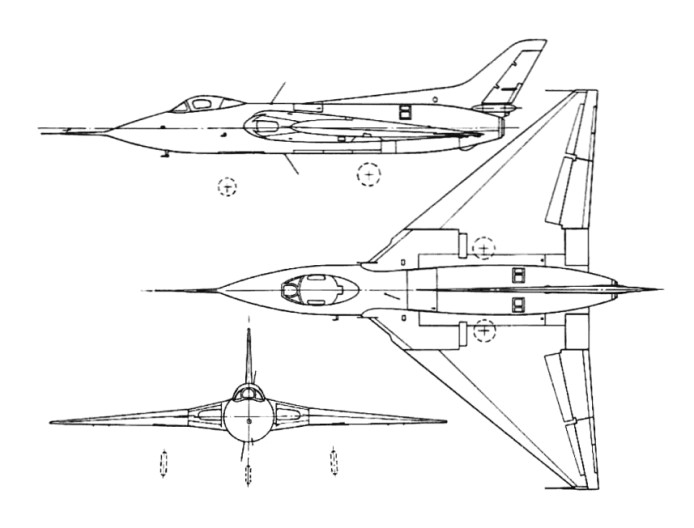
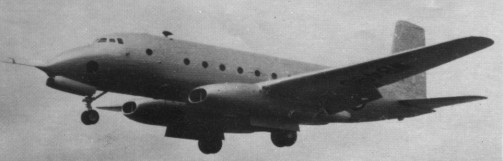
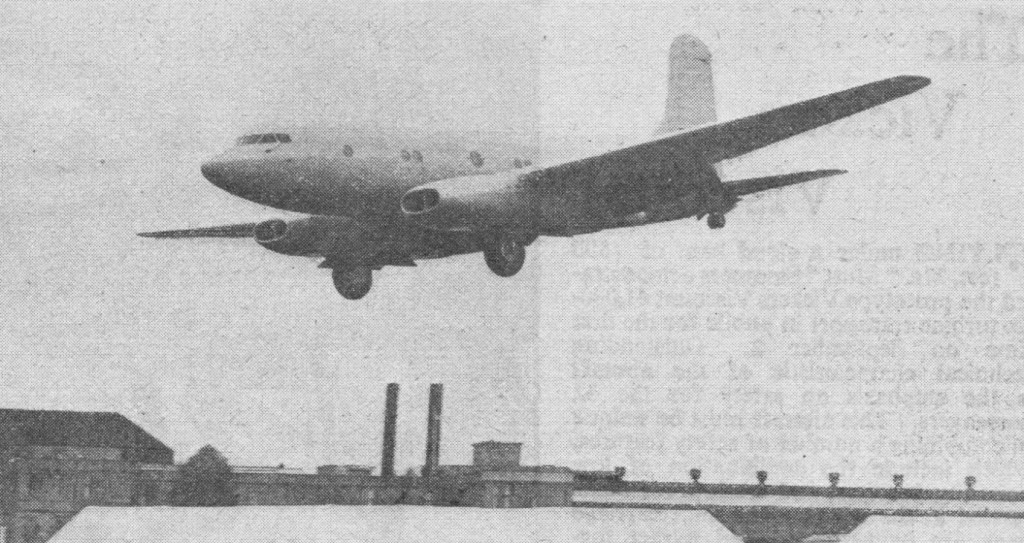
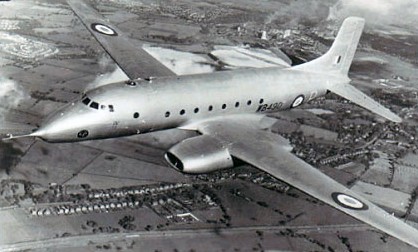
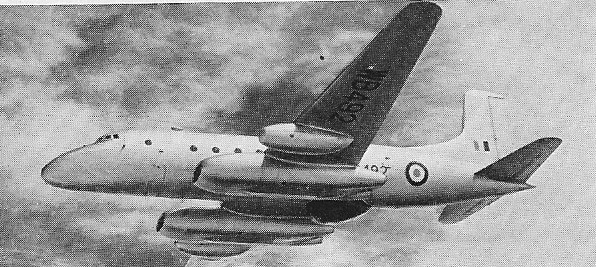
The design for a 50-seat medium-range civil transport began in 1946 initially proposed with two Rolls-Royce Avon turbojets but by autumn 1947 it was apparent these were not available. The design was modified to take four 3600 Rolls-Royce Derwent 5s.
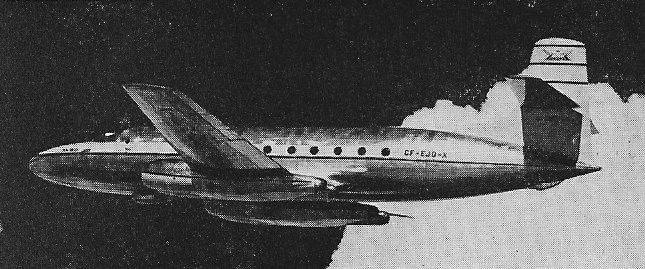
With tricycle landing gear, and four turbojets, the prototype was first flown on 10 August 1949, but only six days later was badly damaged through a landing gear failure. It was repaired and flying again within a few weeks, and its four Derwent 5 engines were replaced by two Derwent 8s (starboard outer, port inner) and two Derwent 9s for evaluation. Construction of a second C-102 prototype began, but was not completed.
The C-102 integral fuel tanks have 1375 Imp.Gal inboard and 1025 Imp.Gal outboard giving a total capacity of 2400 Imp.Gal.
Despite an aggressive marketing campaign directed at U.S. airlines and the USAF, the sales prospects of the Jetliner floundered after the launch customer, Trans-Canada Airlines, reneged on a letter of intent in 1948. The company was still attempting to get the CF-100 into production at the time and, consequently, the Canadian government cancelled any further work on the C102 due to Korean War priorities: C. D. Howe demanded the project be stopped to increase production of the CF-100, so the second C102 prototype was scrapped in the plant in 1951, with the first relegated to photographic duties in the Flight Test Department. After a lengthy career as a camera platform and company “hack,” CF-EJD-X was flown for the last time on 23 November 1956 and broken up in 1956, having flown about 425 hours. The nose section now resides in the Canada Aviation Museum in Ottawa.
C-102 Engines: 4 x Rolls-Royce Derwent 5, 1633kg / 3600 lb Wingspan: 29.90 m / 98 ft 1 in Wing area: 107.49 sq.m / 1157.01 sq ft Length: 25.12 m / 82 ft 5 in Height: 8.06 m / 26 ft 5 in Take-off weight: 29480 kg / 64993 lb Empty weight: 16740 kg / 36906 lb Max. speed: 735 km/h / 457 mph Cruise speed: 650 km/h / 404 mph ROC: 1595 fpm Ceiling: 12285 m / 40300 ft Range: 2000 km / 1243 miles
During the Second World War, Victory Aircraft in Malton, Ontario was Canada’s largest aircraft manufacturer. Prior to 1939, as a part of National Steel Car Ltd. of Hamilton, the concern had been one of a number of “shadow factories” set up in Canada to produce British aircraft designs in safety. National Steel Car had turned out Avro Anson trainers, Handley Page Hampden bombers, Hawker Hurricane fighters and Westland Lysander army cooperation aircraft. National Steel Car Corporation of Malton, Ontario was formed in 1938 and renamed Victory Aircraft Limited in 1942 when the Canadian government took over ownership and management of main plant. During the Second World War, Victory Aircraft built Avro (UK) aircraft: 3,197 Anson trainers, 430 Lancaster bombers, six Lancastrian, one Lincoln bomber and one York transport.
In 1944, an Advisory Committee on Aircraft Manufacture was established by the Canadian government, the Canadian Director of Aircraft Production wrote to Minister of Munitions and Supply C.D. Howe in 1944 to express the “utmost importance to Canada” of the establishment of a Canadian aircraft industry, and UK-based Avro also established in 1944 a company searching for post-war opportunities. Bob Leckie of the RCAF was a strong advocate for years for an industry to design and build aircraft in Canada yet the Department of National Defense, according to Avro’s Roy Dobson, gave “a cold reception” to doing more than building under licence. Howe, as Minister of Reconstruction and Minister of Munitions and Supply (later Reconstruction and Supply), brokered the deal with the Hawker Siddeley Group to take over the Victory Aircraft plant in 1945 with Frederick T. Smye hired by HSG’s Roy Dobson as its first employee.
In 1945, the UK-based Hawker Siddeley Group purchased Victory Aircraft from the Canadian government, creating A.V. Roe Canada Ltd. as the wholly owned Canadian branch of its aircraft manufacturing subsidiary, UK-based A.V. Roe and Company. Avro Canada began operations in the former Victory plant. Avro Aircraft (Canada), their first (and, at the time, only) division, turned to the repair and servicing of a number of Second World War-era aircraft, including Hawker Sea Fury fighters, North American B-25 Mitchell and Avro Lancaster bombers. From the outset, the company invested in research and development and embarked on an ambitious design program with a jet engine and a jet-powered fighter and airliner on the drawing boards.
The new company produced the first Canadian-designed jet fighter, the twin-engined CF-100. Prototype flew in 1950; 639 were built for the RCAF and 53 for the Belgian Air Force. Flew prototype C-102 Jetliner in 1949, but no production order was received. Avro Canada became a member of the Hawker Siddeley Group in 1955, and in 1962 became Hawker Siddeley Canada Ltd. CF-105 Arrow delta twin-jet all-weather fighter prototype flew in 1958. Only five CF-105s were built before the project was cancelled in favour of Bomarc surface-to-air missiles. The Avrocar VTOL aircraft developed under a U.S. Department of Defense contract and flown in 1959 in California. In its prototype form it was a circular flying saucer.
A.V. Roe Canada Ltd. was restructured in 1954 as a holding company with two aviation subsidiaries: Avro Aircraft Ltd. and Orenda Engines Ltd., which began operating under these names on 1 January 1955. Each companies’ facilities were each were located across from each other in a complex at the perimeter of Malton Airport. The total labour force of both aviation companies reached 15,000 in 1958. During the same period, with Crawford Gordon as president, A.V. Roe Canada Ltd. purchased a number of companies, including Dominion Steel and Coal Corporation, Canada Car and Foundry (1957), and Canadian Steel Improvement. By 1958, A. V. Roe Canada Ltd. was an industrial giant with over 50,000 employees in an empire of 44 companies involved in coal mining, steel making, railway rolling stock, aircraft and aero-engine manufacturing, as well as computers and electronics. In 1956 the companies generated 45% of the revenue of the Hawker Siddeley Group. In 1958, annual sales revenue was approximately $450 million, ranking A.V. Roe Canada as the third largest corporation in Canada by capitalization. By the time of the cancellation of the Arrow and Iroquois, aircraft-related production amounted to approximately 40% of the company’s activities with 60% industrial and commercial.
In 1956, 500,000 shares were issued to the public at a total value of $8 million. By 1958, 48% of the shares of A.V. Roe Canada were publicly traded on the stock exchange. Although controlled and largely owned by UK-based Hawker Siddeley Group, all profits from A.V. Roe Canada Ltd. were retained within the company to fund development and growth. Management of the Canadian companies remained in Canadian hands.
In 1962, the Hawker Siddeley Group formally dissolved A.V. Roe Canada and transferred all A.V. Roe Canada assets to its newly-formed subsidiary Hawker Siddeley Canada. Avro Aircraft was closed.
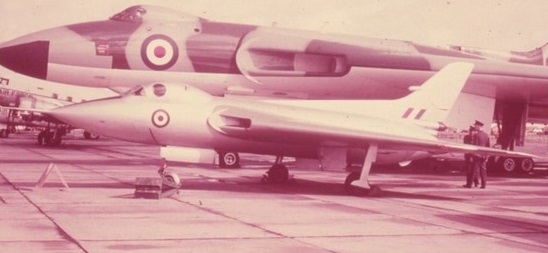
The initial Air Ministry Vulcan contract called for several forms to be built including two prototypes. Along with this commitment included the construction and delivery of several flight demonstrators. The demonstrators, designated as Type 707, proved an important part of early development of the Vulcan and were produced in five examples – Type 707, Type 707A (2), Type 707B and Type 707C.
The first aircraft made its maiden flight at Boscombe Down on 4 September 1949, but was destroyed later in an accident 26 days later. The accident revealed that the airbrake system had not closed, leading the system to enter a stall and eventually crash – and as no ejection seat system was offered to the test pilot, both man and system were lost in the event.
A new revised design appeared in the Type 707B and flew a year later, this time with an ejection system in a lengthened nose assembly for low-speed research. The Type 707A was used as a high-speed test platform and completed as two examples while a Type 707C existed as well, this becoming a test platform and featuring side-by-side seating, a single vertical tail fin and a straight-wing delta arrangement. The two seat 707C tested power control systems and electronics.
Avro 707C WZ744
In all, testing revealed the aircraft to be extremely agile considering the type and size of the aircraft, no doubt due to the large area delta-wing design choice. These development models eventually gave rise to the Type 698 prototype.
Avro 707 Engine: 1 x Rolls Royce Dervent 5, 1630kg Take-off weight: 4303 kg / 9487 lb Wingspan: 10.4 m / 34 ft 1 in Length: 12.9 m / 42 ft 4 in Height: 3.53 m / 12 ft 7 in Crew: 1
707A
707B
707C Engine: Derwent, 2600 lb Wingspan: 34 ft 2 in Length: 42 ft 4 in Height: 11 ft 7 in Weight: approx. 10,000 lb Seats: 2.
Originally titled Tudor 8, modifications to the Tudor airframe needed to produce the test beds were considerable enough to warrant a new name.
The Tudor 8 was first flown on 6 September 1948 when it flew from Woodford to Boscombe Down. The Tudor 8 was demonstrated at Farnborough on 7 September 1948 with four Roll-Royce Nenes of 5000 lb thrust.
Tudor 8 – 7 September 1948
Six Ashtons on order in 1950, which were built for the Ministry of Supply to act as test-beds for research into jet operations.
The first Ashton made its maiden flight on 1 September 1950.
Powered by four 2270kg Rolls-Royce Nene 5 and 6 engines, the Ashton featured a nosewheel undercarriage which retracted forwards.
Avro 711 Ashton
Four marks of Ashton were built.
Mk.1 High altitude turbojet research Engines: 4 x Rolls-Royce Nene 5 and 6, 5000 lb Wingspan: 120 ft Length: 89 ft 6.5 in Height: 31 ft 3 in Loaded weight: 72,000 lb Max speed: 439 mph Cruise: 406 mph
Mk.2 High altitude air conditioning tests
Mk.3 Ventral radome and bomb containers outboard of engine nacelles Bomb sight development One Mk.3 used as Bristol Olympus testbed
Mk.4 Instrument development
Engines: 4 x 2270kg Rolls-Royce Nene 5 and 6 Take-off weight: 32688 kg / 72065 lb Wingspan: 36.58 m / 120 ft 0 in Length: 27.28 m / 90 ft 6 in Height: 9.53 m / 31 ft 3 in Wing area: 132.02 sq.m / 1421.05 sq ft Max. speed: 707 km/h / 439 mph Cruise speed: 654 km/h / 406 mph
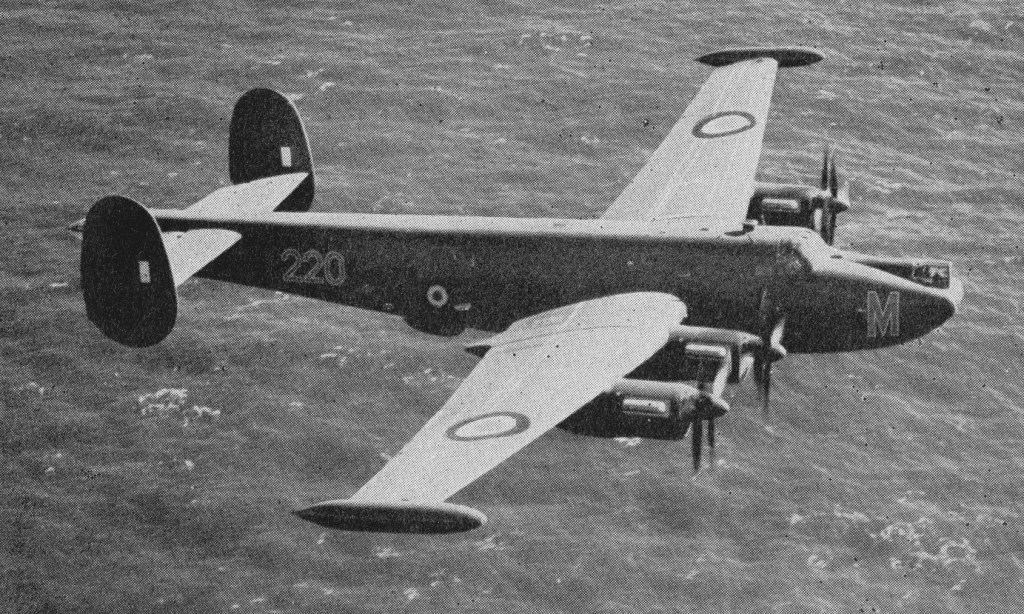
The Shackleton was designed to a 1946 requirement for an all-new long-range maritime patrol aircraft for use by the Royal Air Force Coastal Command. Derived from the Avro Lincoln bomber, The Avro was initially known as the Lincoln ASR.3 and would later become known simply as Type 696 Shackleton (named after English explorer Ernest Shackleton). The Shackleton featured a similar (though all-new) fuselage design and was the first British bomber to feature contra-rotating propeller blades. First flight was achieved on March 9th, 1949.
The Avro Shackleton featured a slender straight-sided fuselage with the aft end extended out past the tail plane. The tail plane also featured twin vertical fins in much the same way as that of Lincoln design. The Shackleton was also fitted with a low-wing monoplane with two engines to a wing and each engine was fitted with two three-blade propellers in a contra-rotating fashion – the first such British four-engine aircraft to do so. Power was delivered by 4 x Rolls-Royce Griffon liquid-cooled in-line engines. The Griffons were noted for requiring a great deal of attention during the aircraft’s career. The undercarriage was retractable tricycle, wth twin wheels on each unit. The main wheels retract forward into inner nacelles and the nose whels retract rearward. Armament in the Anti-Submarine Warfare (ASW) role consisted of 2 x 20mm cannons mounted in the nose while internal bombloads could consist of torpedoes, mines and bombs as needed.
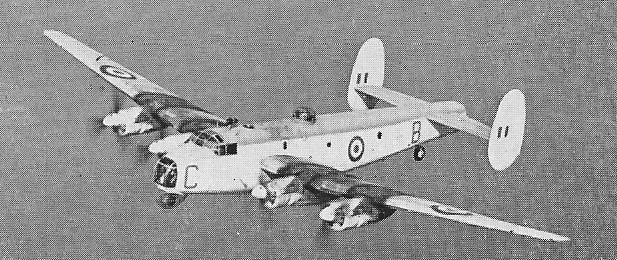
The Shackleton MR.1 first flew on 9 March 1949.
Shackleton M.R.1
This entered service in April 1951 with No 120 Sqn, based in Scotland, as the Shackleton MR.Mk 1, which was soon complemented by the Shackleton MR.Mk.1A and a production run of 77 Mk.1 and Mk.lA with wider outer nacelles. The radar of the early Shackleton was inadequate, and the Shackleton MR.Mk 2, of which eight examples served with the South African Air Force, introduced a new forward fuselage which retained two 20-mm cannon but relegated the radar from a chin radome to a semi-retractable “dustbin” under the fuselage behind the bomb bay. Additionally, the MR.2 featured a reinforced undercarriage, a lengthened nose and tail section and redesigned tail planes. The first of 69 MR.2 came into use in the UK and Malta in 1952.
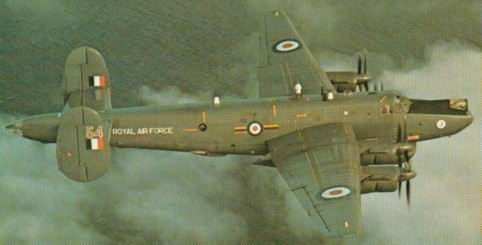
Issued in 1957, thirty-four Shackleton MR.Mk 3 introduced tricycle landing gear, a larger fuselage, sleeping galley for the crew on long flights, a revised wing, improved cockpit canopies, dorsal turrets deleted and wing tip-tanks (giving a 24-hour endurance) and, as a retrofit, extra power from two 2,500-lb (1,134-kg) thrust Rolls-Royce Viper Mk 203 turbojets in underwing nacelles, these being noted by their designation of MR.3 “Phase II”.
Shackleton 3
Eight were delivered to the South African Air Force. South African models were in service up until 1984.
In 1964 there were plans to install a pair of Viper 11 jets of 2500 lb thrust in wing pods to improve take-off performance of the Mk.3s.
The last model was the Shackleton AEW.Mk 2 conversion of the MR.Mk 2 for airborne early warning with APS-20 radar in a large “guppy” radome under the forward fuselage. In 1971 No 8 Squadron, RAF, re-formed at Kinloss with MR.3s. 11 remained operational in 1979 with 7 MR.3 serving in South Africa.
First flown on 28 June 1968 Nimrod MR.Mk 1s began to enter RAF service in October 1969, re¬placing the Avro Shackletons which had assumed this task towards the end of 1951. All marks had either Griffon 57, 57a or 58’s depending upon their modification and phase level.
Shackletons saw their first real use in the Suez Crisis of 1956, the combined British, Israeli and French attack on Egypt after the Egyptian attempt to nationalize the Suez Canal.
In 1964 there were plans to install a pair of Viper 11 jets of 2500 lb thrust in wing pods to improve take-off performance of the Mk.3s.
Production totals for each model type numbered 77 for the Mk 1 series, 70 for the Mk 2 series and 34 for the Mk 3 series with a further 8 of that batch for use in the South African Air Force.
MR.Mk 1 Engines: two Griffon 57 and two Griffon 57A. Wingspan: 120 ft Length: 77 ft 6 in Height: 17 ft 6 in
MR.Mk 1A Engines: four Griffon 57A.
MR.Mk 3 Engines: 4 x 2,455 hp Rolls Royce Griffon.
MR.Mk 2
MR.MR 3 Engines: 4 x Rolls-Royce Griffon 57A inline piston, 2,455-hp (1,831-kW) Wing span 119 ft l0in (36.52 m) Length 92 ft 6in (28.19m) Height 23ft 4in (7.11 m) Wingarea 1,421.0 sq ft (132.01 sq.m) Empty weight 57,800 lb (26,218 kg) Maximum take-off weight 98,000 lb (44,452 kg) Fuel capacity: 4248 Imp.Gal Maximum speed 302 mph (408 kph) at optimum altitude Service ceiling 19,200 ft (5,850 m) Range 4215 miles at 200 mph at 1500 ft Armament: two 20-mm cannons and up to 10,000 lb (4,536 kg) of bombs Crew 10
Engine: 4 x 4 x Rolls-Royce Griffon, 1800kW Take-off weight: 45400 kg / 100090 lb Wingspan: 36.8 m / 121 ft 9 in Length: 26.6 m / 87 ft 3 in Height: 5.3 m / 17 ft 5 in Wing area: 132.4 sq.m / 1425.14 sq ft Max. speed: 485 km/h / 301 mph Cruise speed: 375 km/h / 233 mph Range w/max.fuel: 6000 km / 3728 miles Armament: 2 x 20mm cannons, bombs Crew: 10