A 1978 hang glider.
Post WW2
Bicla Bicla

The Bicla 2 is a 1979 hang glider.
Bicla Bergstar

The Bergstar is a 1977 hang glider.
The Bergstar 2 is a 1978 hang glider.

Bergstar
Wing area: 17.05 m²
Wing span: 8.7 m
Aspect ratio: 4.45
Hang glider weight: 15 kg
Minimum pilot weight: 55 kg
Maximum pilot weight: 85 kg
Minimum speed: 24 km/h
Maximum speed: 75 km/h
Minimum sink rate: 1 m/s
Packed length: 5 m
Packed length short: 2 m
Number of battens: 8
Nose angle: 118°
Bicla Adler

A 1976 hang glider.
Bianchi Santos-Dumont Demoiselle

The film “Those Magnificent Men in Their Flying Machines” is notable for reproductions of 1910-era aircraft, including a triplane, monoplanes, biplanes and also Horatio Phillips’s 20-winged multiplane from 1904. Air Commodore Wheeler insisted on authentic materials but allowed the use of modern engines and modifications necessary to ensure safety. Of 20 types built in 1964 at £5,000 pounds each, six could fly, flown by six stunt pilots and maintained by 14 mechanics. The race takeoff scene where seven aircraft are in the air at once included a composite addition. Flying conditions were monitored with aerial scenes filmed before 10 am or in early evening when the air was least turbulent, for the replicas, true to the originals, were flimsy – and control, especially in the lateral plane, tended to be marginal.
The actual machine upon which they were based on was No.20 built by the Clement Bayard Motor Co in Paris. They were built at White Waltham using a welded steel tube fuselage, wooden wings (with ailerons instead of wing warping) and a 30 hp Ardem 4C02 engine. Initial flight trials were very poor and a 50 hp Ardem 4C02 and a two foot extension to the wing span was put in before they could fly well enough.
The replica of the Santos-Dumont Demoiselle was in its early form unable to leave the ground except in short hops. Extending the wingspan and fitting a more powerful Ardem 50 hp engine produced only marginal improvement. When Doug Bianchi and the Personal Planes production staff who constructed the replica consulted with Alan Wheeler, he recalled that the Demoiselle’s designer and first pilot, Alberto Santos-Dumont was a very short, slightly built man. A suitably small pilot, Joan Hughes, a wartime member of the Air Transport Auxiliary who was the Airways Flying Club chief instructor, was hired. With the reduced payload, the diminutive Demoiselle flew very well, and Hughes proved a consummate stunt flyer.

After filming they were dispersed:
PPS/REP/2 – PPS/DEM/1 to RAF Gatow, Berlin
PPS/REP/3 – PPS/DEM/2 to Sydney, Australia
PPS/REP/4 – PPS/DEM/3 to R.Jude at Laleham, UK
Bianchi Fokker E.III / Personal Planes Services Fokker E.III

The aircraft was a full-scale replica of a Fokker Eindecker EIII that was built circa 1975 to be as close as possible to the original design which entered military service in 1915.

The plans for the aircraft were based on contemporary records and measurements of the only surviving original example, which is housed in the Science Museum in London.

The E.III G-AVJO was marked up as Fok.E.III/157.

The replica E.III with a Continental A75 engine. Registered G-AVJO serial PPS/REP/6 and PPS/FOK/1, it flew with WW1 markings as ‘Fok.EIII/157’ and later in Dutch Air Force colours as ‘La34’. It went into store at Booker.
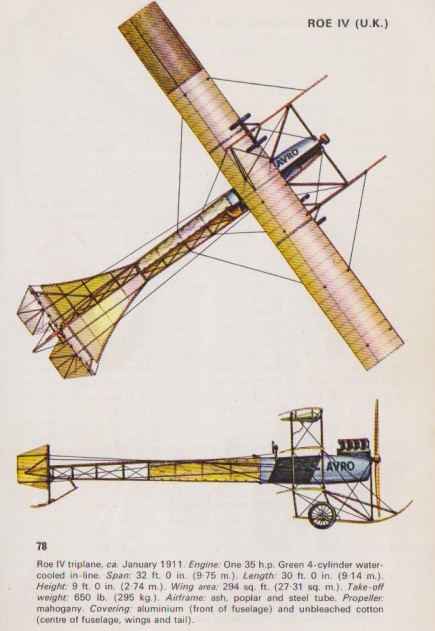
Bianchi Avro IV Triplane
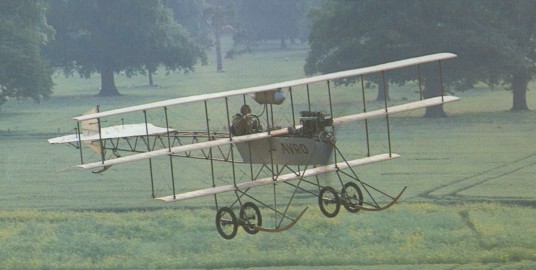
Avro IV Triplane replica
Bianchi Morane N / Personal Plane Services M.S. Type N

A Morane N replica was built purely for fun by Doug Bianchi at Wycombe Air Park. It differs from the genuine article in that it has a fixed tailplane and normal elevators, as distinct from an all flying tailplane, and ailerons are used in¬stead of wing warping.

The engine was a Continental C 90 and although the nose shape is correct it is nine inches too long. The fuselage is made of welded steel and the wings are of wood. The gun is gas operated and works although so far it has only been fired on the ground, as it is rather too close to the petrol tank for comfort. The replica performs well, with a top speed of 100 mph, and will cruise at 80 mph

A M.S. Type N replica was built by Personal Plane Services at Booker in 1969. Powered by a Warner Super Scarab in flew that year, registered G-AWBU PPS/REP/7. It flew in French Air Force colours as ‘No.50’.
B&F Technik Fk 2

Otto Funk worked in the training department in the Heinkelwerk Speyer, and also developed new airplanes and technologies. Thus developed the Fk 2, which was finished in the training workshop with Heinkel in 1962.
B&F Technik FK-1 Greif 1 / Funk Fk-1

Otto Funk became a student to the Heinkel company at Speyer, where he completed the glued metal Greif 1a (FK1), designed in 1959.
Funk used a completely new metal glue building method, which was developed further.
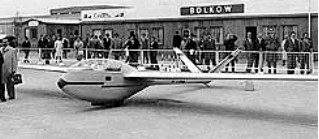
In 1960 a turbo-jet engine was built into the glider, which became the 1b.

