The Borzecki 2RB is a Polish air-cooled, four-cylinder, horizontally opposed, two-stroke, piston engine designed and built by Jozef Borzecki for use in motor gliders. It was designed by J. Borzęcki out of two connected Riedel starter engines from German Junkers Jumo 004 turbojet engine from World War II.
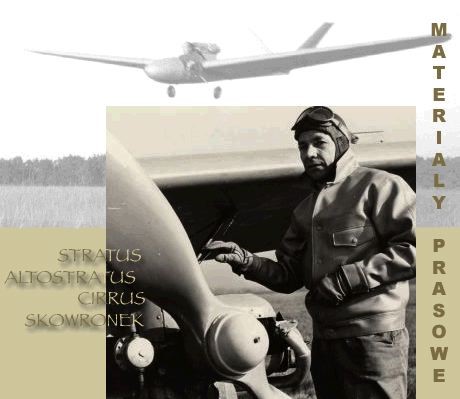
First bench tested in 1970 the 2RB can be used in both tractor and pusher configuration, and the 24 hp (18 kW) engine was first flown in 1972 in his own design motor glider, the Borzecki Alto-Stratus.
Type: Air-cooled four-cylinder horizontally opposed two-stroke piston engine Bore: 70 mm (2.76 in) Stroke: 35 mm (1.38 in) Displacement: 33 cu in (540 cc) Length: 450 mm (17.7 in) Width: 250 mm (9.8 in) Height: 260 mm (10.2 in) Dry weight: 15 kg (33 lb) Designer: Jozef Borzecki Fuel system: Jawa 250 motor-cycle carburettor Fuel type: Mixture of 76-octane petrol and oil Cooling system: Air-cooled Power output: 24 hp (18 kW) at 6,000 rpm Compression ratio: 7.2:1
Józef Borzęcki was born on March 19, 1928 in Olszany near Stary Sącz, as a son of Jan and Wiktoria. It was the Father who awakened the five-year-old boy’s imagination and interest in flying, telling about the famous flight of Stanisław Skarżyński across the Atlantic in 1933. The pre-war atmosphere of worship for aviation reached every corner of reborn Poland. The pilots were the heroes of meetings and legends.
Just before the outbreak of World War II, Józek, as a high school student, received a state guardian for his clearly targeted abilities. However, the outbreak of war changed the path of life for all Poles. Instead of studying at his dream school in Austria, 14-year-old Józef spent four years under German occupation, experiencing hunger, hard work in the factory, inhuman humiliation, fear and rebellion.
In 1945, after liberation of the country from the Nazi occupation, he went to Wrocław and began his education at the Technical Secondary School of Mechanical Engineering, obtaining a diploma as a technician in the design of internal combustion engines. In 1947 he completed glider training at the Aero Club of Wroclaw (at that time he performed flights on SG-38 and Grunau “Baby II” gliders). In a sense of lost youth and the desire to fly, he gives up his technical studies, however, the politicised atmosphere of the Aero Club once again turned his thought to independent aviation constructions. In 1951, he began the first calculations and made experimental models.
In the library, reaching for Russian-language textbooks on aviation technology, he meets his future wife – Aniela Plucinska, born in Nieśniew, who knows Russian. In December 1952 he married Aniela. In 1953, her daughter Elżbieta was born. The young couple are moved, together with the wife’s parents, to a new apartment. This is where the first construction begins to appear. In 1954, daughter Barbara was born.
In 1960, the trial take-off of the first glider “Stratus” took place. There are years of balancing passion with family responsibilities.
In July 1966, the designer invited the pilot of the flight and the editor of the newspaper Polish Word – editor Andrzej Macko to perform a test flight in the Stratus. He made several test flights, issuing a very favorable opinion about him. Articles by A. Macko published in Kulisach and the Polish Word about Józef Borzęcki’s motor glider started a nationwide discussion on amateur aviation in Poland. The construction and piloting of own aircraft were strictly prohibited in Poland at that time. In September 1966, J. Borzęcki wrote a letter to the well-known Soviet designer Oleg K. Antonov, who was a great enthusiast of amateur aircraft and glider construction. After two months, he received an answer, Antonov warmly congratulated him on the achievements in construction and encouraged him to continue working.
In May 1967, an extensive article on amateur aviation was published in Winged Poland, a lot of space was devoted to the glider “Stratus”. In the press and everywhere where there were people interested in aviation, from aeroclubs to the Department of Aviation, there was a discussion about the future of amateur aviation in Poland. Some spoke in favor of amateur aviation, others against him. There were moderate voices, but there were also those aimed at causing sensation. Most opinions, however, were evidence of a thorough reflection on the substance, seeing Stratus as a precedent. In Winged Poland of May 21, 1967 there was an article sharp in tone. It expressed views that the development of amateur aviation in Poland has no justification and is not simply needed, and the amateur construction of gliders, airplanes or even helicopters is today an archaic obsolete, economically unjustified and socially unnecessary. Not only with us. And therefore there will be no green light for this movement. J. Borzęcki received a lot of letters from supporters of amateur aviation that came from home and abroad. Everyone wanted to build a small amateur plane that made their innermost dreams come true. They wrote warmly, friendly. He became an example for them. It was the greatest payment for the designer for many years of effort. The letters confirmed his belief that there were many like him and that it was worth working for them.
In 1967, the second motor glider “Cirrus” was completed and flown, and Józef Borzęcki receives the honorable distinction “Blue Wings” from the editorial team of the weekly Skrzydlata Polska for his aviation activities. Until now it was awarded only for outstanding achievements, for his creative contribution to the development of Polish aviation in the professional and sport fields. Awarding them to an amateur, who was often embarrassing, set a precedent for those who had dreamed of their own wings for years. In the press competition for “Good Work” he was selected by the inhabitants of Wrocław to be “Big Twenty Winners”. In 1969, the motor glider “Cirrus” was recognized as the “Wrocław Work” this year. The Wroclaw Aviation Senior Club also awarded J. Borzęcki.
In 1972, the success of the next, third glider – “Altostratus” – is mixed with the sadness of the designer after losing both his parents. In 1974, Polish Television Wroclaw broadcast a film titled Cirrus. At that time, Józef Borzęcki becomes the initiator of the Amateur Constructors’ Club and a co-organizer of amateur air rallies. Domestic press and foreign magazines have published dozens of interviews as well as problem-technical and adventure articles of his authorship.
Borzęcki kept in touch with the Soviet designer Antonov and translated the diary of Antonow into Polish. Ten times from the beginning. An album published in 1976 in West Germany 50 Moderne Motorsegler, which was a kind of review of the world technique in the field of motor-sailing, contained photographs and technical descriptions of Cirrus and Altostratus. Also, the West German airline with international reach, Der Flieger from 1976, posted an extensive article about J. Borzęcki’s micro-planes and a 24 HP 2 RB engine.
In 1980, the Ossolineum Publishing House of Wrocław published his autobiographical book titled On own Wings. He chooses Olesno Śląskie as his place of residence. There, he also designs and builds the fourth ultra-light structure called JB-4 “Skowronek”.
Józef Borzęcki was a co-designer (next to Tadeusz Dobrociński) of the first “Pterodaktyl 1” soft-wing in Poland. In the 1980s, Józef Borzęcki received from the Amateur Club of Constructors (Aeroclub Opole) glider SZD-10 “Czapla” registered SP-2187. It was a thank you for help in constructing and building amateur aerial constructions. J. Borzęcki wanted to motorize “Heron”. For this purpose, he wanted to use his own drive, based on two MZ-250 engines. The project has not been implemented.
In the fall of October 29, 1989, in the presence of Elżbieta’s daughter, “Skowronek” made several successfully completed take-offs and landings. A year later, on October 14, 1990, he made his last flight. From a height of 200 m, while descending to land, the left wing girder was broken. On this day, Józef Borzęcki died. Grandfather of Magdalena and Samantha.
The Lurko is reported as a light side-by-side seating trainer project in Hungary in the 1950s. Engine was said to be a Hirth HM504A and the Lurko is described as a low wing and wooden construction monoplane.
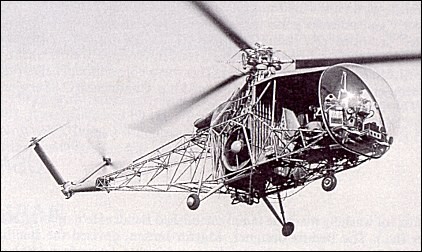
The German car manufacturer, Borgward set up a helicopter division in 1956 under the leadership of Prof. Heinrich Focke, whose Focke-Wulf Fw.61 aircraft of 1937 was one of the earliest successful helicopters. The Kolibri I is the first helicopter of German design to have flown since the war.
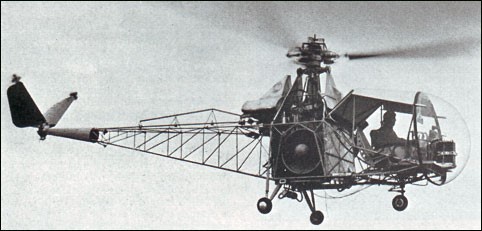
A light three-seat helicopter, the Kolibri I, was designed with a three-blade main rotor. Blades have steel-tube spar, with plastic-bonded plywood covering. Fully-articulated hub with adjustable friction dampers. Main rotor drive is via two-stage cam-wheel. Tail rotor drive via hollow steel-tube shaft and two bevel-gears. Two tail rotors, inclined at 45° to horizontal, at extremities of tail stabilisers. Tail rotor blades of plastic-bonded plywood.
The uncovered steel-tube girder fuselage had a conventional tail boom and a tricycle type landing gear. Shock-absorption by torsion spring and Borgward hydraulic damper. Fuel tank aft of rear fire-wall.
Normal seating for three persons, with a central seat behind and on a higher level than front two seats, with a forward cockpit enclosed with bubble canopy. Alternative loads can include up to 300kg of freight slung from an under-fuselage hook.
The prototype had a 260hp Lycoming VO-435-A1B engine in the centre section.
The prototype made its first free flight on July 8, 1958, piloted by Herr Ewald Rohlfs, who set up several international helicopter records in the pioneer Fw.61 in 1937. Airworthiness trials were progressing satisfactorily in the Spring of 1959, and plans are being made to put the Kolibri in production.
Kolibri I Engine: 1 x Lycoming YO-435-A1B, 260hp Main rotor diameter: 9.40m Main rotor blade area (each) 1.28 sq.m Main rotor disc area 70 sq.m Length of fuselage: 8.30m Height to top of main rotor head: 3.05m Weight empty: 800kg Weight loaded: 1200kg Fuel capacity: 180 litre Wheel track 1.93m Wheel base 1.80m Tail rotor diameter: 1.66m Tail rotor disc area (total) 4.3 sq.m. Main rotor/engine r.p.m. ratio 1 : 10 Tail rotor/engine r.p.m. ratio 1 : 6.75. Max speed (est.): 160km/h Cruising speed (est.): 140km/h Rate of climb at sea level (est.): 240m/min Vertical rate of climb at sea level (est.): 60m/min Absolute ceiling (est.): 4500m Hovering ceiling OGE (est.): 600m Endurance: 3.0h
Bo 209-150 Engine: Lycoming O-320, 150 hp Prop: fixed pitch
Bo 209-150 Engine: Lycoming IO-320-D1A, 160 hp Prop: Constant speed Wingspan: 27 ft 6.75 in / 8.40 m Length: 21 ft 7.75 in / 6.60 m Empty weight: 1067 lb / 484 kg Max payload: 504 lb / 229 kg MTOW: 1807 lb / 820 kg Max cruise 75% 8000ft/2440m: 148 kt / 170 mph / 274 kph ROC SL: 1180 fpm / 360 m/min Service ceiling: 18,100 ft / 5520 m Max range, 65%, no res: 647 nm / 745 mi / 1200 km Cabin length: 4 ft 7 in / 1.40 m Cabin width: 3 ft 3.75 in / 1.01 m Cabin height: 3 ft 6.75 in / 1.11 m Seats: 2 side-by-side
Bo 209S Engine: Rolls-Royce Continental O-240, 130 hp Non-retractable nosewheel Wing: non-folding
Bjorn Andreasson of Sweden, originally designed and constructed the prototype BA-7 in his garage in San Diego, while employed as an engineer at Convair. Andreasson’s BA-7 major objectives were good performance, economy, unusual visibility and maneuverability. Fifteen hundred hours of work, one thousand dollars, and a used seventy-five horsepower Continental engine was the expenditure in the project.
Andreasson first flew his 75hp Continental powered BA-7 homebuilt prototype on 10 October 1958.
Bjorn “Andy” Andreasson and BA-7 Junior prototype October 1958, 75 hp Continental
The fuselage is a sheet metal box with exterior longerons and only three bulkheads. The horizontal tail is all-flying; the vertical tail has been changed to conventional fin-and-rudder combination and swept to enhance directional stability.
The wings, using an airfoll only 8.5% thick, have an extruded spar at 30 percent, and a light rear spar at 75% chord. A heavy magnesium skin adds strength, and countersunk rivetting ensures smoothness. By undoing the rear spar bolts, the wings can be folded alongside the fuselage for easy towing or storage, an attractive feature.
The visibility comes from the slight forward sweep of the wings, the occupants sitting forward of the spar. The one piece free blown canopy is hinged at the rear and held down by two latches, one of which is sufficient to hold it at maximum speeds. The main gear is built around two tapered steel rods, anchored to a box beam. The nose gear has a coil spring, is air damped, and is steared by the rudder pedals. Elevators and ailerons are actuated by a single centrally located stick; rudder pedals are dual, and a single hydraulic cylinder gives braking action to both wheels.
The flap control incorporates a nonreversing mechanism that holds the flap in any selected position. The fuel supply is positioned over the center of gravity behind the pilot, and with the 75 horsepower engine in the prototype, the twenty US gallons provides six hundred miles range. A plastic tube is used to indicate the fuel level.
Liftoff is at about sixty-five miles per hour, and an actual top speed of over 150 has been achieved. A more powerful engine is contemplated for the production version. Present approach speeds are on the order of 70-85, and touching speed approximately 55 miles per hour.
MFI Trainer
Andreasson was producing three copies of the MFI Junior, as it’s been renamed, and with Malmo Flygindustri, Mahno, Sweden, a series of ten to test its market potential.
A couple of years later Andreasson returned to Sweden where he joined up with theMakno Flygindustri company, later becoming head of the Aircraft Division of Malmo, a subsidiary of Saab Scania.
While there he put together an improved version of his BA-7, powered by a flat-four engine of 100hp. Following its test flight, the BA-7 design rights were acquired by Malmo Flygindustri and the BA-7 was renamed Malmo MFI-9 or just MFI to the team. Under the designation MFI 9 Junior, the first prototype Junior took to the air on 17 May 1961. Limited production commenced in 1962 and the first production model flew on 9 August 1962. The Junior is certificated for normal and Utility categories and for glider towing.
The basic MFI, of which 25 were produced by Malmo, had reasonably good beginnings and in 1962 Bolkow Apparatebau GmbH (Germany) became involved. Bolkow started producing the Bolkow B208 Junior as an expansion of the MFI-9 under licence to Malmo and by 1970 had produced 200 examples.
Bolkow 208c
A manufacturing licence agreement was reached with the West German firm of Bölkow-Entwicklungen KG, Munich, and licensed production began in 1962 in Germany at the Bolkow factory as the Bo208 Junior.
Bo.208
Two years later a new model, the Bo208C, emerged with the addition of electrically operated flaps, a trailing link nosewheel suspension and a former optional longspan wing as standard. Amongst other features, the Bolkow had tubular steel main gear well before Cessna adopted the concept. The Bo208 has only required three relatively minor mandatory modifications. Its only real problem came with the nosewheel it was prone to falling off once the aircraft was airborne. The addition of the trailing link nosewheel suspension in the B model sorted that problem out. The Bolkow remained one of the fastest 100hp two seat light aircraft with a duration of four hours in the air (range 804.7km with maximum payload), cruis¬ing at 120 mph. Aerobatic. 186 built in total.
In 1964 nine examples were assembled in Burbank, California, by Pioneer Aviation, the U.S. distributor. The 1964 price was US$7800 fully equipped but minus radios, with its American type certificate A1EU.
Slab tail surfaces were featured on the prototype in original form along with a system of springs to return the elevator to neutral or trimed position. The spring tension is not affected by speed, the stick loading remains light at high speed. With an anti-servo tab the feel heavies up as the speed increases. Andreasson eventually adopted the anti-servo tab for better all-round efficiency. After some experimentation, the rectangular rudder was abandoned for the more conventional swept tail.
The large, one-piece canopy is just under 1/8in thick. It measures 38in across at the widest point and has a base length of 30in. American models have a single, centrally located canopy latch instead of the left and right side handles fitted to German aircraft. The seats are independently mounted. A luggage compartment is situated directly behind the seats and below the fuel tank. It is accessable from the cockpit only.
In order to achieve the excellent visibility from the cockpit and still keep the centre of gravity within permissable limits, Andraesson swept the wings forward three degrees. The employment of the “droop snoot” leading edge has the effect of providing a more forward centre of pressure at higher angle of attack. Structurally the fuselage has four external longerons and the skins are all flat sheets. To prevent excessive vibration, two longitudinal stiffeners are formed in each side panel. The single spar (an I-beam extrusion) wing is composed of a minimum of parts, each panel having only seven ribs. The airfoil is an NACA 23008.5 section modified at the leading edge. The main legs of the landing gear are flexible steel shafs weighing about eight pounds each.
Reinforced fibreglass mouldins are used at the wing tips and on the engine cowling. Self-aligning bolt bearings are used in such places as the top engine mount lug and fuselage wing strut fittings.
Dual throttles, located on the extreme right and left side of the instrument panel, are connected by a transverse torque tube behind the panel. Friction on the torque tube is adjusted by a small knob in the centre of the panel.
Cleveland hydraulic brakes are actuated simultaneously by a lever mounted on the left side of the central keel. A simple ratchet lock disengages easily by pulling the handle a little to one side. The anti-servo trim tab has a lever in the cockpit moving a sheathed, 1/8in steel rod connected to a 1.5in long bellcrank at the tailpost. The bellcrank, fitted with a small friction-disk brake, is linked to the tab by a short rod.
Aileron mass balance weights on the BA-7 were fully enclosed in the wing tips. They are in about the same place on the Junior, but project into the airstream with up aileron. Rudder weights are entirely external and the horizontal tail has a heavy leading edge, largely with the weight necessary for balance.
In its original form the Junior was equipped with manually-operated self-locking flaps which were quick and positive. However, the operating handle was situated above shoulder level between the occupants and on the rear cross tube. During certification tests in Germany, the inspector banged his head several times on the handle and this prompted a recommendation that the system be operated electrically. A small window actuating motor from a Mercedes 220 automobile was adapted for aircraft use.
The toggle switch controlling the flaps is located next to the throttle. A simple flap indicator is an endless sheathed cable running from the flaps to a small pointer projecting through a vertical slot on the instrument panel. The slot is marked to show any position from 0 to 35 degrees. A second, electrical fuel pump is fitted.
In the original BA-7, the elevator was not adequately powerful to keep the nose up at low speeds, which meant that the aircraft had to land faster than should have been necessary. By increasing the elevator area on the Junior and giving it an inverted camber, control was more powerful and touchdown speed was reduced. Recommended approach speed is 70 kt / 80 mph. The Junior’s ailerons are small, 32in x 10.5in, but effective and a 360 degree roll takes under 3 seconds. The landing gear is sprung, with 500 x 5 tires all round. The thrust line is offset 1.5 degrees to the right.
Empty weight has been raised from 590 lb of the BA-7 to 750 lb, due primarily to the use of aluminium instead of magnesium and the use of the 100 hp Continental with full electrical system.
Some 210 Bolkows were built in the years following 1962, ceasing in 1970.
Bo.208C Junior
Meanwhile, Malino had further developed the MFI-9 from which came the MFI-9B Trainer with an enlarged cabin. The 9B was purposely designed for the military as a basic trainer, although the type later became very useful in a ground attack role. Malmo, which built nearly 50 9Bs, was hoping that the Swedish Air Force would acquire its trainer, but that didn’t eventuate.
MFI-9HB
The MFI 9B was followed by a T tailed version with provision for underwing stores, evolving to the MF 15 which was used a military trainer.
About five rocketting 9Bs saw service with the Biafran Air Force during the Biafra-Nigeria Civil War in 1969, when Biafra was fighting for its independence from the much larger country. The five 9Bs actually made up the air component of the BAF, along with a few inactive Harvards. Known as “Biafran Babies”, the militarised 9Bs were flown by Swedish and BAF pilots and were up against the likes of the Nigerian Air Force’s (NAF) MiG-17 jet fighters and the much bigger Ilyushin Il-28 twin-engine jet bombers. It is reported that the little 9Bs either severely damaged or totally wrecked numerous MiGs and three of the NAF’s six Il-28 bombers during ground attack, hit-and-run operations. Other Nigerian targets attacked by the 9Bs included key airfields, armoured vehicles, troop and transport lines and oil depots. One 9B returned to base from a low-level sortie with 12 bullet holes in it.
The 9B was also used in a ‘MiniCOIN’ role, a contraction of miniature counter-insurrection. At the end of seven months of flying combat missions, the BAF’s strike force assets numbered two. Two MFI-9Bs had been shot down with the loss of their pilots and one had been damaged beyond repair.
Bolkow 208C Junior Engine: Rolls Royce Continental 0-200A, 100 hp Wingspan: 26 ft 4 in / 8.02 m Length: 19 ft 0 in / 5.79 m Empty Weight: 874 lb / 380 kg Max All Up Weight normal: 1390 lb / 630 kg Max All Up Weight utility: 1320 lb / 600 kg Fuel Capacity: 21 Imperial Gallons (100 Litres) Max cruise Speed: 111 kt / 127 mph / 205 kph Max ROC SL: 785 fpm / 240 m/min VNE: 153 kt Service ceiling: 14,780 ft / 4500 m Range max fuel: 538 nm / 620 mi / 1000 km Seats: 2
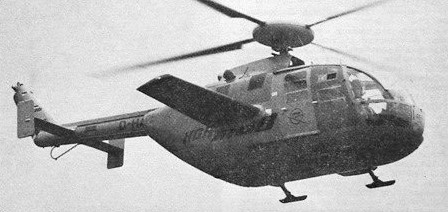
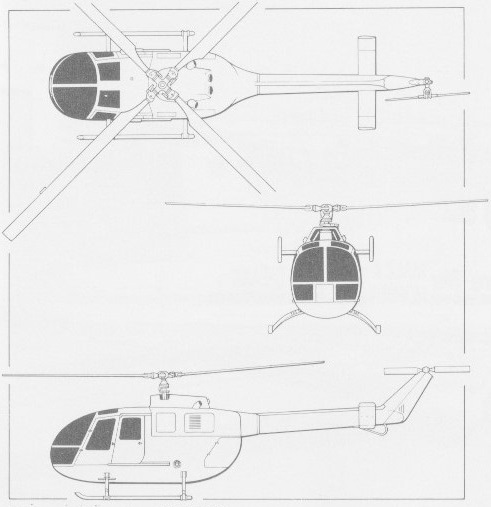
First flown on 25 September 1973 (Prototype D-HDCI), the BO 106 is generally similar to the BO 105 but has the cabin widened by 50cm to seat two or three persons in front and four on the rear bench. Its uprated Allison 250-C20B engines each develop a maximum of 420shp and give 50shp more than the 250-C20 at ISA + 20°C. This gives the BO 106 a performance simflar to that of the BO 105.
An uprated transmission caters for a twin-engine power output of up to 692shp, and single-engine output of 380shp, compared with 636 and 370shp respectively for the BO 105 transmission.
The prototype was developed with government aid (60%). It is hoped to make available kits to convert existing BO 105s to BO 106 standard, as well as new production aircraft.
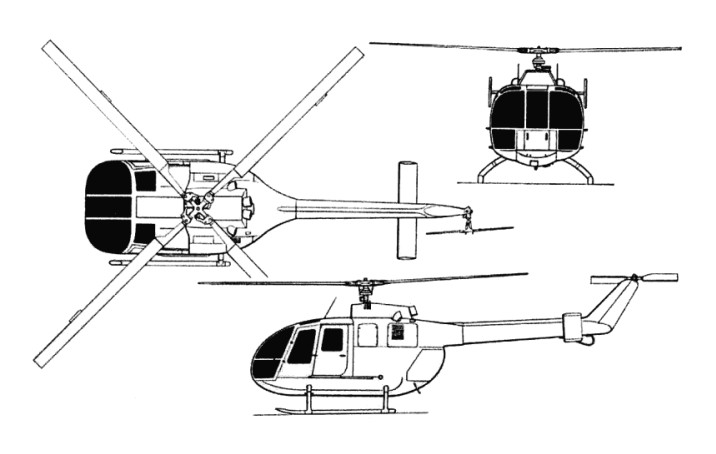
Design of the Bo.105 lightweight, general purpose helicopter was begun in July 1962 utilising basic experience gained by the company in the preceding few years in building the Bo.102 and Bo.103. The former was a non-flying, ultra-light helicopter trainer, and the Bo.103, flown for the first time on 9 September 1961, was essentially the same aircraft minus its fixed base. An enlarged version of the Bo.103 was proposed as the Bo.104, but this project was supplanted by the more promising Bo.105.
Under German government contract, ground rig testing of its radical rigid rotor and construction of the first prototypes began in 1964. The first prototype airframe (V-1) was ready for ground testing September 1969, powered by two Allison 250-C18 turboshaft engines and using the hinged-rotor from a Westland Scout, was destroyed on the ground at an early date by resonance problems. The second prototype, first flown on 16 February 1967 at Ottobrunn (Munich), was the first to take to the air with hingeless titanium rotor hub and composite rotor blades. Powered by twin Allison 250-C18 turboshaft engines, the non-articulated rotor, whose fold-able blades are reinforced with glassfibre, has been developed over several years by Bolkow in association with Sud-Aviation and has been adopted by the French company for its own SA.341 light helicopter.
Further changes and modifications led to the third prototype — the V-3 fitted with two German-built MAN-Turbo 6022 turbines (first flown on 20 December 1967), and to two pre-production models, the Bo.105 V-4 and V-5, the first of which made its maiden flight on 1 May 1969. Two Allison 250-C20 turbines were later installed on the V-4, which thus became the prototype of the definitive Bo.105C. Meanwhile, from spring 1970, new “droop snoot” design blades, which had a marked downward curvature on the leading edge, were introduced. These were made by MBB, the Messerschmitt-Bolkow-Blohm und Voss group — of which Bolkow and its affiliates had become part.
In 1972, the Bo.105 went into full-scale production at the company’s Donauwörth facility in Germany, and was offered with either Allison 250-C18 turbine engines or the more powerful C20. The helicopter was approved by the German Federal Authority LBA with the first power-plant in October 1970, after successfully completing autorotation trials in the autumn of 1969. Approval by the US Federal Aviation Administration followed in March 1971 and was extended to the C20 engines in August 1972, while the Canadian authorities certified the Bo.105 in April 1973. The German helicopter also received a British Certificate of Airworthiness in July 1973 and was recognized by the Italian Aeronautical Register in March 1974.
The German government ordered 20 for its “Katastrophenschutz” programme, to ensure rapid assistance in the event of a disaster. The military version differs little from the civil one. The antitank version can carry six HOT missiles, three on either side of the cabin, with a stabilized sight on the port side.
Bo 105 80+13, June 1986
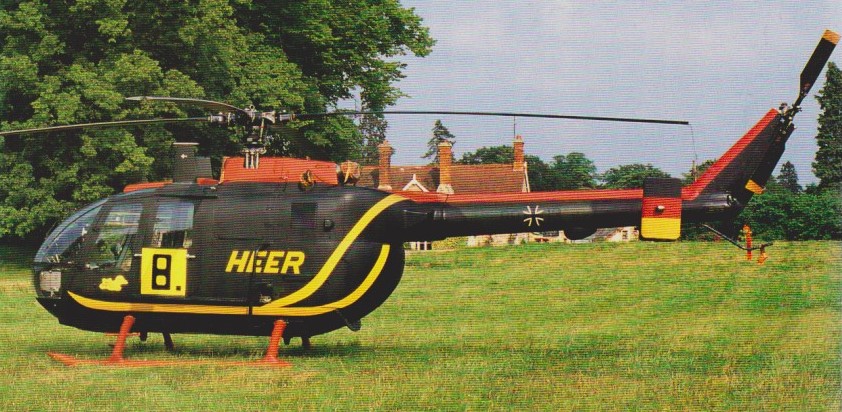
The Federal German government authorised production of a total of 439 BO 105s for service with the German army. These comprised 227 of the BO 105 M(VBH), a liaison and light observation version of which deliveries began in 1980; and 212 of the BO 105 P(PAH-1) anti-tank version, each able to carry six Euromissile HOT missiles. Initial deliveries of this latter version, to Heeresfliegerregiment 16, began in December 1980. MBB has also developed an anti-tank version able to deploy eight Hughes TOW missiles.
Other military operators include the Mexican navy with six radar-equipped versions used for maritime patrol, and the Spanish army with 60 BO 105Ps, 57 of them assembled by CASA. The Spanish company is also assembling 80 105s for other customers, and there are active licence-assembly programmes underway in Indonesia as the Nurtanio NBO 105, and Chile. BO 105 LS helicopters produced at Eurocopter’s Fort Erie facility in Ontario, Canada.
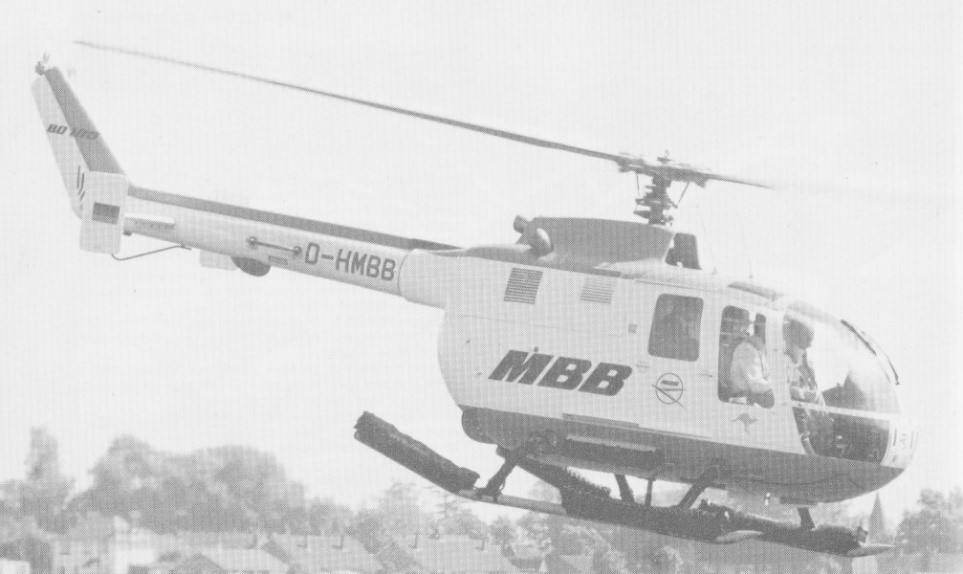
MBB Bo.105C
Others are in use in Brunei, Canada, Ciskei, Colombia, Holland, Iraq, Nigeria, Peru, Sierra Leone and Sweden. Sweden operates an unarmed SAR version known as the HR 9B. By 1991 more than 1,300 BO 105s had been delivered to 37 countries.
The civil version has also been a major export success and was initially marketed through Boeing in the United States before MBB set up its own US facilities. The BO 105C was superseded in 1975 by the BO 105 CB which became the standard production version.
By the end of 1981, total production of the Bo.105 exceeded 1100. More than 100 Bo.105s were in operation in the United States and these were joined in 1982 by the Bo.105CBS Twin Jet II variant, with 420shp Allison 250-C20B turbines, which, apart from having better flying capabilities, has 20 per cent more cabin room. The BO.105CB-3 variant of the standard production CB and CBS versions has a longer fuselage.
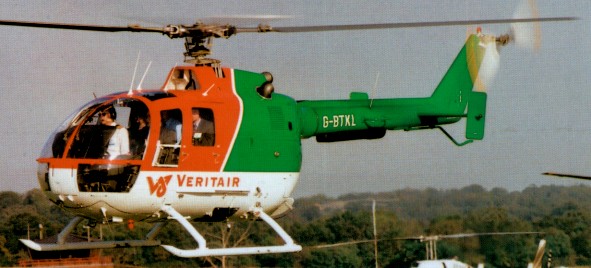
The Messerschmitt-Bolkow-Blohm GmbH Bölkow Bo.105 DBS-4 version has the 10-inch fuselage stretch at the rear of the cabin and the extra small rear side windows.
Further development of the Bo.105CBS led to the introduction in 1981 of the Bo.105LS (Lift Stretch) which combines the enlarged cabin with the uprated transmission of the military version and more powerful 550shp Allison 250-C28C engines to provide a much improved hot/high performance and external lift capability. Bo.105 LSA3 is a stretched cabin version. Featuring two Allison C28B engines, each with a separate drive to the main transmission, separate fuel and lubrication systems and dual hydraulic boost system. Providing the lift and directional control is a hingeless four-bladed main rotor and a semi-rigid two-blade tail rotor, all of fibre reinforced composite material.
The rear-loading clamshell cargo compartment is rigged to al-low accommodation of bulky cargos or stretchers by removing the rear bulkhead behind the passenger compartment.
Sales total more than 1300 to 37 countries by 1990. Navalised BO.105s are fitted with Sperry Primus 500 search radars and other maritime equipment, and have folding main rotor blades for shipboard stowage.
Messerschmitt-Bolkow-Blohm Bo.105HGH
An BO 105 fitted with a rear fuselage fairing, rotor head fairing and four small individual landing gear skids, was developed under a high-speed research programme. Known as the BO 105HGH, this aircraft attained a speed of 372km/h in a shallow dive at max AUW in September 1973. Flight testing was continued in 1974 after the addition of 6.00m fixed wings with an NACA 230 section varying from 15% thickness/chord ratio at the roots to 12% at the tips. Airbrakes are mounted above and below the leading-edge of each wing, and a shorter-legged landing gear is fitted.
The HGH programme (Hochgeschwindigkeits Hubschrauber / High Speed Helicopter) ended on 4 March 1975 with a flight in which the aircraft attained a max speed of 404km/h; max blade tip speed was Mach 0.97. The BO 105HGH, which was converted from a pre-production BO 105 airframe, was to continue in use as a rotor blade testbed.
BO 105 CBS-4 description except where indicated:
DESIGN FEATURES: Four-blade main rotor, comprising rigid titanium head and GFRP blades, with titanium anti-erosion strip and pendulous vibration damper on each blade. NACA 23012 lifting aerofoil with drooped leading-edge and reflexed trailing-edge. Two-blade semi-rigid tail rotor. Tail rotor gearbox on fin. Main rotor 424 rpm. Tail rotor 2,220 rpm. Main transmission utilises two bevel gear input stages with freewheeling clutches and a spur collector gear stage. Planetary reduction gear; three auxiliary drives for accessories. Main transmission rated for twin-engine input of 257kW per engine, or a single-engine input of 283kW. Uprated transmission and Allison 250-C28 engines in BO 105 LS for exceptional hot-and-high performance. EC Super Five has new main rotor blades and performance improvements, including 150kg more rotor lift; better stability; and airframe vibration reduced to less than 0.1g.
FLYING CONTROLS: Main rotor has roller bearings for pitch change. Main rotor brake standard. Dual controls standard on EC Super Five.
STRUCTURE: Folding of two main rotor blades optional. Tail rotor blades of GFRP, with stainless steel anti-erosion strip. The fuselage is a conventional light-alloy semi-monocoque structure of pod and boom type. Glass fibre reinforced cowling over power plant. Titanium sheet engine deck. Horizontal stabiliser of conventional light-alloy construction with small endplate fins.
LANDING GEAR: Skid type, with cross-tubes designed for energy absorption by plastic deformation in the event of a heavy landing. Inflatable emergency floats can be attached to skids.
POWER PLANT: BO 105 CBS: Two 313kW Allison 250-C20B turboshafts, each with a maximum continuous rating of 298kW. Bladder fuel tanks under cabin floor, capacity 580 litres, of which 570 litres are usable. Fuelling point on port side of cabin. Auxiliary tanks in freight compartment available optionally. Oil capacity: engine 12 litres, gearbox 11.6 litres. EC Super Five additionally has scavenge oil filter and one-handed engine starting arrangement. BO 105 LS A-3: Two Allison 250-C2BC turboshafts, each rated at 410kW for 2.5 minutes, and with 5 minute T-O and maximum continuous power ratings of 373kW and 368kW respectively. Main transmission, type ZF-FS 112, rated for independent restricted input of 310kW per engine at T-O power or 294kW per engine for maximum continuous operation; or single-engine restricted input of 368kW at maximum continuous power, or 410kW for 2.5 minutes at T-O power. Fuel capacity as for CB/CBS. Oil capacity 4.5 litres per engine.
ACCOMMODATION: Pilot and co-pilot or passenger on individual longitudinally adjustable front seats with safety belts and automatic locking shoulder harnesses. Optional dual controls. Bench seat at rear for three or four persons, removable for cargo and stretcher carrying. A full EMS version is available. Both cabin and cargo compartment have panelling, sound insulation and floor covering. Entire rear fuselage aft of seats and under power plant available as freight and baggage space, with access through two clamshell doors at rear. Two standard stretchers can be accommodated side by side in ambulance role. One forward-opening hinged and jettisonable door and one sliding door on each side of cabin. Ram air and electrical ventilation system. Heating system optional.
SYSTEMS: Tandem fully redundant hydraulic system, pressure 103.5 bars, for powered main rotor controls. System flow rate 6.2 litres/min. Bootstrap/oil reservoir, pressurised at 1.7 bars. Electrical system powered by two 150A 28V DC starter/generators and a 24V 25Ah Ni/Cd battery; external power socket; stability augmentation system standard on BO 105 LS A-3, with hoist, firefighting kit, weapons fittings, mast-mounted sight and floats optional; EC Super Five has improved hydraulic system.
Variants:
BO 105C: Initial production version offered with either 236kW Allison 250-C18 or 298kW 250-C20 turboshaft engines.
BO 105 CB: Standard production version from 1975, with two Allison 250-C20B engines, operable in air temperatures ranging from -45 to +54°C. LBA certification received in November 1976.
BO 105 CBS-5: Military army/naval version for armed and non-armed missions; can be equipped with anti-tank missiles, rocket launchers. Gun pod or turret. First 12 ordered by the Republic of Korea Army; most assembled from kits by Daewoo. Include Boeing IR/optical sights and defensive aids suite.
BO 105 CBS: version with slightly lengthened fuselage to provide increased seating or cargo capacity
BO 105 CBS-4 / Twin Jet II: Version with increased rear seat leg room in a cabin extended by a 0.25m plug. Available in five-seat executive or six-seat high-density configurations. Identified by small additional window aft of rear door on each side. Marketed in the USA by MBB Helicopter Corporation under the name Twin Jet II. First CBS version certified in early 1983 by FAA for IFR operation in accordance with SFAR Pt 29-4, requiring two pilots, radar, Loran C and a separate battery, but not a stability augmentation system, although SAS was an option.
BO 105D: UK CAA-certified offshore version with modified equipment, supplied to customers in the UK and Nigeria
BO 105 LS: Canadian-built version of BO 105 CBS with increased power for ‘hot-and-high’ operation. Combining the larger cabin of the BO 105 CBS with two Allison 250-C28C turboshafts each with a maximum take-off rating of 373kW. First flight 23 October 1981, German LBA certification July 1984, followed by FAA and Canadian DOT type approval. In Spain, CASA assembled 57 of an initial 60 for the Spanish Army.
BO 105 LSA-3: Hot-and-high version, certified 7 July 1986 and first delivered February 1987. Uprated transmission and Allison 250-C28 turboshaft engines, rated at 410kW for 30 seconds. Built solely by Eurocopter Canada at its Fort Erie, Ontario plant.
BO 105 LSA-3 Super Lifter: Optimised for external load and heavylift missions; max T-O weight 2,850kg; upgraded tail rotor derived from BK 117C-1. Type certification granted October 1995. Built solely by Eurocopter Canada.
BO 105 LS B-1: One-off testbed C-FMCL, powered by two 307kW Pratt & Whitney Canada PW 205B turboshafts, made first flight 13 October 1988.
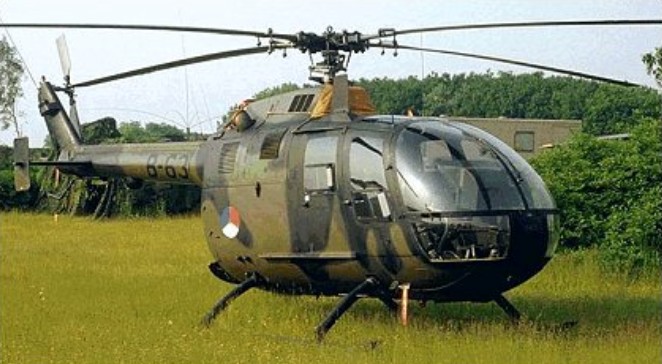
BO 105 M (VBH): Liaison and light observation helicopter for the Federal German Army, with strengthened transmission gearing, reinforced rotor components, a tail rotor with improved thrust and performance, a rupture-proof fuel system and a landing gear able to absorb higher energy levels. Production of 100 approved by the Federal government, to replace Alouette II. Deliveries completed in 1984.
BO 105 P (PAH-1): Anti-tank version of the BO 105 M, with same airframe improvements as BO 105 M, outriggers to carry six Euromissile HOT missiles, a stabilised sight above the co-pilot and a Singer AN/ASN-128 Doppler navigation system. The Federal German government gave its approval for the procurement of 212 PAH-1s for the Federal German Army. Deliveries began on 4 December 1980 and were completed in mid-1984.
EC Super Five: High-performance version of BO 105 CBS-4, derived from German Army PAH-1 upgrade programme; certified late 1993. New main rotor blades, improved performance and reduced vibration; dual flying controls as standard.
KWS-1 upgrade programme implemented in late 1980s, including installation of a digital weapon system, reduction in launcher weight, improved cooling unit, newly developed main rotor blades, and an increase in MTOW to 2,500kg.
BO 105C Engine: Allison 250 C20, 400 shp maximum, 385 shp continuous. TBO: 1,500 hrs. Rotor: four blade, semi rigid, glass fiber and reinforced plastic. Length: 38 ft. 11 in. Height: 9 ft. 7 in. Main rotor diameter: 32 ft. Disc loading: 6.22 lbs./sq.ft. Seats: 5. Empty weight: 2,698 lbs. Useful load: 2,372 lbs. Payload with full fuel: 1,339 lbs. Gross weight: 5,070 lbs. Power loading: 7.9 lb/hp. Fuel capacity (std.): 153 USG/1,033 lbs. Fuel capacity (opt,): 258 USG/1,742 lbs. Baggage capacity: 660 lbs. Baggage area: 57.5 cu. ft. Maximum sling load: 1,984 lbs. Rate of climb: 1,250 fpm. Service ceiling: 17,000 ft. Single engine service ceiling: 4,200 ft. Maximum speed: 167 mph/145 knots. Cruise: 140 mph/122 knots. Econ cruise: 124 mph/108 knots. Range @ max cruise (45 min res., std. tanks): 385sm/335nm. Range @ econ cruise (45 min res., std. tanks): 350sm/304nm. Duration @ max cruise (no res., std. tanks): 3.5 hrs. HIGE: 7,900 ft. HOGE: 5,850 ft. Single engine HIGE: 2,200 ft.
BO.105CB Engine: 2 x Allison 250-C20B turboshaft, 313kW Installed pwr: 600 kW. Rotor dia: 9.8 m. Fuselage length: 8.6 m. Length rotors turning: 11.86m No. Blades: 4. Height: 3m Empty wt: 1276 kg. MTOW: 2500 kg. Payload: 1000 kg. Max speed: 270 kph. Cruising speed: 270km/h ROC: 420 m/min. Ceiling: 5180 m. HIGE: 2560 m. HOGE: 1615 m. Fuel cap (+aux): 580 lt (400 lt ). Range with max payload: 658km Crew: 1. Pax: 4.
BO.105 CBS Engine: 2 x Allison 250-C20B, 420 shp. TBO: 3500 hrs. Main rotor: 32.2 ft. Seats: 5/6. Length: 38.9 ft. Height: 9.8 ft. Max ramp weight: 5291 lbs. Max takeoff weight: 5291 lbs. Standard empty weight: 2780 lbs. Max useful load: 2511 lbs. Max landing weight: 5291 lbs. Max sling load: 1984 lbs. Disc loading: 6.5 lbs/sq.ft. Power loading: 7.6 lbs/hp. Max usable fuel: 1008 lbs. Max rate of climb: 1476 fpm. Service ceiling: 17,000 ft. Hover in ground effect: 8,400 ft. Hover out of ground effect: 5300 ft. Max speed: 145 kts. Normal cruise @ 3000 ft: 126 kts. Fuel flow @ normal cruise: 355 pph. Endurance @ normal cruise: 2.6 hr.
BO.105EC Super Five Engine: 2 x Allison 250-C20. Instant pwr: 313 kW. Rotor dia: 9.8 m. MTOW: 2500 kg. Payload: 1180 kg. Max speed: 250 kts. Max cruise: 130 kts. Max range: 564 km. Crew: 1. Pax: 4/5.
BO.105 LS Engines: 2 x Allison 250-C28C, 500 shp. Main rotor dia: 32.4 ft. Height: 12.5 ft. Skid width: 8.5 ft. Length: 38.9 ft. MTOW: 5732 lbs. Std empty wt: 3153 lbs. Max useful load: 2579 lbs. Max ldg wt: 5732 lbs. Disc loading: 7 lbs/sq.ft. Pwr loading: 5.7 lbs/shp. Std usable fuel: 150 USG/1005 lbs. Optional usable fuel: 106 USG/706 lbs. Max ROC: 1810 fpm. Service ceiling: 20,000 ft. Hover IGE: 11,500 ft. Hover OGE: 8370 ft. Vne: 130 kts. Cruise: 129 kts. Fuel flow at cruise: 335 pph. Endurance at cruise: 3 hr. Seats: 5/6.
BO.105P1 Engines: 2 x 420 hp / 313 kW 250-C20B Gross weight: 5291 lb / 2400 kg Max speed: 187 mph / 270 kph