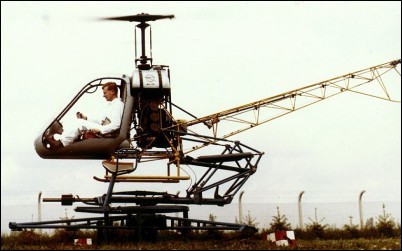
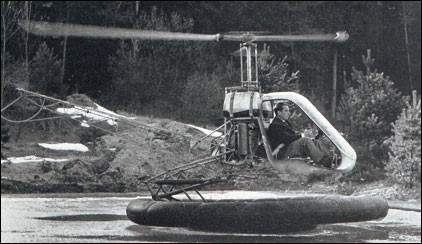
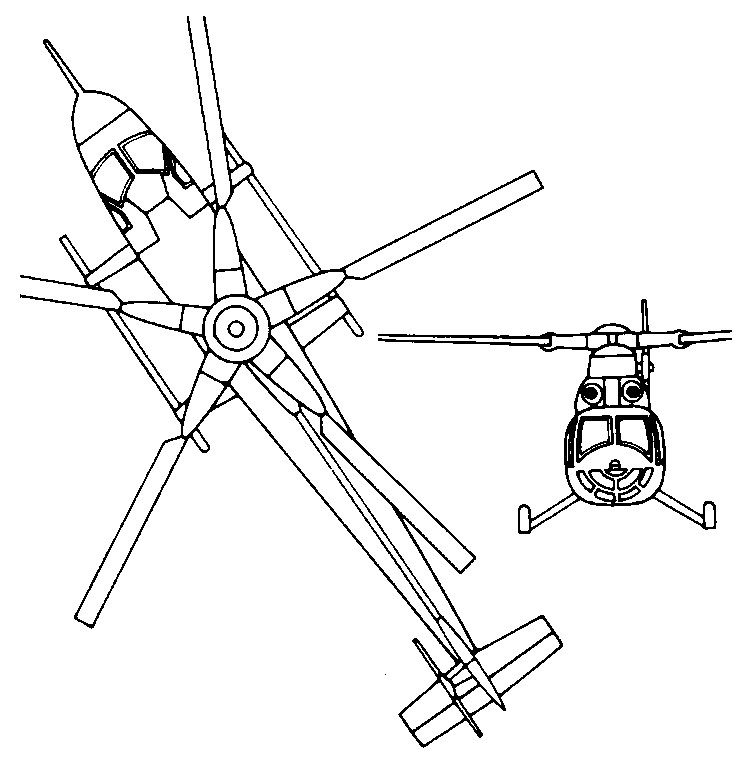
Rolled out in 1959, the Helicopter Trainer was powered by a Hirth 40hp ILO piston engine and had a twenty-one foot counterbalanced fibreglass rotor blade.
Developed in land and water based versions, both of were semi-captive. This feature allowed the helicopter to rise to a height of 0.6m, turn around a vertical axis and dip at up to 6° but prevented it from flying outside these limits.
In all eighteen of these HeliTrainers were built operating throughout Europe, training military helicopter pilots. Although unable to fly, they were ideal for the teaching of hovering techniques and were replaced by dual trainer helicopters.
Bo-102 Engine: 1 x Hirth ILO, 40 hp / 30 kW Main rotor diameter: 6.58m Length: 5.68m Take-off weight without a platform: 325kg
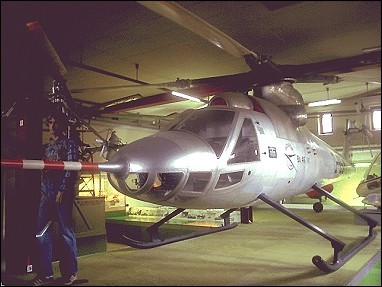
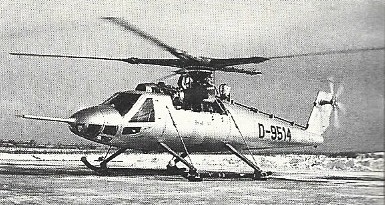
The Bolkow Bo.46, three experimental prototypes of which were built for the German Ministry of Defense, served as a flying test-bed for the Derschmidt semi-rigid rotor. The first model, built jointly with SIAT, began test flights in January 1964. The Derschmidt rotor underwent a long series of wind tunnel tests, for each blade had a hinge about half-way along its radius, enabling the outer section of the blade to rotate 40° backwards or forwards in relation to the inner section connected to the hub. This enabled the movement of the advancing blade to be “delayed,” thereby considerably reducing the tip speed. Conversely, by “accelerating” the movement of the outer portions, quite high rotational speeds could be achieved. However the complexity of this system prevented the Bo.46 from passing the experimental stage.
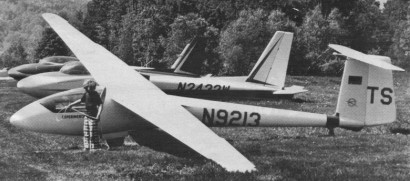
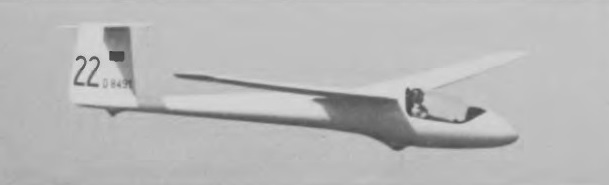
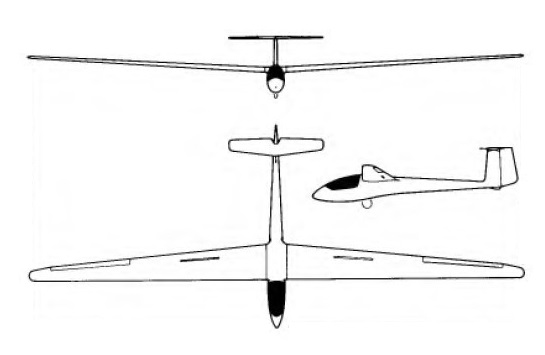
Derived from the Akaflieg Stuttgart FS-24 Phonix, the first sailplane to be built of glassfibre, the Phoebus high-performance single-seater was designed jointly by R. Under, R. Eppler and H.Nagele, the last two of whom had directed design work on the Phonix. The prototype was built by R.Linder and made its first flight on 4 April 1964; it came third in the Standard Class contest in the 1964 German National championships and 8th in the 1965 World Gliding Championships at South Cerney.
Production of the Phoebus was undertaken by Bolkow GmbH at Ottobrun, and three versions appeared: the Phoebus A, the initial production Standard Class 15m (49ft 2.5 in) span variant which had a fixed monowheel and tail bumper for landing; the Phoebus B, which appeared in 1967, was the same as the A but with a retractable monowheel, and the Phoebus C was a 17m (55ft 9in) span version with a retractable monowheel and a tail braking parachute.
The Phoebus was one of the most commercially successful of postwar German sailplanes, a total of 253 having been built when production ended in 1970, and the type did well in contests; at the 1968 World Gliding Championships at Leszno, Poland, Phoebus C pilots took second and sixth places in the Open class and a Phoebus also took third place in the Standard class. The Phoebus, like the Phonix before it, has a basically balsa wood/glassfibre sandwich structure but with a stronger skin. The shoulder wing has air brakes at the 70% chord line and the one-piece all-moving tailplane is mounted on top of the fin to avoid downdraft from the wing. The fuselage is a monocoque structure similar in outline to that of the Phonix, and the pilot is seated under a one-piece canopy, with a control mechanism which is a simplified development of the Phonix’s. Compared to the latter, the Phoebus also has better high speed performance and improved gust response.
First flown in 1957, the Phonix used fiberglass and balsa wood sandwich technique in construction. Designed by Richard Eppler, Hermann Nagele, and Rudolph Lindner.
A 1960 experimental device for the development of a flying platform. Designed by Dr. Heidelberg. Lift and propulsion were supplied by several propellers. The props were driven by compressed air supplied by a compressor on the ground.
This company was founded on May 1,1956 by Ludwig Bolkow, becoming established at Ottobrunn bei Munchen in 1958. Until January 1,1965 was known as Bolkow Entwicklungen KG. Boeing acquired a one-third interest in the business. Bolkow held a 25% interest in Entwicklungsring Sud EWR). Aircraft produced include the Bo 207 four-seat light aircraft, BO 208 C Junior (a license-built version of the Malmo MFI-9) and the BO 105 five-seat light helicopter, which featured a rigid main rotor of glassfiber-reinforced plastics. This helicopter continued in production under the designation MBB BO 105, signifying that it was then built by Messerschmitt-Bolkow-Blohm, and most recently it became a Eurocopter product.
Messerschmitt joined with Bolkow in 1970 to form Messerschmitt-Bolkow. The Bolkow company was absorbed into Messerschmitt-Bolkow-Blohm which by 1990 was part of Deutsche Aerospace.
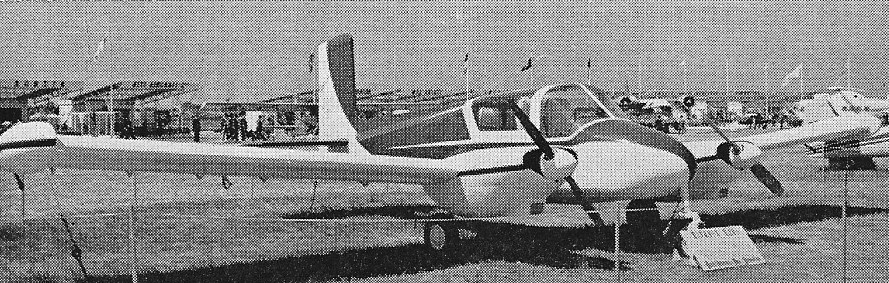
The Boisavia B.260 Anjou was a four-seat twin-engine light aircraft developed in France in the 1950s. It was a low-wing cantilever monoplane of conventional configuration with retractable tricycle undercarriage but fabric-over-tube construction.
Intended by Boisavia as a touring aircraft, it did not find a market and only the single prototype was constructed, first flying on 2 June 1956. At this point, the firm, via NORD, sold the design to SIPA, which modified the design and re-engined it with Lycoming O-360 engines as the Sipavia Anjou, but found that they could not sell it either.
Plans to develop a stretched version with three extra seats and Potez 4D engines were also abandoned.
Avia France says 1 built. But Flight says at least 5 B.260 Anjou were built – or were under construction in 1955 – incl. 2 prototypes by Boisavia and 3 pre-production versions built by SNCAN at Meaulte.
Variants: B.260: Boisavia prototype with Regnier 4L engines (1 built) B.260: 1953 plan was for DH Gipsey Major-powered 4/5-seater B.260: 2 x 170 hp SNECMA-Régnier 4 LO-2 4-cyl inline, B.261: 2 x 190 hp Lycoming O-360-A, 1 B.260 conversion S.261: SIPA designation for the B.261 conversion (1 converted) S.262: Planned seven-seat version (not built)
Specifications: B.260 Engines: 2 × SNECMA licence-built Regnier 4L-02, 127 kW (170 hp) each Wingspan: 12.85 m (42 ft 2 in) Wing area: 21.5 sq.m (231 sq.ft) Length: 7.10 m (23 ft 3 in) Empty weight: 992 kg (2,187 lb) Gross weight: 1,870 kg (4,123 lb) Maximum speed: 260 km/h (160 mph) Range: 1,250 km (780 miles) Service ceiling: 7,125 m (23,370 ft) Rate of climb: 6.0 m/s (1,180 ft/min) Crew: one pilot Capacity: 3 passengers
The Chablis was designed by Lucien Tieles and constructed by Avions Boisavia in 1950. It was a two-seat ultra-light monoplane with a high parasol wing supported by struts. The seats were arranged in tandem. It was a simple all-wood design with fabric covering and was intended to be fitted with a variety of engines in the 50-80 h.p. range.
Two Chablis were built by Boisavia, the first F-PBGO making its first flight on 16 July 1950. Claude Piel built the second, F-PBYF, in 1953. These were powered by a 65 hp (48kW) Continental A65 engine. The Chablis was intended for construction by amateur builders using kits supplied by the firm. In the event, no further examples were completed and further development was not proceeded with.
Engine: 1 × Continental A65, 48 kW (65 hp) Wingspan: 9 m (29 ft 6 in) Length: 7 m (22 ft 11 in) Gross weight: 513 kg (1131 lb) Max speed: 87 mph Cruise: 65 mph ROC: 540 fpm Crew: 2
In 1946, Lucien Tieles built the prototype of a three-seat high wing monoplane – the B.50 Muscadet. This aircraft, powered by an 100 hp Renault engine, was then redesigned with a higher rear fuselage decking to provide full four-seat capacity. Fitted with a 140 hp Renault 4 Pei engine, and designated B.60 Mercurey, the first aircraft made its maiden flight on 3 April, 1949 and Tieles established the Société Boisavia to build the aircraft commercially. It was a conventional high-wing braced monoplane with fixed tailwheel undercarriage. Forty six were built and found use in the normal general aviation roles of tourer, trainer, agricultural aircraft, and glider tug.
While the prototype Mercurey had used a Renault engine, most production units were the B.601L with an 190 hp Lycoming flat four engine. With the same airframe the company was able to produce small numbers of other versions with different engines and Mercurey production continued until the middle of 1962 with virtually all sales being made in France or its overseas territories. Serial numbers ran from c/n 1 to 5, 18 to 29, 51 to 55 and 100 to 116. In addition, the various prototypes had unique serial numbers.
Boisavia B-601L Mercurey
After the two B-60 and three B-601 models, the B-602 was powered by a 165 hp Continental E165-4.
The B-603 Mercurey-Special glide tug variant has a 240 hp Salmson-Argus As 10.
On 29 April 1954 the first B-605 Mercurey flew with an initial production batch of 14 underway.
B-605 Mercurey
Variants:
B.60 Mercurey 3 prototypes powered by 100 kW (140 hp) Renault 4Pei engine Prototype F-WFDV c/n 01, first flown April 3, 1949. B.60 tourer/trainer also employed for ag work and as glider tugs c/n 01 F-BFDV, 02 F-BFLL/F-BFLM, 03 F-BFLP
B.60 Engine: 1 × Renault 4Pei, 104 kW (140 hp) each Length: 7.10 m (23 ft 3 in) Wingspan: 11.38 m (37 ft 4 in) Height: 2.10 m (6 ft 10 in) Wing area: 18.0 sq.m (194 sq.ft) Empty weight: 520 kg (1,146 lb) Gross weight: 1,000 kg (2,205 lb) Maximum speed: 235 km/h (146 mph) Cruising speed: 190 km/h (118 mph) Range: 1,100 km (684 miles) Service ceiling: 5,500 m (18,045 ft) Rate of climb: 4.0 m/s (790 ft/min) Crew: one pilot Capacity: 3 passengers
B-605 Mercurey Engine: 170 hp SNECMA-Regnier 4L-02 Wingspan: 37 ft 4 in Wing area: 182.986 sq.ft Length: 23 ft 5 in Height: 6 ft 10 in Empty weight: 1190 lb Loaded weight: 2204 lb Max speed: 140 mph Cruise: 124 mph Range: 745 mi Seats: 4
In 1946, Lucien Tieles built the prototype of a three-seat high wing monoplane designed by Lucien Tieles, Claude Piel, and M. Dorose – the B.50 Muscadet. This aircraft, c/n 01 F-WBBG/’CZE, powered by an 140 hp Renault Bengali engine, was then redesigned with a higher rear fuselage decking to provide full four-seat capacity and designated B.60 Mercurey.