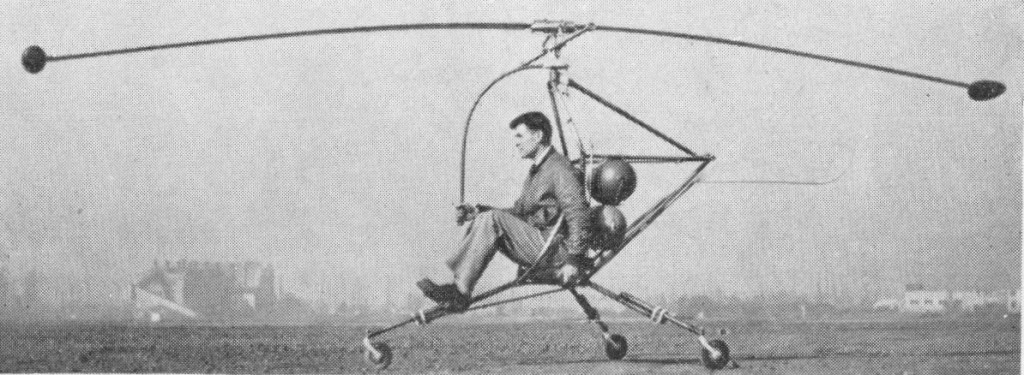
USA Established January 1954 for continued development of C-1 Hoppi-Copter, built previously by Hoppi-Copters Inc. C-1 L, first flown 1954, was a redesigned and simplified version of original 1945 prototype.
Aerotecnica helicopters goes back to the original research carried out in the early 1950s by Jean Cantinieau in France. Cantinieau, an engineer with Sud Ouest (SNCASO), designed his C.100 in cooperation with M. Decroze. It was an open frame single-seat machine with a triangulated tube structure surrounding the pilot and carrying the engine and rotor installation at its apex above the pilot’s head. The engine was mounted just forward of the rotorhead so as to reduce the extent of mechanical linkages and the C.100 had a three-wheel undercarriage and high-set tubular tailboom structure carrying a small tail rotor. The C.100 made its first of a total of three flights on 10 Novembers-1951 at St. Cyr and performed reasonably well.
Italy Company originally called Cantieri Navale Triestino created 1923 as subsidiary of Cantieri Navali di Monfalcone to manufacture civil/military marine aircraft. Most designs produced between 1923-1930 were work of R. Conflenti, including such flying-boats as Cant 6 three-engined biplane bomber; Cant 6 ter, commercial transport version; Cant 7, 7 bis and 7 ter single-engined trainer biplanes; Cant 10 and 10 ter five/six-seat single-engined light transport biplanes; Cant 18 trainer; Cant 22 three-engined eight/ten-seat commercial transport; Cant 25 single-seat fighter. Landplanes included Cant 23 transport and Cant 36 trainer. Company changed its name in 1931 to Cantiere Riuniti dell’Adriatico. Chief designer Filippo Zappata (formerly of Bleriot) completely reorganized the company 1933/1936. From 1934 most aircraft had Z prefixes, marine aircraft being numbered in 500 series, beginning with Z.501 Gabbiano biplane reconnaissance/bomber first flown 1934. Followed by Z.504 two-seat fighter biplane flying- boat and Z.505 twin-float three-engined monoplane, both 1935. Latter developed into Z.506 (1936), built as reconnaissance/ bomber/ASR for Regia Aeronautica (Z.506B Airone) and as commercial transport for Italian airlines (Z.506A and C). Landplane version built by Piaggio. Built Z.508 and Z.509, monoplane flying-boat bombers, and world’s largest floatplane: Z.511 four-engined trans- Atlantic mail/freight variant, first flown 1943. The Z.515 twin-engined twin-float monoplane (coastal reconnaissance), built 1938-1939. Landplanes (designated in 1000 series) included Z.1007 and 1007 bis Alcione three-engined bomber; Z.1011 twin-engined medium bomber/transport; Z.1012 three-engined transport; Z.1015 three-engined derivative of Z1017 bis, first flown January 1939 and used in torpedo trials early in the Second World War. Final type was Z.1018 Leone, twin-engined medium bomber intended to replace Alcione, probably Italy’s best wartime design but too late to see service. Did not continue aircraft manufacture in the post-war period.
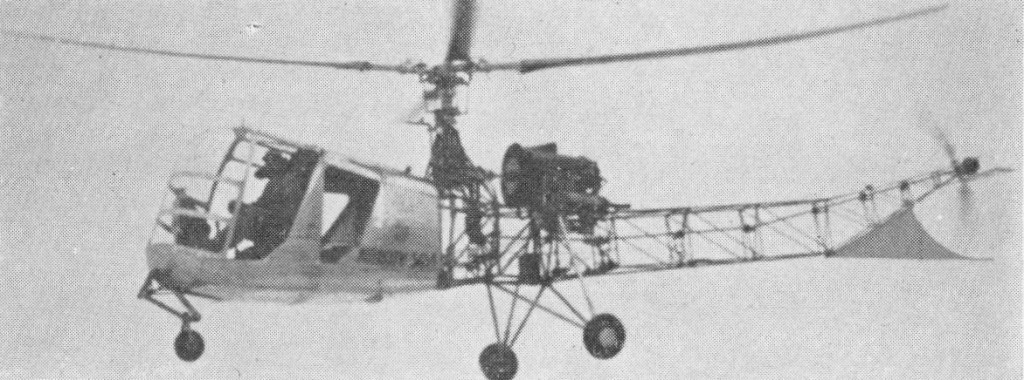
Designed by Bernard Sznycer and Selma Gottlieb as the S.V.IV in 1946, the 1947 Canamerican S.G.VIE was the first helicopter of all-Canadian construction. The prototype was certificated by civil authorities and developed through A, B, C and D versions by Engineering Products of Canada Ltd.
Omega Aircraft Corp was founded 1953 as a subsidiary of Allied Aero Industries for further development of the Sznycer-Gottlieb SG VI helicopter.
The Canamerican company was formed to produce it in the United States, the S.G.VI-E was essentially an improved model of the -D powered by a 200 hp Franklin 6A4-200-C6 engine.
S.G.VIE Engine: 200 h.p. Franklin 6A4-200-C6 Rotor diameter: 35 ft. Rotors: 4-blade main; 3-blade tail Fuselage length: 32 ft. Loaded weight: 2,550 lb Cruise: 78 mph ROC: 760 fpm Typical range: 200 miles at 78 m.p.h. Seats: 3
Wholly owned subsidiary of Vertol Aircraft Corporation; formed February 1954 at former RCAF air base Arnprior, west of Ottawa, to repair and overhaul RCAF/RCN Vertol helicopters. Also produced in 1957 small number of Vertol Model 42A, exclusively Canadian civil conversion of RCAF H-21B helicopters used to supply stations of the mid-Canada radar chain.
The Canadian Car and Foundry Company Ltd, called CCF and later Can-Car, was established in 1909 as a manufacturer of railway rolling stock, with its head office in Montreal and production facilities in several other locations. In 1937 acquired license to build Grumman GE-23 (FF-1) two-seat biplane fighters, in factory at Fort William, Ontario. Built prototype of FDB-1 fighter biplane in 1938. Orders for large numbers of Avro Ansons, Hawker Hurricanes, Avro Lancasters, and Curtiss Helldivers were received. Seven new factories opened by mid-Second World War. Early post-war obtained Canadian license for Burnelli “lifting fuselage” designs; flew prototype CBY-3 (twin Wasp engines) August 1945. Accommodation was three crew plus 38 passengers or 22 passengers and freight. Development of CBY-3 by subsidiary Cancargo. In 1947 acquired assets of Noorduyn Aviation Ltd.; continued manufacture of Mk V Norseman and variants until early 1950s; resold it to its designer in 1953. In early 1950s designated products “Can-Car,” beginning with North American Harvard Mk 4s built under license at Fort William for RCAF and NATO air forces. Gained contract to build 100 BeechcraftT-34A Mentor piston-engined trainers in 1952-1953 for USAF and also for RCAF. Retitled Canadian Car Company Ltd in mid/late 1950s.
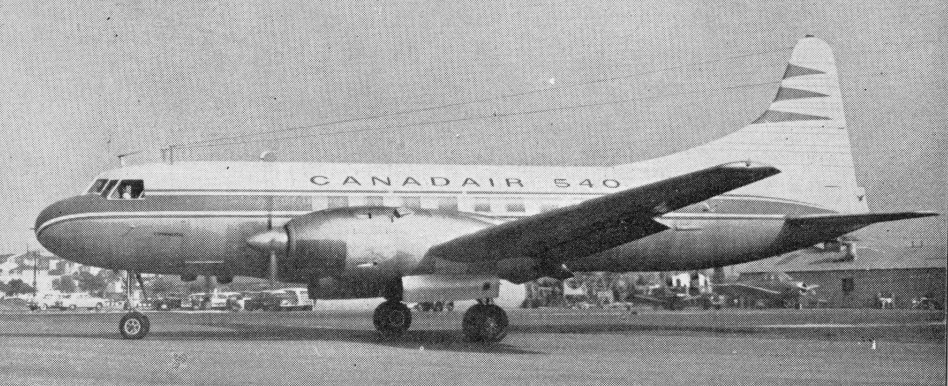
The Canadair 540, in production at Montreal in 1959, combines a Convair 440 with Napier Eland engines. The pre-prototype was a Convair 440 converted by PacAero of Santa Monica and first flown on 11 October 1959.
Lear’s brief collab¬oration with Canadair led to the LearStar 600, subsequently re¬named Challenger 600 after Canadair bought the manufacturing rights. The initial Challenger 600, of which 83 were built, had Avco Lycoming ALF 502s and, on retro-fitted aircraft, winglets, and was flown for the first time on 8 November 1978, near Montreal. During the 50 minute first flight, the air¬plane climbed to 9,500 feet, the gear was cycled and various basic maneuvers were performed. The Challenger began certification flight testing in March 1979 with Lycoming ALF 502s of 7,500 pounds thrust (up from 6,700 pounds) and reduced elevator span to discourage flutter.
The second and third prototypes flew in March and July 1979. On 3 April 1980, a test flight with the first prototype above the Mojave Desert ended in a disaster, with the airplane crashing due to a deep stall. In August 1980, certification was granted with temporary restrictions. Deliveries of the CL-600, powered by two Lycoming ALF-502L turbofans started on 30 December 1980, first flown on 21 September 1979.
CL-604 Challenger
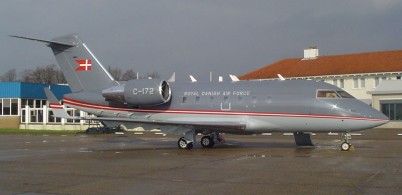
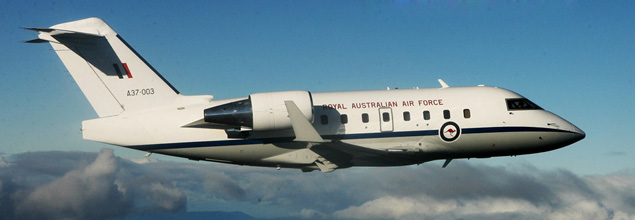
The design was developed further and on 10 April 1982 the Challenger 601, a refined version with the more powerful General Electric CF-34 engines and winglets, made its maiden flight. In 1983, the CL-601 replaced the CL-600 in production. Sales to 1990 exceeded 140. The first 601-1A delivered on 6 May 1983. The first 601-3A flew on 6 May 1987 and the first 601-3A/ER on 19 May 1989. The Canadair CL-601 Challenger 3A completed Canadian certifica¬tion on 21 April 1987, less than 10 months after its roll-out on 18 July 1986. FAA cer¬tification was confirmed on 30 April and the first delivery was made on 6 May, to TAG Aeronautics. The first production aircraft made its public debut at the Paris Air Show in June. Based on the CL-601 — the version of the Challenger that introduced General Electric CF34 turbofans in the original CF-600 air¬frame — the Challenger 601-3A incorporates four significant developments. These are the improved CF34-3A engines to provide better climb and hot day take-off performance; a fully integrated digital avionics suite with higher reliability and improved diagnostics; a power-assisted passenger door and two land¬ing lights mounted in the nose. A “glass’ cockpit features dual Sperry flight guidance systems, a five-tube, four-colour Sperry FF15 with multi-functional display and four-colour digital weather radar; dual Sperry flight management systems; dual Honeywell laser IRS and a comprehensive Collins Pro Line II communications/navigation package. In 1986, Bombardier Aerospace bought Canadair. The Bombardier Challenger became a family of business jets. A number of models entered production including in 1989 the CL-601-3R, an extended range version with an extra fuel tank added to the aircraft’s tail, a 2 crew and up to 19 passengers. The number of models in 1989 included the CL-600-2B16 or Challenger 604 powered by CF-34-3B engines. First flight with these engines was on 17 March 1995, with Transport Canada certification granted that September. First delivery was in January 1996. The first 601-3R flew on 14 July 1993, and the first 604 on 25 January 1996. The Royal Australian Air Force Challenger CL-604 special purpose VIP transports are operated by the Royal Australian Air Force’s No 34 Squadron, based at Defence Establishment Fairbairn in Canberra. The Challenger has a crew of three (pilot, co-pilot and attendant) and carries up to nine passengers. The Challenger CL-604 is fitted with a high-tech wing, high bypass CF34-3B engines, and a Collins ProLine 4 glass cockpit. The Challengers joined the RAAF VIP fleet in July 2002. Challenger certified for operation in 40 countries by 1998. 500th Challenger rolled out 25 May 2000 and handed over 1 September 2000; 600th was undergoing interior outfitting in March 2003.
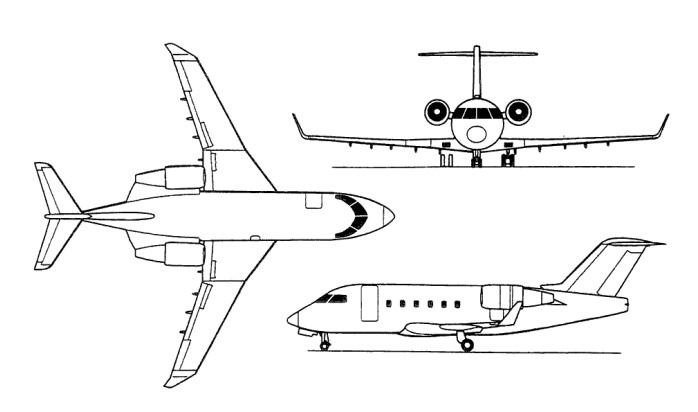
CL-600 Challenger First built: 1978. Engines: 2 x Lycoming ALF-502L, 7500 lbs thrust. Seats: 11/28. Length: 68.4 ft. Height: 20.7 ft. Wingspan: 61.8 ft. Wing area: 450 sq.ft. Wing aspect ratio: 8.5. Maximum ramp weight: 40,550 lb Maximum takeoff weight: 40,400 lb Standard empty weight: 18,600 lb Maximum useful load: 21,950 lb Zero-fuel weight: 27,500 lb Maximum landing weight: 36,000 lb Wing loading: 89.7 lbs/sq.ft. Power loading: 2.69 lbs/lb. Maximum usable fuel: 16,725 lbs. Best rate of climb: 3600fpm. Certificated ceiling: 45,000 ft. Max pressurisation differential: 9.3 psi. 8000 ft cabin alt @: 45,000 ft. Maximum single-engine rate of climb: 1045 fpm @ 170 kts. Single-engine climb gradient: 368 ft/nm. Single-engine ceiling: 29,000 ft. Maximum speed: 480 kts. Normal cruise @ 43,000ft: 425 kts. Fuel flow @ normal cruise: 2105 pph. Stalling speed clean: 137 kts. Stalling speed gear/flaps down: 113 kts. Turbulent-air penetration speed: 280 kts. Range : 4017 nm / 7440 km
Canadair CL-601 Challenger light airliner, corporate jet, transport, Canada, 1986 Engine: 2 x CF 34 A1, 39829 N / 4060 kp Length: 68.57 ft / 20.9 m Height: 20.669 ft / 6.3 m Wingspan: 64.304 ft / 19.6 m Wing area: 519.901 sqft / 48.3 sq.m Max take off weight: 43107.8 lb / 19550.0 kg Weight empty: 19955.3 lb / 9050.0 kg Payload: 23152.5 lb / 10500.0 kg Max. speed: 460 kts / 851 km/h Cruising speed: 442 kts / 819 km/h Initial climb rate: 4527.56 ft/min / 23.00 m/s Service ceiling: 41011 ft / 12500 m Wing load: 83.03 lbs/sq.ft / 405.00 kg/sq.m Range: 3440 nm / 6370 km Crew: 2 Payload: 19 Pax
Challenger CL-601-3A Power Plant: Two x General Electric CF34-3A turbofans each flat-rated at 9,140 lb St (4 146 kgp) including automatic power reserve (five-minute limit), up to 70 deg F at sea level. Cascade-type fan air thrust reversers. Fuel capacity, 2,451 US gal (9 278 1). High speed cruise, 459 kts (850 km/h) or Mach = 080 Normal cruise, 442 kts (819 km/h) or M =077 Long-range cruise, 424 kts (786 km/h) or M = 074 Time to climb to initial cruise altitude, 23 mm Max operating altitude, 41,000 ft (12 497 m) Single-engine ceiling, 24,000 ft (7 315 m) Take-off balanced field length, 5,400 ft (1 646 m) Landing dis¬tance, 3,300 ft (1 006 m) Max range, (NBAA IFR reserves, long-range cruise), 3,430 naut mls (6 352 kin) with five passengers. Typical operating weight empty, 24,685 lb (11197 kg) Max fuel load, 16,665 lb (7 559 kg) Payload with max fuel, 1,900 lb (862 kg) Max payload, 4,815 lb (2 184 kg) Max take-off weight, 43,100 lb (19 550 kg) Max zero fuel weight, 29,500 lb (13 381 kg) Max landing weight, 36,000 lb (16 329 kg). Wing span, 64 ft 4 in (19,61 m) Overall length, 68 ft 5 in (20,85 m) Overall height, 20 ft 8 in (6,30 m) Wing area, 450 sq ft (41,81 sq.m) Wing sweepback at quarter chord line, 25 deg Undercarriage track, 10 ft 5 in (3,18 m) Wheel¬base, 26 ft 2½ in (7,99 m). Flight crew: two Accommodation: 12 – 15. Cabin length, 28 ft 3 in (8,61 m) Max height, 6 ft 1 in (1,85 m) Max width, 8 ft 2 in (2,49 m) Cabin volume: 1,150 cu ft (32,56 cu.m)
Bombardier Challenger CL-604 Engines: Two General Electric CF34-3B turbofans (9,220 lbs thrust each) Length: 20.86m Height: 6.3m Wingspan: 19.61m (including winglets) Max takeoff: 21,863kg Max landing: 17,236kg Normal ops Speed: 870km/h Range: 5,600km (with max fuel and reserves) Ceiling: 41,000 feet Crew: Two pilots and one crew attendant Accommodation: 9 passengers
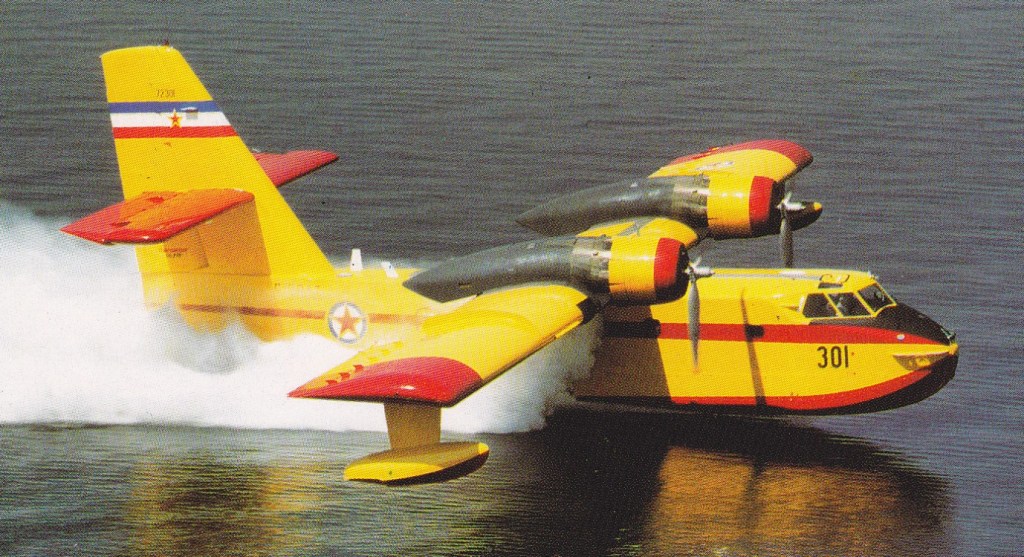
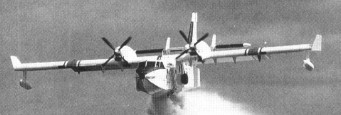
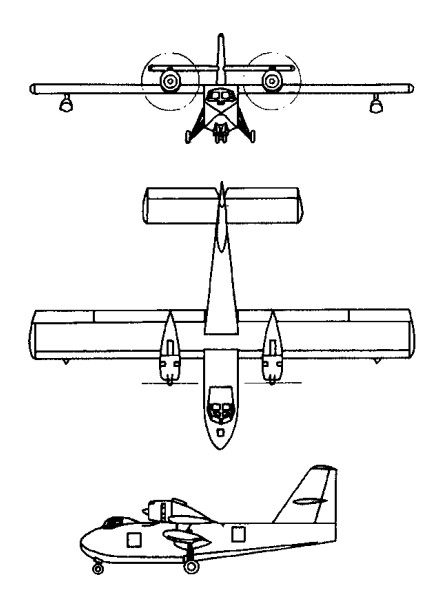
Designed principally for firefighting duties, the CL-215 twin-engined general-purpose amphibian also has military applications, including search and rescue and coastal patrol, Spain and Thailand use their CL-215s in both of these roles. The first prototype flew on October 23, 1967.
The CL-215’s two fuselage tanks hold 1412 USG / 5345 lt of water which can be scooped up in 10 seconds from a lake or sea surface, and can be dumped in one second.
Canadair offers a number of special military configurations, including flight inspection, maritime surveillance using an ALL AN/APS-128 search radar, electronic warfare support and training, cargo transport, and airborne early warning (AEW).
Production of the basic CL-215 was completed with delivery in 1990 of the 126th airframe, having been exported to France, Greece, Spain, Italy, Yugoslavia, Thailand and Venezuela.
CL-415T
In September 1986 Canadair announced the CL-215T turboprop development. Designed as a retrofit package for existing operators of the piston-engined aircraft and – if sufficient new orders were received – for full production, the CL-215T has two 2,380 shp (1 175 kW) PW123AF engines driving four-bladed propellers. As a water-bomber (its primary mission) the CL-215T will carry 6,132 litres (1,620 US gal).
The first CL-215T flew on 8 June 1989 powered by two 2380 shp / 1775 kW Pratt & Whitney Canada PW123AF turboprops, and could carry 1620 USG / 6132 lt of water.
CL-215 Engines: 2 x Pratt & Whitney R-2800-CA3, 1566kW, 2100hp Wingspan: 28.6 m / 93 ft 10 in Wing area: 100.33 sq.m / 1079.94 sq ft Length: 19.82 m / 65 ft 0 in Height: 8.92 m / 29 ft 3 in Max Take-off weight: 17100-19731 kg / 37699 – 43500 lb Empty weight: 12161 kg / 26811 lb Max level speed: 172 mph (293 kph) at 10,000ft/3050m Cruise speed: 291 km/h / 181 mph Initial ROC: 1000 fpm / 305 mpm Range: 2095 km / 1302 miles Payload: 5453kg 12,000 lb of water, 3864 kg / 8518 lb freight, or 26 passengers