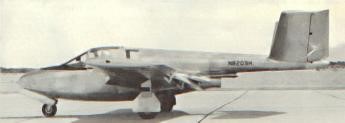
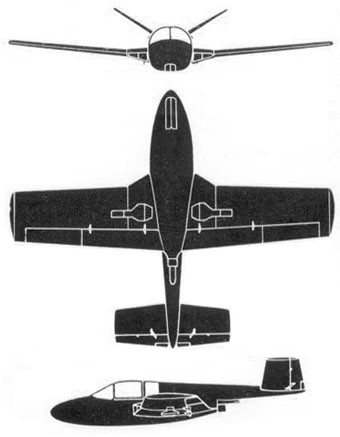
In the early fifties Harold Dale played with the idea to design the ideal jet trainer: seating trainee and instructor side-by-side in front of the wing for clear visibility all around. It should have a slow landing speed and a comfortable cruising speed of 350 mph. The plane Harold had in mind was a mid-wing cantilever monoplane of aluminium alloy structure, with slotted flaps, leading edge intake ducts, semi-monocoque fuselage, upwards opening doors, butterfly tail unit and retractable tricycle landing gear.
Harold Dale was a project engineer with North American working on the F-100, so his ideal plane had to be designed in the spare time. He had assistance from his wife Eleanor who also had an engineering degree, handling much of the mathematics, administration, etc.
The name chosen was the WEEJET 800 (WE=Harold and Eleanor), the 800 meaning the power class of the licence built Turboméca Marboré II engine of 880 lb thrust.
In February 1952 Dale Air-Engineering (Torrance, California) and the WEEJET 800 were official registered and the first material was submitted to the CAA West Region Administration. It was the first jet aircraft in the small plane field submitted to the CAA, who followed every phase of the two and a half years of design and evaluated all data during development.
In 1954 a local aircraft parts manufacturer (Carma Manufacturing Co) heard of the design and got involved in the project in two ways: he supplied the hydraulic shock absorber struts and offered to built the aircraft in his plant in Tucson, Arizona. Now it became feasible to produce and market the aircraft. Construction started at Tucson in the second half of 1954 and five people worked one and a half years on it.
The prototype (N8209H) conducted its 20 minutes first flight on Good Friday March 30, 1956, with Harold Dale at the controls. During the following weeks further test flights were made by another pilot, except for the spin tests, these were performed by USAF-pilot Doneby; the aircraft handled and performed well.
During 1956 the US Navy had become interested in jet trainers and the WEEJET was to be in their evaluation. Therefore all data had to be available before the end of the month and the aircraft was to be flown to Patuxtent, Maryland on April 29. On April 28 1956 disaster struck: during the final spin test the pilot inadvertently activated the trim tab into full nose-down position. The pilot lost control while trying to recover and had to bail out, the aircraft crashed and burned. Later data was found thrown clear of the wreckage, showing the spin tests were a complete success.
All following data was issued on April 25, 1956 in a proposal to the US Navy for the production version. The designation was Carma WEEJET TRAINER.
Carma VT-1 WEEJET Type: Two side by side seat primary jet trainer Engine: Continental J69-T-9 (Marbore II), 920 lb (417 kg) s.t. Wingspan: 28 ft 0 in (8.53 m) Length: 24 ft 6 in (7.47 m) Height: 6 ft 8 in (2.03 m) Wing area: 150 sq.ft (13.94 sq.m) Empty Wt: 2,481 lb (1,125 kg) Max T/O Wt: 4,541 lb (2,060 kg) Max speed: 334 mph (537 km/h) at 15,000 ft (4,570 m) Cruise speed: 208 mph at 25,000 ft Max climb: 2,200 ft (670 m)/min Service ceiling: 35,000 ft (10,670 m) Endurance: 1.72 hr at sea level
USA Established 1948 to manufacture electrical, mechanical, and aircraft control equipment. Aircraft manufacturing division formed in 1954 at Tucson, Arizona, to build a turbojet- powered two-seat trainer, the Carma VT-1 Weejet. Prototype first flew March 30,1956.
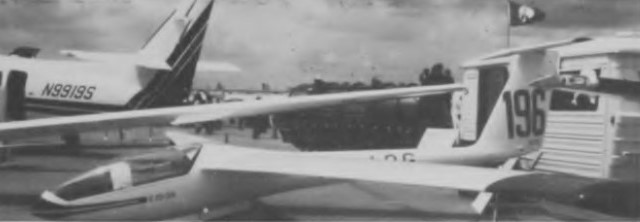
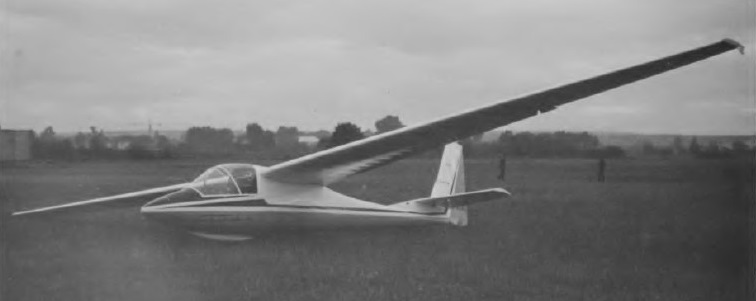
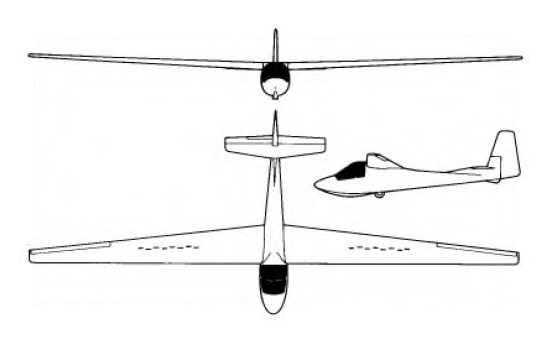
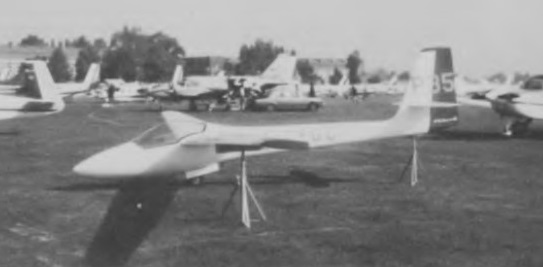
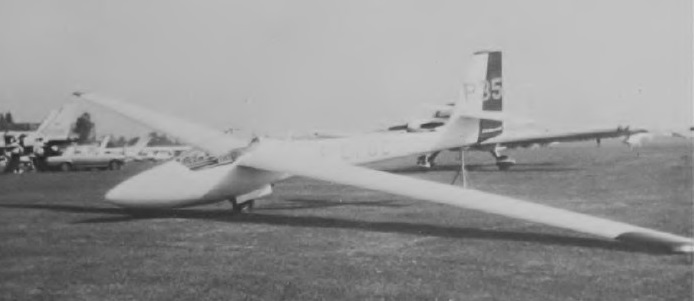
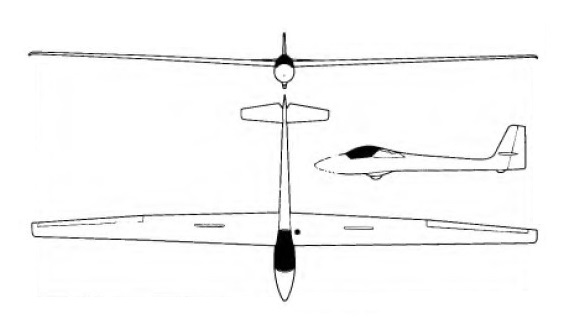
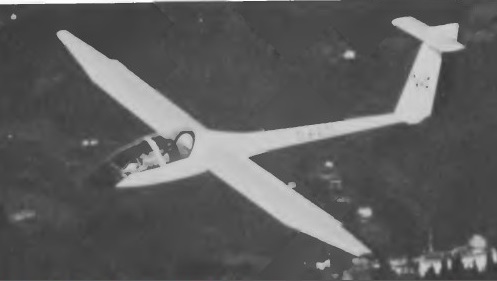
Designed by Alberto and Piero Morelli, the M-200 is a two-seater high performance version of their Standard Class M-100S which was built under licence both in Italy and by CARMAM at Moulins-Avernes as the M-100S Mesange (Tomtit). The prototype M-200 was built under contract for the Aero Club of Italy by the CVT (Centra di Volo a Vela del Politecnico di Torino) at Turin, and made its first flight in May 1964.
Production was undertaken under an exclusive licence by CARMAM, who built it as the M-200 Foehn, completing one more prototype and five pre-production aircraft before starting the definitive production batch. Main difference between the M-200 and the M-100S is the former’s widened fuselage to accommodate two staggered side-by-side seats, the one-piece canopy opening sideways to port; this seating arrangement obviates the need for ballast when the aircraft is flown solo, and gives good visibility to both pilots. The M-200 is designed to be easy to fly for first solos and, like the M-100S, is fully aerobatic; it is also suitable for flying in cloud. Wing span of the M-200 has been increased from the 15m of the M-100S to 18.15m (59ft 6.5 in) and it is slightly longer; the wing structure is very similar to that of the M-100S, with a leading edge torsion box and air brakes consisting of four instead of three pairs of light alloy rotating plates above and below each wing. The fuselage is of plywood construction with frames and stringers and the landing gear consists of a non-retractable monowheel with a drum brake and a rubber-sprung nose-skid; there is also a tailskid.
M-200 Span: 18.14m / 59 ft 6.5 in Length: 7.6 m / 24 ft 1.25 in Height: 6 ft 5 in Wing area: 17.46 sq.m / 188.4 sqft Aspect ratio: 19.0 Empty Weight: 345kg / 760lb Gross Weight: 570kg / 1255lb Payload: 225kg / 495lb Water ballast: None Wing Load: 32.65kg/sq.m / 6.7lb/sq.ft Max speed: 121 kt / 225 km/h / 140 mph (in smooth air) Max rough air speed: 81 kt / 150 km/h Stalling speed: 38 kt / 70 km/h MinSink: 0.64 m/s / 2.1 fps / 1.24 kt Best glide ratio / L/DMax: 32:1 at 98 kph/ 54 kt/ 61 mph No. of Seats: 2 Airfoil: NACA 63-619/15
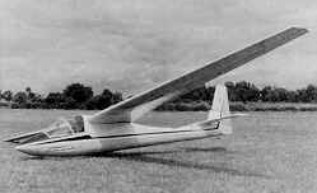
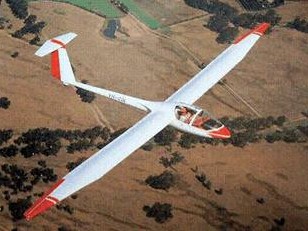
The Aiglon (Eaglet) was a private venture design by CARMAM’s technical directors Robert Jacquet and Jean Pettier, and is a restricted Standard Class sailplane; design work began in September 1971, and the prototype made its first flight on 14 June 1974.
Series production began in 1976, the first production JP15-36A making its first flight on 16 October that year; a version with a retractable monowheel and provision for up to 121 lb of water ballast is designated JP 15-36AR.
The single-seater Aiglon is intended for intensive club use and so special attention has been paid to good flying qualities and safe landing characteristics for not-so-experienced pilots. Construction is of glassfibre, the cantilever mid wing having a single glassfibre spar and a glassfibre/Rohacell/epoxy sandwich skin and steel-tipped wing tip ‘salmon’ fairings. The ailerons are of plastic and can be operated either differentially or in unison, and there are Schempp-Hirth airbrakes on the upper and lower surfaces; for ease of wing rigging the aileron and air brake controls are designed to connect automatically. The semimonocoque glassfibre fuselage is moulded in two halves and joined at the centreline, a single bulkhead forming the cockpit backrest and a shock-absorbing structure for the monowheel. A large one-piece canopy gives excellent visibility, while both seat and rudder pedals are adjustable in flight: on the JP 15-36A the monowheel s fixed and has a cable brake, and there is also a tail bumper. The swept back fin is integral with the fuselage, and the wooden rudder is fabric-covered, the all-moving tailplane is of plastics construction.
JP.15-36 Aiglon
The Pettier PA 15-34 Kit-Club homebuilt version is essentially the same as the JP 15-36A but with some structural simplification and redesign to make it more suitable for amateur builders; the glassfibre wings are factory-made. Plywood-covered spruce construction of the fuselage and tail unit replaces the Aiglon’s more sophisticated glassfibre structure, although the Kit-Club’s nose-cone is of glassfibre. The tail boom, rudder and rear part of the tailplane are fabric-covered, and there is a fixed unsprung monowheel, with a cable-operated drum brake on production aircraft. The change to wood construction results in only a slight weight penalty, the maximum weight going up to 926lb, and performance is very similar to the JP15-36A’s. The prototype Kit-Club made its first flight on 6 November 1976, and 12 had been built by December 1979. The Kit-Club is also available in factory-built form from CARMAM.
By January 1980 a total of 39 JP 15-36Aand JP 15-36AR Aiglons had been sold
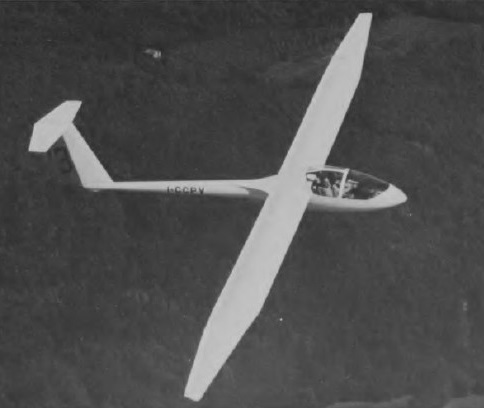
The CARMAN JP 15-38 Standard Class single seater utilises the same wings as the JP 15-36A Aiglon with provision for 220lb of water ballast; these are married to a new fuselage of similar construction to the JP 15-36A, which has a mechanically retractable unsprung monowheel. Instead of the Aiglon’s low-set tailplane the 15-38 has a T-tail, with elevator and spring trim.
15-38
Construction of the 15-38 began in February 1977 and the prototype made its first flight on 17 June 1979.
JP. 15-36 Aiglon Wing span: 15.0 m / 49 ft 2.5 in Length: 6.4 m / 21 ft 0 in Height: 1.4 m / 4 ft 7 in Wing area: 11.0 sq.m / 118.4 sq.ft Wing section: Wortmann FX-67-K-170/67-126 Aspect ratio: 20.4 Empty weight: 200 kg / 441 lb Max weight: 390 kg / 860 lb Water ballast: None Max wing loading: 35.5 kg/sq.m / 7.27 lb/sq ft Max speed: 130 kt / 240 km/h Stalling speed: 33.5 kt / 62 km/h Min sink: 0.6 m/sec / 2 ft/sec at 40.5 kt / 75 km/h Max rough air speed: 108 kt / 200 km/h Best glide ratio: 36 at 49.5 kt / 92 km/h
CARMAM JP15-36A Span: 49ft 2.5 in Length: 20ft 3 in Height: 4ft 7 in Wing area: 114.7 sqft Aspect ratio: 20.4 Empty weight: 505 lb Max weight: 860 lb Max speed: 136mph (in smooth air) Max aero-tow speed: 103 mph Min sinking speed: 2.03ft/sec at 45 mph Best glide ratio: 36.9:1 at 50 mph
CARMAM 15-38 Span: 49ft 2.5 in Length: 21 ft 11.75 in Height: 4ft 8 in Wing area: 118.4 sqft Aspect ratio: 20.6 Empty weight: 507 1b Max weight: 970 lb Max speed: 136 mph (in smooth air) Max area-tow speed: 136 mph Min sinking speed: 1.97ft/sec at 46.5 mph Best glide ratio: 38:1 at 62 mph
Puerto Rico Acquired assets of Doman Helicopters Inc. in August 1965. Tooling began in January 1966 to produce Doman D-10B helicopter; however, rights repurchased by parent company in late 1967, emerging as Berlin Doman Helicopters Inc.
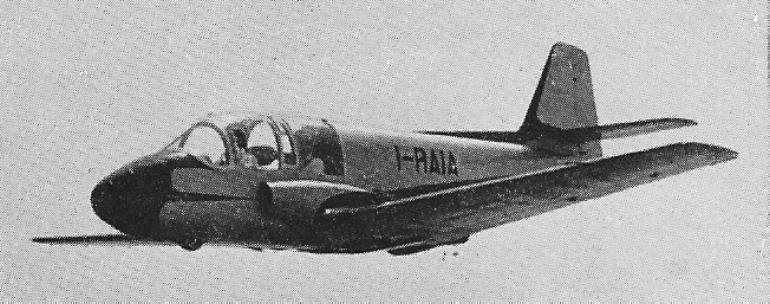
The F.5 tandem two-seat training monoplane designed by Stelio Frati was the first light jet aircraft of Italian design, flying for the first time on 20 May 1952.
Powered by a 330 lb Turbomeca Palas turbojet, the F.5 is of all wood construction, with dual controls and jettisonable canopies. A retractable nosewheel undercarriage is fitted.
Engine: 330 lb Turbomeca Palas Wing area: 107.63 sq.ft Wing span: 25 ft 8 in Length: 21 ft 7.5 on Empty weight: 1032 lb Loaded weight: 1650 lb Max speed: 224 mph at SL / 242 mph at altitude Time to 16,400 ft: 23 min Service ceiling: 23,300 ft
In 1969, the Caproni Vizzola began producing a series of gliders baptized Calif, the names of their designers Carlo Ferrarin and Livio Sonzio: A- 10 (one unit), A-12 (two units), A- 14 (one unit). A-15 (one unit), A- 20, A-21 and their derivatives were produced in series from 1972-73.
The A-15 high performance single-seater was metal with a 23m span. The wing had a long parallel centre-section with short tapered tips.
Span: 23.1m Wing area: 18.48 sq.m Aspect ratio: 28.9 Empty weight: 475 kg AUW: 702 kg Wing loading: 38.1 kg/sq.m Min sink: 0.45 m/sec at 75 kph Stall: 64 kph Mac speed: 252 kph Glide ratio: 50-1 at 92 kph
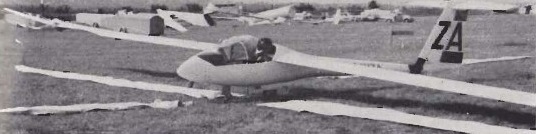
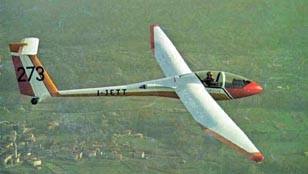
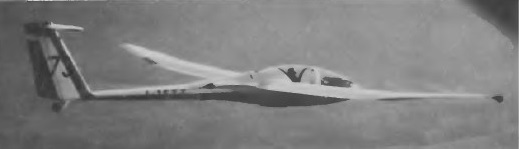
Designed by G. Ferrarin and L. Sonzio, the original A-21, the prototype of which made its first flight on 23 November 1970, was a high performance two-seat version of the A-14, from which it differed in having a slightly longer fuselage widened to accommodate two in luxurious side-by-side seating.
This version was succeeded by the A-21S, which held four world records for two-seaters; among these is the Class D2 speed record for women over a 300km closed circuit, set up on 18 August 1974 by Adele Orsi and Franca Bellingeri in an A-21S at a speed of 60.73mph.
Caproni Vizzola Calif A-21 S
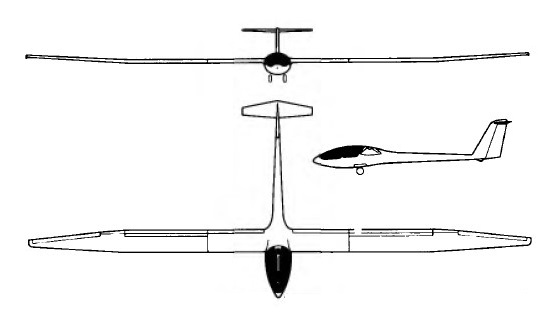
The cantilever mid wings have a wide constant chord centre section and tapered trapezoid outer panels, and are all-metal; the three-piece all-metal main spar is supplemented by two auxiliary spars in the centre section and one in each outer panel, the downturned wing tips being of glassfibre. The trailing edge flaps/spoilers can act as air brakes when deflected to 89 downwards, and as camber-changing surfaces between ±8°; the plain ailerons are differentially-operated. The forward fuselage is a glassfibre/foam plastics semimonocoque structure with a load-carrying light alloy frame, and the rear fuselage is a thin boom of all metal stressed skin construction. The distinctive high aspect ratio fin and rudder is all-metal, and has the all-moving metal tailplane and elevator, which both have glassfibre tips, mounted on top; the tailplane trim is spring-adjusted. The mechanically retractable twin main wheels have rubber-incompression shock absorbers and a brake, and there is a fixed steerable tailwheel, as well as a small wheel in each downturned wing tip. The two pilots have dual controls under a rearward-sliding two piece canopy, and sit in luxury seating equivalent to the best light plane standards.
Over 100 A-21S Califs had been built, production of a third batch of 54 being ordered by January 1980.
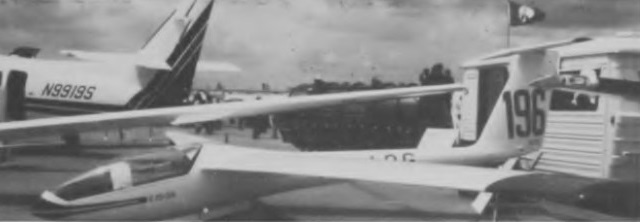
With 66.9 feet of wingspan, the A-21SJ is the only production turbojet-powered sailplane in the world. It offers side-by-side seating and all-metal construction. The engine retracts into the fuselage just aft of the cockpit. Cruise speed is 124 mph and climb is 945 fpm. On 36 gallons of fuel, range is about 217 miles, with a ceiling of 43,300 feet. Takeoff run requires only 1,181 feet. Up to 90 percent of the parts between the sailplane and the motorglider are common to both, so the glider can be transformed easily into a jet glider, even in retrofit. The landing gear for both aircraft features dual main gear that retract into the undercarriage. Two small wheels are built into the wingtips. The wing is all-metal with a single spar, stressed skin, and fiberglass tips; the wing is fitted with top-hinged, differentially operated ailerons plus lower-hinged, aerodynamically balanced flaps/spoilers. The fuselage has a monocoque forward section of fiberglass with a load-carrying lightweight alloy structure. The tailboom is an all-metal stressed-skin unit ending in an all-metal single-spar tailplane. Caproni (which built its first glider in 1908 at Vizzola Ticino, Italy) produced the first A-21 (designed by Carlo Ferrarin and Livio Sonzio) in 1970, and within two years had collected four world multi-place sailplane speed and distance records with it. A 2-place all-metal ship with a fiberglass forward fuselage, the A-21 was followed into production by the slightly improved S model. The ship features a roomy side-by-side cockpit and widely spaced retractable twin landing wheels. Aft-hinged brakes on the lower surface, and these, with large flaps (which deflect to +89 degrees) limit speed in a vertical five to 188 kph / 102 kt / 117 mph. The T-tail is all moving. A steerable tail wheel and water ballast were optional. The Calif A-21S was produced im a small-series produced (6 aircraft) at the Gomolzig Flugzeug- und Maschinenbau. The Italian construction offers good performance (comparable to Janus C) and good flying characteristics, giving the aircraft a broad range of applications reaching from advanced training and guest flights up to performance flights. Only for competition flights in the double-seater class, it is exceeding the 20-meter definition by a few centimeters. The A- 21S cost approximately 20000 Marks less than a Duo Discus and features a fixed tailplane. The A-21JA self launch jet model is a 2 place, side by side all metal sailplane. Forward fuselage is glass fibre. Dual, manually retracting undercarriage. Fixed tail wheel. Rudder pedals adjustable. Both seats adjustable. Extremely powerful trailing edge flap / brakes. Flaps have a thermal setting, cruise setting and fully variable down for landing. Automatic control hook up. No manufacturers fatigue life limit. A very high quality structure, built by an aircraft manufacturer not a glider manufacturer. It was well and truly “state of the art” in 1974.
First flying in late January 1972, the A21 J jet version added a SERMEL TR18 100 kp thrust (220 lb) jet engine. The span was reduced from 22.87 to 20 m, and overall length increased from 7.27 to 8m. The tare weight (equipped) is reduced from 484 to 434 kg. The engine is mounted in the lower part of the fuselage, behind the seat, the ejection of gas under the fuselage. The volume of wing and fuselage tanks hold 160 litres of kerosene. The engine is started with a compressed air bottle.
A21 J
In 1976 the first prototype of the A- 21J was purchased by Lockheed to be used in a research program conducted in cooperation with the Mississippi State University. The experiments concerned inter alia the effects of wind, dust, insects and rain on some wing sections, as well as measures and vortex noise rappport the fuselage. In the initial test phase, the A- 21J was towed to the appropriate altitudes.
The J was succeeded by the A-21SJ, which first flew in May 1977 and was based on the production A-21S sailplane. The main difference between the A 21A and A 21 SJ is the positioning of the 198 lb st Microturbo TRS 18-046 turbojet engine. In remains in the fuselage behind the pilot, but now in the top position. Its air intake is by a removable NACA inlet located on the back of the fuselage. The ejection of the exhaust is by a nozzle opening on each side of the fuselage. The A-21SJ has a metal fuselage with fiberglass monocoque forward section surrounding aluminum load-carrying structure; all metal wings and tail with minor fiberglass fairing.
Caproni Vizzola Calif A-21SJ
Up to 242.5 lb of fuel is carried in fuselage and wing tanks, and there is a starter/generator and batteries for in-flight and ground starting. Apart from the engine the A-21 SJ is very similar to the A-21S, but has larger mainwheels and tailwheel. Two A-21SJs had been completed by May 1979 and five more were being built. One A-21SJ was being tested with a more powerful Microturbo TRS 18 jet of 242.5 lb st.
Prototype A21J Span: 20 36 m Length: 7 84 m Height: 1.919 m Wing area: 16,19 m² Wing loading: 39.8 kg / m² Maximum weight: 644 kg Max speed: 255 km / h Climb speed: 63 km / h
A 21J Engine: Sermel TRS 18, 220 lb. Seats: 2. Wing loading: 8.91 lbs/sq ft. Wing aspect ratio: 25. Gross: 1,543 lbs. Empty: 957 lbs. Useful: 586 lbs. Max airspeed: 162 kts. Rough air speed: 162 kts. Stall: 41 kts. Lift / drag: 43 at 63 kts. Sink: 1.97 fps at 49 kts. Fuel: 236 lbs. Length: 26 ft 3 in. Wing span: 65 ft 7.5 in
A-21JA Glide ratio: 1:43 at 58 kt / 1:42 at 60 kt. Never Exceed Smooth Air: 138 knots Max Rough Air: 91 kts Stall: 34 /38 knots Climb rate: 650 ft/min Ceiling: 30,000 ft Power Cruise: 115 kts
A-21S Span: 66ft 10.5 in Length: 25ft 4.5 in Height: 5ft 8.5 in Wing area: 174.3 sqft Aspect ratio: 25.65 Empty weight: 961 1b Max weight: 1,419 lb Max speed: 156 mph Max aero-tow speed: 87 mph Min sinking speed: 1.97 ft/sec at 53 mph Best glide ratio: 43:1 at 65 mph
A-21 SJ Span: 66 ft 10.25 in Length: 25 ft 4.5 in Height: 5 ft 3.5 in Wing area: 174.3 sqft Aspect ratio: 25.65 Empty weight: 1,164 lb Max weight: 1,781 lb Max level speed: 143 mph (power on) Max rate of climb: 787 ft/min (sea level, power on) Take-off run: 985 ft (power on)
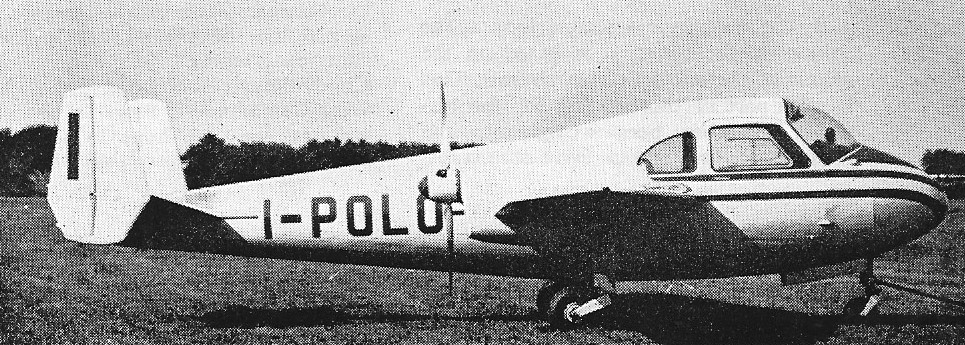
The 1948 Caproni Ca.193 is a cantilever mid-wing monoplane powered by two 155 hp Blackburn Cirrus Major 3 engines driving two blade fixed pitch pusher propellers. The cabin is forward of the main spar, giving appreciable sweep-back to the wing leading edge. Construction is all-metal, the wing monospar with stressed skin covering. The fuselage is a monocoque and the dihedral tailplane has twin fins and rudders at the tip with statically and aerodynamically balanced trim tabs mounted in the movable surfaces. The designer was considering a single fin. The cabin provides accommodation for five.
The only Caproni Ca.193 built was flown for the first time on 1947. The five/six seat pusher aircraft was displayed at the Venice Exposition.
Engines: 2 x Blackburn Cirrus Major III, 155 hp Wingspan: 45 ft 3 in Wing area: 205 sq.ft Length: 29 ft 6 in Height: 8 ft 2 in Empty weight: 2685 lb Loaded weight: 4185 lb Useful load: 1500 kb Max speed: 186 mph at SL Max speed 9840 ft: 164 mph Min speed no flap: 65 mph Climb to 9840 ft: 14 min Service ceiling: 17,700 ft
One of the companies form¬ing part of the industrial empire founded by Count Gianni Caproni in 1908 was Caproni Vizzola, originally an important pilot training school, but from 1934 a design and construc¬tion organization as well. Company’s founder, Count Gianni Caproni di Taliedo, built and flew his first aircraft in May 1910. Count Gianni Caproni di Taliedo designed his first heavy bomber in 1913. Caproni’s big biplane bombers had a demoralizing effect on ground troops during the Austro-Italian conflict, more by virtue of their size and threatening ap¬pearance than their destructive power, and led to a series of immense triplane bombers during World War I. The first was de¬signed in mid-1915 and was designated Caproni Ca. 40. A later development, the Ca.42. At one time, largest aircraft manufacturer, the Caproni group comprised more than 20 companies, of which the principal aircraft building members were Aeroplani Caproni Trento, Caproni Aeronautica Bergamasca, Caproni Vizzola SpA, Compagnia Nazionale Aeronautica, Aeronautica Predappio SpA, and Officine Meccaniche Reggiane SpA. The Isotta-Fraschini aero- engine company was also part of the group. The most prolific company in the group was the Compagnia Aeronautica Bergamasca, which began aircraft design in 1927, joining the Caproni group in the ‘thirties. The chief designer was Cesare Pallavicino, formerly chief designer to Ernesto Breda, and initially the original designs produced by Bergamasca were given Caproni-Bergamaschi designations, but later “Berga- maschi” was dropped and aircraft emanating from the Bergamo works could only be identified by their type numbers, which were in the 300 series.
After formation of Regia Aeronautica in associating with various partners until First World War. 1923 Caproni achieved success with such military aircraft as the Ca 1 -Ca 5 series of large tri-motor biplane and triplane bombers During the 1920s, a retrospective series of manu¬facturer’s designations was applied to war¬time Caproni designs, in an endeavour to clarify different variants. Under this system the prototype Ca.1 was designated Ca 31 and the Fiat engined Ca 1 was allocated Ca 32; to avoid confusion between the two systems. Achieved an international reputation with the Ca 36, Ca 73 and Ca 74. The following decade produced the Ca 101, Ca 111, and Ca 133 range of aircraft and a series of multipurpose reconnaissance/light bomber/transport types, production of which was shared with the Bergamasca subsidiary. Early post-war publicity gained by Ca 60, an enormous eight-engined ‘triple-triplane’ of 1921, intended to carry 100 passengers, which was shared with the Bergamasca subsidiary. Cantieri Aeronautici Bergamaschi had been absorbed by Caproni in 1931. Initially built Ca 100 and Ca 101, then built the new aircraft to the designs of Ing Cesare Pallavicino.
In the mid ‘thirties Caproni-Vizzola activities were expanded and a fully-equipped factory built. The plant was primarily engaged on sub-contract work building the Breda Ba 65 attack aircraft, but in 1938 its first original designs, the F.4 and F.5 single-seat fighters appeared, powered respectively by the 1,025-h.p. Isotta-Fraschini Asso 121 R.C.40 and the 840-h.p. Fiat A.74 R.C.38 radial. Designed by Ing. Fabrizi, a pre-production batch of fourteen of the radial-engined F.5 fighter was built immediately prior to Italy’s entry into the war, but like most of Italy’s fighters of this period the F.5 was under-powered (maximum speed being 326 mph) and under-armed (two 12.7-mm. guns). Nevertheless, a squadron was equipped with the F.5 for a short period and employed for the night defense of the area surrounding Rome.
One of the fourteen F.5 fighters was re-engined in 1941 with a 1,050-h.p. DB 601 engine. This conversion was designated F.6, but the most interesting development was the F.6Mz powered by the 1,250-h.p. Isotta-Fraschini Zeta engine (which was also to have been installed in the Reggiane Re 2004). The F.6Mz flew for the first time late in 1942 and was to have carried an armament of four 12.7-mm. guns or two 12.7-mm. and two 20-mm. guns. Maximum speed was 404 mph, but the Zeta engine was insufficiently developed for operational service, and the F.6Mz progressed no further than the prototype stage.
Major production types during 1934-1944 were A.P.1 single-seat fighter, followed by the family of multi-purpose twin-engined aircraft: Ca 309 Ghibli; Ca310/310 bis Libeccio; Ca 311 Libeccio; Ca 312 bis Libeccio; Ca 314, and 316. More than 2,500 examples of the Ca 100 training/touring biplane were built during the 1930s; the Ca 161 bis, a single-seat single-engined biplane, set an international altitude record of 17,083m that remains unbeaten today in its class. The Caproni-Campini CC-1 of 1940 was Italy’s first and the world’s second aircraft to fly by jet propulsion, though it was not powered by a turbine. During the Second World War the company was chiefly concerned with the production and development of the Ca 310-Ca 314 multipurpose twin-engined aircraft and with the Reggiane Re. 2000-Re 2005 series of single- seat fighters. During the lifetime of the group some 180 different types were built, in addition to licensed construction of almost as many by other designers. The parent company went bankrupt in 1950. Aeroplani Caproni Trento survived the bankruptcy and in May 1952 flew Italy’s first postwar jet light aircraft, the F.5, designed by Dott Ing Stelio Frati. In 1969, Caproni – Vizzola began producing in his workshops 30,000 m² located near the airport of Milan – Malpenza.
Caproni Vizzola Costruzioni Aeronautiche SpA was formerly the Scuola Aviazione Caproni, the oldest flying school in Italy, and became the last surviving part of the company until bought by Agusta in 1983, producing the Calif series of sailplanes and finally the C22J Ventura two-seat very light basic trainer with two Microturbo turbojet engines, first flown 1980. Earlier it remodeled the Ca 133 for ambulance and military transport duties and assisted in production of the Breda Ba 65. Its first original design had been the F.4 single-seat fighter designed by Ing F Fabrizi, flown in 1940. Prototype F.6 had more powerful engine.