Chrislea was based originally at Heston, Middlesex, in 1936, building joint designs of R. C Christophorides and B. V. Leak. In 1938 one L.C.1 Airguard was built, a two-seat, low-wing cabin monoplane for Civil Air Guard. Company transferred to Kentish Town shortly before Second World War, undertaking subcontract work for aircraft industry. Moved again in 1947 to Exeter Airport, where during 1948-1950 a series of four-seat lightplanes were constructed: Series 1 CH.3 Ace, Series 2 CH.3 Super Ace, and Series 4 CH.3 Skyjeep. The first of these high-wing cabin monoplanes was flown in August 1946, but high operating costs and unacceptable control system affected sales of the Ace and Super Ace; more conventional system used on 1949 Skyjeep. Total production (all three types) about 26 aircraft. In 1952 assets acquired by C. E. Harper Aircraft Ltd and all surviving models were scrapped.
Post WW2
Chinhae Naval Shipyard 1957 Flying boat
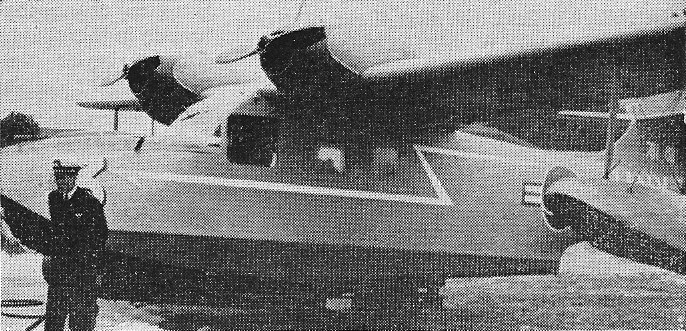
Constructed at the Republic of Korea Chinhae Naval Shipyard in 1957, the then un-named flying boat was of mixed metal and wood construction. Power was two 213 hp Continental 0-470-11 engines.
Chincul SACAIFI
In response to the considerable aging and reduction of the inventory of the country’s air fleet, the FAA encouraged a plan for the progressive replacement of the fleet through manufacturers of national origin.
It was decided for Chincul SACAIFI to manufacture aircraft under license from Piper Aircraft Corporation. The company was a wholly owned subsidiary of “La Macarena S.A.”, Piper’s Argentine distributor. Thanks to Piper’s licensed production plan to produce aircraft. abroad, it envisaged assembly in emerging third world countries, with the main benefit of commercial penetration and the reduction of labor costs that this implied.
With industrial promotions, which gave reductions and tax deferrals to certain areas of the country, they took the owners of Chincul to settle in the town of Pocito in the province of San Juan.
There were built two hangars: Endings, and production: 70 m front by 110 m long. Together with other sectors and annexed workshops, the total covered area reached 14,000 sq.m covered.
The inauguration of the plant occurred on December 12, 1972. The plant maintained a simultaneous process with 10 assembly lines, with about 450 employees (between technicians and aeronautical mechanics), working 24 hours a day, 365 days a year “24×7”. In total they produced some 960 aircraft. In 1978 there were 500 employees.
By the middle of the 1980s, the Sanjuanina plant started a slow downward slope due to the inflationary process that was experienced at that time, in addition to the bankruptcy of its Piper Aircraft mother house.
The Cuyano settlement of the Beraza tried to keep the head for a while longer, but 10 years of setbacks prevented it.
Signed agreement with Bell Helicopter Textron 1990 for helicopter co-production.
Finally, between 1991 and 1994, a final series of the PA-18 Super Club model was produced, definitively ceasing the activity on January 31, 1995, the date on which its huge gates were closed at the Pocito plant.
Today the facilities offer the image of a sad abandonment.
Chilton Cavalier
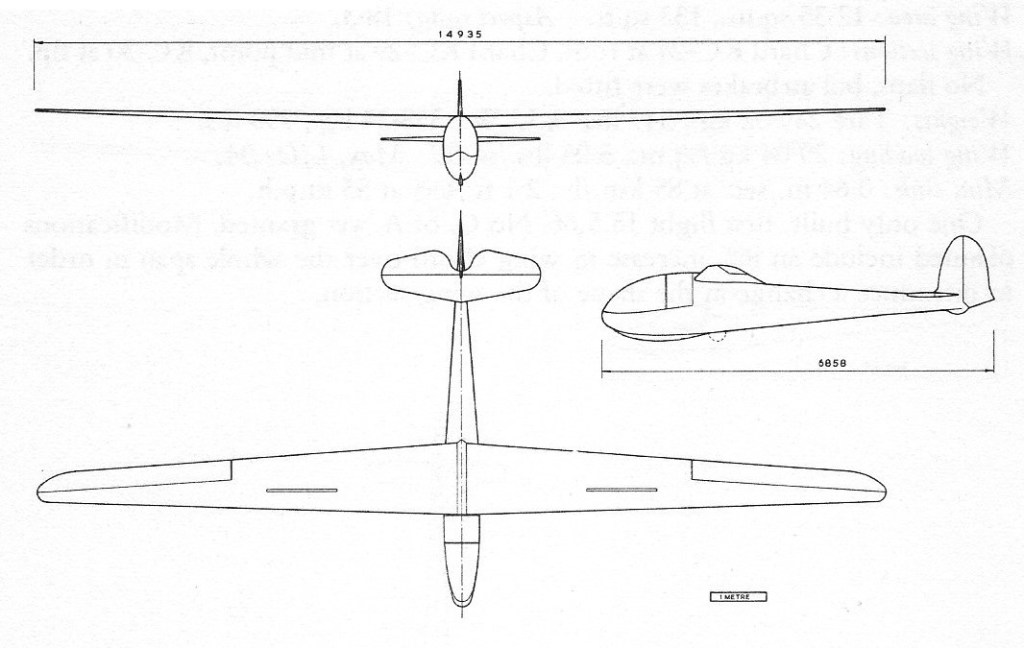
The Chilton Aircraft Ltd Cavalier was a 15m sailplane designed by Chilton in 1944, intended for production at the end of the war.
No flaps, but airbrakes were included. The undercarriage was retractable main wheel, and a tail bumper.
A project only, the glider was not built.
Wingspan: 14.94 m / 49 ft 0 in
Length: 6.86 m / 22 ft 6 in
Chilton Aircraft Co Ltd
Founded at Chilton, near Hungerford, Berkshire, in 1937 to build D.W.1 single-seat light aircraft designed by Hon Andrew W. H. Dalrymple and A. R. Ward, both former de Havilland students.
A low wing open-cockpit wooden monoplane with fixed “trousered” landing gear and Carden-Ford engine, first flown April 1937. Three D.W.1 s built, followed by one faster D.W.1 A, first flown July 1939. Design of D.W.2 only half finished when Second World War began and it was never completed.
During the war company did subcontract work for MAP and aircraft industry generally. Dalrymple died in a flying accident in December 1945, and company reregistered on June 5,1946 as Chilton Aircraft Company Ltd.
The death of Dalrymple in a flying accident on Christmas Day 1945 brought an end to the aeronautical activities.
Prototype Olympia single-seat sailplane built 1947; rights in this sold to Elliotts of Newbury Ltd. in 1952. Company began work in electrical industry.
Chetverikov TA-1
Three prototypes of the eight-passenger TA-1 flying-boat were completed in 1947.
Cheranovski BICh-23 / Che-23
In parallel with the development of the BICh-22 or Che-22 glider, the OKB MAI began the development of a new model of two-seater glider in a flying wing configuration, which was known as BICh-23, or Che-23 (In Russian Черановский БИЧ-23 or Че-23). In contrast to the Che-22, the new Che-23 was characterized by its somewhat smaller dimensions and an increased sagging of the wing.
The Che-23 glider was conceived as a prototype for a large supersonic fighter development.
The Che-23 was built in the MAI workshops and successfully flown in 1948 by test pilot I. A. Petrov.
Che-23 (BICh-23)
Wingspan: 6.7 m
Wing area: 15 m²
Length: 5.96 m
Glide ratio: 12.3
Accommodation: 2
Cheranovski BICh-22 / Che-22

BI Cheranovski developed between 1947 and 1948 a set of novel designs, among which a new glider stands out that returned to the old “Parabola” scheme, but this time introducing the leading edge with variable angle of incidence. This glider was developed in the bureau of experimental constructions of the Moscow Aviation Institute, where Cheranovski worked at that time, and it became known as BICh-22 (Russian Черановский БИЧ-22) or Che-22 from the new Soviet designation system.
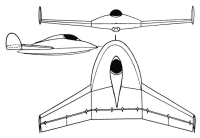
The BICh-22 was conceived as a single-seater experimental glider and featured a flying wing configuration. A scale model was built and studied in the wind tunnel of the Moscow Aviation Institute. The results of these tests showed good stability and validated the new shape.

The wing had a leading edge with variation in the angle of incidence and was made up of a short, parabolic centroplane to which the tapered trapezoidal wing consoles were attached. Vertical empennages were located on the wingtips (although in one of the project’s configurations these empennages were eliminated). The trailing edge of the consoles and the center plane featured control surfaces along the entire span. The ailerons were located on the consoles, while the elevator rudders were attached to the centroplane.
The wing profile was designed by the builder himself. The closed cockpit for the pilot was located in the central area of the centroplane, covered frontally by an oval and transparent cover that ended in an aerodynamic drop-shaped fairing.
The entire glider was made of wood with plywood and calico coating and its weight reached only 60 kg.
In 1948 the Che-22 prototype was built in the MAI workshops which was successfully tested and certified.
On 17 July 1949 during an air show at Tushino the flyover, among the aircraft was the Che-22, piloted by IA Petrov.
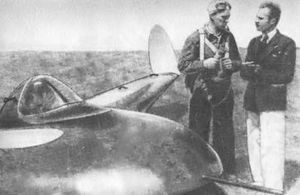
After some flight tests, the Central Committee of the DOSAV (Society for Cooperation with Aviation), placed an order with the OKB of Cheranovski to build a small series of 10 Che-22 gliders. At the end of 1949 in the DOSAV workshops in the Moscow suburb of Chornoye an accident occurred during a flight of the Che-22, killing the test pilot IA Petrov. Development work on the glider series was cancelled.
The prototype provided the theoretical basis for the development of more advanced models powered by ramjets and turbo jets.
Che-22 (BICh-22)
Wingspan: 7.50 m
Wing area: 14.03 m²
Length: 5.04 m
Height: 0.93 m
Empty weight: 60 kg
Glide ratio: 18-1
Accommodation: 1
Chengdu J-9
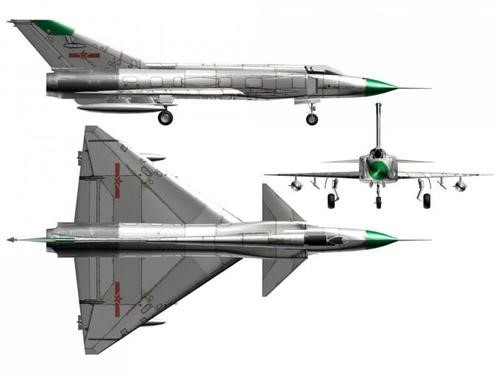
The J-9 used a completely new single-engined design. It was to have a top speed of Mach 2.4, necessitating the use of variable geometry inlets and a high-power turbofan engine. Four configurations were considered, all incorporating delta wings. However, each proposed configuration was found to lack agility and experience stability issues at certain speeds. A new configuration was devised, resembling the canard layout of the Saab Viggen. However, just as this major change was made, the Cultural Revolution hit the project, bringing work to a standstill. Meanwhile, Chinese involvement in Vietnam led to rapidly changing requirements, calling for unrealistic range and top speeds higher than originally specified. Work resumed in the 70’s, with a prototype reportedly making a flight. However, the WS-6 turbofan that was to power the aircraft proved a failure, and the competing Shenyang J-8 was not only entering service but was more promising. In 1978 the J-9 was finally cancelled.
Chengdu Aircraft Company / CAC
Founded in 1958 for jet fighter and jet trainer development and production, based on original Soviet designs. J- 7 tactical fighter and air-defense interceptor first flew in January 1966, developed from the Soviet MiG-21 F-13 following 1960-1961 discussions between the two nations, though technology transfer had not been completed when cooperation came to an abrupt end. J-7 originally assembled by Shenyang, but production moved to Chengdu in 1967. Many new versions followed, including F-7 Airguards for export, with production and development continuing in 1999. A replacement for J-7/F-7 has been under development as the FC-1. Another early program led to the JJ-5 which first flew in May 1966 as an advanced lead-in/fighter conversion trainer, based on the Shenyang J-5A single-seat fighter (itself a Chinese-produced variant of the Soviet MiG-17PF), but with a MiG-15UJI-style tandem cockpit arrangement. Much more recently, Chengdu has also developed the new J-10 as a very advanced multirole fighter, first flown in March 1998 and possibly using some technology derived from the abandoned Israeli Lavi program of the 1980s. A further multirole fighter has been under development as J-12, about which little is yet known.

