A four-seat all-metal version of Cheetah, the Super Cheetah; prototype built by Aircraft Industries of Canada. This flew September 1964, but no production took place.
Post WW2
Clairco Cheetah
1962, an all-wood two-seat light aircraft
Cheetah Light Aircraft Co Ltd / Clairco
Canada
Clairco formed January 14,1964 at St Jean, Quebec, by David Saunders (an RCAF pilot 1957-1963). Built and flew, in 1962, an all-wood two-seat light aircraft named Cheetah. Founded company to build a four-seat all-metal improved version, the Super Cheetah; prototype built by Aircraft Industries of Canada. This flew September 1964, but no production took place.
Châtelain AC-5 Bijou

The AC-5 Bijou was one of several original homebuilt aircraft designed and built by Armand Châtelain in the 1950s and 1960s.
The sole AC-5 was initially powered by a 75 hp Minié 4DC-32 Horus engine, and was registered F-PHQO. It first flew on September 10, 1956. Later it was re-engined with one 65 hp Continental A65, the aircraft was still active in 2012.
Chasle YC-12 Tourbillion

The Tourbillion (Whirlwind) is a single seat, amateur-built, light low-wing plane that comes from France.

Designed by Yves Chasle in 1964, the wooden prototype F-PMXQ first flew on 9 October 1965.
It is available in several models that differ only in their engine size. Most common is the 65-hp Continental. Airframe construction includes wood and fabric wings and a plywood-covered fuselage structure.
Plans no longer available.
Variants:
YC-12
prototype with Continental A65 engine
YC-121
similar to prototype with enlarged tailfin for limited certification
YC-122
similar to YC-121 but with Continental C90 engine
YC-123
similar to YC-121 but with Potez 4E-20b engine
YC-121
Powerplant: 1 × Continental A65, 48 kW (65 hp)
Propeller: 2-bladed EVRA fixed pitch wooden propeller, 1.75 m (5 ft 9 in) diameter
Wingspan: 6.7 m (22 ft 0 in)
Aspect ratio: 6
Airfoil: NACA Srs.7
Length: 5.95 m (19 ft 6 in)
Empty weight: 285 kg (628 lb)
Max takeoff weight: 432 kg (952 lb)
Fuel capacity: 60.5 l (16.0 US gal; 13.3 imp gal)
Maximum speed: 235 km/h (146 mph, 127 kn) at sea level
Cruise speed: 205 km/h (127 mph, 111 kn) at 70% power
Stall speed: 75 km/h (47 mph, 40 kn)
Range: 800 km (500 mi, 430 nmi)
Rate of climb: 4.6 m/s (910 ft/min)
Wing loading: 57.5 kg/sq.m (11.8 lb/sq ft)
Power/mass: 0.112 kW/kg (0.068 hp/lb
Takeoff run 855 ft
Landing roll 900 ft
Range 500 miles
Crew: 1
Chase C100-S
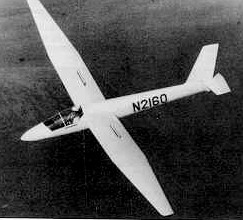
Designed by Robert Chase, the C100-S made its first flight in 1968. It uses a 3-piece wing with an airfoil 15% thick and no aerodynamic twist. Wood and Styrofoam are used in the construction of the wing (as well as the tail), but the entire surface and the stress- bearing material is fiberglass. The fuselage is of all-metal stress-skin construction, with a skid and fixed wheel.
Wing Span: 16.76 m / 55 ft
Wing Area: 12.82sq.m / 138sq.ft
Empty Weight: 240kg / 530lb
Payload: 91kg / 200lb
Gross Weight: 331kg / 730lb
Wing Load: 25.82kg/sq.m / 5.3 lb/sq.ft
L/DMax: 38 @ 88 kph/ 46 kt/ 55 mph
Aspect ratio: 22
MinSink: 0.61 m/s / 2.0 fps / 1.18 kt
Airfoil: NACA 4(3)-165
No. of Seats: 1
No. Built: 1
Structure: aluminum, fiberglass, wood
Chase YC-122 Avitruc
A powered version of the gliders, the 30-troop YC- 122 Avitruc was first flown on November 18,1948. Twelve built for USAF trials but no further production
Chase Aircraft Corp
Chase Aircraft Corp was established in New York in 1943 by Michael Stroukoff to develop experimental assault/cargo gliders. Produced XCG-14, XCG-14A and CG-18A. Moved to Trenton, New Jersey, late 1946, developing a powered version, 30-troop YC- 122 Avitruc, first flown November 18,1948. Twelve built for USAF trials ,but no further production. Followed by larger C-123 Avitruc, first flown 14 October 1949, derived from XG-20 cargo glider; this project later taken over by Fairchild as C-123B and renamed Provider. An XC-123A prototype (four General Electric turbojets) flew on April 21,1951: first flight of a U.S. transport powered by jet engines. Chase became wholly owned subsidiary of Willys Motors Inc. of Toledo, Ohio, in 1953, itself owned by Kaiser- Fraser. In June 1953 a USAF contract for 300 C- 123Bs was canceled, a smaller contract going to Fairchild that autumn.
Chargus Vortex
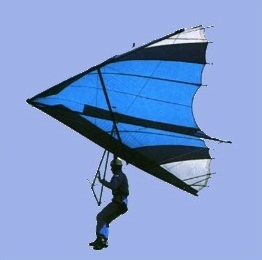
Made in 1978, the Vortex was Chargus’ first contribution to the intermediate glider market. The machine, which was supplied in two sizes, follows the Superscorpion deflexerless concept but with the addition of vortex generators. These are little holes cut in the wing tips just behind the leading edge to give a lower stalling speed than normal. Rigging utilised a difficult to assemble control frame and bolt-on cross booms, like the Mk 1 Superscorpion. Finish was good with lots of attention to details and all tubing is anodised matt black.
The performance of the Vortex is good at slow speeds where it really proves its slow flying, slow sink rate ability. The machine however becomes very light in roll at high speeds and will oscilate badly in rough air, particularly if the pilot is inexperienced and is overcorrecting.
In 1978 the Vortex 110 was priced at £397.00 inc bag and VAT, and the Vortex 120 at £415.00 inc bag and VAT.
Vortex 110
Leading edge: 19 ft 0 in
Keel: 12 ft
Sail area: 196 sq ft
Nose angle: 110 deg
Billow: 0.68 deg
Aspect ratio: 4.6
Span: 30 ft
Vortex 120
Leading edge: 19 ft 0 in
Keel 12 ft
Sail area: 204 sq ft
Nose angle: 120 deg
Billow: 0.68 deg
Aspect ratio: 5.23
Span: 32ft 8 in
Chargus Midas

The original Midas was superseded by the 1976 Midas E which was retrospectively re-titled as Midas C. the price including carrying bag, harness and VAT, was £ 450.00 in 1976
The 1977 Midas E was an excellent performing and popular glider. Its short chord at the keel is an unusual feature.


The 1978 Midas Super E has some special features, amongst which are an adjustable C of G strop, large diameter cross boom and short or long keel option. Triple tubular wing posts give greater strength to the airframe and more control to the canopy shape. Aircraft push pins are used for uncomplicated and rapid assembly. Another feature is the floating truncations which greatly contribute to the machine’s speed range, glide ratio and sink rate. The Midas Super E is constructed only of top grade materials and uses American Dacron sail cloth.
Midas C
Sail area: 166 sq.ft
Leading edge: 19 ft 3 in
Keel: 8ft. 3in
Nose angle: 110 deg
Billow 1.6 deg
Aspect ratio: 6.0
L/D: 8 to 1
Midas E
Leading edge 19 ft 11 in
Keel 8ft.3 in
Sail area 188 sq.ft
Nose angle 110 deg
Billow 1.6 deg
Aspect ratio 5.7
L/D 8.5 to 1
Midas Super E
Leading edge: 19 ft 10 in
Root chord: 8 ft
Sail area: 188 sq ft
\Nose angle: 110 degs
Aspect ratio: 5.7
L/D: 9.5:1
Mean chord: 5.74 ft
Keel: 17 ft 5 in
Span: 32 ft 9 in

