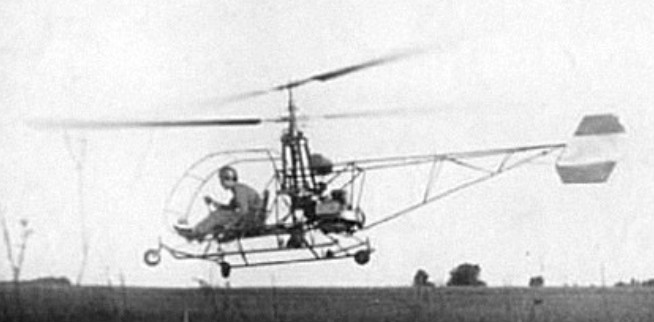
The first (1961) helicopter designed and built by Augusto Cicare is a single-seat single-engine with two counter-rotating coaxial rotors. Each rotor has two blades. The cyclic control varies the inclination of the rotors axis. The airframe is made of steel tubes. The four stroke, four opposite cylinders engine was also designed and built by Augusto.
Founded by Fernando Cicaré in 1972 in Argentine, Cicaré Helicópteros S.A. (originally Cicaré Aeronáutica S.A.) is an Argentine helicopter manufacturer.
From late 1960s Cicare designed and built the Cicare I and II experimental light helicopters. Followed September 1976 by C.K.1 (originally CH-III) two/three-seat light helicopter for training and agricultural use, aimed mostly at the South American market.
A number of prototypes were constructed, including one under contract from the Argentine Air Force, but no great successes were achieved until the CH-7 light sporting helicopter in the 1990s. In March 2007 the first prototype of Cicaré CH-14 a light helicopter for the Argentine army was ready.
On March 18, 2010 they presented the CH-7B and CH-12 during the EAA Argentina Annual Meeting.
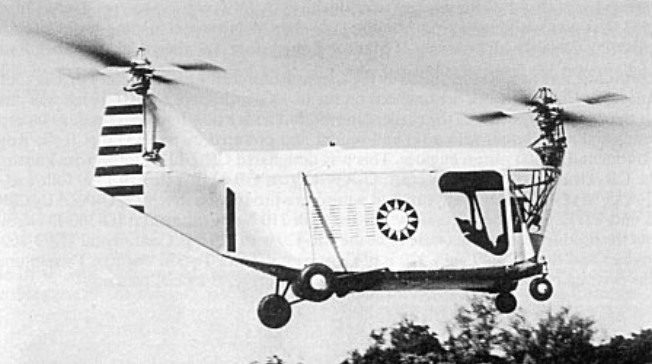
In 1952 Major-General C.J. Chu produced a small tandem-rotor helicopter known as the CJC-3 which was a side-by-side two-seater with a centrally-mounted 190hp Lycoming engine and fixed four-leg undercarriage.
CJC-3 Engine: 1 x Lycoming, 190hp Rotor diameter: 6.47m / 25 ft Overall length: 32 ft. 10 in. Gross weight: 930kg Empty weight: 680kg Maximum speed: 180km/h Cruising speed: 136km/h Inclining climb: 466m/min Ceiling: 3660m / 16,800 ft Range: 216km / 130 miles at 68 m.p.h. Seats: 2
Though the helicopter principle, as is shown by the Chinese top, has been known in China for centuries, the first true Chinese helicopter goes back only as far as 1945. It was produced by Major-General Chu.
G.J.Chu studied aviation technology in the U.S.A, returned to China and was for thirteen years director of an aircraft manufacturing plant at Yunnan, which built various American aircraft and also the Soviet I-15 under licence.
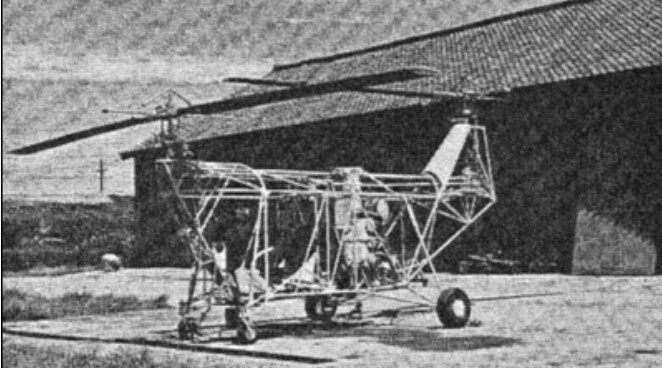
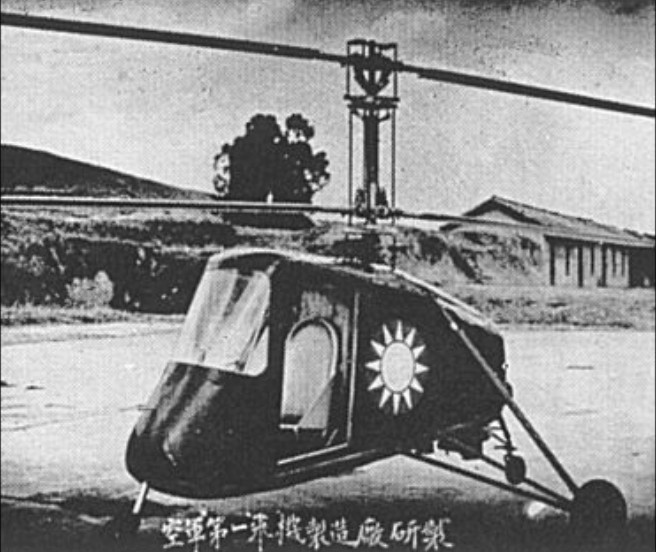
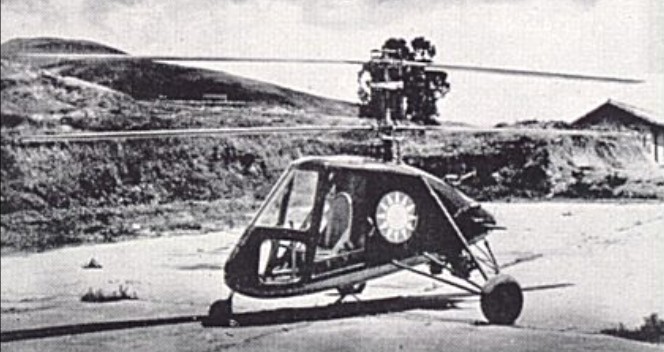
In 1945 C.J.Ghu turned his attention to rotorcraft and designed a co-axial helicopter, known as the Humming Bird Model A. During the tie-down test, the ground screw came off with the rope, the Humming Bird tipped over and both its rotors were broken.
A start was immediately made on building a second version, the Humming Bird Model B.
Chu Humming Bird B
But, as the general tells the story: “Just as it was finished, however, I was sent to Formosa and for a variety of reasons we had to leave the ship on the mainland …”
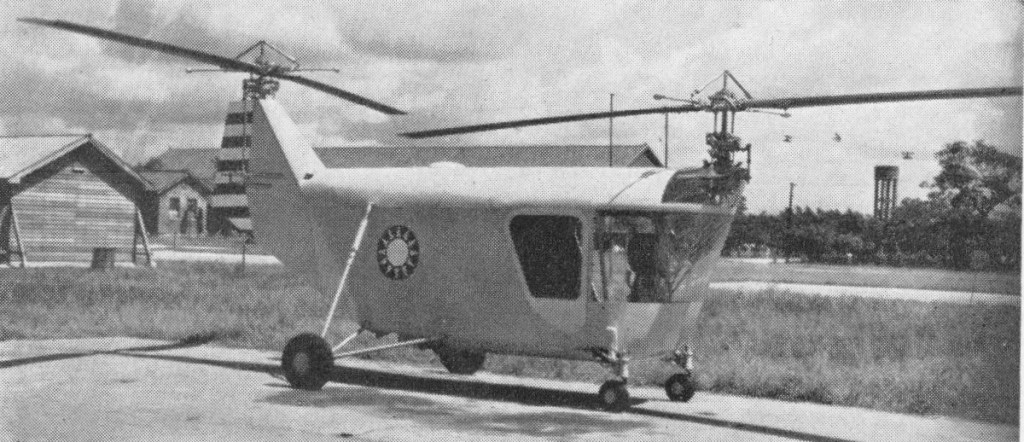
While in Formosa, Chu became interested in the tandem configuration and set to work again. After eighteen months’ work, the aircraft was ready.
Humming Bird Model B Engine: 1 x Kinner B-5, 125 hp Rotor diameter: 7.62m Width: 2.34m Height: 2.63m Gross weight: 725kg Empty weight: 590kg Maximum speed: 136km/h Cruising speed: 112km/h Inclining climb: 140m/min Hover ceiling: 910m Range: 219km
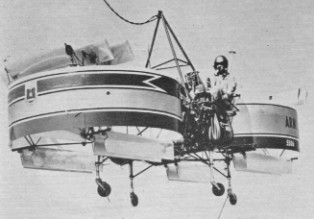
In 1959, the U.S. Army, through its Trans¬portation Research and Engineering Command, initiated the development of three types of VTOL research aircraft in a programme aimed at pro¬ducing a flying jeep. Fundamentally a cross between an Army jeep and a reconnaissance helicopter, this type was intended ultimately to operate at speeds of about 50 mph a few feet above the ground, carrying a payload of about 1000 lb. Contracts were placed with the Chrysler Corporation, Acrophysics Development Corp¬oration and Piasecki Aircraft Corp¬oration. The Chrysler VZ 6, like the Piasecki flying jeep, was of the ducted fan type, using two fans in tandem with the pilot and engine in between. Work on this configuration had been going on at the Chrysler Defense Engineering Company since 1955 and a unique feature of the design was the use of rigid fixed pitch three blade rotors or fans. Since the fans could not therefore contribute to control of the aircraft, Chrysler developed a system of control vanes. Pitch control came from lateral vanes across the duct intakes and yaw and roll control came from longitudinal vanes in the duct exit. The engine was located in the center of the rectangular-shaped vehicle, next to the off-set pilot’s position. Rubber skirts around the outside of the vehicle’s bottom edge helped sustain the fan-generated lift. A 373 kW (500 hp) Lycoming engine powered the VZ 6, which weighed about 2,300 lb. fully loaded and was 23 ft. long. The diameter of the ducted fans was 8 ft. 6 in. During 1959, the VZ 6 (58 5506) made some tethered hovering flights. On the first attempt at a free flight it got out of control and overturned. The prototype was not repaired and the second example (serial 58-5507) which had been ordered (58 5507) was not completed. Both prototypes were disposed of in 1960.
Chrysler VZ-6 Engine: 1 x Lycoming piston, 370kW Rotor diameter: 2.6m Length: 6.55m Height: 1.58m Take-off weight: 1080kg
The Jaguar began in 1969 as a biplane class racing aircraft Pete Tomalesky, was interested in racing and felt that, the recently evolved biplane class would be fertile ground to explore. The project was literally shelved in early 1970 as business matters took most of Tomalesky’s time. As often happens, interests change, and he abandoned the project to design and build a two-place, side-.by-side biplane he called the Tomcat. The aircraft bare bones were purchased by Stavros Chrysostomides, a South Carolina artist/homebuilder.
This aircraft was designed for an O-290 Lycoming of 125 hp, and the mount was welded directly to the airframe to save weight. A one-piece steel spring landing gear was formed and fitted with 500 x 5 wheels and tires, which were later sold to a fellow building a Knight Twister.
The negative staggerwing configuration was selected to provide the pilot maximum visibility in pylon turns, and since the top wing root was aft of the pilot’s head, the forward sweep of the top wings was needed to locate the wing properly in relation to the CC and the lower wing.
Chrysostomides discovered. the need to adjust the angle of a forward sweep since he was using a larger O-320 Lycoming. Also included was a statically balanced elevator to reduce chances of high-speed elevator flutter. The counterweight was attached to the elevator horn, and thereby completely concealed inside the Nselage. Calculations placed the top speed near 200 mph with a cruise near 150 mph.
Frank Christensen says he once tried to buy the Pitts Special type certificate but was turned away by the price. That apparently bothered him, because he went out and designed his own family of kit built sport biplanes, and the results were on view for the first time at Oshkosh 1977.
The criteria were: unlimited class aerobatic performance; a two place cockpit; all the creature comforts the Pitts lacked; attractive styling; and, last but in a way most essential, that the airplane should be amateur built. To certificate and sell the airplane in the normal market would be too confining and too expensive, Christensen felt. By selling it as a kit, he could channel his expenditures where they belonged into providing materials of the highest quality instead of into justifying everything to the FAA.
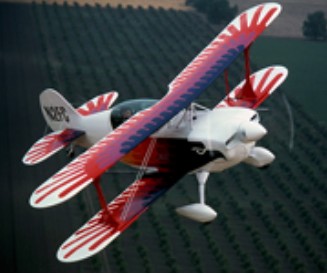
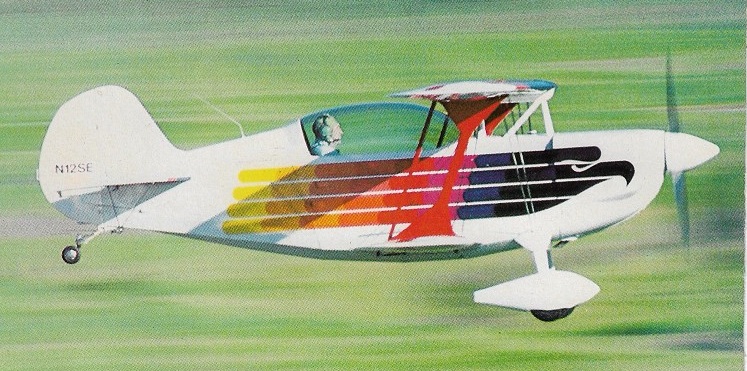
The Eagle is a biplane with a swept symmetrical wing structure of built up wooden ribs and spars. The Eagle’s bubble cano¬py, hinged oh the right side of the airplane, slides back to unlock and swings aside to ad¬mit the pilot and passenger to a long, wide tandem cockpit with a single instrument pan¬el in front and dual controls. The fuselage is built from welded steel tube and covered with metal back to the rear cockpit, then fabric the rest of the way aft. The fabric-covered wings are built with wood ribbing over spruce spars. The amateur builder has the option of buying 26 kits in sequence, starting with the ailerons, to test his dexterity.
Many parts are prefabricated or partially prefabricated, and the Ea¬gle’s steel tube structures are welded at the factory. Christen kits include everything you need to build them. Price in 1982: $41,000 (includes complete kit). Kit less engine and propeller, costs $26,000. Units delivered to June 1982: 450 started, 100 flying.
The Eagle I and I F will be the single-¬place unlimited competition version, pow¬ered by a 260 horsepower Lycoming aero¬batic engine; the F means fixed pitch. The I model will compete at 1,262 pounds and carry 1,478 pounds at gross with a wing loading of 11.82 pounds per square foot. Its empty weight power loading is 3.83 lbs. per hp. With a rate of climb of 2,640 fpm, it offers social climbers a verti¬cal penetration of 1,650 feet. The II, by comparison, is pure luxury, featuring a spacious forward cockpit with no intruding instructor’s feet and a huge bubble canopy molded of a single hunk of clear plastic. It rides behind 200 hp Lycoming AEIO 360 AlD and a second F version, except that this time, the F means the 260 hp en¬gine of the I model. Its gross weight is 1,578 pounds, and it provides for an elec¬trical system and a radio. Both models are stressed to +9and 6 Gs and have roll rates of 187 degrees per second and a power loading of 5.25 lbs/hp. For a second time, Christensen turned his attention toward the Pitts factory (locat¬ed at Afton, in the middle of nowhere in Wy¬oming). This time, he was successful: Pitts Aerobatics is now part of Christen Indus¬tries, and Christensen wants the Pitts and the Eagle, formerly arch rivals in the field of competition aerobatics, to live in harmony as stablemates. Christensen himself, of course, developed the Eagle as a refined Pitts after purchase negotiations with Curtis Pitts fell through in the mid 1970s. Although the very exis¬tence of the Eagle testifies to which airplane Christensen thinks is better, he is quick to assure the Pitts purists that their airplane has its own special place in the past and in the future. Christensen had no plans to axe the Pitts marque, but one model, the 200¬hp two seat S 2A, will mutate to become the factory built Eagle. This is a crucial reason behind Christen Industries’ acquisition of Pitts Aerobatics. It is the most direct route to a factory built, certificated Eagle. For the purposes of certification, the factory built Eagle will actually be a Pitts S 2A modified to Eagle standards. The Christen Eagle is very similar to the S 2A: both share the same airfoil, span, length, engine and propeller, but the Eagle has less lower wing dihedral, a further aft CG, different cowling and landing gear, modified ailerons and linkages and a more spacious and better designed interior. Christensen sees the Eagle as being almost imperceptibly different: “Like a washed car, it runs smoother.” At the time he was developing the Eagle, Christensen was convinced that an unusual¬ly complete kit would appeal to a larger market than would comparable homebuilts or factory built airplanes. With 550 kits sold by 1975, it seems he was right.
The Eagle II is a two-seat sporting biplane that can be used for unlimited-class aerobatics as well as for advanced training. The Eagle II and II-F have a full electrical system (starter-alternator-battery). The Eagle II uses a 200-hp engine with constant-speed propeller. The Eagle II-F uses a 260-hp engine with fixed-pitch propeller. Characterized by their startling paint scheme, the Eagles feature swept symmetrical wings, a strong fuselage, and a blown canopy that covers both cockpits. With a roll rate of 187 degrees/second and a power loading of 7.89 lbs./hp, the Eagle is a strong performer. The fuselage is finished in metal from the cowling back to the rear cockpit. The midsection, all the way to the empennage, is covered in fabric. The fabric-covered wings are built with aluminum ribbing over spruce spars. The amateur builder has the option of buying 25 kits in sequence, starting with the ailerons, to test his or her dexterity.
The Eagle II, first offered in kit form in 1977, was still available in 1998 at US$55,000.
First flew in 1977 Eagle II two-seat unlimited-class aerobatic biplane; hundreds of kits sold for amateur construction. In 1983 acquired former Pitts Aerobatics company and this plant at Afton in Wyoming became company headquarters. Thereafter added Pitts Special aerobatic biplane to product line, plus A-1 Husky two-seat cabin monoplane (first flown 1986) as assembled and certificated aircraft.
At Exeter Airport, during 1948-1950, a series of four-seat lightplanes were constructed: Series 1 CH.3 Ace, Series 2 CH.3 Super Ace, and Series 4 CH.3 Skyjeep. The first of these high-wing cabin monoplanes was flown in August 1946, but high operating costs and unacceptable control system affected sales of the Ace and Super Ace.
The prototype CH.3 Series 1, was fitted with a 125 hp Lycoming engine, a single fin and rudder, and a wooden wing.
Production versions, the CH.3 Series II, was all-metal and fitted with a 145 hp DH Gipsy Major 10 engine. It also has the twin fin and rudder assembly later fitted to the prototype.
The CH.3 Series III had a tailwheel landing gear.
The Series IV version of the Series III had a hinged rear fuselage deck.
By August 1959 the tail wheel undercarriage CH.3 Srs. 4 Skyjeep VH-RCD four-seater had a deepened rear fuselage.
Engine: 1 x Gypsy Major Mk.10, 145 hp Wingspan: 36 ft Length: 21 ft 6 in Empty weight: 1344 lb Loaded weight: 2350 lb Max speed: 126 mph Cruise: 110 mph Stall: 38 mph Range: 400 mi Seats: 4