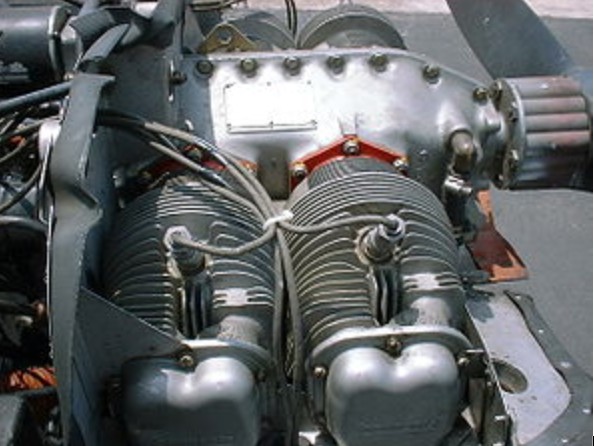
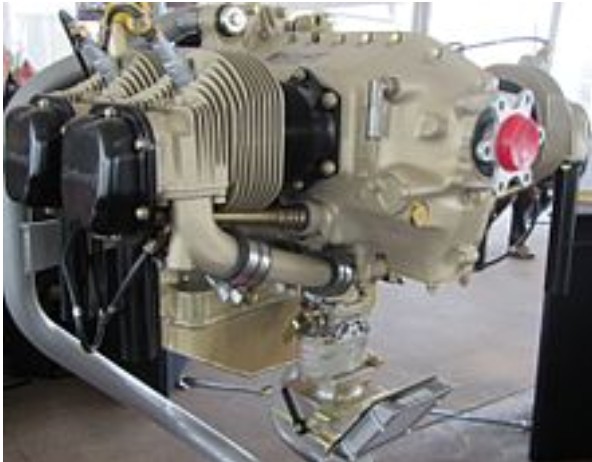
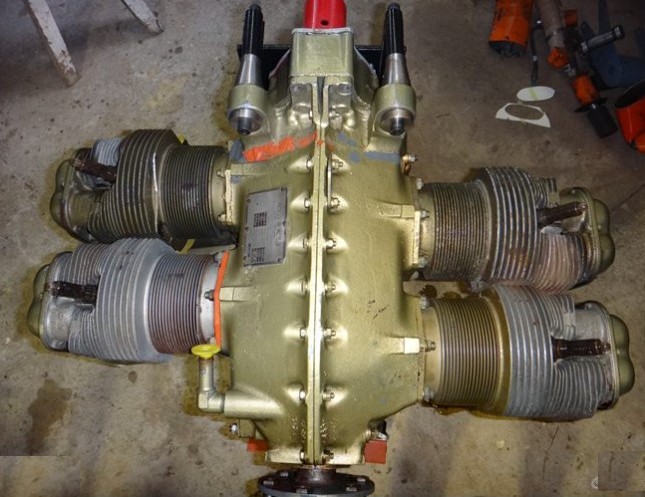
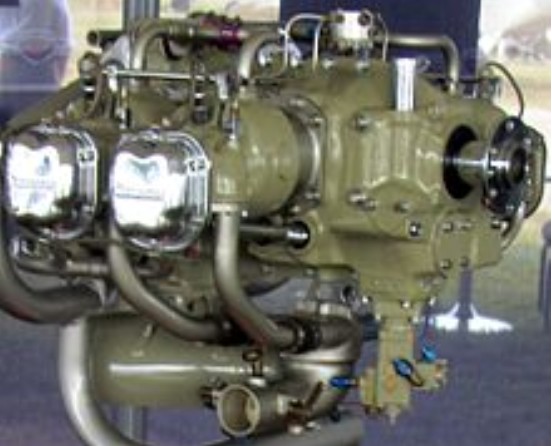
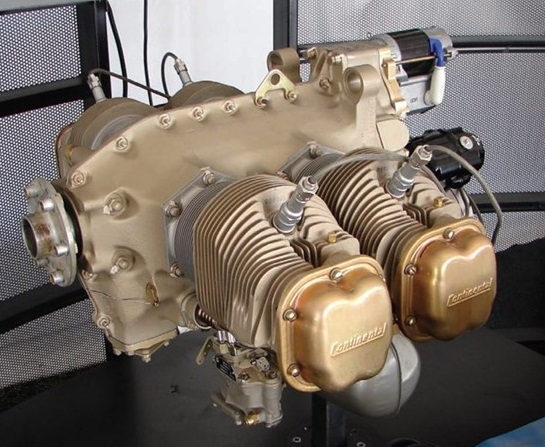
Continental began development of the horizontally opposed Tiara series in 1965. At the time, CAE, Continental Motor’s turbine engine subsidiary, had developed the T65, a small turboshaft engine which was being considered by Bell for its new Model 206 helicopter. Faced with having to fund the production tooling for the T65 in order to keep the price reasonable, or funding the Tiara series, Continental’s corporate management chose to invest in the Tiaras. While the Tiara series were basically traditional boxer engines, they did have some unique features. The engines had high rotational speeds, 0.5:1 gearing was used to reduce propeller speed, with the camshaft forming an extension of the propeller shaft. The propeller shaft featured the Hydra-Torque drive to reduce the shaft’s vibrations. The engines were available with four, six- and eight-cylinders. All were fuel-injected, with turbocharging being optional. The engines’ fuel consumption was high, which became a disadvantage during the 1973 oil crisis era. In addition, the Tiaras’ performance was not significantly improved over existing engines, making it difficult for aircraft manufacturers to justify the costs of certificating their products for the engines. These problems led Continental to finally discontinue the engines in 1980.
Series Four-cylinder: Tiara 4-180 (O-270) 180 hp. Four-cylinder, 271 cu in capacity
Six-cylinder: Tiara 6-260 (O-405) 260 hp. 406 cu in capacity
Tiara 6-285 (O-405) 285 hp. 406 cu in capacity
Tiara 6-320 (O-405) 300 hp. 406 cu in capacity
Tiara T6-260 (O-405) 260 hp 406 cu in capacity, turbocharged
Tiara T6-285 (O-405) 285 hp 406 cu in capacity, turbocharged
Tiara T6-320 (O-405) 300 hp 406 cu in capacity, turbocharged
Eight-cylinder: Tiara 8-380 (O-540) 380 hp, 541 cu in
Tiara T8-450 (O-540) 450 hp, 541 cu in, turbocharged
The Continental O-470 engine is a family of carbureted six-cylinder, horizontally opposed, air-cooled aircraft engines that was developed especially for use in light aircraft by Continental Motors. The family includes the E165, E185 and the E225 engines. It has been in production since 1950.
The IO-470 is a fuel injected version of the same basic engine.
The first engine in this series was the E165, a 471 cubic inch (7.8 L) engine producing 165 hp (123 kW) and the first of Continental’s “E” series engines. Later versions were given the company designation of E185 (185 hp (138 kW) continuous) and E225 (225 hp (168 kW)). When the US military gave them all the designation of O-470 the company adopted the designation and future models were known as Continental O-470s.
The O-470 family of engines covers a range from 213 hp (159 kW) to 260 hp (194 kW). The engines were first developed in the late 1940s and certification was applied for on 23 October 1950 on the regulatory basis of Part 13 of the US Civil Air Regulations effective 1 August 1949 as amended by 13-1. The first O-470 model was certified on 19 January 1951.
Variants:
Carbureted models
E165-2 165 hp (123 kW) at 2050 rpm, dry weight 351 lb (159 kg), Marvel-Schebler MA-4-5 carburetor.
E165-3 165 hp (123 kW) at 2050 rpm, dry weight 352 lb (160 kg), Bendix-Stromberg PS-5C or PS-5CD carburetor.
E165-4 165 hp (123 kW) at 2050 rpm, dry weight 344 lb (156 kg), Bendix-Stromberg PS-5C or PS-5CD carburetor.
E185-1 205 hp (153 kW) at 2600 rpm for five minutes, 185 hp (138 kW) at 2300 rpm continuous, dry weight 344 lb (156 kg), Bendix-Stromberg PS-5C or PS-5CD carburetor.
E185-2 185 hp (138 kW) at 2300 rpm, dry weight 351 lb (159 kg), Marvel-Schebler MA-4-5 carburetor.
E185-3 205 hp (153 kW) at 2600 rpm for five minutes, 185 hp (138 kW) at 2300 rpm continuous, dry weight 352 lb (160 kg), Bendix-Stromberg PS-5C or PS-5CD carburetor.
E185-5 185 hp (138 kW) at 2300 rpm, dry weight 343 lb (156 kg), Bendix-Stromberg PS-5C or PS-5CD carburetor.
E185-8 205 hp (153 kW) at 2600 rpm for five minutes, 185 hp (138 kW) at 2300 rpm continuous, dry weight 344 lb (156 kg), Bendix-Stromberg PS-5C or PS-5CD carburetor, identical to E185-1 but with revised starter drive with dog rather than gear type starter.
E185-9 205 hp (153 kW) at 2600 rpm for five minutes, 185 hp (138 kW) at 2300 rpm continuous, dry weight 352 lb (160 kg), Bendix-Stromberg PS-5C or PS-5CD carburetor, identical to E185-3 except for revised starter drive to accommodate dog rather than gear type starter.
E185-10 205 hp (153 kW) at 2600 rpm for five minutes, 185 hp (138 kW) at 2300 rpm continuous, dry weight 352 lb (160 kg), Bendix-Stromberg PS-5C or PS-5CD carburetor.
E185-11 205 hp (153 kW) at 2600 rpm for five minutes, 185 hp (138 kW) at 2300 rpm continuous, dry weight 344 lb (156 kg), Bendix-Stromberg PS-5C or PS-5CD carburetor, identical to E185-8 but with revised mounting brackets.
E225-2 225 hp (168 kW) at 2650 rpm, dry weight 359 lb (163 kg). Certified 19 July 1951.
E225-4 225 hp (168 kW) at 2650 rpm, dry weight 355 lb (161 kg). Certified 5 July 1952.
E225-8 225 hp (168 kW) at 2650 rpm, dry weight 347 lb (157 kg). Certified 12 July 1950. Military 225hp GIO-470-A with direct-drive turbocharger; 80/87 fuel.
E225-9 225 hp (168 kW) at 2650 rpm, dry weight 363 lb (165 kg). Certified 30 October 1950.
E250 250 hp variant
O-470-2 250 hp (186 kW) at 2600 rpm, dry weight 484 lb (220 kg), supercharged model. Certified 2 February 1955.
O-470-4 225 hp (168 kW) at 2600 rpm, dry weight 415 lb (188 kg), previously designated 0-470-13B. It is identical to the Model 0-470-13A except for the Bendix-Stromberg Model PS-5CD carburetor in place of the PS-5C. Certified 19 January 1951.
O-470-7 Non-certified military engine, identical to E185-3, 205 hp (153 kW) at 2600 rpm, dry weight 352 lb (160 kg), Bendix-Stromberg PS-5C or PS-5CD carburetor. When equipped with 18 mm. spark plugs, it is designated 0-470-7A.
O-470-11 213 hp (159 kW) at 2600 rpm, dry weight 391 lb (177 kg), two sixth order dampers. Certified 19 January 1951.
O-470-11B 213 hp (159 kW) at 2600 rpm, dry weight 391 lb (177 kg), identical to the 0-470-11 but with 0-470-15 cylinders and pistons. Certified 19 January 1951.
O-470-13 225 hp (168 kW) at 2600 rpm, dry weight 415 lb (188 kg), one fifth and one sixth order dampers or two sixth order dampers. Certified 19 January 1951.
O-470-13A 225 hp (168 kW) at 2600 rpm, dry weight 415 lb (188 kg), identical to the 0-470-13 but with an additional tachometer drive through the camshaft gear and one fifth and one sixth order crankshaft damper. Certified 19 January 1951.
O-470-15 213 hp (159 kW) at 2600 rpm, dry weight 405 lb (184 kg), identical to the 0-470-11 except: four sixth order damper crankshaft, propeller control provisions, revised engine mounting brackets and long skirt pistons. Certified 19 January 1951.
O-470-A 225 hp (168 kW) at 2600 rpm, dry weight 378 lb (171 kg). Certified 4 December 1952.
O-470-B 240 hp (179 kW) at 2600 rpm, dry weight 410 lb (186 kg), similar to O-470-A except increased power, different damper configuration, incorporation of inclined valve cylinders, downdraft pressure carburetor and induction changes. Identical to E185-9. Certified 4 December 1952.
O-470-E 225 hp (168 kW) at 2600 rpm, dry weight 390 lb (177 kg), same as O-470-A except downdraft pressure carburetor. Certified 4 December 1952.
O-470-G 240 hp (179 kW) at 2600 rpm, dry weight 432 lb (196 kg), similar to O-470-M except crankshaft damper configuration, revised oil sump integral cast intake air passage and mounting brackets. Certified 4 December 1952 (ATC 273).
O-470-H 240 hp (179 kW) at 2600 rpm, dry weight 495 lb (225 kg), same as O-470-C with -470-D cylinders, pistons, bearings, extension propeller shaft, approved for pusher installations, 100/130 fuel. Certified 4 December 1952.
OO-470-H O-470-M with extended propshaft; 455 lb dry.
O-470-J 225 hp (168 kW) at 2550 rpm, dry weight 378 lb (171 kg), same as O-470-C except reduced max rpm and induction system risers, manifold and balance tube. geared 7:1, Slick mags, 80/87 fuel. Certified 4 December 1952.
O-470-K 230 hp (172 kW) at 2600 rpm, dry weight 404 lb (183 kg), similar to O-470-J except max rpm, crankshaft damper configuration, incorporation of shell-molded cylinder heads and revised mounting brackets. Updraft carb, sheet metal oil sump, 80/87 fuel, geared 7:1, Slick mags. Certified 4 December 1952.
O-470-L 230 hp (172 kW) at 2600 rpm, dry weight 404 lb (183 kg), same as O-470-K except relocated carburetor, revised intake manifold oil sump. Certified 4 December 1952.
O-470-M 240 hp (179 kW) at 2600 rpm, dry weight 410 lb (186 kg), same as O-470-B except crankshaft damper configuration and incorporation of shell-molded cylinder heads, 91/96 fuel. Certified 4 December 1952.
O-470-N 240 hp (179 kW) at 2600 rpm, dry weight 410 lb (186 kg), IO-470-C with -470-D cylinders, pistons, bearings, 100/130 fuel. Same as O-470-M except crankshaft damper configuration. Certified 4 December 1952.
O-470-P 240 hp (179 kW) at 2600 rpm, dry weight 432 lb (196 kg), identical to O-470-G except crankshaft damper configuration with extended propshaft. Certified 4 December 1952.
O-470-R 230 hp (172 kW) at 2600 rpm, dry weight 401 lb (182 kg), same as O-470-L except crankshaft damper configuration. Certified 4 December 1952.
O-470-S 230 hp (172 kW) at 2600 rpm, dry weight 401 lb (182 kg), same as O-470-R except piston oil cooling and semi-keystone piston rings. Certified 4 December 1952.
O-470-T 230 hp (172 kW) at 2400 rpm, dry weight 410 lb (186 kg), similar to the O-470-S except crankcase design and max rpm. Certified 4 December 1952.
O-470-U 230 hp (172 kW) at 2400 rpm, dry weight 412 lb (187 kg), similar to the O-470-S except max rpm rating and crankshaft damper configuration. Certified 4 December 1952.
Fuel-injected models
IO-470-A 240 hp (179 kW) at 2600 rpm, dry weight 432 lb (196 kg), equipped with a TCM 5580 fuel injector. Certified 4 December 1952.
IO-470-C 250 hp (186 kW) at 2600 rpm, dry weight 410 lb (186 kg), equipped with a TCM 5620 or 5827 fuel injector, geared 8:1, fuel injection, 91/96 fuel. Certified 4 December 1952 (TC 3E1).
IO-470-D 260 hp (194 kW) at 2625 rpm, dry weight 426 lb (193 kg), equipped with a TCM 5648, 5808 or 5832 fuel injector, geared 8.6:1, 100/130 fuel. Certified 14 October 1958.
IO-470-E 260 hp (194 kW) at 2625 rpm, dry weight 429 lb (195 kg), equipped with a TCM 5648, 5808 or 5832 fuel injector, 100/130 fuel. Certified 26 November 1958.
IO-470-F 260 hp (194 kW) at 2625 rpm, dry weight 426 lb (193 kg), equipped with a TCM 5648, 5808 or 5832 fuel injector, 100/130 fuel. Certified 3 December 1958.
IO-470-G 250 hp (186 kW) at 2600 rpm, dry weight 431 lb (195 kg), equipped with a TCM 5648, 5808 or 5832 fuel injector. Certified 30 March 1959.
IO-470-H 260 hp (194 kW) at 2625 rpm, dry weight 432 lb (196 kg), equipped with a TCM 5620-2 fuel injector. Certified 7 August 1959.
IO-470-J 225 hp (168 kW) at 2600 rpm, dry weight 400 lb (181 kg), equipped with a TCM 5612-1 fuel injector. Certified 31 July 1959.
IO-470-K 225 hp (168 kW) at 2600 rpm, dry weight 400 lb (181 kg), equipped with a TCM 5807 fuel injector. Certified 9 June 1960.
IO-470-L 260 hp (194 kW) at 2625 rpm, dry weight 429 lb (195 kg), equipped with a TCM 5648, 5808 or 5832 fuel injector, 100/130 fuel. Certified 9 March 1960.
IO-470-LO 260 hp (194 kW) at 2625 rpm, dry weight 429 lb (195 kg), equipped with a TCM 5648, 5808 or 5832 fuel injector. Certified 26 September 1967.
IO-470-M 260 hp (194 kW) at 2625 rpm, dry weight 428 lb (194 kg), equipped with a TCM 5648, 5808 or 5832 fuel injector, 100/130 fuel. Certified 10 March 1960.
IO-470-N 260 hp (194 kW) at 2625 rpm, dry weight 432 lb (196 kg), equipped with a TCM 5830 fuel injector. Certified 9 June 1960.
IO-470-P 250 hp (186 kW) at 2600 rpm, dry weight 472 lb (214 kg), equipped with a TCM 5648 fuel injector. Certified 31 March 1961.
IO-470-R 250 hp (186 kW) at 2600 rpm, dry weight 431 lb (195 kg), equipped with a TCM 5648, 5808 or 5832 fuel injector. Certified 7 October 1960.
IO-470-S 260 hp (194 kW) at 2625 rpm, dry weight 429 lb (195 kg), equipped with a TCM 5648, 5808 or 5832 fuel injector, 100/130 fuel. Certified 10 May 1961.
IO-470-T 250 hp (186 kW) at 2600 rpm, dry weight 475 lb (215 kg), equipped with a TCM 5648 fuel injector. Certified 1 July 1963.
IO-470-U 260 hp (194 kW) at 2625 rpm, dry weight 426 lb (193 kg), equipped with a TCM 5648, 5808 or 5832 fuel injector. Certified 28 August 1963.
IO-470-V 260 hp (194 kW) at 2625 rpm, dry weight 426 lb (193 kg), equipped with a TCM 5648, 5808 or 5832 fuel injector. Certified 15 June 1965.
IO-470-VO 260 hp (194 kW) at 2625 rpm, dry weight 426 lb (193 kg), equipped with a TCM 5648, 5808 or 5832 fuel injector. Certified 26 September 1967.
LIO-470-A 250 hp (186 kW) at 2600 rpm, dry weight 475 lb (215 kg), equipped with a TCM 6022 fuel injector. The same as an IO-470-T, except that the crankshaft turns in opposite direction for use on twin-engined aircraft. Certified 18 March 1964.
FSO-470-A 260 hp (194 kW) at 3000 rpm, dry weight 533 lb (242 kg), Supercharged model, specifically approved for helicopters. Certified 2 February 1955.
TSIO-470-C TSIO-470-A for various applications.
TSIO-470-D TSIO-470-A for various applications.
Applications: E165 Boisavia Mercurey Luscombe 11
E185 Beechcraft Bonanza Macchi M.B.320 Muniz Casmuniz 52 Ryan Navion
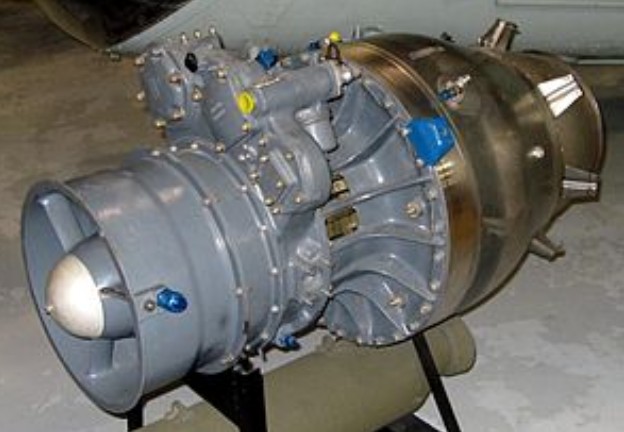
The Teledyne CAE J69 was a small turbojet engine produced by Continental Aviation and Engineering (CAE) under license from Turbomeca. A development of the Marboré II, the J69 powered a number of US drones, missiles and small aircraft. Later produced by Teledyne CAE, the J69 was also developed into the J100 turbojet optimized for higher altitudes
The Continental C115, C125 and C140 aircraft engines were made by Continental Motors in the 1940s, all sharing the US military designation O-280. Of flat-6 configuration, the engines produced 115 hp (86 kW) 125 hp (93 kW) or 140 hp (104 kW) respectively.
The C115 was in production from 1945 to 1951, the C125 was in production from 1945 to 1952, and the C140 from 1945 to 1946.
The C125 has the same crankcase as the Continental C145, although the engines differ in stoke, compression ratio and carburetor jetting. The C125 features a cast iron camshaft and hydraulic tappets.
Applications:
C125 Aero-Flight Streak Baumann Brigadier Call-Air A-3 Globe Swift Grumman Tadpole Hockaday Comet KZ VII Meyers MAC-125 Miles Gemini
Specification:
C-115 1945 115hp 281.9ci
C125 Type: 6-cylinder air-cooled horizontally opposed aircraft piston engine Bore: 4.0625 in (103 mm) Stroke: 3.625 in (92 mm) Displacement: 282 in³ (4.6 L) Length: 39.75 in (101.0 cm) Width: 31.5 in (80.0 cm) Height: 23.25 in (59.0 cm) Dry weight: 286 lb (130 kg) Cooling system: Air-cooled Power output: 125 hp (93 kW) at 2,550 rpm Specific power: 0.44 hp/in³ (20.2 kW/l) Compression ratio: 6.3:1 Power-to-weight ratio: 0.43 hp/lb (0.72 kW/kg)
First run in 1947, the Continental C90 and O-200 are a family of air-cooled, horizontally opposed, four-cylinder, direct-drive aircraft engines of 201 in³ (3.29 L) displacement, producing between 90 and 100 horsepower (67 and 75 kW).
The C90 was introduced in 1947 as a follow-on to the A65, which had been in production since 1939. Many of the designs powered by the C90 are upgraded variants of earlier A65 powered designs, such as the Piper J-3 Cub and PA-11 Cub Special, Aeronca 7AC, and Luscombe 8A. The engine was developed from the earlier O-190 by increasing the stroke 1⁄4 inch.
This engine family is considered to be dependable, according to both industry publications and the FAA, certified under ATC 252.
While the C90 is approved for takeoff power of 95 horsepower (71 kW) for 5 minutes, the designation derives from its continuous power rating of 90 hp (67 kW). As noted above, certain models of the C90 replace the usual carburetor with a fuel injection system. In addition, there are models which provide for the installation of a controllable pitch propeller and one, the C90-12FP, designed for pusher installation. While slightly less horsepower than the O200, many floatplane operators prefer the performance of the C90 over the O200, due to its higher torque at lower rpm. This is primarily due to the C90’s camshaft design. The C90 is also known by its military designation of O-205.
Though the C90 was superseded by the O-200, and many of the designs utilizing the O-200 had gone out of production by 1980, with the 2004 publication of the United States Federal Aviation Administration light-sport aircraft regulations came a resurgence in demand for the O-200. The light-sport aircraft standard is for small, simple single- and two-seat aircraft for which the O-200 is well-suited.
The O-200 is an updated and upgraded version of the engine, achieving increased power of 100 hp (75 kW) as a result of higher maximum rpm. The standard and most common model of the engine is the O-200-A; the -B model is designed for pusher installation, the -C model provides for the installation of a controllable pitch propeller, and the -D model is a lightweight model designed for Light Sport aircraft.
Continental O-200D
With 23,949 Cessna 150s built, this type is the most common application for the O-200.
In a cooperative venture, Rolls-Royce produced these same designs in England, under separate certification, with model designations beginning RR, e.g. the Rolls-Royce RR C90-12FH is the equivalent of the Continental C90-12FH; the Rolls-Royce versions are “directly interchangeable with the equivalent models manufactured by Continental.” The Rolls-Royce O-200-A powers the Beagle B.121 Pup 100, the Bölkow BO 208 C Junior, the Avions Robin DR 220, and the Morane-Saulnier MS-880.
Rolls Royce O-200-B
All versions of the C90 and O-200 are Four-stroke reciprocating engines and are all similar in size, displacement and weight. These engines are typically fitted with an updraft carburetor, though the C90-8FJ, -12FJ, and -14FJ are equipped with fuel injection systems. They utilize a redundant ignition system requiring no external power, driving two magnetos, each of which fires one spark plug per cylinder. Each cylinder has one intake valve and one exhaust valve, pushrod-activated.
Continental’s recommended time between overhaul (TBO) for these engines is 1,800 hours of operation or 12 years in service, whichever is reached first. The standard certification for the C90 and O-200 specifies Avgas 80/87 as the minimum fuel grade. Both are eligible for operation on automobile gasoline on the basis of Supplemental Type Certificates.
An engine designated the IOL-200, an O-200 variant modified with fuel injection and liquid cooling, powered the 1986 non-stop, non-refueled global circumnavigation flight of the Rutan Voyager. The 110-horsepower (82 kW) IOL-200, also referred to as the Voyager 200, was the rear engine and—unlike the forward engine, another modified engine, a Continental O-240 —ran throughout the entire 9-day flight save for a four-minute shutdown due to a fuel problem.
Continental IOL-200
Formula One racer Sharp Nemesis, designed and flown by Jon Sharp, was powered by a ‘stock’ O-200. Between 1991 and 1999, the plane won 45 of the 48 events in which it was entered, as well as winning three Louis Blèriot medals, four Pulitzer Trophies, and setting 16 speed records in its class. In one of those records, Nemesis was clocked at over 290 mph (467 km/h). By contrast, the O-200 powered Legend Cub cruises at 95 mph (152.9 km/h).
The Continental O-190 (Company designations C75 and C85) is a series of engines made by Continental Motors beginning in the 1940s. Of flat-4 configuration, the engines produced 75 hp (56 kW) or 85 hp (63 kW) respectively.
The two variants shared the same bore, stroke and compression ratio. The C85 produced ten extra horsepower by virtue of having a maximum permissible rpm of 2575 versus the 2275 of the C75. The C75 was in production from 1943 to 1952 and the C85 from 1944 to 1970.
Variants:
C75
C85 85 hp 177 ci 4 cylinder Weight: 170 lb
C-85-8 A-65 but 188ci tapered propshaft Weight: 188 lb
C-85-8F C-85-8 with flanged propshaft.
C-85-12 C-85-8 with starter.
C-85-12F C-85-12 with flanged propshaft.
O-190 Military designation for the C75, C85 family of engines. 85 hp 177 ci 4 cylinder Weight: 170 lb
The Continental CAE T51 was a small turboshaft engine produced by Continental Aviation and Engineering (CAE) under license from Turbomeca. A development of the Artouste, it was followed by three additional turboshaft engines, the T72, the T65, and the T67. However, none of these engines, including the T51, entered full production. CAE abandoned turboshaft development in 1967 after the XT67 lost to the Pratt & Whitney Canada PT6T (T400) to power the Bell UH-1N Twin Huey.
Variants and derivatives:
XT51-1 (Model 210) Based on the Artouste I; 280 shp.
XT51-3 (Model 220-2) Based on the Artouste II; 425 shp.
XT72 (Model 217-5) Based on the Turbomeca Astazou; 600 shp.
XT65 (Model 217-10) A scaled-down version of the Astazou; competed against the Allison T63 to power the Light Observation Helicopter; 305 shp.
XT67 (Model 217A) two engines driving a common gearbox; based on the Astazou X and T72; 1,540 shp.
The Continental IO-360 is a family of fuel-injected air-cooled, six-cylinder aircraft engines manufactured by Continental Motors in the United States of America, and first run in 1962.
The engine was available in both normally aspirated, fuel injected IO-360 model and a turbocharged TSIO-360 versions. It was also available in both left and right hand rotation versions for use on twin-engined aircraft.
There was no carbureted version of this engine therefore the base model is the IO-360.
The IO-360 was first certified by the Federal Aviation Administration on 15 May 1962 to the CAR 13 certification standard, effective June 15, 1956, as amended by 13-1 thru 13-3. The engine is produced by Continental under Production Certificate No. 508.
The turbocharged TSIO-360 series was first certified on 11 October 1966 to the Federal Aviation Regulations Part 33 standard effective February 1, 1965, as amended by 33-1. This series was manufactured under Production Certificate No. 7, except the TSIO-360-D which is under Production Certificate No. 508.
Variants:
IO-360-A 210 hp (157 kW) at 2800 rpm, Minimum fuel grade 100 or 100LL avgas, compression ratio 8.5:1. Base IO-360 model: a six-cylinder air-cooled, horizontally opposed direct drive, fuel injected engine. Uses a TCM 639230A3 fuel injector. The crankshaft has two 6th order dampers.
IO-360-AB 210 hp (157 kW) at 2800 rpm, Minimum fuel grade 100 or 100LL avgas, compression ratio 8.5:1. Uses a TCM 639230A3 fuel injector. Same as the IO-360-A except for modified crankshaft. The crankshaft has one 6th and one 4½ order damper.
IO-360-AF 180 hp (134 kW), designed to run on lower octane fuels such as the proposed 94UL avgas. The designation of “AF” stands for alternative fuel. The version incorporates lower-compression pistons, giving a 7.5 to 1 compression ratio and a revised fuel injection system.
IO-360-B 180 hp (134 kW) at 2700 rpm, Minimum fuel grade 80/87 avgas, compression ratio 6.0:1. Uses a TCM 639230A3 or 6006 fuel injector. Same as IO-360-A except for reduced compression ratio and rated power. The crankshaft has two 6th order dampers.
IO-360-C 210 hp (157 kW) at 2800 rpm, Minimum fuel grade 100 or 100LL avgas, compression ratio 8.5:1. Uses a TCM 639231A3 fuel injector. Same as the IO-360-D except for accessory drive provisions. The crankshaft has two 6th order dampers.
IO-360-CB 210 hp (157 kW) at 2800 rpm, Minimum fuel grade 100 or 100LL avgas, compression ratio 8.5:1. Uses a TCM 639231A3 fuel injector. Same as the IO-360-C except for modified crankshaft. The crankshaft has one 6th and one 4½ order damper.
IO-360-D 210 hp (157 kW) at 2800 rpm, Minimum fuel grade 100 or 100LL avgas, compression ratio 8.5:1. Uses a TCM 639231A3 fuel injector. Same as the IO-360-A except for power rating and oil cooled pistons. The crankshaft has two 6th order dampers.
IO-360-DB 210 hp (157 kW) at 2800 rpm, Minimum fuel grade 100 or 100LL avgas, compression ratio 8.5:1. Uses a TCM 639231A3 fuel injector. Same as the IO-360-D except for modified crankshaft. The crankshaft has one 6th and one 4½ order damper.
IO-360-E 210 hp (157 kW) at 2800 rpm, Minimum fuel grade 100 or 100LL avgas, compression ratio 8.5:1. Uses a TCM 639231A3 fuel injector. Same as the IO-360-D except for oil sump and suction tube. The crankshaft has two 6th order dampers.
IO-360-ES 210 hp (157 kW) at 2800 rpm, Minimum fuel grade 100 or 100LL avgas, compression ratio 8.5:1. Same as the IO-360-HB except for the modified spider induction system and the use of a TCM 639289A95 fuel injector. The crankshaft has one 6th and one 4½ order damper.
IO-360-G 210 hp (157 kW) at 2800 rpm, Minimum fuel grade 100 or 100LL avgas, compression ratio 8.5:1. Uses a TCM 639231A3 fuel injector. Same as the IO-360-C except for crankshaft counterweight tuning. The crankshaft has one 6th and one 4½ order damper.
IO-360-GB 210 hp (157 kW) at 2800 rpm, Minimum fuel grade 100 or 100LL avgas, compression ratio 8.5:1. Uses a TCM 639231A3 fuel injector. Same as the IO-360-G except for modified crankshaft. The crankshaft has one 6th and one 4½ order damper.
IO-360-H 210 hp (157 kW) at 2800 rpm, Minimum fuel grade 100 or 100LL avgas, compression ratio 8.5:1. Uses a TCM 639231A3 fuel injector. Same as the IO-360-D except for crankshaft counterweight tuning. The crankshaft has one 6th and one 4½ order damper.
IO-360-HB 210 hp (157 kW) at 2800 rpm, Minimum fuel grade 100 or 100LL avgas, compression ratio 8.5:1. Uses a TCM 639231A3 fuel injector. Same as the IO-360-H except for modified crankshaft. The crankshaft has one 6th and one 4½ order damper.
IO-360-J 210 hp (157 kW) at 2800 rpm, Minimum fuel grade 100 or 100LL avgas, compression ratio 8.5:1. Uses a TCM 639231A3 fuel injector. Same as the IO-360-H except for power rating. The crankshaft has one 6th and one 4½ order damper.
IO-360-JB 210 hp (157 kW) at 2800 rpm, Minimum fuel grade 100 or 100LL avgas, compression ratio 8.5:1. Uses a TCM 639231A3 fuel injector. Same as the IO-360-J except for modified crankshaft. The crankshaft has one 6th and one 4½ order damper.
IO-360-K 195 hp (145 kW) at 2600 rpm, Minimum fuel grade 100 or 100LL avgas, compression ratio 8.5:1. Uses a TCM 639231A3 fuel injector. Same as the IO-360-H except for power rating. The crankshaft has one 6th and one 4½ order damper.
IO-360-KB 195 hp (145 kW) at 2600 rpm, Minimum fuel grade 100 or 100LL avgas, compression ratio 8.5:1. Uses a TCM 639231A3 fuel injector. Same as the IO-360-K except for modified crankshaft. The crankshaft has one 6th and one 4½ order damper.
TSIO-360-A 210 hp (157 kW) at 2800 rpm, Minimum fuel grade 100 or 100LL avgas, compression ratio 7.50:1. Base TSIO-360 model: a six-cylinder air-cooled, horizontally opposed direct drive, fuel injected, tuned induction, turbocharged engine with internal piston cooling oil jets.
TSIO-360-AB 210 hp (157 kW) at 2800 rpm, Minimum fuel grade 100 or 100LL avgas, compression ratio 7.50:1. Same as the TSIO-360-A except for a modified crankshaft.
TSIO-360-B 210 hp (157 kW) at 2800 rpm, Minimum fuel grade 100 or 100LL avgas, compression ratio 7.50:1. Same as the TSIO-360-A except for accessory drive provisions.
TSIO-360-BB 210 hp (157 kW) at 2800 rpm, Minimum fuel grade 100 or 100LL avgas, compression ratio 7.50:1. Same as the TSIO-360-B except for modified crankshaft and different dampers.
TSIO-360-C 225 hp (168 kW) at 2800 rpm, Minimum fuel grade 100 or 100LL avgas, compression ratio 7.50:1. Same as the TSIO-360-A except for rating, crankshaft dampers provision for cabin pressurization.
TSIO-360-CB 225 hp (168 kW) at 2800 rpm, Minimum fuel grade 100 or 100LL avgas, compression ratio 7.50:1. Same as the TSIO-360-C except for a modified crankshaft.
TSIO-360-D 225 hp (168 kW) at 2800 rpm, Minimum fuel grade 100 or 100LL avgas, compression ratio 7.50:1. Same as the TSIO-360-C except for cabin pressurization.
TSIO-360-DB 225 hp (168 kW) at 2800 rpm, Minimum fuel grade 100 or 100LL avgas, compression ratio 7.50:1. Same as the TSIO-360-D except for a modified crankshaft.
TSIO-360-E 215 hp (160 kW) at 2575 rpm, Minimum fuel grade 100 or 100LL avgas, compression ratio 7.50:1. Same as the TSIO-360-C except for rating, engine mounted turbocharger, freon compressor drive and cabin pressurization.
TSIO-360-EB 215 hp (160 kW) at 2575 rpm, Minimum fuel grade 100 or 100LL avgas, compression ratio 7.50:1. Same as the TSIO-360-E except for a modified crankshaft.
TSIO-360-F 200 hp (149 kW) at 2575 rpm, Minimum fuel grade 100 or 100LL avgas, compression ratio 7.50:1. Same as the TSIO-360-E except for the power output rating and the exhaust system configuration.
TSIO-360-FB 200 hp (149 kW) at 2575 rpm, Minimum fuel grade 100 or 100LL avgas, compression ratio 7.50:1. Same as the TSIO-360-F except for a modified crankshaft.
TSIO-360-G 210 hp (157 kW) at 2700 rpm, Minimum fuel grade 100 or 100LL avgas, compression ratio 7.50:1. Same as the TSIO-360-E except for the power output rating and the exhaust system configuration.
TSIO-360-GB 210 hp (157 kW) at 2700 rpm, Minimum fuel grade 100 or 100LL avgas, compression ratio 7.50:1. Same as the TSIO-360-G except for a modified crankshaft.
TSIO-360-H 210 hp (157 kW) at 2800 rpm, Minimum fuel grade 100 or 100LL avgas, compression ratio 7.50:1. Same as the TSIO-360-G except for rating and cabin pressurization.
TSIO-360-HB 210 hp (157 kW) at 2800 rpm, Minimum fuel grade 100 or 100LL avgas, compression ratio 7.50:1. Same as the TSIO-360-H except for a modified crankshaft.
TSIO-360-JB 225 hp (168 kW) at 2800 rpm, Minimum fuel grade 100 or 100LL avgas, compression ratio 7.50:1. Same as the TSIO-360-HB except for the increased power output rating.
TSIO-360-KB 220 hp (164 kW) at 2800 rpm, Minimum fuel grade 100 or 100LL avgas, compression ratio 7.50:1. Same as the TSIO-360-EB except for the increased power output rating.
TSIO-360-LB 210 hp (157 kW) at 2700 rpm, Minimum fuel grade 100 or 100LL avgas, compression ratio 7.50:1. Same as the TSIO-360-GB but with a larger throttle body, larger induction elbows, relocated overboost valve, magneto pressurization and an exhaust muffler.
TSIO-360-MB 210 hp (157 kW) at 36″ mp and 2700 rpm, Minimum fuel grade 100 or 100LL avgas, compression ratio 7.50:1. Same as the TSIO-360-LB except for intercooler, wastegate controller, maximum manifold pressure, and cluster manifold.
TSIO-360-NB 210 hp (157 kW) at 2700 rpm, Minimum fuel grade 100 or 100LL avgas, compression ratio 7.50:1. Same as the TSIO-360-LB except for an intercooler.
TSIO-360-PB 200 hp (149 kW) at 2600 rpm, Minimum fuel grade 100 or 100LL avgas, compression ratio 7.50:1. Same as the TSIO-360-MB but not equipped with an intercooler.
TSIO-360-RB 220 hp (164 kW) at 2600 rpm, Minimum fuel grade 100 or 100LL avgas, RH95/130 or B95/130 CIS, compression ratio 7.50:1. Same as the TSIO-360-KB except the manifold pressure is controlled with a wastegate controller, an intercooler is installed in the induction system, and uses a Precision Airmotive RSA-5AD2 fuel injection servo.
TSIO-360-SB 220 hp (164 kW) at 39″ mp and 2600 rpm, Minimum fuel grade 100 or 100LL avgas, compression ratio 7.50:1. Same as the TSIO-360-MB except for the manifold pressure, RPM, and power output rating.
LTSIO-360-E 215 hp (160 kW) at 2575 rpm, Minimum fuel grade 100 or 100LL avgas, compression ratio 7.50:1. Same as the TSIO-360-E except for direction of rotation.
LTSIO-360-EB 215 hp (160 kW) at 2575 rpm, Minimum fuel grade 100 or 100LL avgas, compression ratio 7.50:1. Same as the LTSIO-360-E except for a modified crankshaft.
LTSIO-360-KB 220 hp (164 kW) at 2800 rpm, Minimum fuel grade 100 or 100LL avgas, compression ratio 7.50:1. Same as the LTSIO-360-EB except for the increased power output rating.
LTSIO-360-RB 220 hp (164 kW) at 2600 rpm, Minimum fuel grade 100 or 100LL avgas, RH95/130 or B95/130 CIS, compression ratio 7.50:1. Same as the TSIO-360-RB except for direction of rotation.
The Continental IO-346 engine is a fuel-injected four-cylinder aircraft engine, first run in 1962, that was developed especially for the Beechcraft Musketeer Custom III by Continental Motors. It was produced for that aircraft between 1965 and 1969.
There is no carbureted version of the engine therefore the base model is the IO-346.
The IO-346 was designed to run on 91-98 avgas. The engine has a dry weight of 269¾ lb or 297 lb including the generator and starter. The ignition system consists of dual magnetos, one Scintilla S4RN-201 and one S4RN-205 or, alternatively, two Slick Electro 449 magnetos.
Variants:
IO-346-A Base model, certified 27 July 1962
IO-346-B Identical to IO-346-A except it incorporates provisions for a hydraulic propeller control. Certified 23 June 1964.
The Continental O-300 and the C145 are a family of air-cooled flat-6 aircraft piston engines built by Teledyne Continental Motors. First produced in 1947, versions were still in production as of 2004. It was produced under licence in the United Kingdom by Rolls-Royce in the 1960s.
The C-145 was developed from the 125 hp (93 kW) C125 engine. Both powerplants share the same crankcase, although the C145 produces an additional 20 hp (15 kW) through a longer piston stroke, higher compression ratio of 7.0:1 and different carburetor jetting.
The O-300 is a modernized C145 and retains the same weight, dimensions, bore, stroke, compression ratio, displacement and output power of the earlier engine.
Continental O-300-C
The GO-300 employs a reduction gearbox, so that the engine turns at 3200 rpm to produce a propeller rpm of 2400. The GO-300 produces 175 hp (130 kW) whereas the ungeared O-300 produces 145 hp (108 kW).
The GO-300 engine has a TBO (Time Between Overhaul) of only 1200 hours, while 1800 hours is the standard for ungeared O-300 engines. The GO-300 engine also suffered reliability problems as a result of pilots mishandling the engine and operating it at too low an engine rpm. This caused the Cessna Skylark to develop a poor reputation for engine reliability. Many Skylarks flying today have been converted to different larger displacement direct drive engines.
GO-300-C GO-300-A with short oil filler neck and breather tube.
GO-300-D GO-300-A with starter, electrical system, shielded ignition.
GO-300-E GO-300-D with governed hydraulic prop.
Voyager 300 Liquid-cooled, fuel-injected version developing 170 hp (127 kW) at 2,700 rpm.
Rolls-Royce O-300 Licence production in the United Kingdom.
Applications:
O-300 Aeronca Sedan Baumann Brigadier Cessna 160 – intended for production model Cessna 170 Cessna 172 and T-41 Mescalero Maule M-4 Meyers MAC-145 Taylorcraft 15 Temco TE-1A Globe Swift
GO-300 Cessna 175 Goodyear GZ-19 and GZ-19A
Voyager 300 Alexeev Strizh
Specifications:
O-300 Type: 6-cylinder air-cooled horizontally opposed aircraft piston engine Bore: 4.0625 in (103.2 mm) Stroke: 3.875 in (98.4 mm) Displacement: 301.4 in³ (4.94 L) Length: 39.75 in (101.0 cm) Width: 31.5 in (80.0 cm) Height: 23.25 in (59.0 cm) Dry weight: 268 lbs (121.5 kg) dry, without starter or generator Cooling system: Air-cooled Power output: 145 hp (108 kW) at 2,700 rpm Specific power: 0.58 hp/in³ (26.5 kW/l) Compression ratio: 7.0:1 Power-to-weight ratio: 0.54 hp/lb (0.89 kW/kg)