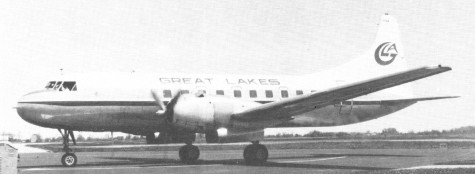
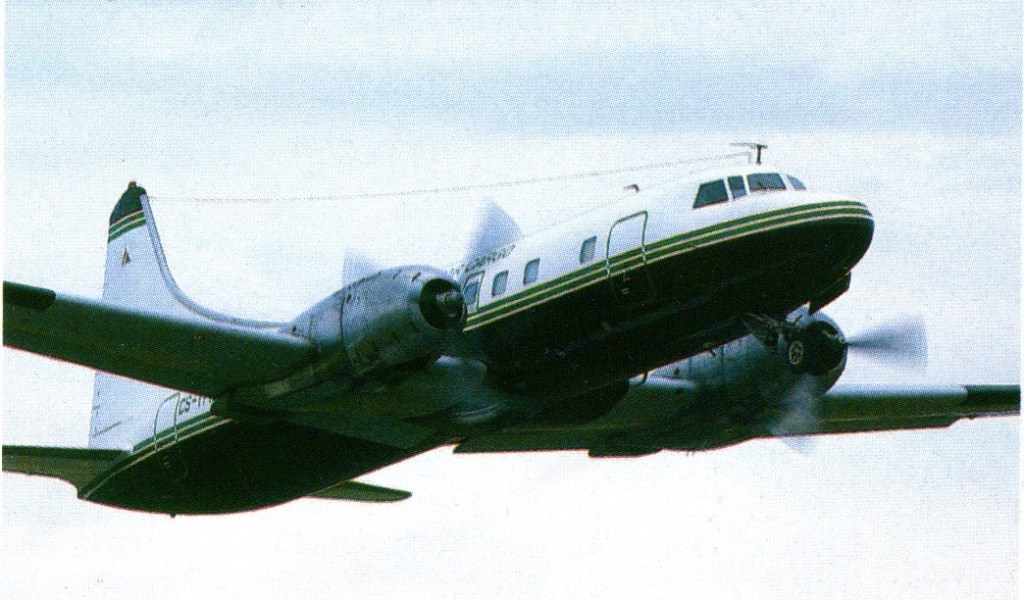
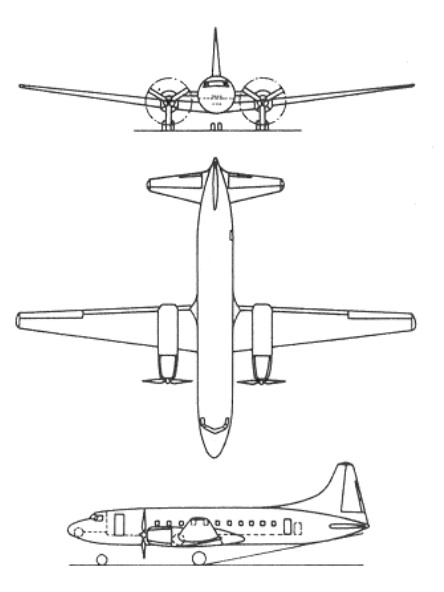
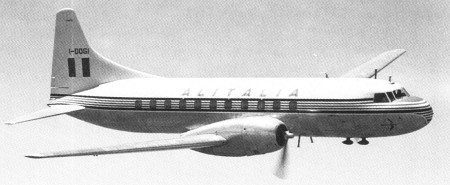
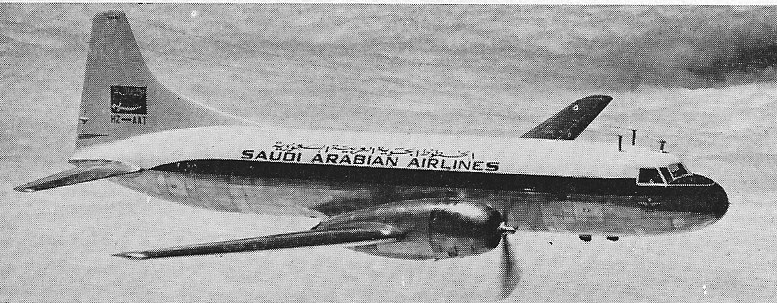
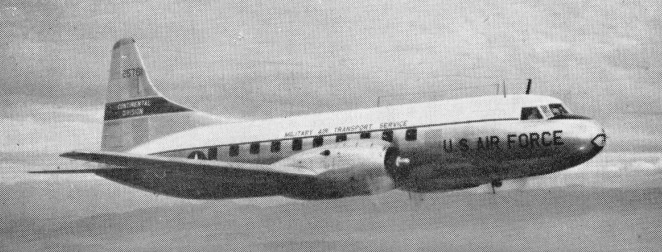
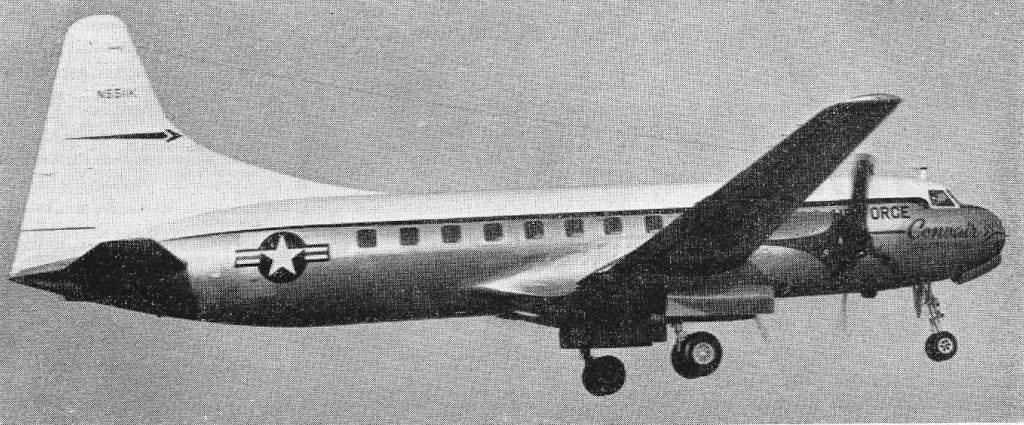
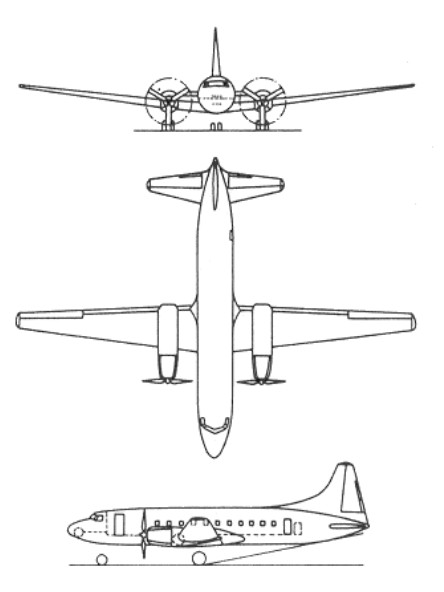
The 440 was a development of the 340 with modifications to increase speed by about 8km/h and to reduce the noise level in the cabin. Special kits were also made available to convert 340 to 440 standard with longer engine nacelles and a longer “radar nose”. Accommodation was provided for between 44 and 52 passengers. The prototype first flew on 6 October 1955 and 162 were built before production was phased out in the spring of 1958. A few were also operated by the USAF and US Navy.
Convair 440 Engines: 2 x Pratt-Whitney R-2800-CB16 Double Wasp, 1864kW Max take-off weight: 22226 kg / 49000 lb Empty weight: 15111 kg / 33314 lb Wingspan: 32.11 m / 105 ft 4 in Length: 24.13 m / 79 ft 2 in Height: 8.59 m / 28 ft 2 in Wing area: 85.47 sq.m / 919.99 sq ft Cruise speed: 465 km/h / 289 mph Ceiling: 7590 m / 24900 ft Range w/max.payload: 756 km / 470 miles Passengers: 52
Although based on the Convair 240, the 340 was largely a new aircraft with greater wing span (32.11m) and area; a 54-in longer fuselage for 44 passengers; R-2800-CB16 or CB17 engines; greater all-up weight of 21,318kg; and many interior design improvements.
The first aircraft (N3401) flew on 5 October 1951 and the first delivery to an airline was N73103, to United Air Lines on 28 March 1952.
A total of 209 had been built by January 1955, when the last two production aircraft were delivered to REAL (Brazil).
CV-340-B
The C-131B, based on larger Convair-Liner 340, was being produced in 1955 as flying laboratory for electronics equipment.
YC-131C was a ConvairLiner 340 fitted experimentally with two 3,750 h.p. Allison T56 turboprops.
Some standard ConvairLiner 340s were also ordered as C-131D.
The USAF operated the 340 as C-131 or VC-131 transports, flying and ECM trainers and for other duties; while the US Navy/Marine Corps received 37 transports as R4Y. The U.S. Navy equivalent of the C-131A is designated R4Y-1Z.
Many Convair 340s were converted to 440 and 580 standard.
A total of 209 CV-340s was built, followed by 186 CV-440s.
Convair C-131A Samaritan
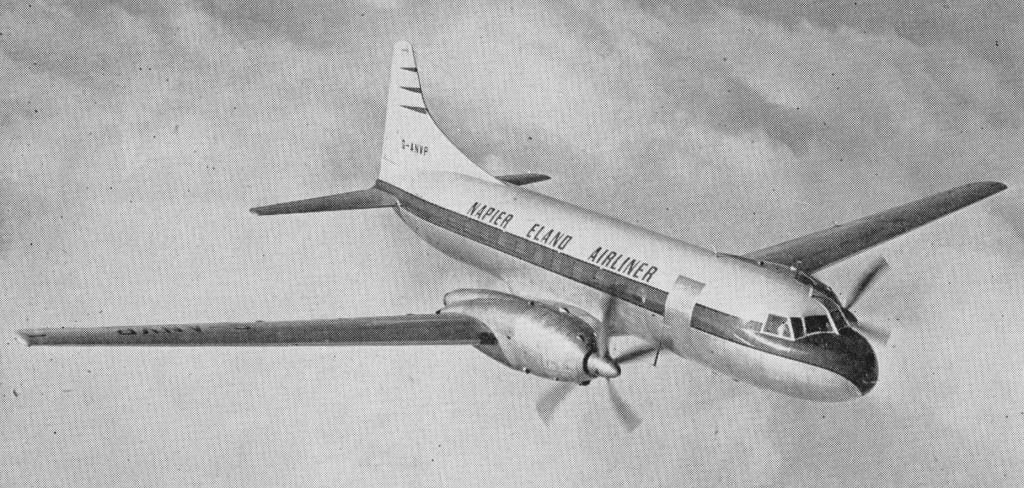
In November 1957 a Convair 340 with Napier Eland turboprop engines was flown to the USA to serve as a prototype. In 1958 the RCAF ordered a version of the Convair with Eland engines, to be built by Canadair as the CL-66.
Convair 340 Napier Eland conversion
In 1954 two Convair 340 were built as experimental YC-131C models to flight test Allison YT-56 turboprops. The first flew on 20 May 1954 with a gross weight of 53,200 lb compared to 47,000 lb for the standard 340.
YC-131C
The Convair 440 Metropolitan is a 52-seat development of the Model 340, having increased all up weight.
CV-340-B Engines: 2 x Pratt & Whitney R-2800-CB16, 2400 hp Wingspan: 105 ft 4 in Length: 79 ft 2 in Height: 28 ft 2 in Wing area: 920 sq.ft Empty weight: 32,399 lb Loaded weight: 47,000 lb Max speed: 314 mph at 16,000 ft Cruise speed: 292 mph Range: 1150 mi Seats: 44
Convair C 131 Samaritan Engine: 2 x Pratt & Whitney R-2800-103W, 2466 hp Length: 79.167 ft / 24.13 m Height: 28.15 ft / 8.58 m Wingspan: 105.348 ft / 32.11 m Wing area: 963.378 sq.ft / 89.5 sq.m Max take off weight: 47008.4 lb / 21319.0 kg Weight empty: 29004.6 lb / 13154.0 kg Max. speed: 265 kt / 491 km/h Cruising speed: 238 kt / 440 km/h Cruising altitude: 18635 ft / 5680 m Wing load: 48.79 lb/sq.ft / 238.0 kg/sq.m Maximum range: 1652 nm / 3060 km Range: 1652 nm / 3060 km Crew: 3 Payload: 48 Pax
Convair C-131A Samaritan Air evacuation and cargo transport. Engines: 2x 2,500 h.p. Pratt & Whitney R2800-99W Wingspan: 91 ft. 9 in Length: 74 ft. 8 in Empty weight: 29,000 lb Loaded weight: 43,575 lb. Max speed: 313 m.p.h. at 14,500 ft Cruise: 285 mph at 20,000 ft ROC: 1410 fpm Ceiling: 24,500 ft. Range: 875 miles Accommodation: 40 passengers or 27 stretchers. Armament: None
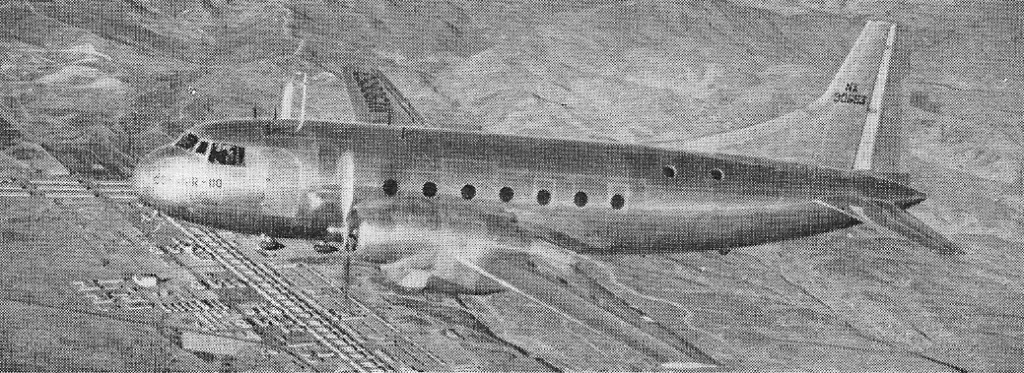
The ConvairLiner project started with the Model 110, of which the prototype NX90653 was flown for the first time on 8 July 1946. American Airlines convinced Convair to alter the CV-110 into the larger CV-240.
After the end of the War, in 1946 Ted Hall and Tommy Thompson from the Consolidated Vultee Aircraft designed and built the two-seat Convair Model 116.
Convair Model 116
Convair Model 116
This prototype completed 66 test flights, and Hall designed another model, named the 118 (or the Convair Car). Two prototypes were built.
Convair Model 118
Convair Model 118
Consolidated Vultee bought rights to the original roadable design by their own Chief Development Engineer, Ted Hall. His creation was unusual in that the car portion looked exactly like a scaled down conventional automobile of the period, though suspended beneath its self contained ‘flight module’. The automobile had a streamlined glassfibre body with four seats, and was powered by a 26 hp Crosley car engine.
Where the ConvAircar also differed from previous roadables was that the company planned to sell only the car part, for $1500. Aircraft modules with 190 hp Lycoming aero engines would be rented out by the hour or day when the owner wanted to go flying. Convair spent $800,000 on building two prototypes at their San Diego plant and gearing up for a planned production run of 160,000 ConvAircars. The 725 lb auto-plane prototype first flew during November 1947. All went well until the third test flight, late in November 1947. The ConvAircar took-off with minimal gasoline in its tanks. The ConvAircar ran out of fuel and was wrecked, and shortly afterwards Convair ran out of enthusiasm.
In 1941, Consolidated Aircraft and Vultee merged to form Convair, and Stinson Aircraft became a division of Convair. In July 1948 the Stinson factory was closed and five month later Convair sold Stinson Aircraft to Piper Aircraft. The company that Eddie Stinson had founded 22 years earlier had built over 12,000 aircraft. Convair Division of General Dynamics Corporation; title adopted from April 30,1954 by Consolidated Vultee following acquisition in 1953 of major shareholdings by General Dynamics. Major products have been the Convair F-102 Delta Dagger and F-106 Delta Dart interceptors, B-58 Hustler supersonic bomber and Convair 880, and 990 four-jet commercial transports. Developed subsequently F-111/FB-111 variable-geometry combat aircraft, now the responsibility of GD’s Fort Worth Division. Convair was grouped with GD’s Fort Worth and Pomona Divisions in September 1970 to form the single Convair Aerospace Division, but Fort Worth was again made a separate division in June 1974. Convair Division at San Diego became responsible for commercial aircraft and space exploration systems, product support for Convair 240/340/440 and derivatives and the Convair 880/990. It also built major components for McDonnell Douglas DC- 10, Space Shuttle Orbiter vehicle and Tomahawk cruise missile.
USA With Robert E. Fulton Jr. as president, company was formed 1945 at Danbury, Connecticut. Prototype Airphibian flew November 7, 1946, a two-seat “roadable”aircraft, with tricycle landing gear, detachable wings/tail/rear fuselage. Certificated December 1950 as Fulton Model FA-2 Airphibian; production model, designated FA-3, appeared 1954.
The Continental O-520 is a six-cylinder, horizontally-opposed aircraft engine, first run in 1963 as a development of the O-346. It has been produced in versions incorporating fuel injection (IO-520), turbo-charging (TSIO-520), and gearing (GTSIO-520).
The IO-520 series of engines normally produced 285-310 HP and were used in numerous aircraft such as certain models of the Bellanca Viking 300 and Super Viking, the Beech Bonanza and Baron, and the Cessna 185, 206, 210, 310 and 400 series of aircraft. It has largely been superseded by Continental’s newer IO-550 engine. The IO-520 series of engine is considered to be a reliable engine, but some of the early versions of this engine had a weaker crankcase than subsequent versions. Versions featuring more substantial crankcases are often referred to as having “heavy crankcases.”
The GTSIO-520 was not as common and in its most common application (the Cessna 404 and Cessna 421 twin-engine aircraft) it produces 375 horsepower (280 kW). Gearing reduces the RPM of the propeller making the engine quieter running than many other engines.
The Continental O-240 engine is a four-cylinder, horizontally opposed, air-cooled aircraft engine that was developed in the late 1960s for use in light aircraft. The 130 hp (97 kW) O-240 was a new engine design derived from the six-cylinder Continental O-360 and introduced in 1971. It is generally similar in overall dimensions to the Continental O-200, but with a higher 8.5:1 compression ratio, designed to run on 100/130 avgas. The O-240 delivers 30% more power than the O-200 while it weighs only 12% more. It may be mounted in tractor or pusher configuration. The first O-240 was certified on 7 July 1971.
The O-240 was produced under license in the United Kingdom by Rolls-Royce Limited and was used to power the Reims Aviation-built Cessna 150s constructed in France under license. Rolls-Royce acquired the rights to the O-240, but not the IO-240 in 1977.
The fuel-injected IO-240-A and -B were introduced in 1993. The A and B versions differ only in the type of fuel injector used.
The engine was not selected to power any production North American-manufactured aircraft until the Liberty XL-2 entered production in 2006 powered by the IOF-240-B. The IOF-240 is similar to the IO-240-B except that it employs an Aerosance FADEC system to control the ignition and fuel injection systems.
Variants:
O-240-A Dual ignition, 130 hp (97 kW) at 2800 rpm, dry weight 246 lb (112 kg) including starter and generator. Uses a Marvel-Schebler MA-3SPA IO 5067 carburetor. Certified 7 July 1971
IO-240-A Dual ignition, 125 hp (93 kW) at 2800 rpm, dry weight 246 lb (112 kg), uses a TCM 639231A27 fuel injector
IO-240-B Dual ignition, 125 hp (93 kW) at 2800 rpm, dry weight 246 lb (112 kg), uses a TCM 639231A34 fuel injector
IOF-240-B Aerosance FADEC system controls the ignition and fuel injection systems, 125 hp (93 kW) at 2800 rpm, dry weight 255 lb (116 kg)
IOF-240-B Type: “4-cylinder, air-cooled, naturally aspirated, horizontally opposed, fuel-injected, spark ignition, four-stroke, direct drive. The engine incorporates a full authority digital electronic control (FADEC) system to control the ignition and fuel injection functions.” Bore: 4.438 in (112.7 mm) Stroke: 3.875 in (98.4 mm) Displacement: 240 in³ (3.93 L) Height: 24.0″ / 60.96 cm Width: 31.4″ / 79.76 cm Length: 29.1″ / 73.91 cm Dry weight: 255 lb (116 kg) Installed Runnable Dry Weight: 328 lbs / 148.8 Kg Oil Sump Capacity: 6 US Quarts / 5.67 L Valvetrain: One intake and one exhaust valve per cylinder Fuel system: Aerosance FADEC system Fuel type: 100LL avgas Cooling system: Air-cooled Power output: 125 hp (93 kW) at 2,800 rpm Specific power: 0.52 hp/in³ (23.66 kW/L) Compression ratio: 8.5:1 Power-to-weight ratio: 0.49 hp/lb (0.80 kW/kg)