A 1978 hang glider.
Wing area: 15.3 m²
Wing span: 11 m
Aspect ratio: 7.9
Hang glider weight: 25 kg
Minimum pilot weight: 60 kg
Maximum pilot weight: 100 kg
Packed length short: 5.58 m
Number of battens: 12
Nose angle: 127°
A 1978 hang glider.
Wing area: 15.3 m²
Wing span: 11 m
Aspect ratio: 7.9
Hang glider weight: 25 kg
Minimum pilot weight: 60 kg
Maximum pilot weight: 100 kg
Packed length short: 5.58 m
Number of battens: 12
Nose angle: 127°


The SK 2 SS was a 1978 version.

SK 1
Wing area: 15 m²
Wing span: 9 m
Aspect ratio: 4.5
Hang glider weight: 19 kg
Packed length: 4.9 m
Number of battens: 10
Nose angle: 120°
SK 2
Wing area: 17 m²
Wing span: 9.1 m
Aspect ratio: 4.5
Hang glider weight: 22 kg
Minimum pilot weight: 60 kg
Maximum pilot weight: 85 kg
Packed length: 5.15 m
Number of battens: 10
Nose angle: 120°
SK 3
Wing area: 20.3 m²
Wing span: 10.5 m
Aspect ratio: 4.5
Hang glider weight: 25 kg
Packed length: 6.05 m
Number of battens: 10
Nose angle: 120°

The Danis Sabre was released in 1979.
Patrick Bayle was the pilot of test and piloted it at the world championship in Saint Hillaire du Touvet in September 1979 (member of the team of France world champion).

A 1974 hang glider.
Trainer
Wing area: 19.8 m²
Biplace
Wing area: 26 m²

A 1975 hang glider for Advanced pilots.
Models included the 130A.

A 1975 hang glider for Intermediate pilots.
Slight, very handy, and faster than the famous cylindro-conical gulls, but a drop rate a little higher (1.5 m / s). Very pleasant to fly, with a glide a little more than 5. On the safety side, this wing had no anti-dive devices, and could pass in irreversible dive (aerial-elastic flag).
Wing area: 19.20 m²
Hang glider weight: 18 kg
Packed length short: 6.20 m
Nose angle: 92°

A 1979 hang glider.

A 1978 hang glider.
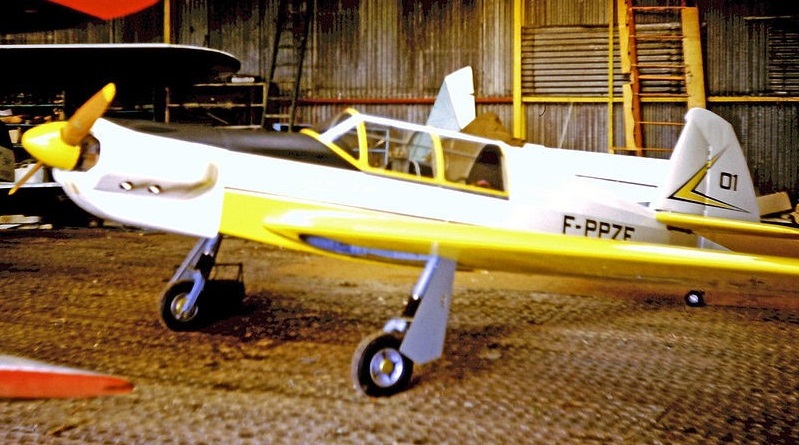
The DM-165 was a French tandem two-seat low-wing monoplane designed by Michel Dalotel. Powered by a 165 hp (121 kW) Continental IO-346A flat-four piston engine. It had a tailwheel and retractable landing gear which folded inwards. Dalotel was assisted by Société Poulet in the construction of the prototype, registered F-PPZE, which was first flown in April 1969. The aircraft was successfully tested during 1970 but despite efforts to market the aircraft none were ordered. Only the prototype was built.
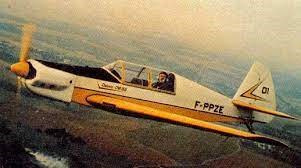
The aircraft was based at Meaux-Esbly airfield, to the west of Paris, for several years and was then sold to a pilot owner in the United Kingdom and registered G-BILA.
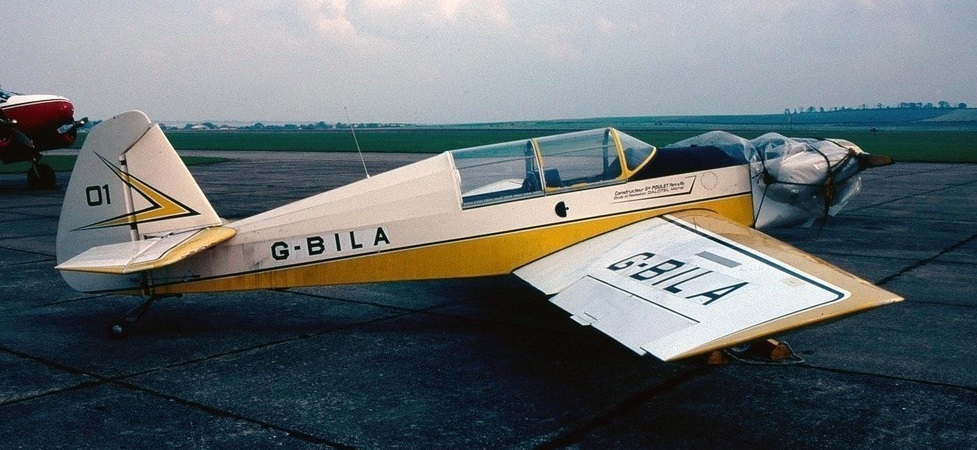
The aircraft had a forced landing in a cornfield due to fuel management issues in about 1983. The aircraft was damaged in the accident and flipped over onto its back, significantly damaging the RH wing, and doing minor damage to the LH wing, fuselage, cowl, and tail section.
The aircraft was put into storage for years and was subsequently sold to a gentleman in the US (Idaho) who imported the remains for rebuild and restoration. After some work was done on it, it was sold to a gentleman in Calgary, Alberta, Canada, where it is currently being restored.
Dalotel DM-165
Powerplant: 1 × Continental IO-346A, 121 kW (165 hp)
Wingspan: 8.40 m (27 ft 6.75 in)
Height: 1.76 m (5 ft 9.25 in)
Wing area: 12.30 m2 (132.40 sq ft)
Length: 6.96 m (22 ft 10 in)
Maximum speed: 300 km/h (186 mph, 162 kn)
Crew: two
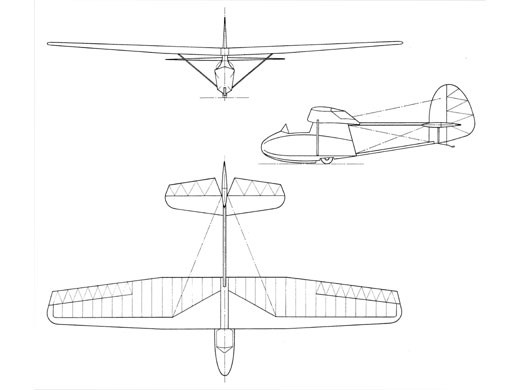
In the early years of World War II there was little gliding activity in Canada. Feeling that a Gliding Club would be well received by the military, and with the approval of their employers, some staff at the de Havilland Aircraft Company of Canada decided to form their own. The initiative was taken by Wacław Czerwinski who went on to lead the design of the group’s own glider, a very close copy of the W.W.S.1 Salamandra which Czerwiński had designed before the war in Poland. Members of the drawing office worked in their own time to produce the engineering blueprints, de Havilland and other companies took an interest, assisting the project with donations of instruments and a landing wheel.
The design aim was to produce an aircraft which could be used both as basic trainer (primary glider) and as a sailplane capable of exploiting the strong thermals of the Toronto region. The docile handling of a typical primary glider, particularly in the stall, had to be maintained alongside a better lift to drag performance than most of that class.
It was a high wing aircraft, with a single spar wing with rounded tips, straight taper on the outer ⅔ of the span and a constant chord centre section. The wings were ply covered from the leading edge to the main spar and fabric covered aft. The wings carried some dihedral and there was washout, a decrease in angle of incidence outwards along the span, on the outer panels to avoid spin initiation at the stall. Generous differential ailerons, also fabric covered, ran from the wingtips over most of the outer, tapered panels. The wing was mounted on a fuselage pedestal above and immediately behind the cockpit in the flat sided forward fuselage. Though open, this cockpit enclosed the pilot as in a light aircraft, rather than leaving him fully exposed as on many earlier primary gliders. A pair of lift struts joined the main spar to the lower fuselage longerons.
Behind the wing trailing edge the enclosed fuselage was replaced by a pair of nearly horizontal beams, one vertically above the other, which carried the tail unit. The ply-covered tailplane and fabric covered elevators were mounted on the upper fuselage beam. Fin and rudder, ply and fabric covered respectively, continued down below the horizontal surfaces to the lower beam, the rudder moving in an elevator cut-out. Like the wing, the tailplane was strut braced from below. The rear surfaces were braced against lateral deflections by pairs of wires from the upper wing surfaces to the top of the fin and by similar wires from below to its bottom.
The undercarriage consisted of a keel skid which ended about midway below the wing, where a single wheel was partially exposed. There was a tailskid and wire loops at the wing tips to protect them and ease ground handling.
The Czerwiński Sparrow, sometimes known as the de Havilland Canada glider, flew for the first time in late August or early September 1942, aero-towed by a Tiger Moth. Released at 1,380 ft (420 m), it reached an altitude of 5,800 ft (1,770 m) during a 2 hr test flight.
The Sparrow was operated by the de Havilland Glider Club at Downsview, Ontario, initially without a registration, being registered as CF-ZAI on 10 June 1947. In 1948 it was donated to the Toronto Gliding Club, and was wrecked in an accident at Oshawa Airport on 4 June 1950.
The Czerwiński Robin was an improved version of the Sparrow.
Czerwiński Robin
Wingspan: 11.35 m (37 ft 3 in)
Wing area: 15.68 m2 (168.8 sq ft)
Aspect ratio: 8.2
Airfoil: Sikorski G.S.1
Length: 5.8 m (19 ft 0 in)
Empty weight: 120 kg (265 lb)
Gross weight: 214 kg (472 lb)
Stall speed: 41 km/h (25 mph, 22 kn)
Never exceed speed: 161 km/h (100 mph, 87 kn)
Rough air speed max: 161 km/h (100.0 mph; 86.9 kn)
Aerotow speed: 161 km/h (100.0 mph; 86.9 kn)
Winch launch speed: 93.8 km/h (58.3 mph; 50.6 kn)
Maximum glide ratio: 16.4 at 55 km/h (34.2 mph; 29.7 kn)
Rate of sink: 0.823 m/s (162.0 ft/min) at 51.4 km/h (31.9 mph; 27.8 kn)
Wing loading: 13.65 kg/m2 (2.80 lb/sq ft)
Crew: 1