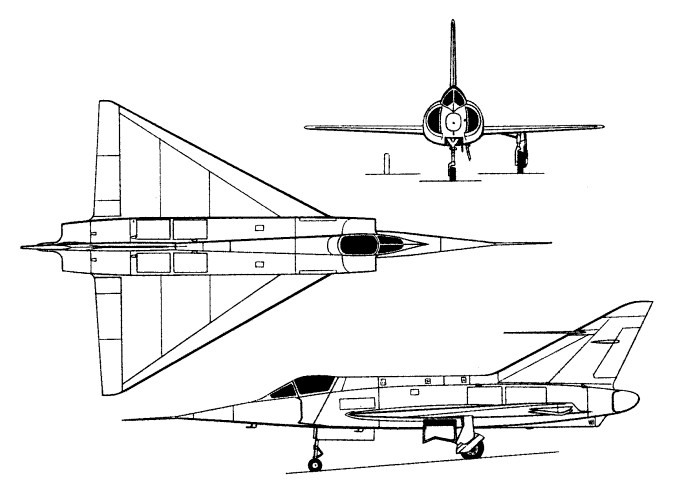
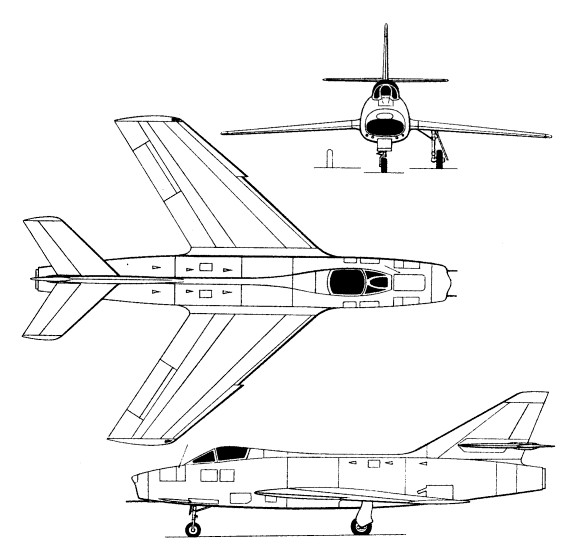
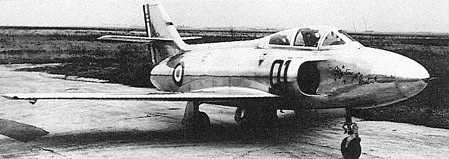
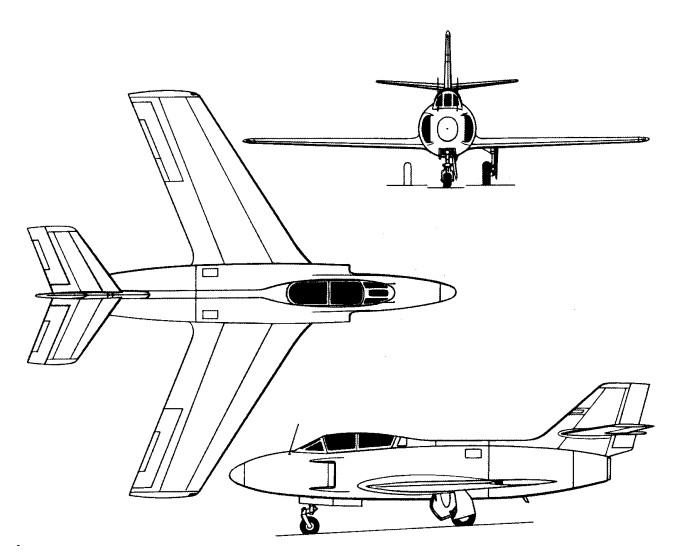
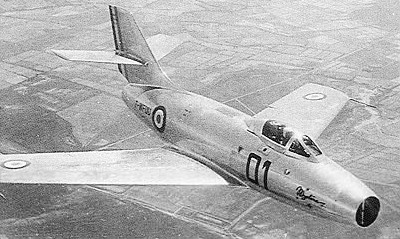
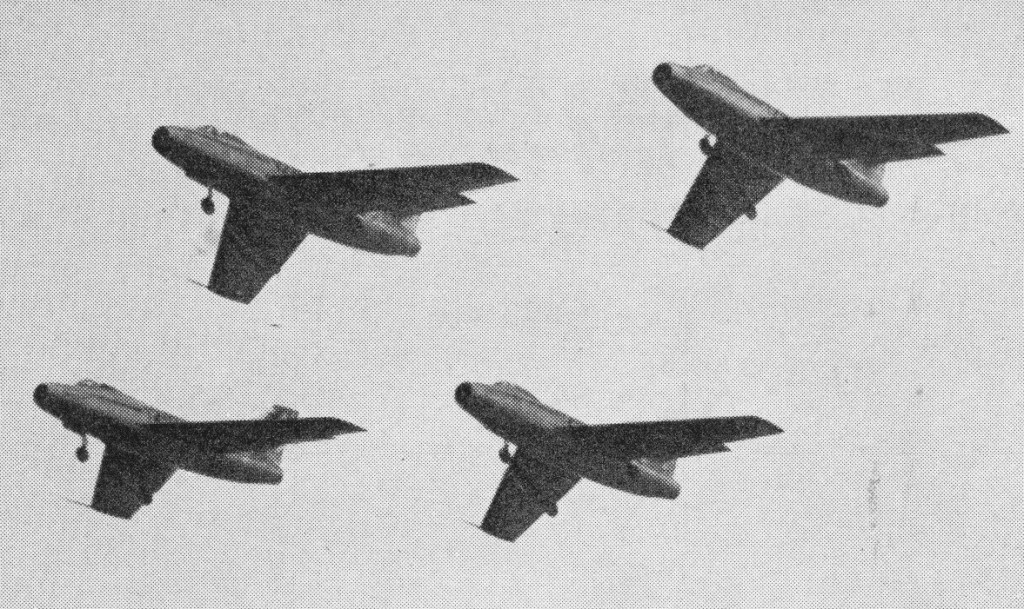
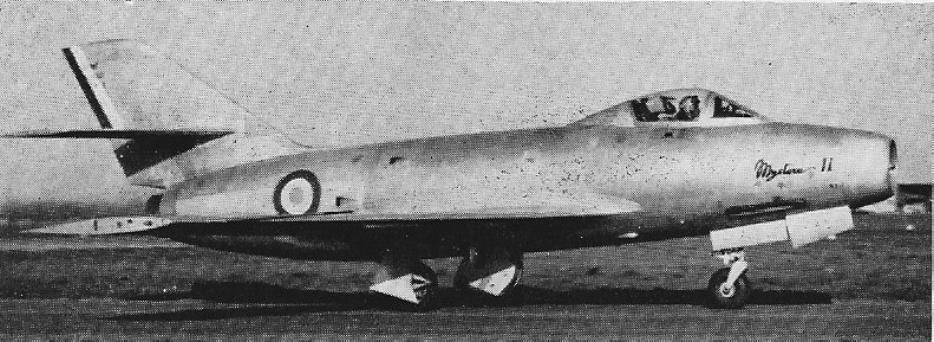
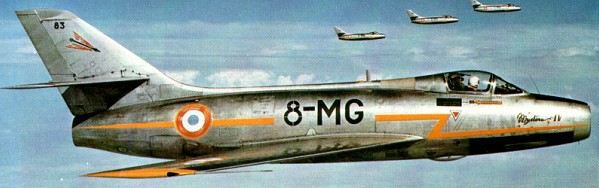
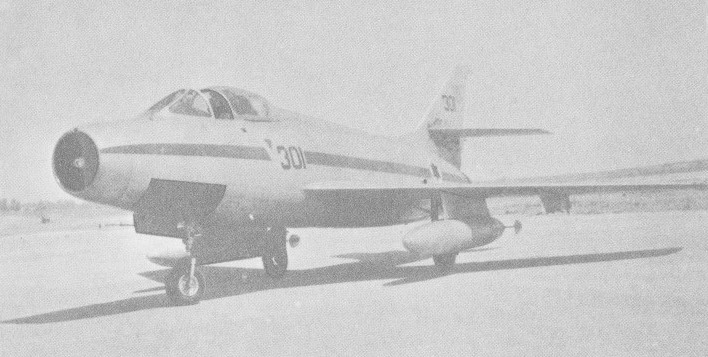
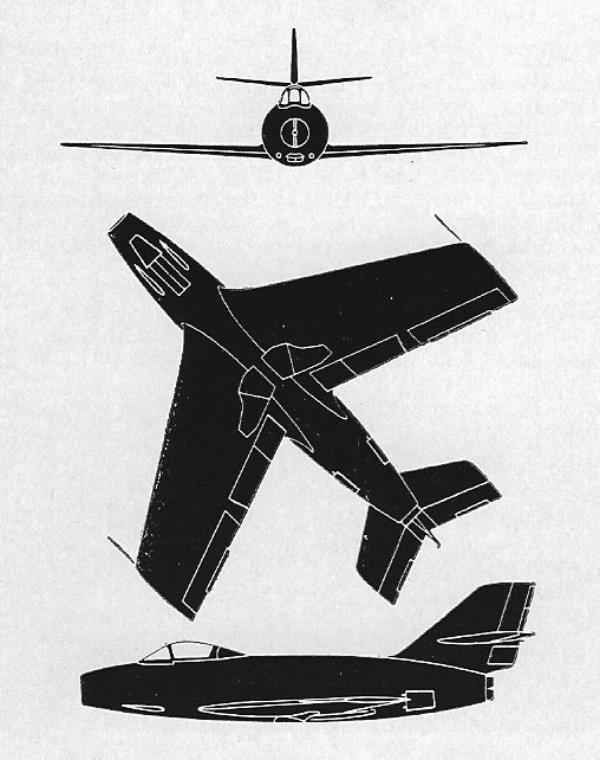
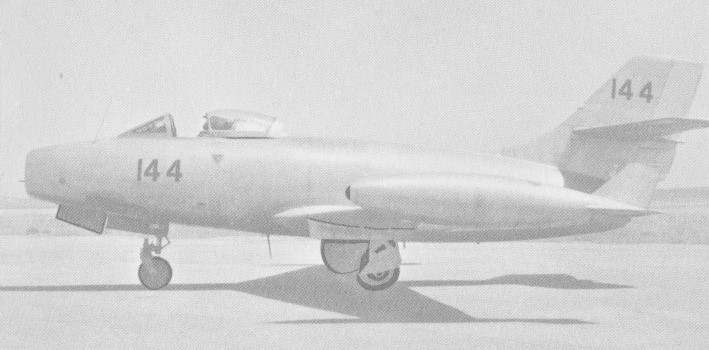
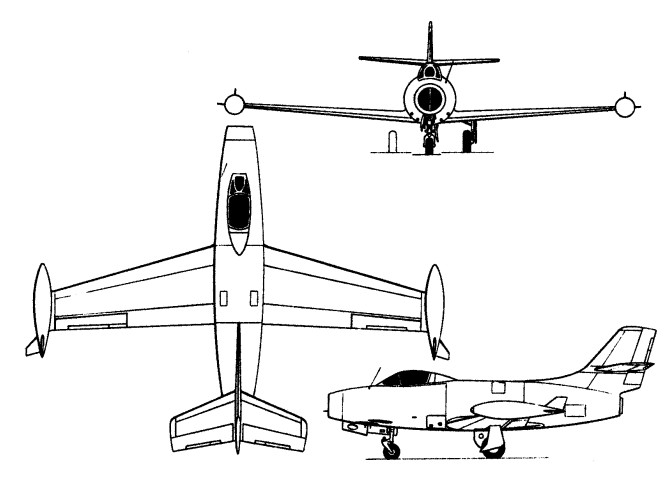
The MD 550 was designed to meet the requirements of a 1954 specification calling for a small all-weather interceptor fighter capable of attaining an altitude of 18,000m within six minutes and sustaining a speed in excess of M=1.0 in level flight. Initially known as the Mystere-Delta, it was competing with the SE.212 Durandal and the SO.9000 Trident. To attend the Armée de L’Air requirements, the Marcel Dassault company presented the project MD.550, a delta wing configuration, with a 5% chord (ratio of airfoil thickness to length) and 60 degree sweep. A tailless delta layout, the MD 550 was powered by two MD 30R (Armstrong Siddeley) Viper turbojets each rated at 980kg with afterburning, and first flew on 25 June 1955.
With the original delta vertical tail replaced by swept back surfaces and a 1500kg thrust SEPR 66 bi-fuel auxiliary rocket motor installed, the MD 550 was renamed Mirage I, and, on 17 December 1956, attained M=1.3 in level flight without rocket power and M=1.6 with the rocket lit.
Intended armament was a single Matra or Nord AAM carried externally. However, it was concluded that the Mirage I was too small to carry an effective military load, and a slightly enlarged version, the Mirage II with a pair of Turbomeca Gabizo turbojets, was proposed. This proposal was eventually discarded in favour of the Mirage III.
Engine: 2 x M.D. 30R (Armstrong Siddeley) Viper turbojets, 980kg and 1 x 1500kg thrust SEPR 66 rocket motor Max take-off weight: 5070 kg / 11177 lb Empty weight: 3330 kg / 7341 lb Wingspan: 7.30 m / 23 ft 11 in Length: 11.10 m / 36 ft 5 in Wing area: 27.10 sq.m / 291.70 sq ft Max. speed: 1700 km/h / 1056 mph
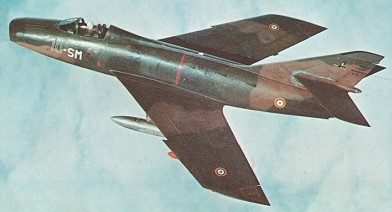
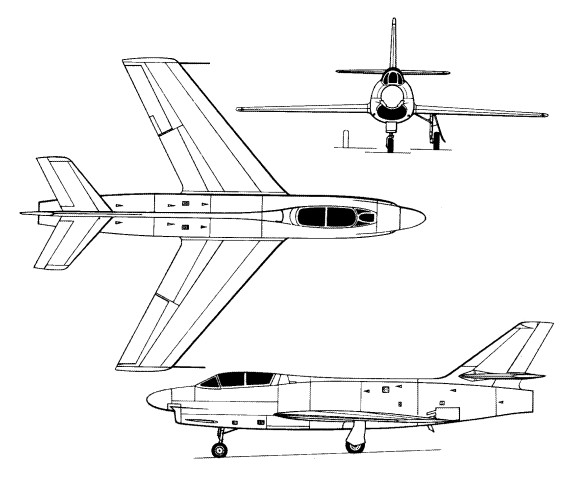
The Super-Mystere shared only a common design origin with the Mystere fighter series, being an entirely new type. The first prototype, designated Super-Mystere B1 and powered by a Rolls-Royce Avon RA 7R with an afterburning thrust of 4330kg, was flown on 2 March 1955. In March 1955, the B1 became the first production standard European fighter to achieve more than Mach 1 in level flight.
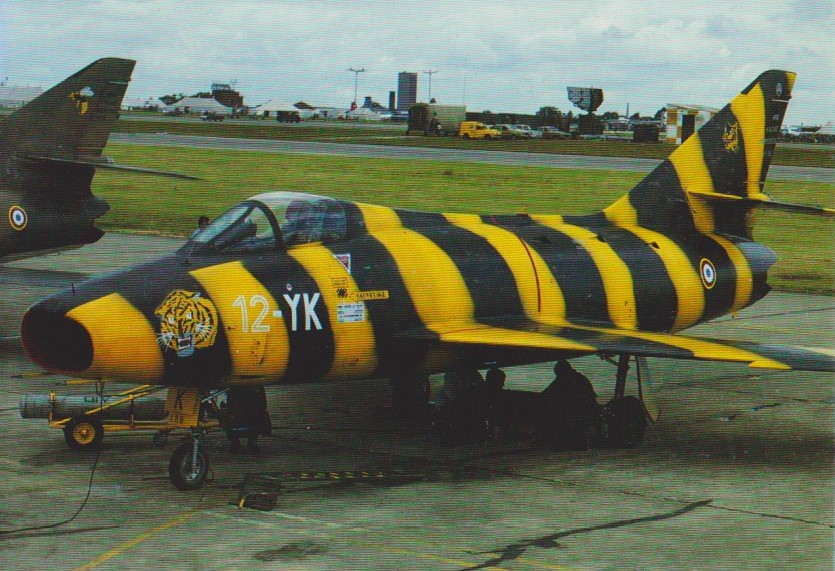
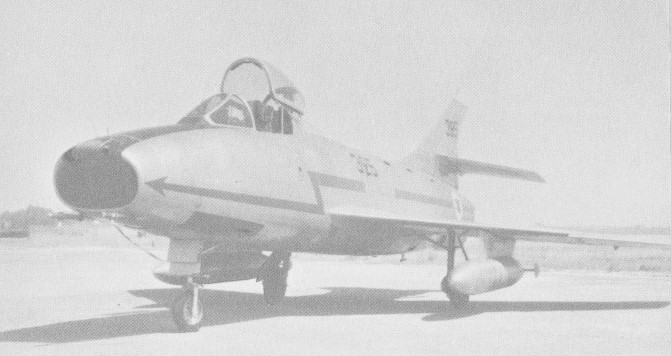
The Super-Mystere has low-mid wings, swept-back at 45°, with dog-tooth leading edges. The tail-surfaces are swept with the tailplane mounted part way up the fin. Control is by conventional ailerons, rudder, and all-moving tailplane. Split trailing-edge flaps are fitted. Air brakes are on each side of the rear fuselage. The tricycle undercarriage has a single wheel on each unit. The main wheels retract inward into the fuselage and the nose wheel retracts rearward.
The first of five SNECMA Atar-powered pre-production Super-Mystere B2s followed, flying on 15 May 1956. Production was ordered for the Armee de l’Air, the first series Super-Mystere B2 flying on 26 February 1957, and a total of 180 were built of which 36 were bought by Israel in 1958.
The Super-Mystere B2 was powered by an Atar 101G-2 or -3 of 3375kg dry thrust and 4460kg with maximum afterburning. Armament consisted of two 30mm cannon and 35 internally-housed 68mm rockets (the rockets being discarded at an early service stage), external loads including two Sidewinder AAMs, two 400-500kg bombs or rocket pods.
Mystere B.2 EC 1/12 at Greenham Comon Tigermeet 1977
The Armee de l’Air Super Mystere were phased out in 1959 in favour of the Mirage IIIC.
Two examples were completed as Super Mystere B4s in 1958, these having Atar 9B engines rated at 6000kg with afterburning. During Israeli service, the Super-Mystere B2s were re-engined with a non-afterburning Pratt & Whitney J52-P-8A turbojet of 4218kg. In 1977, 18 of these aircraft were sold by Israel to Honduras where the last surviving examples were withdrawn from service in 1989.
Super-Mystere B1 Engine: Rolls-Royce Avon RA 7R, afterburning thrust 4330kg
Super-Mystere B2 Engine: SNECMA Atar 101G-2 or -3 of 3375kg dry, 4460kg / 9700 lb afterburning Wingspan: 10.52 m / 34 ft 6 in Length: 14.13 m / 46 ft 4 in Height: 4.55 m / 15 ft 11 in Wing area: 35 sq.m / 376.74 sq ft Max take-off weight: 10000 kg / 22046 lb Loaded weight: 6932 kg / 15283 lb Empty weight: 15,400 lb Max speed: 605 kt / 1195 km/h / 743 mph / M1.125 at 36,000 ft Max ROC: 17,500 fpm Service ceiling: 44948 ft / 13700 m Range: 870 km / 541 miles Range w/max.fuel: 1790 km / 1112 miles Armament: two 30mm DEFA cannon, 35 x 68mm rockets External load: two Sidewinder AAMs, two 400-500kg bombs or rocket pods. Crew: 1
Super-Mystere B2 Engine: Pratt & Whitney J52-P-8A turbojet, 4218kg thrust Wingspan: 10.52 m / 34 ft 6 in Length: 14.13 m / 46 ft 4 in Height: 4.55 m / 14 ft 11 in Wing area: 35 sq.m / 376.74 sq ft Armament: two 30mm cannon, 35 x 68mm rockets Crew: 1
Super Mystere B4 Engine: Atar 9B, 6000kg afterburning Wingspan: 10.52 m / 34 ft 6 in Length: 14.13 m / 46 ft 4 in Height: 4.55 m / 14 ft 11 in Wing area: 35 sq.m / 376.74 sq ft Armament: two 30mm cannon, 35 x 68mm rockets Crew: 1
The development of a night fighter based on the MD.450 Ouragan day fighter was begun early in the evolution of the latter as the tandem two-seat MD.451 Aladin. It was proposed to install AI Mk 17 or APG 33 intercept radar in the extreme nose, leading to the adoption of lateral intakes. The 11th pre-series Ouragan was completed with the lateral air intakes plus twin 30mm cannon in place of the standard quartet of 20mm weapons, and flown on 24 January 1952 as the MD.450-30-L (signifying 30mm cannon and lateral intakes). Development of the MD.451 was discontinued in favour of an essentially similar two-seat night fighter derivative of the Mystere II designated MD.453 Mystere IIIN, or Mystere denuit. With lateral air intakes and a 2850kg Hispano-Suiza Tay 250 engine, the first of three prototypes ordered was flown on 18 July 1952. No radar was installed and the second and third prototypes were cancelled. The sole Mystere IIIN prototype flown had completed 146 flight tests by December 1953, when the programme terminated, the aircraft subsequently being used to test ejection seats.
Take-off weight: 7335 kg / 16171 lb Loaded weight: 5915 kg / 13040 lb Wingspan: 11.62 m / 38 ft 1 in Length: 12.86 m / 42 ft 2 in Height: 4.47 m / 14 ft 8 in Wing area: 31.90 sq.m / 343.37 sq ft Max. speed: 1080 km/h / 671 mph
From the Ouragan evolved the swept-wing Mystere I that first flew in February 1951 with a Nene 104B turbojet. A progressive development of the basic MD.450 Ouragan, the first prototype, the Mystere I, first flew on 23 February 1951. It retained the fuselage, Nene engine and armament of the MD.450, with a new, sweptback (30 deg) wing and redesigned tail surfaces. Wing thickness chord ratio 9%.
Three more prototypes followed, differing primarily in power plant, two having the 2850kg Hispano-Suiza Tay 250 and the third having a 2500kg Atar 101C. Eleven (later reduced to 10) pre-series Mystere IIs had been ordered in September 1951, and, of these, the first three and fifth were completed to the Tay-engined IIB standard, the third with twin 30mm cannon. The sixth and subsequent received a similar armament, SNECMA Atar 101C-1, -3, and later D-1 or -2 engine with revised intake trunking and rearranged fuel tanks as Mystere IICs.
The first six of the initial order for 40 was added to the pre-series, the final two of these receiving the afterburning Atar 101F-2 of 3800kg.
Production of an additional 90 Mystere IIC fighters was ordered for the Armee de l’Air, the last flying in January 1957. The series model featured increased tail sweepback, twin 30mm cannon and 2800kg Atar 101D-2 or D-3 turbojet.
Mystere IIC
Flown in prototype form for the first time on 28 September 1952, the Mystère IVA was in fact largely funded by the United States, being subject to two large offshore procurement orders covering the manufacture of 325 aircraft in all.
The prototype was powered by a Tay 250A turbojet as used in the Mystere IIA and IIB. The low-mid wings were swept at 40 degrees 57 minutes, and an all-moving tailplane. Wing thickness chord ratio 7.5%. The tricycle undercarriage has single wheels on each unit, the main wheels retracting inwards and the nosewheel retracting forward. Airbrakes are on each side of the rear fuselage.
In the following April, an offshore procurement contract (as part of US support for NATO nations) was placed for 225 Mystere IVAs. This was subsequently supplemented with a contract from the French government for a further 100 aircraft.
Dassault Mystère IVa
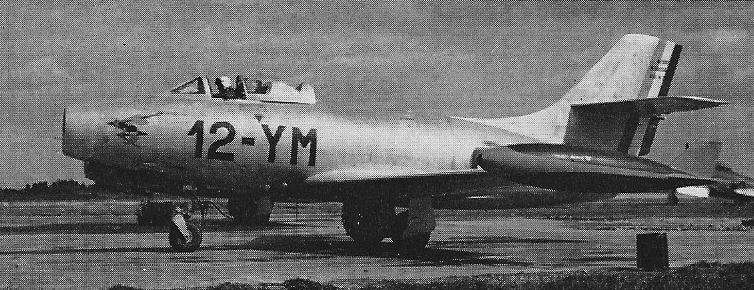
Initial production versions were powered by the Hispano-¬Suiza Tay 250A turbojet engine rated at 2850-kg (6,283-lb) thrust, but this was fairly soon supplanted by the rather more powerful Verdon 350. Differences between the Mystère IIC and Mystère IVA models centred around the wing and fuselage structure, the wing featuring increased sweep and reduced thickness/chord ratio while the fuselage was much more robust. Integral armament consisted of a pair of 30-mm DEFA cannon in the forward fuselage below the cockpit but external ordnance such as 227-kg (500-lb) or 454-kg (1,000-lb) bombs and rocket pods could be car¬ried when the type was operating in the tactical role.
The first series Mystere IVA was flown on 29 May 1954, the initial batch of 50 retaining the Tay 250A engine of the prototype, all subsequent aircraft having the 3500kg Hispano-Suiza Verdon 350 (licence-built Tay). Basic armament comprised two 30-mm cannon.
Mystere IVA
Introduction to the operational in¬ventory came during 1955 when the Mystère IVA began to enter service with the 12e Escadre at Cambrai. However, the advent of the Mirage in the early 1960s resulted in the Mystère IVA being progressively relegated to second-line training duties during that decade.
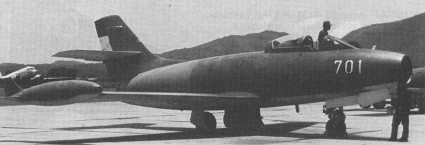
Of the 275 Verdon-powered Mystere IVAs produced, 60 were supplied to Israel, with deliveries commencing April 1956, and a further contract for 110 was placed by India with deliveries commencing in 1957. The Mystère IVA saw combat action with both of these nations.
A process of aerodynamic refinement of the Mystere IVA led to the Mystere IVB, which, in fact, shared only wings, horizontal tail surfaces and main undercarriage members with the earlier model. The Mystere IVB was intended for an afterburning SNECMA Atar 101G axial-flow engine in place of the non-afterburning centrifugal- flow Tay or Verdon. It featured an entirely redesigned fuselage of increased fineness ratio, an upper engine air intake lip for the radar ranging aerial in place of the splitter-plate conical body and a lower-mounted horizontal tail. The first prototype was flown on 16 December 1953 with a Rolls-Royce Avon RA 7R engine developing a maximum afterburning thrust of 4330kg. Two additional prototypes followed, the first of these, powered by the Avon RA 7R, flying on 18 June 1954, and the second, with an Atar 101F-12, flying on 31 March 1955. Of seven pre-series Mystere IVBs completed, the first two each had a SEPR 66 bi-fuel rocket motor to augment the thrust of the Atar 101F engine, and the final two had the Atar 101G-2 engine developing an afterburning thrust of 4500kg. The series Mystere IVB was to have been powered by an Atar 101G-31 rated at 4700kg with maximum afterburning, but the programme was cancelled owing to the superior performance potential of the Super-Mystere B2.
Developed in parallel with the Mystere IVB as a tandem two-seat night and all-weather interceptor, the Mystere IVN differed from the single-seat fighter in several respects. A 1.4m section was added to the forward fuselage to accommodate a second crew member; internal fuel capacity was substantially increased and provision was made for an APG 33 intercept radar with the scanner above the engine air intake. Powered by a Rolls-Royce Avon RA 7R rated at 4330kg with maximum afterburning, the Mystere IVN had provision for an armament of two 30mm cannon and a retractable rocket pack for 52 unguided air-air rockets of 68mm calibre. The sole prototype was flown on 19 July 1954, by which time it had been decided to discontinue the development programme owing to France’s inability to finance the simultaneous development of two night fighters (the other being the Vautour), the insufficient endurance of the Mystere IVN, and the unsuitability of the proposed APG 33 radar.
Having almost completed all Ouragan contracts for the Armde de PAir, for the Indian Air Force (where 71 are in service under the name Toofani), and against off -shore orders, Dassault were beginning to turn out Tay- and Atar-powered Mystere 2s in 1955. These were be followed by the RA.7R-powered Mystere 4B and the 4N. The first prototype 4N was being assembled; it looks much like a Sabre F-86D with two tandem seats and has a single-piece “all-flying” tailplane and full radar interception fire-control.
Total production numbered 421 by the time the assembly line closed in late 1958 and, since they were funded by American money, most of the survivors have been re¬turned to USAF control for disposal.
MD 452 Mystère II Max take-off weight: 7460 kg / 16447 lb Loaded weight: 5730 kg / 12633 lb Wingspan: 11.33 m / 37 ft 2 in Length: 12.24 m / 40 ft 2 in Height: 4.5 m / 14 ft 9 in Wing area: 30.28 sq.m / 325.93 sq ft Max. speed: 1030 km/h / 640 mph
Mystere IIC Engine: SNECMA Atar 101D-1, 6600 lb Wingspan: 38 ft 1.5 in Wing area: 326.15 sq.ft Length: 38 ft 4 in Empty weight: 11,511 lb Loaded weight: 16,442 lb Max speed: 658 mph at SL / 581 mph at 39,270 ft ROC: 8460 fpm Endurance: 1 hr 30 min Armament: 2 x 30 mm DEFA cannon
Mystere IVA Engine: 1 x Hispano-Suiza Verdon 350 turbojet, 3500kg / 7,716-lb Wingspan: 11.12 m / 36 ft 6 in Length: 12.85 m / 42 ft 2 in Height: 4.6 m / 15 ft 1 in Wing area: 32.0 sq.m / 344.44 sq ft Wheel track: 10 ft 8 in Max take-off weight: 9500 kg / 20944 lb Loaded weight: 5870 kg / 12941 lb Empty weight: 5870 kg / 12,941 lb Fuel capacity: 572 fal Drop tank fuel capacity: 275 Gal Max. speed: 1120 km/h / 696 mph at sea level Service ceiling: 15000 m / 49200 ft Initial climb rate: 2700 m / 8,860 ft/min Range, clean: 915 km / 569 miles Ferry range: 1690 km / 1,050 miles Normal endurance: 70 min Crew: 1 Armament: two 30-mm DEFA cannon Bombload: two 454-kg (l,000-lb) or four 227-kg (500-lb) bombs, or two pods each containing 3637-mm (1.46-in) rockets.
Mystere IVB Take-off weight: 8300 kg / 18298 lb Empty weight: 6170 kg / 13603 lb Wingspan: 11.12 m / 36 ft 6 in Length: 13.75 m / 45 ft 1 in Height: 4.55 m / 14 ft 11 in Wing area: 32.0 sq.m / 344.44 sq ft Max. speed: 1180 km/h / 733 mph
MD 452 Mystère IVN Take-off weight: 10320 kg / 22752 lb Empty weight: 7140 kg / 15741 lb Wingspan: 11.12 m / 36 ft 6 in Length: 14.92 m / 48 ft 11 in Height: 4.60 m / 15 ft 1 in Wing area: 32.0 sq.m / 344.44 sq ft Max. speed: 1030 km/h / 640 mph
The MD.450 Ouragan (Hurricane) was designed by engineers Deplant, Cabriere and Rouault as the first fighter developed by Avions Marcel Dassault and the first jet fighter of French design to attain series production. The Ouragan began full-scale development after the end of World War II, a prototype flying for the first time on 28 February 1949 powered by a 2267kg Rolls-Royce Nene Mk 102. The second and third following on 20 July and 2 June. Twelve (later increased to 14) pre-series aircraft were followed by 350 production Ouragans.
The Ouragan has a low wing, swept back at 14 degrees, and slightly swept tail surfaces, with the tailplane mounted part-way up the fin. Conventional ailerons, elevators, rudder, and split flaps are fitted. Airbrakes are on each side of the rear fuselage. A tricycle undercarriage has a single wheel on each unit. The mains retracting inwards into the fuselage, and nose wheel retracts forward.
Of the production Ouragans, the first 50 were completed to an interim standard as MD.450As, subsequent aircraft embodying modifications and equipment changes as MD.450Bs. Changes included replacement of the Nene 102 by the lighter Nene 104B of 2300kg. Armament was four 20mm cannon which could be augmented by 16 Matra T-10 rockets externally.
The 352 produced for the Armêe de l’Air, mainly serving as a fighter-bomber, were superceeded by the Dassault Mystêre IVA in the later 1950s.
An Indian Air Force order for 71 MD.450Bs was placed on 25 July 1953, these having the Nene 105A of 2350kg and British Mk V versions of the French 20mm Hispano-Suiza cannon. Named Toofani in Indian service (the Hindi equivalent of Ouragan), the Dassault fighter remained in first-line use until 1967, a further 33 having been procured from the Armee de l’Air (including 20 unused machines from storage) in March 1957.
Twenty-four MD.450BS were ordered by Israel in January 1955, these being supplied from Armee de l’Air stocks in the following October-November and a further 46 (including one MD.450A) being delivered subsequently. Eighteen ex-Israeli Ouragans were delivered to El Salvador in 1975, remaining in service into the late 1980s.
Engine: 1 x Hispano-built Rolls-Royce Nene Mk104B turbojet, 2270kg / 5,000-lb Wingspan: 13.16 m / 43 ft 2 in Length: 10.74 m / 35 ft 3 in Height: 4.14 m / 13 ft 7 in Wing area: 23.8 sq. m / 256.18 sq ft Max take-off weight: 7900 kg / 17417 lb Empty weight: 4140 kg / 9127 lb Max. speed: 940 km/h / 584 mph at SL Initial climb rate: 2400 m (7,874 ft) /min Ceiling: 13000 m / 42650 ft Absolute ceiling: 49,213 ft Range w/max.fuel: 920 km / 572 miles Endurance: 72 min Armament: 4 x Hispano 404 20mm canon Hardpoint capacity: 2 x 434kg Seats: 1
Toofan Engine: 5070 lb Hispano-Suiza Nene 105 Wingspan: 40 ft 3.5 in Length: 35 ft 2.25 in Height: 13 ft Wing area: 256.18 sq.ft Armament: 4 x 20 mm Hispano 404 model 50 canon Seats: 1 Bombload: 2 x 1100 lb
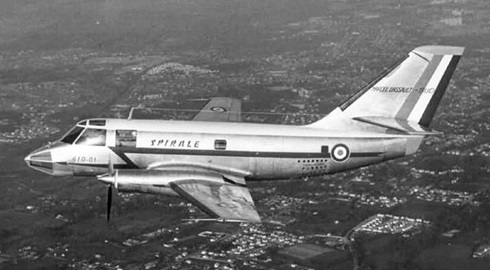
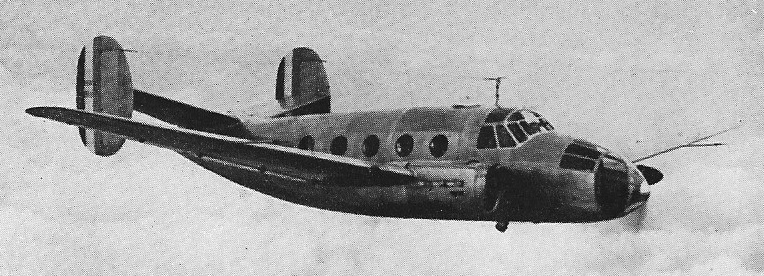
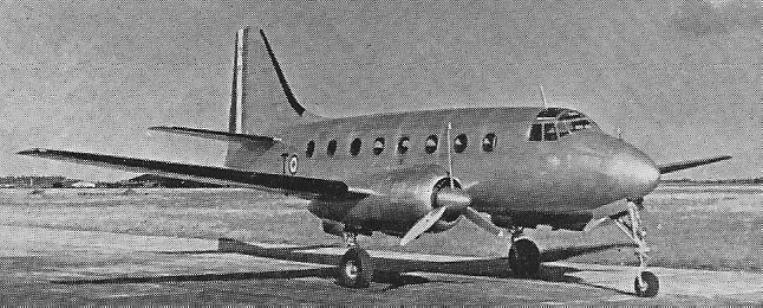
The Dassault M.D.410 Spirale was one of two nearly identical prototypes produced for the French Air Force – the M.D.410 Spirale and M.D.415 Communauté. The M.D.410 was to be the ground-attack variant of the M.D.415 which was a liaison and general duty aircraft (training, command liaison and ambulance), with the M.D.410’s windows removed and a glazed nose installed along with hardpoints and provisions for cannons.
MD.415 Communauté
Designed as a military communications and staff transport, the Dassault MD.415 Communauté made its first flight on 10 May 1959. Power was by two Turboméca Bastan turboprops.
Neither variant generated any interest and the project was abandoned.
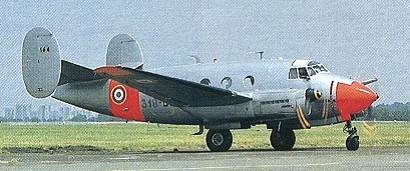
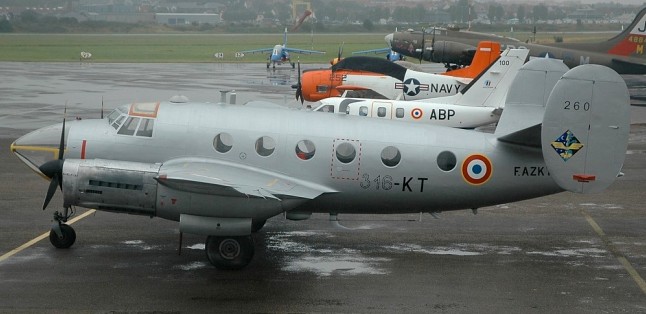
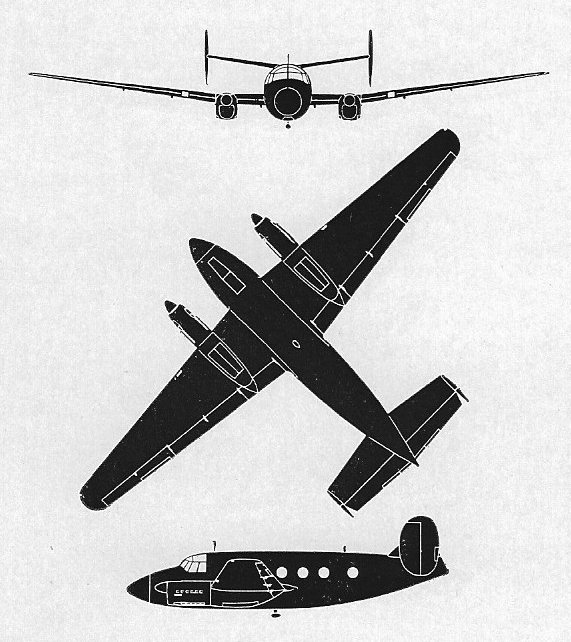
The Dassault M.D.315 Flamant (Flamingo) utility transport and aircrew trainer prototype made its maiden flight on 10 February 1947. Engines were two 580 hp SNECMA 12S 201 inverted V 12 air¬cooled, previously known as the Renault 12S and before that the German Argus As 410. This had the designation M.D.303, and was evaluated successfully at the Centre d’Essais en Vol at Bretigny later that year.
Production Flamants, the first of which was flown in January 1949, were intended for service with the Armee de I’Air in France’s overseas territories, and deliveries to AOF (Afrique Occidentale Francaise) squadrons began in October 1950.
The Flamant was produced in three main versions, the first, the M.D.311, was a bombing, navigation and photography trainer of which 39 were built.
MD.311
The six-seat M.D.312 military liaison/communications aircraft (142 built) and the 10-seat M.D.315 light utility transport (137 built), were used over a long period by the Armee de I’Air and, in the case of the M.D.312, by the Aeronavale. The production continued 1949 52.
The first production version was the MD.315 Flamant with a crew of two and up to ten passengers or a tonne of freight. The MD.312 was furnished for only six VIP passengers and the MD.311 was a crew trainer, with glazed nose for visual bombing. Most Flamants could be equipped as casevac stretcher (litter) ambulances.
Over 200 were still in service in the mid-1960s, a few were still in use in 1978, though retired by the French armed forces by the 1990s.
Convertible from passenger to cargo or aero-medical transport, several were passed on to other air forces such as those of Cambodia, Madagascar, Tunisia and Vietnam, as they were withdrawn from French service.
One M.D.315 was converted as the M.D.316, with 611kW SNECMA 14X Super Mars radial engines, first flying on 17 July 1952.
MD.316 number 2
A single-finned second prototype, the M.D.316T, had 597kW Wright R-1300-CB7A1 Cyclone radials. These were intended for crew training and commercial transport operation, but neither entered production.
Avions Marcel Dassault MD 315 Flamant Engines: 2 x SNECMA-Renault 12S 02-201 inline, 433kW / 572 hp Wingspan: 20.7 m / 67 ft 11 in Length: 12.6 m / 41 ft 4 in Height: 4.5 m / 14 ft 9 in Wing area: 47.2 sq.m / 508.06 sq ft Max take-off weight: 5800 kg / 12787 lb Empty weight: 4250 kg / 9370 lb Max. speed: 380 km/h / 236 mph Cruise speed: 300 km/h / 186 mph ROC: 984 fpm Service ceiling: 8000 m / 26250 ft Range: 656 nm / 1215 km / 755 miles Crew: 2+10 137 built
MD.316T Engines: 2 x Wight R-1300 Cyclone C7BA1, 800 hp Max speed: 255 mph at 7218 ft Cruise: 243 mph ROC: 1181 fpm Empty weight: 12,566 lb Loaded weight: 16,755 lb Wingspan: 66 ft 11 in Length: 51 ft 8 in Height: 21 ft 4 in
French transport, utility and trainer aircraft. When Marcel Dassault (the prewar Marcel Bloch) recovered from his wartime experience in Buchenwald concentration camp, he set up in the aircraft business with a factory at Talence and a scheme for his universal twin‑engined machine. Civil markets proved elusive, but the Armee de l’Air bought considerable numbers.
Marcel Dassault designed under his original name, Marcel Bloch, before the Second World War. It was not until after World War II that Marcel Bloch, born a Jew, converted to Catholicism and changed his name to Dassault.
The surviving private portion of Bloch became Dassault in 1948.
As Avions Marcel Dassault built the MD 315 Flamant light transport for the Armee de l’Air in 1945. A successful line of fighters for France and export began with the Ouragan (1949); followed by swept-wing Mystere (1952). Afterburning Super-Mystere (1959) was first European supersonic production aircraft. Etendard naval fighter appeared 1958.
By 1958 Dassault was one of the richest men in France and owned 98% of the company.
Large family of aircraft included Mirage prototype (1956), Mirage III (1958), Mirage IV supersonic bomber (1959), Mirage V (1967), Mirage III/VVTOL strike fighter prototype (1965), F2 interceptor (1966), and G8 variable-geometry prototypes (1967), Mirage F1 (1966), and Milan (1969). Also produced Mercure airliner (1971) and successful executive Falcon 10 (1970), and 20 (1963) twin jets (originally called Mystere; U.S. production called fan Jet Falcon). Involved in formation of Air-Fouga (Etablissements Fouga), 1956.
Dassault acquired majority holding in Breguet Aviation, becoming Avions Marcel Dassault-Breguet Aviation on 14 December 1971.
Completing the arrangements first proposed in mid-1977, the French government acquired 32% of the shares in Avions Marcel Dassault-Breguet Aviation at a cost of £64m. The deal gives the government nominees on the board a blocking vote. The transfer of stock was made on 1 January 1979.
The Dassault name was adopted in 1990 for the former Avions Marcel Dassault-Breguet Aviation, with programs including Atlantique 2, Mirage 2000, Rafale air-superiority and strike fighter for the French Air Force and Navy (first flown July 1986), Falcon 50 series, Falcon 900 series and Falcon 2000 (first flown March 1993).
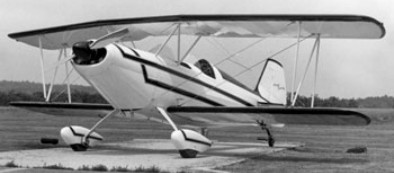
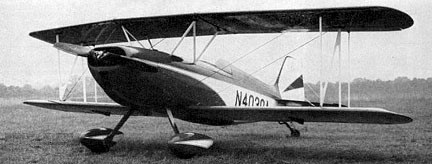
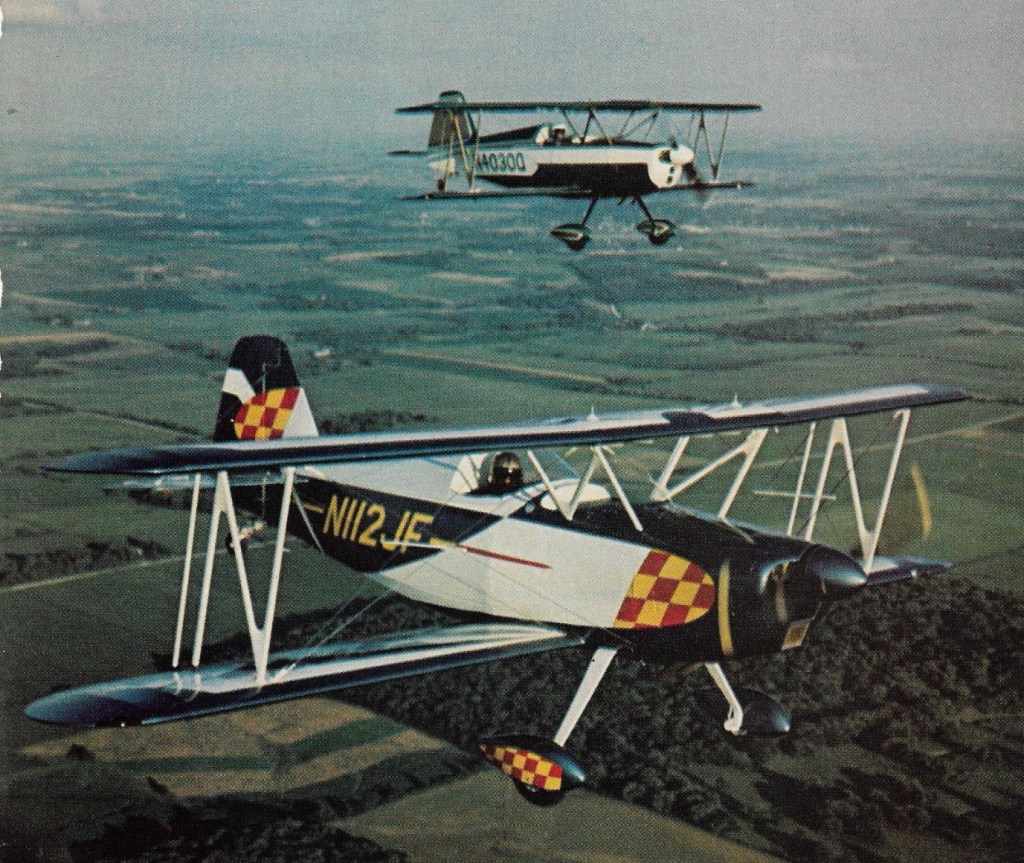
Designed by Nicholas D’Apuzzo, the aerobatic Senior Aero Sport was available as either a single or two-seater. One prototype, N40304, was designed and built at the request of Rodney Jocelyn as an exhibition aircraft for world champion aerobatic pilot Lindsey Parsons at competitions in Spain. It first flew on 28 July 1960.
PJ-260 N40304
Rod Jocelyn completed a PJ-260 Joc-Par Special for entry in the 1964 World Aerobatic Championships in Spain. Powered by a 260 hp Lycoming VO-435-A1F, 27 ft span and 21 ft length, gross weight was 1600 lb. Scothply plastic was used instead of steel spring for landing gear, saving 40 lb.
This sport biplane has a wood-faired steel tube fuselage, wire-braced steel tube tail section, all fabric covered. The fuel supply and the front seat passenger are very close to the center of gravity, so trim is little affected by expending fuel or by the presence or absence of a passenger. A variety of engines can be used from 190 to 260 hp.
Reportedly 7 amateur-built planes up to February 1974. Also seen recorded as Joc-Par. One example is the grand champion homebuilt at the 1968 EM fly-in at Rockford, Illinois.