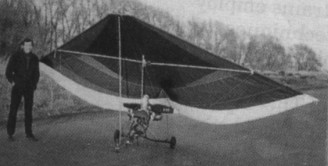
Dmitriev X-8
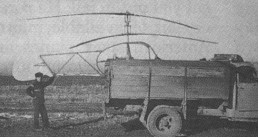

Victor Dmitriev was a teacher, truck driver, and aviation enthusiast in the Soviet Union. He pored over every bit of available information on American sport planes and taught himself how to design aircraft when the Soviet state considered such knowledge secret. Over the course of 24 years he built 30 aircraft, scrounging materials from the trash, now and then buying real aircraft parts through an illegal under-ground network. He modified a Czechoslovakian motorcycle engine for an airplane power plant. His de-sign studio, assembly plant, and hangar were all located in the four room apartment his family shared with two others in Beslickek (formerly Frunze) in Kirghizia, a republic between Kazakhstan and China.
Dmitriev built a whole series of tiny X planes over the years. “I built very many wings,” he said. “Without flaps. With one flap. With two flaps. With three flaps.”
Victor’s first attempt to build an airplane, in 1968, used a version of the Rogallo wing, a triangular kite-like device popular with early hang gliders. It didn’t work, but he was undeterred. In 1970, he got an aircraft off the ground; in 1979, he flew his first circle.
Dmitriev made contact with other closet airmen who helped one another. He said they sometimes sold aircraft parts under the table, and when he couldn’t find parts, he made them. He carved his own propellers with hand tools. He covered the wing and tail surfaces with parachute fabric, then shellacked and painted it for a smooth, drum tight surface. He made lightweight wing struts by shaping pieces of wood, cutting them in half, hollowing them out, and gluing them back together, and then epoxying on a layer of fiberglass cloth.
His work surfaced in the West in 1990 when the magazine Aviation Week & Space Technology published a photo of his machine. In 1991, he sent photographs of the X 14d in flight to the Experimental Aircraft Association (EAA) in Oshkosh, Wis., which published them in the magazine it sends to its members.
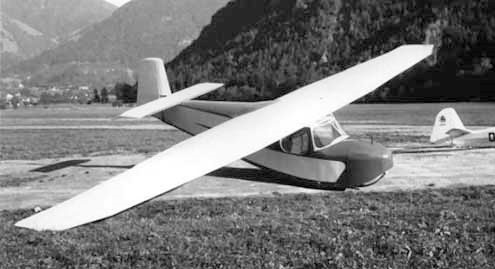
The Heini Dittmar designed wood and canvas HD 53 Möwe first flew in 1953.
Wingspan: 10.5m
Length: 6.2m
Height: 1.5m
Wing area: 16.8 m2
Empty weight: 225kg
MTOW: 520kg
Wing loading: 21.5 kg / m2
Minimum speed: 38 km/h
Maximum glide: 17 at 58 km/h
Minimum sink rate: 1.1 m/s at 45 km/h
Seats: 2
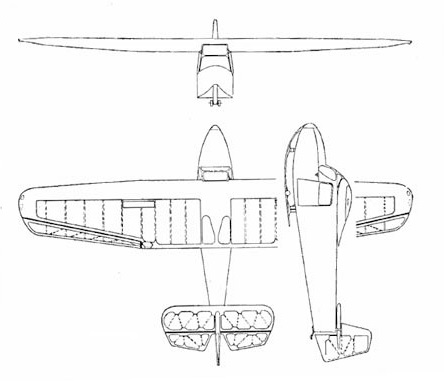
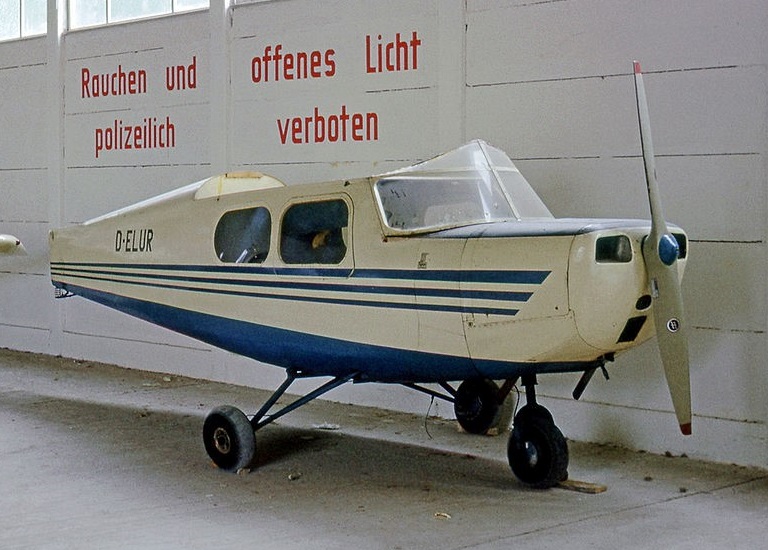
The three-seat HD 156 modification of the HD 153 featured revised front and side cabin glazing with additional side windows.
Small numbers of the type were completed by the end of 1960 and on 1 January 1961 four HD 153 and four HD 156 Motor–Möwen appeared in the West German civil aircraft register. In 1965 four HD 153 and five HD 156 Motor-Möwen were registered in West Germany. By 2007, no examples were known to be active.
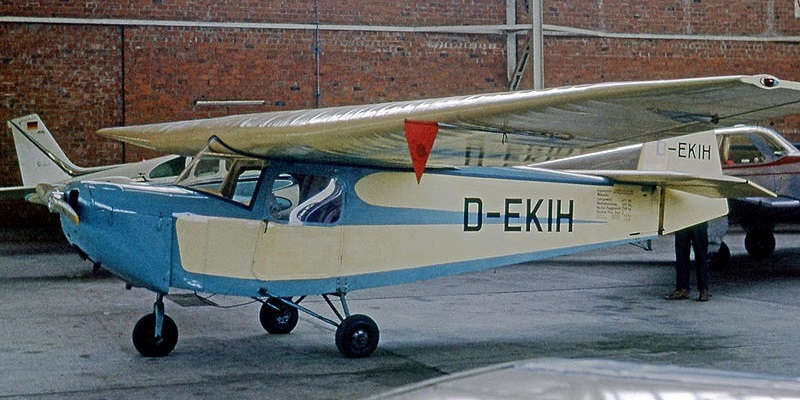
The Motor-Möwe, designed by Heini Dittmar who had designed the Dittmar HD 53 Möwe sailplane, was a motorized development of this sailplane and was initially designed to be powered by engines of 48–63 kW (65–85 hp). Heini Dittmar, the designer, was well known before the war as an international Gliding champion.
The fuselage is of wood, plywood covered, with the rear top decking detachable. An entrance door on the left side gives access to the two side-by-side seats, one of which comes out if an extra tank is fitted. Baggage room is at rear of cabin. Dual control is fitted. The wooden wing has a one-piece spar with torsion-box plywood leading edge, and lift spoilers on the top surfaces. The tail unit is of similar construction, the balanced rudder being fabric covered. Spring tabs are fitted to the elevators. A fixed spatted tricycle undercarriage has nose-wheel steering direct from a hand lever in the cabin.
Preparations for road-towing are simplicity itself; two bolts are withdrawn to release the tail controls, the wing, rudder and tailplane are stowed on top of the fuselage and bolted down, and a dolly with ball coupling is attached to the undercarriage.
The aircraft was designed for private and club use and served as a trainer and glider tug.
Heini Dittmar, the aircraft’s designer, was killed in 1960 when his Motor-Möwe crashed near Essen/Mulheim airport.
The prototype, D-EBEF, first flight was in November 1953
A second prototype aircraft was fitted with a 45 kW (60 hp) Hirth engine. The second Motor Gull (D-EHYT differs from prototype (D-EBEF) by having redesigned fin/rudder and more windows.
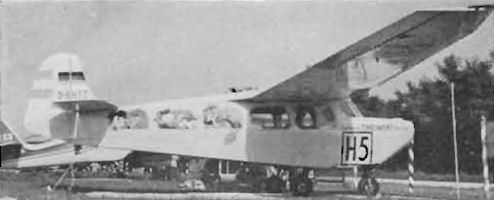
Production HD 153 two-seat aircraft were designated HD 153A-1.
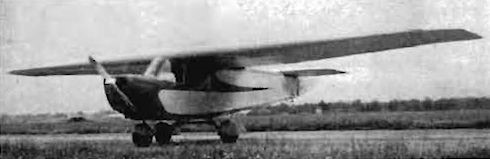
Small numbers of the type were completed by the end of 1960 and on 1 January 1961 four HD 153 and four HD 156 Motor–Möwen appeared in the West German civil aircraft register. In 1965 four HD 153 and five HD 156 Motor-Möwen were registered in West Germany. By 2007, no examples were known to be active.

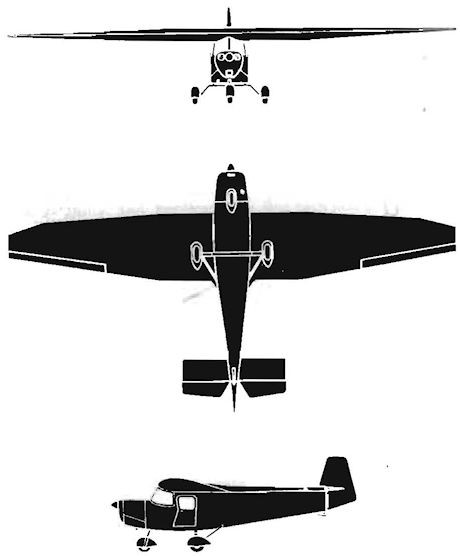
The RAAB Mora was a two-seat powered version of the Doppelraab (Reihe 6).
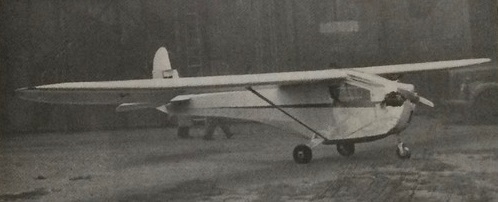
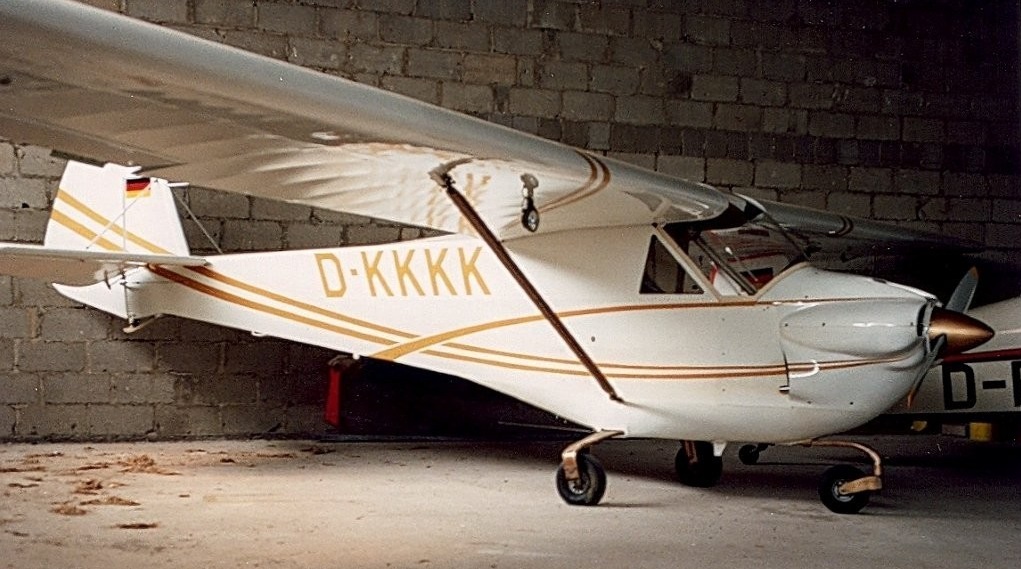
Built as Doppelraab VII glider, the Raab Doppelraab Hankur 1 D-KKKK was rebuilt as a motor glider.
RAAB Mora
Engine: VW 25 hp
Wingspan: 13.64 m
Wing area: 19.00 sq.m
Length: 6.80 m
Height: 1.60 m
Empty weight: 350 kg
MTOW: 550 kg
Wing loading: 29 kg/sq.m
Power loading: 23 kg/hp
Cruise: 120 kph
Landing speed: 45 kph
T/O run: 200 m
ROC: 1.5 m/sec
Range: 1000 km
Seats: 2
HD 153 Motor-Move
Powerplant: one 65-h.p. Continental
Propellor diameter 5.9 ft
Wingspan: 39 ft 4 in
Wing area 197 sq ft
Length: 21 ft 4 in
Height: 5 ft 3 in
Empty weight: 2151 lb
MTOW: 1,542 lb
Load: 736 lb
Top speed: 102.3 m.p.h.
Cruising speed: 89.5 m.p.h.
Landing speed: 37.2 m.p.h.
Climb to 3,280 ft: 7 min
Fuel capacity: 16.5 Imp gallons
Endurance: 4.5 hours
Opt extra fuel: 44 Imp gallon
Endurance opt/fuel: 13 hours
Fuel Consumption 24 m.p.g.
Accommodation: two.
Powerplant: 85-h.p. Continental
Propellor diameter 5.9 ft
Wingspan: 39 ft 4 in
Wing area 197 sq ft
Length: 21 ft 4 in
Height: 5 ft 3 in
Empty weight: 2151 lb
MTOW: 1,542 lb
Load: 736 lb
Top speed: 124 m.p.h
Cruising speed: 105.4 m.p.h
Landing speed: 37.2 m.p.h.
Climb to 3,280 ft: 7 min
Fuel capacity: 16.5 Imp gallons
Endurance: 4.5 hours
Opt extra fuel: 44 Imp gallon
Endurance opt/fuel: 13 hours
Fuel Consumption 24 m.p.g.
Accommodation: two.
Powerplant: 1 × Continental C90-12F, 67 kW (90 hp)
Propeller: 2-bladed Hoffman “HoCo” fixed pitch wooden
Wingspan: 12 m (39 ft 4 in)
Wing area: 18.3 m2 (197 sq ft)
Aspect ratio: 8.5
Airfoil: Göttingen 367 modified
Length: 6.5 m (21 ft 4 in)
Height: 2.1 m (6 ft 11 in)
Empty weight: 465 kg (1,025 lb) equipped
Gross weight: 760 kg (1,676 lb)
Fuel capacity: 140 l (36.98 US gal; 30.80 imp gal) in two wing tanks
Optional fuel: 200 l (52.83 US gal; 43.99 imp gal) overload tank
Maximum speed: 170 km/h (110 mph, 92 kn)
Cruise speed: 150 km/h (93 mph, 81 kn)
Landing speed: 65 km/h (40 mph; 35 kn)
Range: 1,000 km (620 mi, 540 nmi)
Ferry range: 1,872 km (1,163 mi, 1,011 nmi)
Endurance: 4.5 hours (13 hours with overload tank)
Service ceiling: 4,500 m (14,800 ft)
Time to altitude: 1,000 m (3,300 ft) in 6 minutes
Take-off run: 150 m (492 ft)
Landing run: 130 m (427 ft)
Crew: one
Capacity: one passenger (334 kg (736 lb) payload)
Inspired by his gliding brother Edgar, Heini Dittmar made an apprenticeship at the German Research Institute for gliding after leaving school. At the age of 18, he passed his A and B gliding test in 1929. In 1932, at the age of 21, he won the first victory of his class in the Rhön gliding competition with a self-made glider (Condor). Then he became involved as a research pilot.
After success with long-distance gliding, Dittmar became a member of the German gliding expedition to Argentina together with Hanna Reitsch and Wolf Hirth in 1934, where he set new world height records for gliders (February 16, 1934 over 4350 m). In 1934, Dittmar set another long-distance world record with Fafnir II and was awarded the Hindenburg Cup. In 1936, he made the first crossing of the Alps in a glider. Heini Dittmar crowned his career as a glider pilot with victory in the first international Rhön competition in 1937, which was later recognized as the first world championship in gliding. In addition, he was awarded the Golden Mark in Slide No. 1.
With the rocket aircraft Me 163 A-V4 KE + SW, Heini Dittmar reached 1003.67 km / h for the first time in a test flight on October 2, 1941 and was the first person to exceed the 1000 km / h mark in an aircraft. On July 6, 1944, Heini Dittmar reached a speed of 1130 km / h with Me 163 B V18 Komet VA + SP.
During and after World War II, Heini Dittmar worked as an aircraft designer and test pilot, but remained largely apolitical in the spirit of National Socialism. The National Socialists also used the enthusiasm for gliding that arose after the First World War to train young pilots and not least for the air force that was established. Heini Dittmar, who despite all modesty was also very popular abroad, represented the best possible advertisement for gliding through his appearance and success, which was carried out with books about Dittmar’s sporting achievements that were suitable for young people until the war.
A designer of high-performance sailplanes, Heine Dittmar produced a motorized version of his Segelmowein in 1953-1954 as the HD 153 Mowe two-seat light aircraft. Wing and tail detached for road transport. A small number of these aircraft, and of the later HD 156 three-seat aircraft, was built.
He died in 1960 when he crashed on a test flight with his own design HD-153 Motor-Möwe near Essen-Mülheim airfield. The machine, which was originally designed as a glider under the name HD 53 Möwe (later HD 153A-1 or HD 156A-1), had its first flight in 1953, but the type certification lasted until 1957. In the end, only eight or nine HD 153 and seven were built. HD 156 (more luxurious version of HD 153) of the machines equipped with a 71 kW Continental C-90 engine.
In his hometown, Mülheim an der Ruhr, as well as in Augsburg and Schweinfurt, the streets bear his name (Heini-Dittmar-Straße), as well as in Kiel-Holtenau (Dittmarweg).
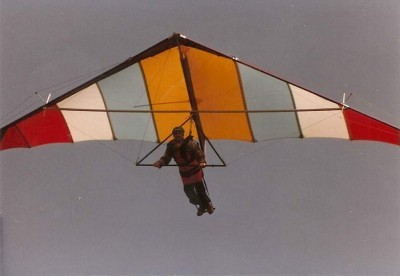
The 1976 String Ray was a copy of UP’s Dragon Fly. The String Ray was on the market within weeks of first seeing the Dragon Fly at the Nationals at Escape Country. Russ Hansen played the curious spectator, asking UP’s pilots about various aspects of their new glider so as to ease Dinger Wings re-creation.
Manufactured by Dean Aldinger Sacramento Ca in the 70’s, the sting ray had clipped tips, but no battens, the prototype was dark blue with red leading edges/tips and only had one deflector pointed down at a 45* angle.
He didn’t make a lot of that model and the tips were heavy IMO. This model is not one considered very safe except under the mildest conditions. It was high performance for its time but not especially stable. This glider wasn’t stable, which is why he stopped making it. He made a lot of innovations incorporated into later models.
Dean was a great hang glider builder but lost some friends that were flying his hang gliders and quit building.
Nose angle: 105°
Dean Aldinger of Sacramento CA, USA, was a great hang glider builder but lost some friends that were flying his hang gliders and quit building. Great pilot too but got out of building them after several tragedies.
 All Aero