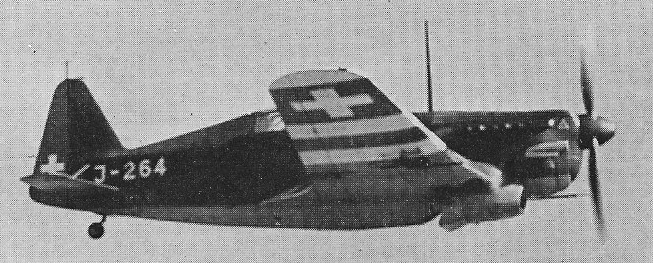
Swiss fighter aircraft. In 1938 the Swiss government purchased two Morane Saulnier M.S.405 fighters from France and, after careful evaluation, purchased a licence for the production version, the M.S.406C. Manufacture of a Swiss version of the 406 was assigned to Dornier Flugzeug at Altenrhein, with the Swiss designation D 3800. This differed from the French aircraft in having a Saurer/SLM licence built Hispano Suiza 12Y 31 of 860 hp, cooled by a fixed ventral radiator.
In 1939 40 Dornier delivered 82, followed in 1940 44 by 207 D 3801 fighters with many refinements and in having the 860 hp Hispano 12Y-31 engine replaced by a 1000 hp Hispano 12Y-51 built by A.G.Adolph Saurer.. Both types had one 20 mm (0.79 in) Hispano cannon and two 7.7 mm (0.303 in) wing guns, with provision for two 50 kg (110 lb) bombs.
D-3801
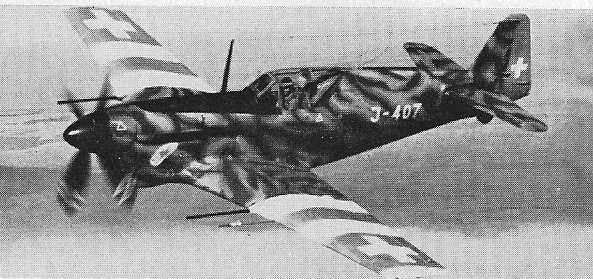
The D 3802 single-seat fighter prototype was built in 1943 by Dornier Werke to designs provided by Morane-Saulnier (designated M.S.450). A second prototype modified up to production standards was produced as the D-3802A, and orders were placed by the Swiss Air Force for 100. With the end of the war in Europe, the order was reduced to ten, built in 1944.
D-3802A
The 1500 hp (12Y 53) D 3803 of 1947 remained a one off, by which time the company had become Flug & Fahrtzeug¬werke (F&FW).
D 3801 Engine: 1000 hp Hispano 12Y-51 Span: 10.61 m (34 ft 9.75 in) Length: 8.16 m (26 ft 9.25 in) Empty weight: 4694 lb Gross weight: 2725 kg (6007 lb). Maximum speed: 523 km/h (325 mph) at 13,950 ft Econ cruise: 190 mph Time to 16,400 ft: 5.4 min Service ceiling: 35,400 ft
D-3802A Engine: Hispano-Suiza 1250 hp 12Y-52 Wingspan: 35 ft 2.75 in Length: 30 ft 7 in Height: 10 ft 11 in Empty weight: 6327 lb Loaded weight: 7716 lb Max loaded weight: 8014 lb Max speed: 391 mph at 21,325 ft Time to 19,865 ft: 7.1 min Ceiling: 33,500 ft Armament: three 20mm (0.79 in) cannon
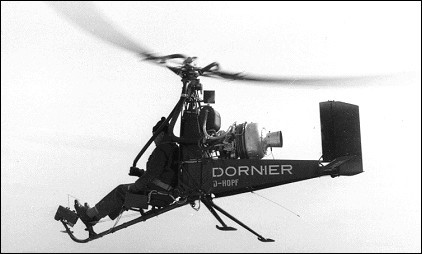
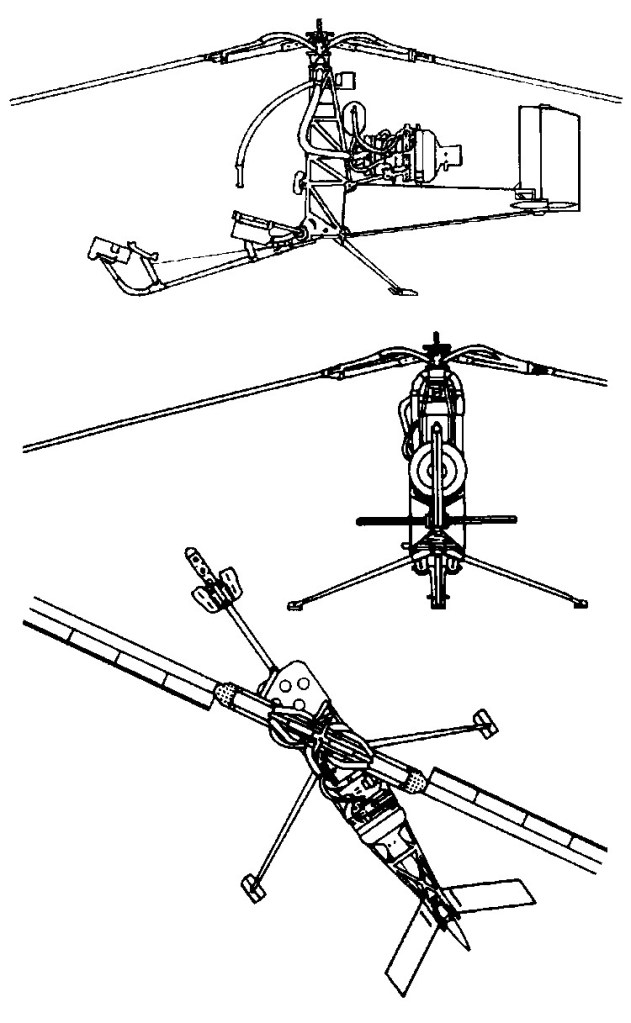
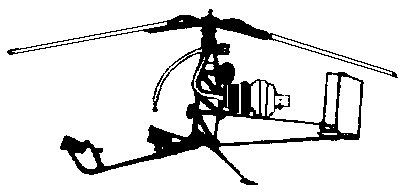
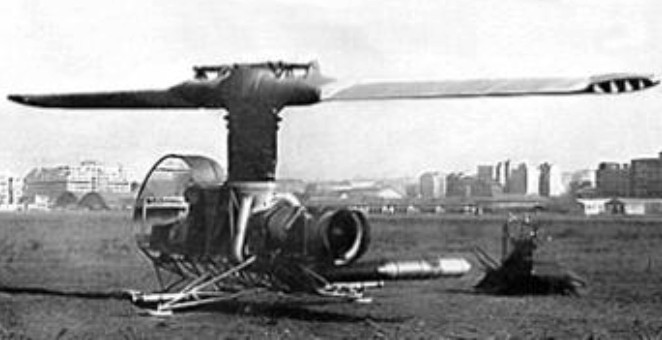
The Dornier Do.32 was one of the first helicopters designed and built by the German helicopter industry after the war. It was a small, ultra-lightweight single-seater which could be carried in a container of modest size, measuring 3.8m long and less than 1m wide. The container was fitted with wheels, could be towed by an ordinary motor car, and also served as a take-off and landing platform. The mini helicopter could be assembled in just five minutes.
The Do.32 was powered by a 100shp BMW 6012 turbine which drove the rotor through a cold cycle. The prototype was tested on 29 June 1962 and completed the test programme in mid 1963, when the German company displayed a second model at the Paris Air Show. A few others were built but the two-seat derivative (with a 250shp turbine) offered to the German government was not adopted.
Do-32 Engine: BMW 6012 turbine, 100shp Main rotor diameter: 7.50m Fuselage length: 3.20m Height: 1.90m Max take-off weight: 280kg Empty weight: 151kg Max speed: 115km/h Cruising speed: 115km/h Range: 90km Endurance: 50min, Crew: 1
Do 32 E/U Kieblitz Engine: BMW Turbokompressor 6012 L Length: 10.499 ft / 3.2 m Height: 6.234 ft / 1.9 m Rotor diameter: 24.606 ft / 7.5 m Max take off weight: 617.4 lb / 280.0 kg Max. speed: 62 kts / 115 kph Range: 49 nm / 90 km Crew: 1
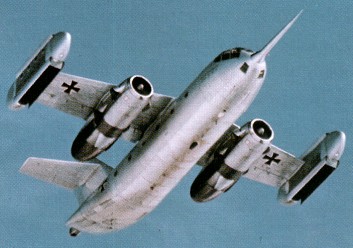
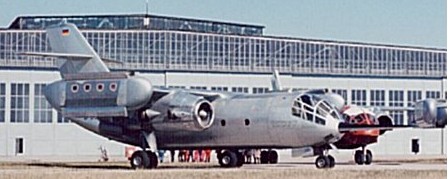
In 1962, the German Federal Ministry of Defense awarded Dornier a design contract for the Do 31 V/STOL transport aircraft. Under this experimental program, the production program covered a small and a large hovering rig for studying design principles, an airframe for structural testing, and a systems test stand for hydraulic and electric systems. Two prototypes were built and a third airframe was completed for static tests. The Do 31 E-1 was equipped with two engines providing power for cruising flight as well as lift during takeoff and landing via vectored nozzles. To support the cruise engines in hover flight another eight engines were installed in nacelles at the wing ends. By tilting the cruise engine nozzles, the Do 31 was accelerated to the speed of approximately 250kph required for aerodynamic horizontal flight, and the eight lift-producing engines were stopped again after 20 seconds. In the two prototypes, the main cabin was occupied by test equipment, but the fuselage volume of 1,765 cu ft (50.0 cu.m) would be equivalent, in a production version, to accommodation for 36 people. The Do 31 E was preceded by a small flying bedstead test rig, which in its one year’s flying made 247 test flights with nine different pilots; and then, in January 1967, by a larger rig which immediately preceded the first flight of the Do 31 E1 on 10 February 1967.
The first Do 31E1 first flew on 10 February 1967 with two Pegasus vectored-thrust turbofans in underwing nacelles and two removable wingtip pods each containing four 4400-lb (1996-kg) thrust RB.162 turbojets. During its three year test programme, the Do 31 investigated problems associ¬ated with all weather flying and opera¬tional noise levels, as well as those con¬cerned with VTOL operation. The Do 31, which established several world records during its ferry flight to the 1969 Paris Air Show. The Do 31 E concluded its test flying programme in April 1970, exactly six years after Dornier’s first little test rig made its original flight.
Do-31 E3 Engines: Two 15.500 lb (7,000 kg) st Rolls Royce Bristol Pegasus 5 2 vectored thrust turbofan for propulsion, plus eight 4,400 lb (2.000 kg) st Rolls Royce RB.162 4D lift jets in wing tip pods. Wing span: 59 ft 3 in (18.06 m). Length: 68 ft 6 in (20.88 m). Height: 8.53 m / 27 ft 12 in Wing area: 57.0 sq.m / 613.54 sq ft Gross weight: 60,500 lb (27,500 kg). Empty weight: 22453 kg / 49501 lb Max. cruising speed: 400 mph (650 km/h) at 20,000 ft (6,000 m). Ceiling: 10515 m / 34500 ft Accommodation: up to 36 fully equipped troops. Crew: 2
Professor Claude Dornier started his first aircraft company in 1922 as the successor to the “Do” division of the Zeppelin Werke, GmbH. When aircraft manufacturing became forbidden in Germany after World War II, Dornier continued his design work in Spain. There he developed the Do 25, a general-purpose airplane that later evolved into the Do 27.
The Do 28 began as a simple twin-engined derivative of the Do 27, the basic structure being retained virtually unchanged. The prototype flew for the first time on 29 April 1959, with two 180 hp Lycoming O-360-A1A engines, and the second machine introduced 250 hp Lycoming O-540-A1D engines and an increase in wingspan and area. This version entered production as The Do 28A1 in 1960, eighty produced by mid-1963.
1960
The Do 28 was produced until 1971. The Skyservant’s twin Lycomings and landing gear are mounted on stub wings that protrude from the lower fuselage directly underneath the main wings.
The Do 28B, introduced in 1963, featured 25 modifications, including the redesign of the nose, an enlarged tailplane, and auxiliary tanks in the wingtips. Two versions were available; the Do 28B1 and Do 28B2. The B2 having turbocharged engines.
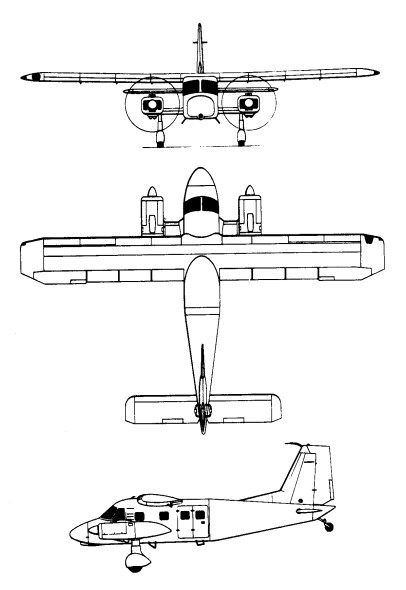
While the original Do 28 series had an advantage over the Do 27 by providing twin-engine safety and enhanced performance, it did not have any more internal space, the cabin dimensions being identical to those of its predecessor. Financial assistance provided by the German Ministry of Economics helped Dornier to develop the layout into a bulkier, higher-powered STOL transport which could carry up to 13 passengers and this redesigned version was designated Dornier Do 28D, later being named Skyservant. The redesign was so drastic that, apart from the layout and designation, the Do 28D bore little resemblance to the Do 28B. The prototype flew on 23 February 1966, receiving type approval a year later.
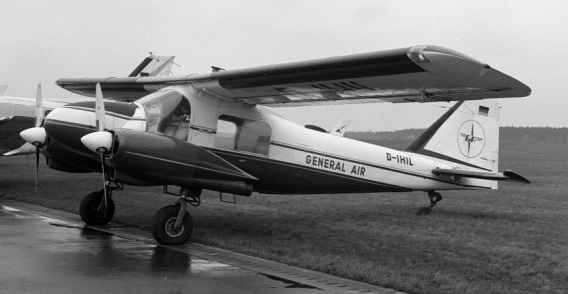
Dornier Do-28A-1 Skyservant D-IHIL (3002)
Developed as the Do 28D-1, the type won FAA certification on 19 April 1968 and military type approval in January 1970. Orders for 125 were placed for the German Luftwaffe and Bundesmarine, and other military deliveries have been made to Ethiopia, Morocco, Nigeria, Turkey and Zambia. More than 220 Skyservants are in operation world-wide. A Do 28D-1 set several class records for piston-engined business aircraft in 1972, including an altitude of 8624m with a 1000kg payload, as well as several time-to-height records. It was followed by the Do 28D-2, which introduced a number of refinements. In 1980, a Luftwaffe Do 28D-2 was re-engined with Avco Lycoming TIGO-540 turbocharged engines under a contract from the German Federal Ministry of Defence prior to upgrading that country’s military Skyservants; the new designation was Do 28D-2T.
Further development of the basic Do 28D design continued under a new designation: Do 128 Skyservant. Two basic designs were offered, the Do 128-2 and Do 128-6. Both 10-passenger models, the main difference was in powerplant, the Do 128-2 having two Avco Lycoming IGSO-540 piston engines and the Do 128-6 two 298kW Pratt & Whitney PT6A-110 turboprops. The latter had first been seen in prototype form as the Do 28D-5X, known then as the TurboSky and powered by two 447kW Avco Lycoming LTP 101-600-1A turboprops flat-rated to 298kW. The Do 128-6 had, in addition, a new fuel tank, reinforcements to the underwing engine supports and other modifications. Orders and options for 30 Do 128-6s from African customers were announced, the first going to Lesotho Airways. A variant of the Do 128-6 was also delivered to Cameroun for maritime patrol work, equipped with a 360 deg MEL Marec surveillance radar. Production ceased in the mid-1980s.
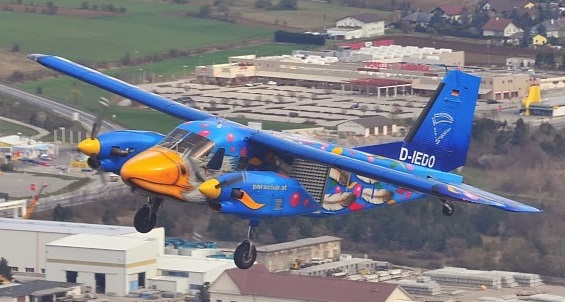
A Slovakian Do-28 G92 derivative of the Skyservant is fitted with two Walter M601-D2 turbine engines. It will haul 15 skydivers to altitude 4 times in one hour.
Dornier DO 28 D Skyservant Length : 37.402 ft / 11.4 m Height : 12.795 ft / 3.9 m Wingspan : 50.853 ft / 15.5 m Max take off weight : 8048.3 lb / 3650.0 kg Max. speed : 173 kt / 320 km/h Service ceiling : 24278 ft / 7400 m Range : 992 nm / 1837 km Engine : 2 x Lycoming IGSO-540-A1E, 375 hp Crew : 2+12
Do-28D-1 Engines two 380 hp Lycoming O-540. Gross wt. 8,470 lb Empty wt. 5,066 lb Top speed 202 mph. Cruise 170 mph. Stall 65 mph. Vmca: 42 kts. Initial climb rate 1,180 fpm. Range 1,255 minle. Ceiling 25,200 ft Takeoff distance (50′) 1,020 ft Landing distance (50′) 1,000 ft Seats 12-13.
Do 128-2 Engine: 2 x Avco Lycoming IGSO-540-A1E, 283kW Max take-off weight: 3842 kg / 8470 lb Empty weight: 2346 kg / 5172 lb Wingspan: 15.55 m / 51 ft 0 in Length: 11.41 m / 37 ft 5 in Height: 3.9 m / 12 ft 10 in Wing area: 29 sq.m / 312.15 sq ft Max. speed: 325 km/h / 202 mph Cruise speed: 211 km/h / 131 mph Ceiling: 7680 m / 25200 ft Range: 642 km / 399 miles
Do-128-6 Engine: 2 x P&WAC PT6A. Installed pwr: 600 kW. Span: 15.9 m. Length: 11.4 m. Wing area: 29 sq.m. Empty wt: 2540 kg. MTOW: 4350 kg. Payload: 1275 kg. Cruise speed: 340 kph. Initial ROC: 385 m / min. Ceiling: 8580 m. T/O run (to 15m): 555 m. Ldg run (from 15m): 435 m. Fuel internal: 895 (+475) lt. Range/payload: 1460 km with 805 kg. Capacity: 12 pax.
Oficinas Tecnicas Dornier was set up after the Second World War by Dr. Claude Dornier. First designed the Do 25, a general-purpose airplane from which the very successful Do 27 STOL aircraft was built. Spanish Company Construcciones Aeronauticas SA produced 50 of these.
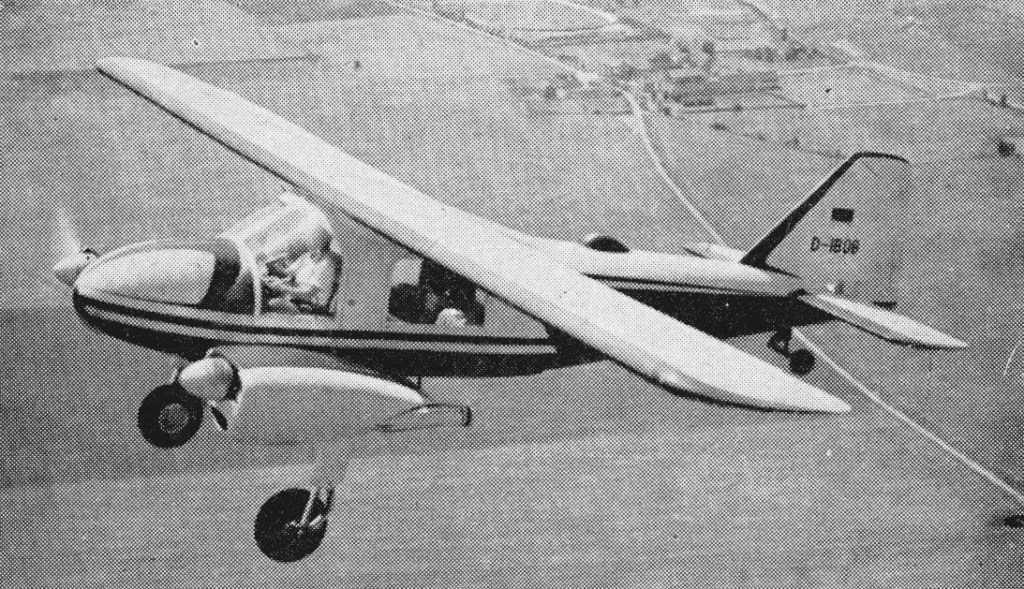
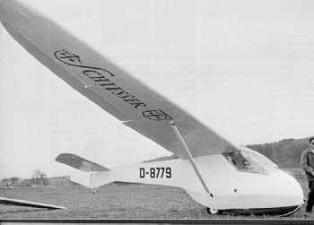
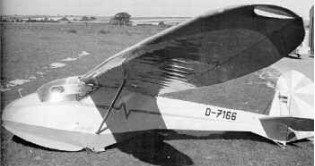
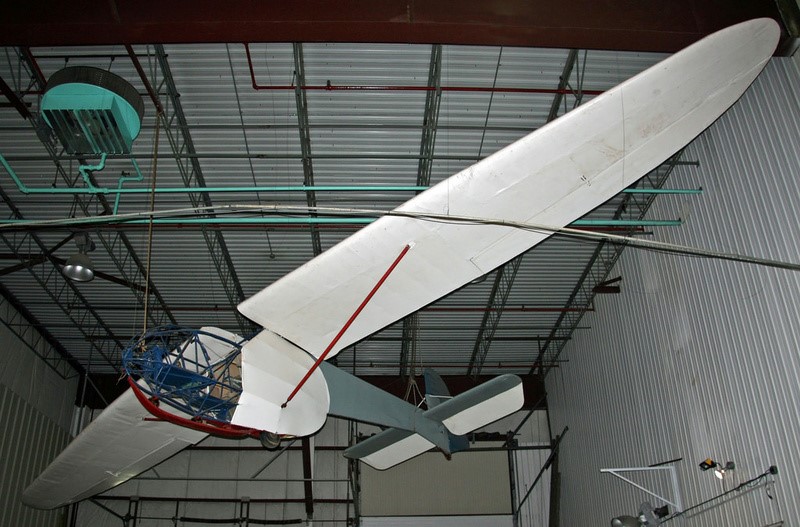
Designed by Fritz Raab. A 1950 glider trainer that was well used after the war because its compactness and low cost. The instructor seat was elevated and had no controls. The instructor having to reach over the students shoulders to take the controls.
Wing span: 12.76m Wing area: 18sq.m Length: 29.692 ft / 9.05 m Empty Weight: 185kg Gross Weight: 350kg Wing Load: 19.4kg/sq.m Aspect ratio: 9.05 Airfoil: Go 550 MinSink: 0.85 m/s 50 kph L/DMax: 20 @ 55 kph No. of Seats: 2 No. Built: 220


 All Aero