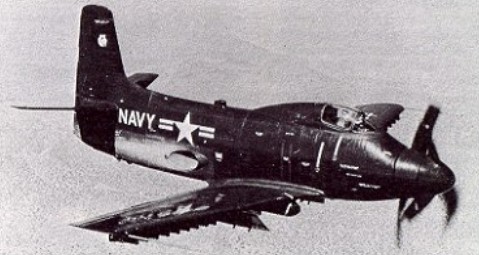
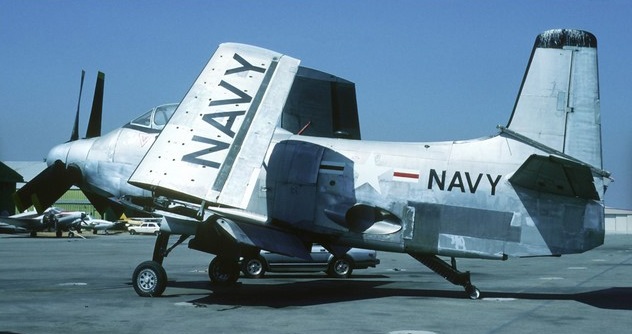
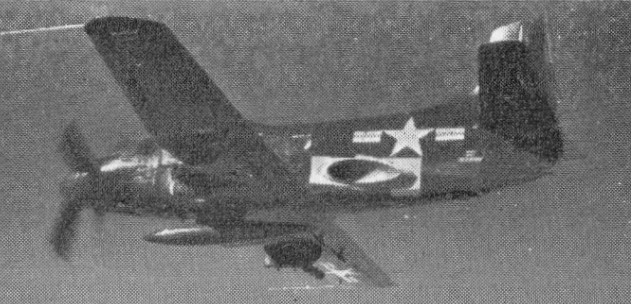
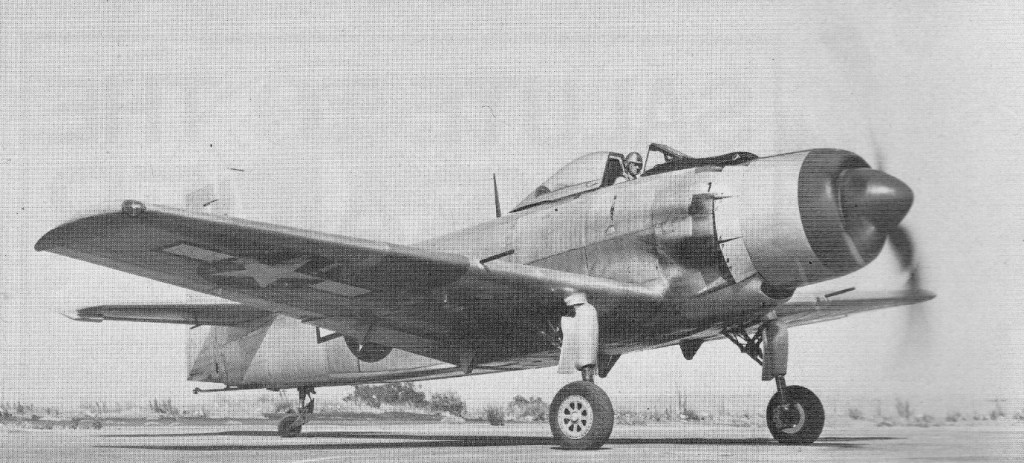
While the Navy was planning its turboprop aircraft to replace the Skyraider, Douglas was developing the XA2D 1 Skyshark powered by a 5,332 shp turboprop and the pilot was equipped with an ejection seat. The A2D was armed with four 20 mm cannon, was fitted with an ejection seat and grossed 22,000 lb (10 000 kg). The first of two prototypes made its maiden flight on 26 May 1950. It demonstrated a climb rate of 7,200 ft/min (36,6 m/sec) and a level speed of up to 435 kt (806 km/h). In 1955, an A2D carried out a speed run from Indianapolis to Florida, covering 1,086 mls (1738 km) in an elapsed time of 2 hr 33 min, which was quite commendable for a turboprop. However, the engine and gearbox gave endless problems. The propeller control mechanism consisted of 25 unreliable vacuum tubes in a black box about the size of a suitcase and gave constant trouble. Other problems included bearing failures and overheated skin around the exhausts.
One prototype crash landed on 14 December 1950, killing the pilot, while, in June 1953, the second aircraft shed its propellers in flight. Development continued, marred by the loss of gearboxes or props on three of the five Douglas test aircraft. Twelve Skysharks were built, but only eight ever received engines. Meanwhile, jets had overtaken the turboprop and, by 1954 Douglas was testing the XA4D Skyhawk, and the A2D was abandoned.
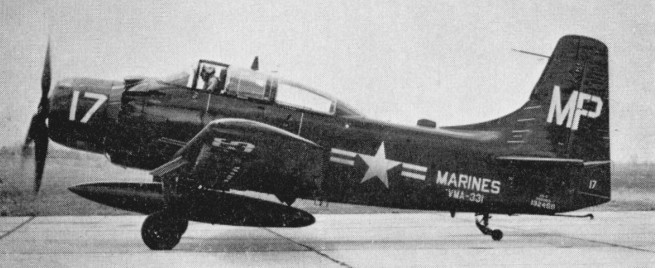
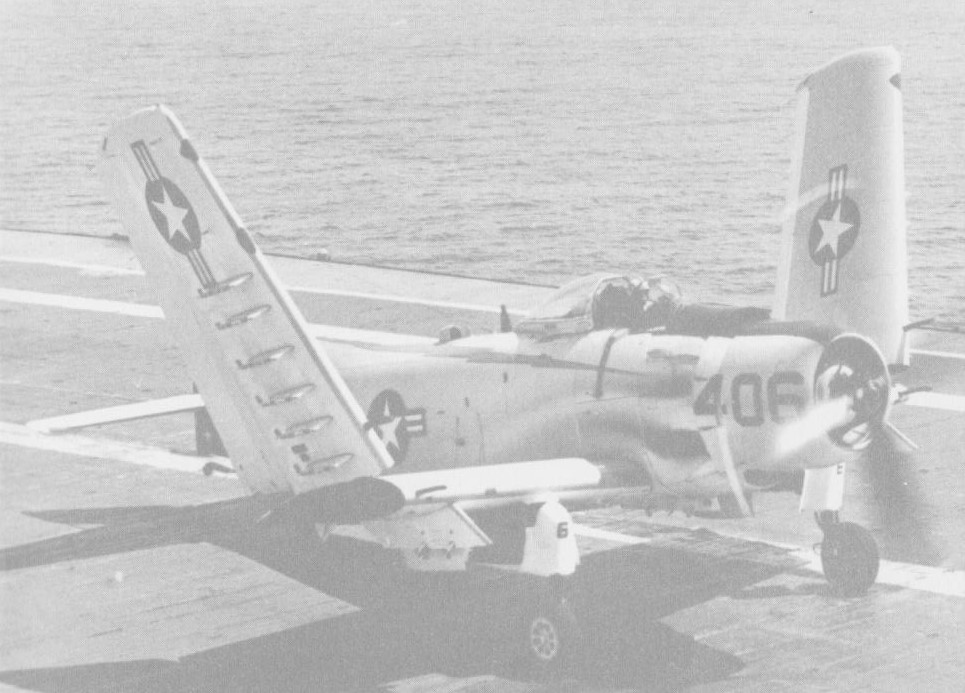
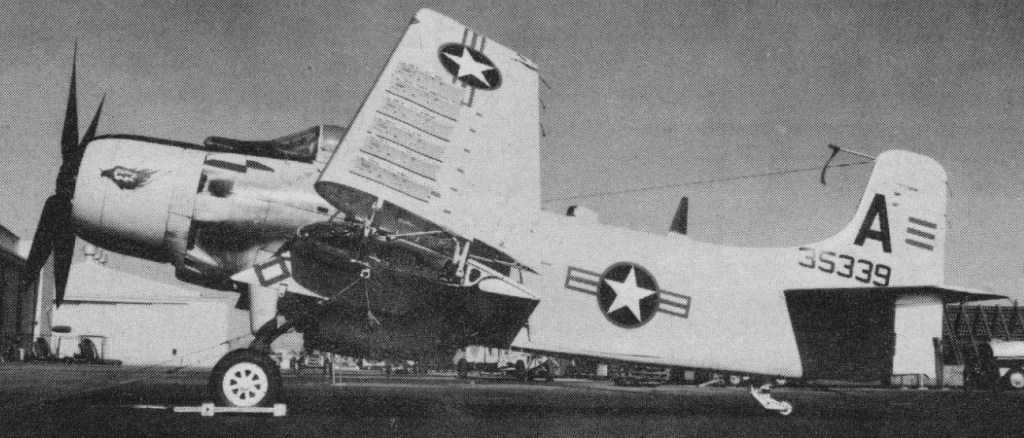
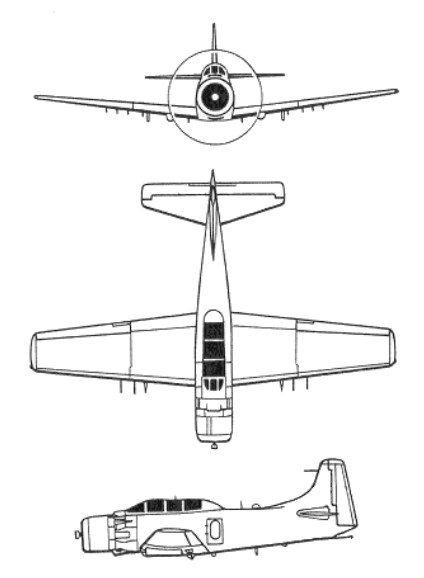
A2D-1 Skyshark
Engine: 1 x Allison XT-40-A-2 turboprop, 3803kW Max take-off weight: 10417 kg / 22966 lb Empty weight: 5871 kg / 12943 lb Wingspan: 15.24 m / 50 ft 0 in Length: 12.56 m / 41 ft 2 in Height: 5.20 m / 17 ft 1 in Wing area: 37.16 sq.m / 399.99 sq ft Max. speed: 805 km/h / 500 mph Cruise speed: 443 km/h / 275 mph Ceiling: 14660 m / 48100 ft Range: 1025 km / 637 miles Armament: 4 x 20mm cannons, 2500kg of bombs Crew: 1
In a meeting at the Navy Department, Ed Heinemann got an idea, and during a coffee break, he approached some of the brass with it: let Douglas cancel the BTD 1 and design a dive bomber the way it ought to be built. Heinemann knew he had stirred some interest, and when the meeting reconvened, a Marine colonel spoke up and asked that Heinemann be allowed to present an idea “that has a lot of merit.” When Heinemann was finished, he sat back and waited. Only one part of his proposal would cause a problem: he had specified a Pratt & Whitney engine. The Navy had already contracted to buy a large number of Curtiss Wright engines, and if he wished to get the job, he would have to use the Wright.
Flown for the first time in prototype form, BuNo 09085, as the XBT2D-l on 18 March 1945, the type was ordered into production just one month later. At first the 25 prototypes were named Destroyer IIs but this was changed to Skyraider shortly before nearly 600 were ordered.
XBT2D-1 Dauntless II
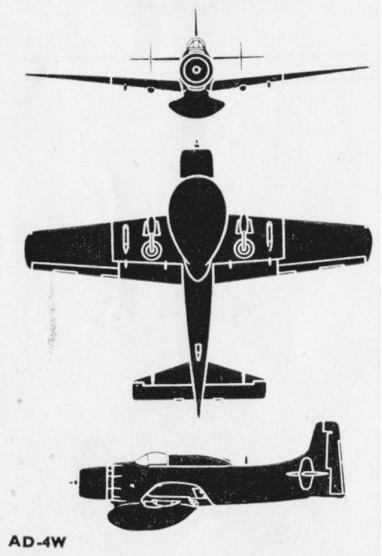
At the end of the war with Japan the 600 ordered was reduced to 242 AD 1s (as it was now redesignated) with 35 AD 1Qs. Radar equipped machines were designated AD 1W whilst the strike version the AD 2 was also built. There then followed other versions such as the AD 2Q, AD 2QU, AD 3, AD-3N, AD 3Q, AD 3w, AD 4, AD 4B, AD 4n, AD-4Q and AD 4W. The AD 2Q carried radar countermeasures equipment and the AD 3 was something quite different with a turboprop engine. The AD-4W was supplied to the Royal Navy and served as the AEW 1. The side by side seating of the AD 5 (redesignated A 1E) and EA 1E (formerly the AD 5W) were for many purposes. The single seater AD-6/A-1H and the final AD 7, A-1J were delivered in 1957.
The Skyraider entered service with Attack Squadron VA-1B in 1947. A total of 3,180 Skyraiders were completed between 1945 and February 1957, when the assembly line finally closed. These aircraft saw service with the US Air Force, the US Navy and the US Marine Corps as well as overseas air arms including those of France, South Vietnam and the UK.
Skyraiders were supplied to the Royal Navy under MDAP during the Korean Emegency for radar picket duties, until replaced by the Fairey Gannet AEW.3.
Royal Navy Douglas Skyraider
Douglas AD-5 Skyraider
Single-seat attack aircraft such as the AD-1, AD-6 and AD-7, there was also the multi-place AD-5 of 1951.The AD-5 introduced larger tail surfaces and side-by-side seating for two. Flown for the first time in Au¬gust 1951, variants of the AD-5 subsequently performed AEW (AD-5W), ECM (AD-5Q), day attack (AD-5) and night attack (AD-5N) missions amongst other tasks, making it easily the most versatile model of this remarkable warplane. The AD-5 could be equipped for twelve different roles including transport with eight passengers or four stretchers in the fuselage. The AD-6 reverted to single-seat attack configuration.
AD-6
The AD-7 was strengthened. In 1962 the type was re-designated A-1.
The new Douglas factory at Torrance (Plant B-6) in May 1954 was in volume production with both the AD-5 and 6 Skyraider and the F4D-1 Skyray, the latter with the J57 turbojet with afterburner. This leaves the El Segundo division almost clear to turn out twin-jet Skywarriors. The U.S.A.F. version of this machine (B-66) is made at Long Beach, and the main factory, at Santa Monica, makes Globemasters and DC-7s.
The Skyraider went out of USN service in 1969 with the last actually leaving in 1971. During the period awaiting the arrival of the Gannet the Royal Navy used Skyraider AEW 1 and Avenger aircraft to bridge the gap in November of 1951. 50 machines started arriving, and these ex AD 4Ws formed 778 Squadron at RNAS Culdrose. During 1953 the squadron had five flights with a total of 39 Skyraiders having by then been delivered – the remainder coming during 1956. By 1959, they were being phased out, but 12 of them were sold to Sweden as target tugs and remained in service until the late 70s.
It was the conflict in Vietnam which saw the aircraft that the USN had withdrawn in 1968 being purchased by the USAF and a number of A 1E/AD 5, A 1H/AD 6 and A 1J/AD-7 saw active service after what was supposed to be the end of their career. Others were supplied to the South Vietnam air force.
Refurbished AD-6 for South Vietnam Air Force 1964
A 1s were in Africa with the French as late as 1973 and many of these machines were transferred to the forces of Chad, Khmer and The Central African Republic.
When the US tri-service designations were rationalised in 1962, AD-1 to AD-7 versions became re-designated from A-1A to A-1J. Eventually Douglas built 3,818 of the AD Skyraider at El Segundo, California, prior to production termination in 1957.
AD-5 Engine: Wright R3350-26W, 3,150 h.p. Wingspan: 50 ft Length: 39 ft. 3.75 in. Loaded weight: 16,667 lb Max. speed: 365 m.p.h. Ceiling: 25,000 ft. Range: over 1,500 miles. Armament: 2×20 mm cannon Bombload: 6,000 lb Crew: 1-3.
AD-6 Engine: Wright R-3350-26W, 2700 hp Wingspan: 50 ft 0.25in Wing area: 400 sq.ft Length: 38 ft 10.5 in Height: 15 ft 8 in Empty weight: 11,968 lb MTOW: 25,000 lb Fuel capacity: 316 Gal External fuel: 3 x 125 Gal External stores: 10,000 lb Max speed: 365 mph at 15,000 ft Max range: 3000 miles Armament: 4 x 20 mm guns
AD-7 Skyraider Powerplant: one 3,050-hp (2274-kW) Wright R-3350-26WB radial piston. Maximum speed 552 krn/h(343 mph) at 6095 m (20,000 ft) Service ceiling 7740 m (25,400 ft) Range 2092 km (1,300 miles) Empty weight 5486 kg (12,094 lb) Max take-off weight 11340 kg (25,000 lb) Span 15.25 m (50 ft 0.25 in) Length 11.84 m (38 ft 10 in) Height 4.78 m(15 ft 8.25 in) Wingarea 37.2 sq.m (400.33 sq ft) Armament: four 20-mm cannon Hardpoints: 15 up to 3629 kg (8,000 lb)
A-1 Seats: 1
A-1E Seats: 2
EA 1F Skyraider
A-1G Seats: 4.
A 1 J Skyraider Length : 38.845 ft / 11.84 m Height : 15.682 ft / 4.78 m Wingspan : 50.755 ft / 15.47 m Wing area : 402.574 sq.ft / 37.4 sq.m Max take off weight : 25004.7 lb / 11340.0 kg Weight empty : 12550.9 lb / 5692.0 kg Max. speed : 276 kt / 512 km/h Cruising speed : 164 kt / 303 km/h Service ceiling : 31168 ft / 9500 m Cruising altitude : 5906 ft / 1800 m
AD-7 (AD-1J) Engine: 1 x Wright R-3350-26WA, 1985kW Max take-off weight: 11340 kg / 25001 lb Empty weight: 4785 kg / 10549 lb Wingspan: 15.47 m / 50 ft 9 in Length: 11.84 m / 38 ft 10 in Height: 4.78 m / 15 ft 8 in Wing area: 37.16 sq.m / 399.99 sq ft Max. speed: 515 km/h / 320 mph Ceiling: 7740 m / 25400 ft Range: 1448 km / 900 miles Armament: 4 x 20mm cannon, 3629kg of bombs
Designed as a replacement for the A-1 Skyraider, the initial work was carried out as a private com¬pany exercise without government funding and a draft proposal was submitted to the Bureau of Aeronautics in January 1952. The US Navy was impressed with what it saw but, as it was already committed to a number of new fighter designs, asked that the concept be applied to a jet-powered, carrier-borne attack bomber. Such an aeroplane was required to have a top speed of not less than 805km/h (500mph), a combat radius of 555km (345 miles) with a 908kg (20001b) weapons load and a maximum take-off weight of no more than 13,600kg (30,000lb). The Navy visualised the aircraft as a twin turboprop grossing approximately 30,000 lb (13 605 kg). However, the service also specified a unit cost limit of $1m, due to severe budgetary restrictions (the Korean War was coming to an end). Jumping ahead with the story, Douglas actually produced the first 500 Skyhawks at a price of $860,000 apiece.
By the time inspection of a mock-up took place, the Skyhawk had crystallised into a 12.01m (39ft 4¾in) long fuselage housing a pilot, fuel systems and a licence-built Armstrong Siddeley Sapphire jet engine mated to a modified delta wing, spanning just 8.38m (27ft 6in) and a stalky tricycle undercarriage. On 21 June 1952, Douglas was awarded a contract for 20 such aircraft under the designation A4D 1 (BuAer Nos 137812 31).
Construction of the XA-4A (originally XA4D-1) prototype Skyhawk began in September 1953 and the first flight of this aircraft, powered by a Wright J65-W-2 engine (32 kN), took place 22 June 1954.
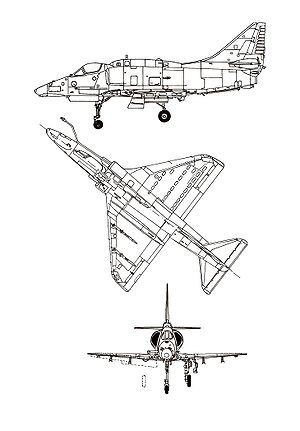
Heinemann approached the Skyhawk design on the basis of a growth factor of 10, and set out to save weight wherever humanly possible. Assuming that the mission could be performed by a 12,000 lb (5 442 kg) aircraft, he chose the 7,200 lb (3 265 kg) Wright J65 W 2, a licence built Armstrong Siddeley Sapphire. This was used in the prototype, but the pre¬-production and production aircraft were to have the 7,800 lb (3 537 kg) J65 W 4 and 4B, most of which were reconditioned engines previously flown in the USAF’s F 84F Thunderstreak. Simplicity was the keynote of the airframe design. The Skyhawk was given a single piece wing based on a three spar box continuous from tip to tip, forming a single integral fuel tank. To minimise wing cutouts, the main undercarriage units were mounted externally. To minimise restrictions on external stores, the main legs were retracted forward to lie in fairings below the wing surface, while the wheels turned through 90 degrees to lie flat in apertures ahead of the main structure.
The fuselage was fastened on top of the wing by ten bolts, and contained an avionics bay in the nose, and a single fuel tank between the cockpit and the engine. To save weight, the fuselage had a single transport joint, and “broke” in the middle, where the frame that carried the engine was bolted to the wing intermediate spar. Engine change was effected by removing the rear fuselage complete with tail. The nose undercarriage retracted forward below the cockpit, so that emergency extension was assisted by both gravity and aerodynamic drag. One of the most unusual aspects of the Skyhawk design was its two tank fuel system, with 560 US gal (2 120 lt) in the wing and 240 US gal (908 lt) in the fuselage, which must have saved significantly in terms of weight of pipes and valves.
The same philosophy of simplifying to reduce weight was applied to the avionics, the many black boxes supplied by the Navy being repackaged as a single item, with a single power supply and one multi pin connector. Douglas designed its own ejection seat, which was much lighter than existing products. The company had already designed its own bomb racks, eliminating the normal high drag sway bracing, and had developed low drag shapes for external stores: the Aero IA series of bombs, and fuel tanks of 150, 300 and 450 US gal (568, 1136 and 1705 lt) capacity. The aircraft was armed with two Colt 20 mm MK 12 cannon in the wing roots, each gun being provided with 100 rounds. The initial aircraft were fitted with three pylons for ordnance and drop tanks, with a total load capacity of 8,055 lb (3 653 kg).
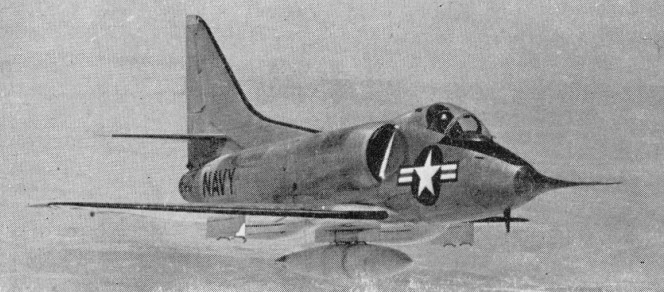
On 22 June 1954 the first XA-4D-1 Skyhawk took to the air from Edwards air force base, California piloted by Bob Rahn. The first of 19 pre production A4D 1s was flown seven and a half weeks later, on 14 August 1954. Eight years later, when the US forces adopted a uniform system of aircraft designations, the A4D-1 became the A-4A.
Flight trials showed up a number of minor aerodynamic problems but the basic design more than vindicated itself.
As a result of early flight tests, the sugar scoop fairing was added to the tail cone and vortex generators to the outer wing, and the rudder structure was redesigned to eliminate buzz, although these modifications became standard only on the A-4B. This “inside out” rudder was a North American idea, first used on the FJ 4 Fury. In September 1955, preliminary carrier trials were carried out on the USS Ticonderoga, and on 15 October 1955, an A-4A, still fitted with the less powerful J65-W 2, set up a 500 km (310.7 mile) closed circuit world speed record of 695.127 mph (1112,2 km/h) at Edwards AFB on 15 October 1955.
A4D-1
A total of 165 of the first production model were constructed, including the 19 pre production aircraft. The first production model, designated the A4D-1, was cleared for operational service in September 1955, deliveries to the fleet began on 9 September 1956, the A 4A going to VA 72 attack squadron, based at Quonset Point NAS, Rhode Island. The Skyhawk was declared operational on 26 October that year, and deliveries to the first Marine Corps unit, VMA 224, began in the following January. The A-4A went through various stages of uprating, ending with the J65 W 18 of 8,500 lb (3 855 kg). It had an empty weight of only 8,400 lb (3810 kg), of which avionics represented 138 lb (62,6 kg), and a maximum take off weight of 20,000 lb (9 070 kg).
The A4D-1, or A-4A as it became known in 1962, was powered by a single Wright J65-W-4 or W-4B turbojet and carried an internal armament of two 20mm cannon. Up to 2268kg (5000 lb) of external stores could be carried on a fuselage and two wing racks which could, alternatively, support three drop tanks with a capacity of 3028 litres (800 gallons) to increase range. Production continued until 1957, by which time 165 had been built. The A-4B, of which 542 were to be built, first flew on 26 March 1956 and entered service in 1957. It corrected various shortcomings of the first series, introducing the revised rudder as a production item, plus dual hydraulics, powered flying controls and a beefed up structure to permit clearance to 7g. Provisions were made for carriage and firing of the Bullpup air surface missile and for in flight refuelling, using a long straight probe attached to the lower starboard side of the front fuselage. Douglas also developed a buddy refuelling pack for the centreline station, allowing an A 4 to act as a tanker. Aside from the drogue and hose, and associated equipment, the pod also contained 300 US gal (1136 lt) of fuel, equal to the capacity of the long range tanks carried on each of the wing pylons. The system allowed for the transfer to the receiving aircraft of all the A 4 tanker’s external fuel, plus half of the internal capacity, making a transferable total of 1,300 US gal (4 925 lt). This second series was typically powered by the J65 W 16A of 7,700 lb (3 492 kg), although it was later uprated to the W 18 of 8,500 lb (3 855 kg). Empty weight grew to 9,146 lb (4 148 kg) and maximum take off weight to 22,500 lb (10 205 kg). A-4B deliveries began to Marine Corps squadron VMA 211 in September 1957, and to the first Navy unit, VA 12, in the following February.
The next model designated after the A4D 2 (A-4B) in the pre-1962 series was the A4D 3, a variant of the 2 with J52 P 2 engine. Ten were ordered but then cancelled, and no equivalent designation was given in the A 4 series. Also remaining in the project category was the A4D4, intended to be an A4D 2N (A4C) with J52 engine. A-4C (A4D-2N) appeared in 1959. Essentially similar to its predecessor, the A-4C was optimised for all-weather operations and was equipped with terrain-following radar, an autopilot, a low-altitude bombing system and an improved ejector seat. Initial production machines received the W-16A engine but later aircraft incorporated the W-16C model.
The key to this extended capability was a small, lightweight radar, which, in its way, was just as remarkable as the Skyhawk itself. Developed specifically for the Skyhawk from a simple radar ranging set by the US Navy Avionics Facility at Indianapolis, it had the designation APG 53A. Manufactured by Westinghouse, it weighed 90 lb (40,8 kg) and used a dish of only 16 in (40,6 cm) diameter. Aside from performing surface mapping (B scope) and ranging functions, this radar produced a vertical profilometer (E scope) display, enabling the pilot to fly a terrain clearance path at relatively low altitude and high speed. Other new equipment for this series included the TPQ-10 blind bombing system, AJB 3 low altitude bombing system and all attitude reference, an automatic flight control system and an ADD (airstream direction detector). Total avionics weight was now 395 lb (179 kg), giving an empty weight of 9,728 lb (4 412 kg).
The first flight of the A4C took place on 21 August 1958, and the first deliveries followed in March 1960 to VMA 225 at Cherry Point MCAS, South Carolina. The first Navy squadron to receive it was VA 192, which began conversion at the end of 1961. A total of 638 was subsequently built, making this the most prolific member of the Skyhawk family; at one stage it equipped 23 Navy and nine Marine squadrons, in addition to various training units.
The 1000th Skyhawk was delivered in February 1961. Production of the A-4C ended in 1962.
The next model to enter series production was the A-4E (A4D-5) in which the J65 used in all previous variants gave place to the two spool Pratt & Whitney J52 P 6. This provided a static thrust of 8,500 lb (3 855 kg), and was far more economical than the ageing Sapphire. It also had considerable growth potential, whereas the J65 had reached the end of the line. The A4E had a locally strengthened structure and two additional pylons, giving a total theoretical external load capacity of 9,155 lb (4 152 kg). New equipment included a further improved ejection system, a Doppler radar, Tacan, radar altimeter and the improved AJB 3A LABS/all attitude and heading reference. The avionics now amounted to 526 lb (238,5 kg) and empty weight had climbed to 9,853 lb (4 468 kg). The first aircraft of this upgraded sub series flew on 12 July 1961, and the A4E began to enter service in November 1962, the first squadron (VA 23) reaching operational status in the following year. A total of 498 of this series was built following two YA4Es.
The use of the J52 engine improved the type’s combat radius by virtue of its lower fuel consumption compared with the previously used J65. Most importantly, the A-4E marked the end of the Skyhawk as a nuclear bomber; this model and all subsequent ones were optimised for conventional bombing and ground attack work. The A-4E remained in production from 1961 until 1966, by which time 499 had been built.
Like the A4D-3 and A4D-4, the A4D-6 remained a paper project.
In 1964, the Navy placed an order for two prototypes of an operational trainer version under the designation TA 4E, the first example of which flew on 30 June 1965. Provision for a second cockpit involved lengthening the fuselage by 28 in (71 cm), duplicating some of the avionics, a 136 US gal (515 lt) reduction in fuselage fuel tankage and the installation of the J52 P 8A engine used in the A4F. The two seater took on other features of the A4F, notably the nosewheel steering, wing spoilers and zero zero seat, and was accordingly redesignated TA-4F soon after first flight.
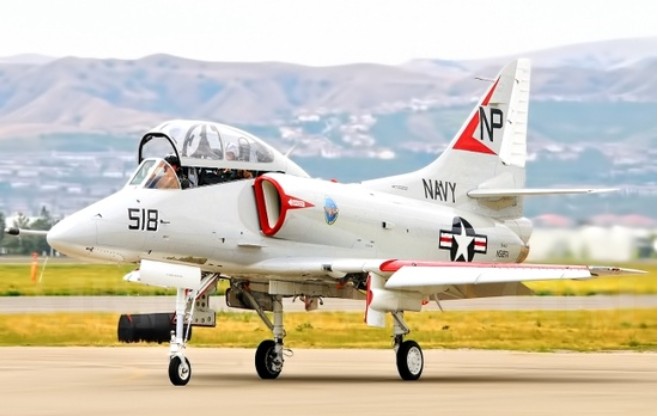
A total of 241 TA 4Fs was built (including the prototypes), with deliveries beginning in May 1966 to VA 125 at Lemoore NAS. The majority of TA 4F aircraft were subsequently converted to serve as TA 4Js, replacing the TA 9J Cougar, with a further 292 TA 4Js being built as such from the ground up (including 17 for Israel). This current two seater has no nav attack system since it is used purely for advanced flying training, for which purpose the less powerful J52 P 6 is fitted. The maiden flight of the TA 4J took place on 21 November 1969, with deliveries beginning the following month to VT 21 and VT 22 training squadrons at Kingsville, Texas, and this two seater now equips all Navy advanced flying training units. It is also used by some fleet training units and Marine squadrons. As an advanced trainer it is to be replaced in the late 1980s by the new VTX project, which will also supersede the Rockwell T 2 Buckeye in the basic training role. Twenty three of those TA4Fs that were not converted to 4J standard were reworked for the forward air control task as OA 4Ms. This work was carried out by the Naval Air Rework Facility at Pensacola, the first OA 4M flying on 23 May 1978 and entering USMC service at Cherry Point late 1979.
Douglas TA-4J Skyhawk
The last major single seat variant developed for the US Navy was to be the A-4F which first flew in August 1966, of which 146 were built. This introduced the more powerful J52 P 8A engine of 9,300 lb (4 218 kg) and a large dorsal fairing (later retrofitted to A 4Es) to provide additional avionics space. Other modifications included cockpit armour and other vulnerability reduction changes, nosewheel steering, low pressure tyres, a zero zero ejection seat and wing spoilers for improved landing performance, especially in crosswinds and a dorsal ‘hump’ fairing to house additional avionics. One hundred A 4Fs were retrofitted with the more powerful J52 P 401 which required slightly enlarged intakes. With the A4F, avionics weight had escalated to 744 lb (337 kg) and empty weight to 10,448 lb (4 738 kg). The first of this series flew on 31 August 1966, and the type entered service in June of the following year.
The dorsal hump was also retrofitted to a number of A-4Es. A two-seat training version was produced under the designation TA-4F, a few of which were later re-equipped for the electronic warfare role under the designation EA-4F. Total production of the A/TA-4F series amounted to 385 units of which 147 were single-seaters and 238 the trainer model.
In July 1967, the Royal Australian Navy received eight new-build A-4Gs and two two seat TA4Gs, these aircraft being generally similar to the A 4E but were powered by the J52-P-8A engine, and TA 4F; first flights were made on 19 July and 7 August 1967 respectively. In 1971, these were augmented by eight refurbished ex US Navy A4Fs and two TA4Fs. Approximately half have since been lost in accidents (mainly in operating from HMAS Melbourne), but the remainder served with VF 805 and training squadron VG 724 at Nowra, NSW.
The first was delivered 22 Nov 1967, and the last delivered on 8 July 1971.
The A-4F Super Fox is used by adversary squadrons, with reduced avionics, no armament, and an uprated J-52-P-8A engine (nearly 2000 lb thrust more) to provide dissimilar combat training.
Israel has been by far the largest export customer for the Skyhawk. Delivery of 48 A 4Hs for service with Heyl Ha’Avir began in 1967 (after a first flight on 27 October 1967) with modifications that included a braking parachute, the modified fin later used on the A 4M, and a revised internal armament consisting of two 30 mm DEFA cannon with 150 rounds per gun. These were followed by a further 42 A 4Hs and 10 two-¬seat TA 4Hs (first flown on 15 April 1969), and as many as 60 ex US Navy A4Es, and 17 TA 4Js, some of which arrived in 1969, and others at the time of the October 1973 war, replacing aircraft lost in combat. From late 1972, Israel also received an initial batch of 90 A4Ns, fundamentally similar to the Marine Corps’ A 4M, but with an improved nav attack system and revised cockpit layout. The A 4N first flew on 8 July 1972 and the final total of A 4N deliveries was 117 aircraft, and thus Israel received no fewer than 267 single seat and 27 two seat Skyhawks in all, although 53 of these were lost in the Yom Kippur war alone. Some of Israel’s Skyhawks have been modified to suit local requirements (eg, an extended jetpipe to reduce the effects of the SA 7 warhead) and the 100 or so remaining on strength were expected to be replaced in Heyl Ha’Avir service towards the end of the decade.
The Indonesian Air Force (TNI AU) has been a more recent purchaser of the Skyhawk, last year receiving 14 A 4Es and two TA 4Hs from Israeli stocks. Reports indicate that these are to be augmented by 16 ex US Navy A4Es, but it is not yet clear who is to refurbish these aircraft. The success of the two-seat Skyhawks as trainers led to the development of the next model to be built, the TA-4J, which flew from 1966. Unlike the earlier TA-4F, the J carried only a single 20mm cannon armament and had much operational equipment re¬moved. Power was provided by a J52-P-6 engine. The US Navy’s Air Advanced Training Command received a total of 293 such aircraft.
In 1970, New Zealand took delivery of the first of a batch of 10 A4Ks and four two seat TA4Ks, these being new build aircraft (first flown on 10 November and 5 December 1969 respectively), based on the A 4F, but with a braking parachute, modified radios and the revised fin used on the A 4H and A 4M. These equipped No 75 Sqn of the RNZAF, based at Ohakea.
Douglas A-4K
The A 4L was an A 4C updated to the standard of the A4F in terms of equipment and control system, including the distinctive fairing on top of the fuselage. However, the A4L retained the three pylons of the earlier model and the J65 engine of 8,500 lb (3 855 kg). One hundred of these conversions were made at Naval Air Rework Facilities (NARF); the first flight was made on 21 August 1969 and the first deliveries took place at the end of 1969. The A4L went first to Navy and Marine reserve units, where, in the former case, they began to be replaced by early model A 7 Corsair IIs in the mid 1970s, the Skyhawks then passing to regular fleet utility (VC) squadrons.
In principle, both the Navy and Marine Corps were to have replaced the Skyhawk with the winner of the VAL contest, designed to requirements issued in May 1963. Vought won this competition with the A 7 Corsair II, early in 1964, the resulting A 7A making its first flight on 27 September 1965. Powered by a single Pratt & Whitney TF30 P 6 turbofan of 11,350 lb (5 147 kg), the A 7A had an empty weight of 14,857 lb (6738 kg), a total of eight weapon pylons, and a design catapult gross weight of 32,500 lb (14 740 kg). Due to its larger size and more economical engine, it could fly further with heavier warloads and more equipment than the diminutive Skyhawk. However, the Corsair II was clearly going to cost far more and require more maintenance effort than the smaller, simpler Skyhawk. In addition, it may well have been that the A 7 provided capabilities that were far in excess of those demanded by the Marines for the short range close support mission. The two services therefore went their separate ways, the Navy adopting the Corsair II, while the Marine Corps funded a further stage of Skyhawk development. The resulting A-4M was the final variant for the US services. It adopted yet another increase in engine thrust, with the 11,200 lb (5080 kg) J52 P 408A, producing a reduction in take off run of approximately 20 per cent 305m (l000ft) and an increase in climb rate of the order of 50 per cent. In addition, the A4M featured a larger canopy giving better rear view, a redesigned fin, an angled flight refuelling probe to minimise interference with the nose radar, a braking parachute, double the ammunition capacity of earlier Skyhawks, an uprated electrical generator, a self contained gas turbine starter and a ram air turbine for emergency services. This considerably improved Skyhawk had its maiden flight on 10 April 1970, and deliveries began twelve months later to VMA 324 at Beaufort, South Carolina. A total of 158 A 4Ms was built, in addition to two A4Fs converted, the last of the series being handed over by Douglas on 27 February 1979 (30 such aircraft had been transferred to Israel during the Yom Kippur War of 1973) in a ceremony that marked the end of Skyhawk production. This 2,960th A 4 was delivered to VMA 331 at Cherry Point. The emergence of the A-4M added new impetus to the export model Skyhawks, acting as a basis for the A-4N, the A-4KU and providing elements for the A-4S. The first of these, the A-4N or Skyhawk II, was the second model built for Israel. Employing the M’s basic airframe and engine, the model N featured a new navigational and weapons delivery system including a head-up display and a built-in armament of two 30mm DEFA cannon. First flown in 1972, a total of 129 A-4Ns were built, most of which have received the elongated jet pipe modification. Another notable feature is the addition, in Israel, of a fin top fairing to house a radar warning system.
In late 1974, the Kuwait Air Force ordered 30 A 4KU single-seaters and six TA4KUs trainers, all new build aircraft based on the A 4M. Deliveries began in 1977 after first flights, respectively, on 20 July and 14 December 1976, and these aircraft were operated by two attack squadrons. The KU was similar to the M with the addition of a braking chute housing below the rear fuselage.
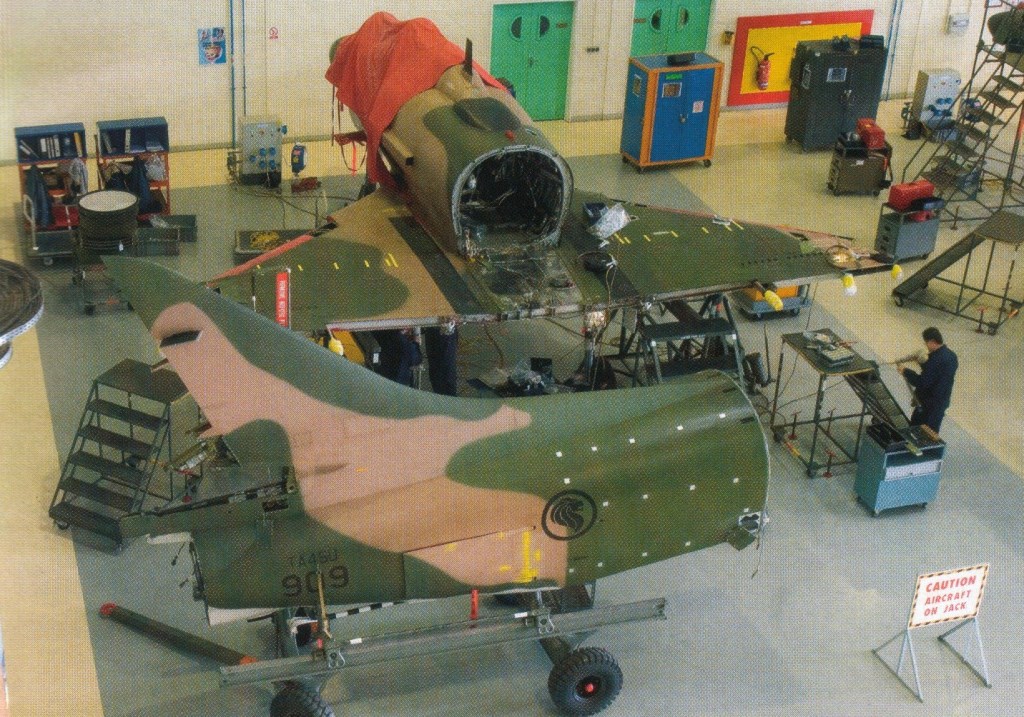
The A-4S appeared in 1972. As well as incorporating elements such as the refuelling probe from the A-4M, the S represented the final product of Douglas’s ‘new from old’ refurbishing programme. Ordered by the Singapore government, the A-4S had a re-worked, ex-US Navy A-4B airframe incorporating a redesigned cockpit, solid state electronics, the ventral braking parachute housing, 30mm Aden cannon in place of the original weapons, and overhauled and up-rated J65 engines. Converted by Lockheed Aircraft Services, 40 aircraft were produced, complemented by seven TA-4S trainers. The first eight conversions taking place in 1973 in California (first flight 14 July 1973) and the remainder in Singapore by 1976. More than 100 modifications included the installation of the 8,100 lb (3674 kg) J65 W 20, 30 mm Aden cannon, a modern nav-attack system including a Ferranti lead computing sight, spoilers and a braking parachute. The seven TA 4S Skyhawks (first flown 21 February 1975) differ from the standard Navy two seaters, in having separate hoods, rather than a combined canopy over the two cockpits. The A4S Skyhawks equip No 142 Gryphon and No 143 Phoenix squadrons at Tengah, while others serve alongside Hunters in the OCU role with No141 Squadron.
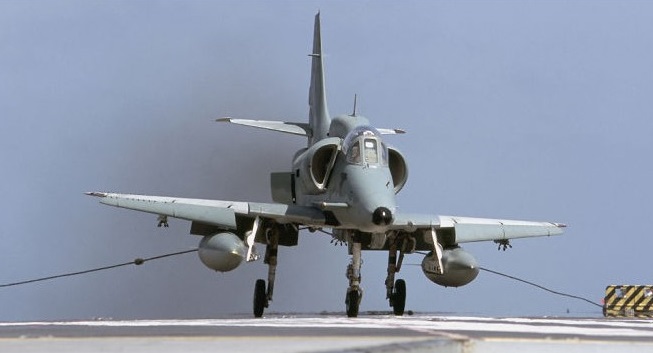
The first refurbished Skyhawk model appeared during 1965 under the designation A-4P. Production totalled 75 units, the aircraft being an overhauled A-4B or A-4C. Work on the type was undertaken by Douglas (50 aircraft) and Lockheed (25), the Lockheed machines being originally A-4Cs and fitted with the Ferranti Dl 26R Isis weapons sighting system. Sixteen extra A-4Bs were supplied to the Argentinian Navy under the designation A-4Q for use aboard the carrier Veinticinco deMayo. Argentina was the first foreign recipient of the Skyhawk. An initial batch of 25 ex US Navy A4Bs, redesignated as A 4Ps, was delivered in 1966 for use by the Fuerza Aerea Argentina. These were followed by a similar batch in 1970, and 25 former A4Cs in 1976. The Skyhawks serve in the attack role with I Escuadron de Caza Bombardiero of IV Brigada Aerea at El Plumerillo AB, Mendoza, and with IV and V Escuadrones of V Brigada at General Pringles AB Villa Reynolds. In 1971, the Comando de Aviacion Naval Argentina purchased 16 refurbished A4Bs, these being assigned the designation A 4Q. These Skyhawks have been operated by 3 Escuadrilla Aeronaval de Caza y Ataque at Comandante Espora NAS, with detachments aboard the carrier 25 de Mayo. The 10 surviving A 4Qs were being replaced by the Dassault¬Breguet Super Etendard.
Republic of Singapore Air Force A-4S Skyhawks have been re-engined with General Electric F404 non-afterburning turbofans, and the first flew in late September 1986. Redesignated A-4SU after the upgrade, including HUD and laser INS.
Following the 1982 Falklands/Malvinas War in the South Atlantic, in 1983 the U.S. placed an embargo on sale of military aircraft to Argentina. In April 1983 it was reported a number of the 24 ex-Heyl Ha’Avir A-4E and A-4H were in te process of delivery by Israel to Argentina. Of 16 original A-4Q, Argentina lost five in accidents and six during the Falklands conflict.
The remaining Argentine Skyhawks continued operational until March 1999, when the last five of the old inventory were retired.
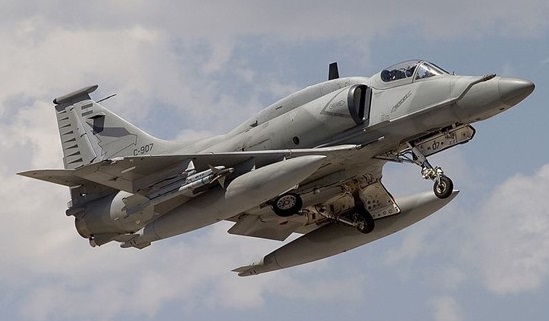
In 1994, the United States made Argintina an offer to modernize 36 ex-USMC A-4M Skyhawks in a US$282 million deal that would be carried out by Lockheed Martin and included the privatization of the Fabrica Militar de Aviones (Spanish for Military Aircraft Factory), now Lockheed Martin Aircraft Argentina SA. The program was named Fightinghawk in recognition of the F-16 Fighting Falcon, which was the source of its new avionics. In 2010, FMA reverted to the Argentine government as Fabrica Argentina de Aviones (FADEA).
Argentine Air Force technicians chose 32 A-4M (built between 1970/1976) and 4 TA-4F airframes from the Aerospace Maintenance and Regeneration Center at Davis-Monthan Air Force Base in Tucson, Arizona to upgrade. The upgrade plans included: Complete overhaul of the airframe, wiring looms and the Pratt & Whitney J52P-408A engine Installation of Douglas Escapac 1-G3 ejection seats HGU-55/P helmets Honeywell Normal Air-Garrett’s OBOGS (On Board Oxygen Generation System) Westinghouse/Northrop Grumman AN/APG-66V2 (ARG-1) radar HOTAS controls and a ‘glass’ cockpit (2 CRT color screens) Sextant Avionique/Thales Avionics SHUD Litton/Northrop Grumman LN-100G inertial navigation system MIL-STD-1553B data bus Two General Dynamics Information Systems AN/AYK-14 mission computers Northrop Grumman AN/ALR-93 (V)1 Radar warning receiver AN/ALQ-126B jammer AN/ALQ-162 jammer ALR-47 chaff/flare dispenser IFF AN/APX-72
The A-4M airframes were equipped with the TV and laser spot tracker Hughes AN/ASB-19 Angle Rate Bombing System (ARBS) but these were removed after their conversion as A-4AR, as the radar could provide the same data.
The contract stipulated that 8 airframes would be refurbished at the Lockheed-Martin Plant in Palmdale, California and the rest (27) in Córdoba, Argentina at LMAASA (ex-FMA).
At least ten TA-4J and A-4M airframes for use as spare parts, eight additional engines, and a new A-4AR simulator were also delivered.
Lockheed Martin A-4AR Fightinghawk
The Fightinghawks, received Air Force serials C-901 to C-936, saw their first group arrive in Argentina on 18 December 1997 and the first “Argentine” A-4AR was rolled out on 3 August 1998 at Cordoba. The last one, number 936, was delivered to the Air Force in March 2000. Two aircraft (a one-seat and a two-seat) remain some time in the United States for weapons homologation.
All of the A-4ARs were delivered to the 5th Air Brigade (V Brigada Aérea) at Villa Reynolds, San Luis Province, where they replaced two squadrons of Falklands/Malvinas veteran A-4P (locally known A-4B) and A-4C. They were soon deployed in rotation around the country from Rio Gallegos in the south to Resistencia in the north where they were used intercept smugglers and drug trafficking airplanes.
Argentina Air Force McDonnell Douglas A-4AR Fightinghawk
In September 1998, just months after their arrival and again in April 2001, United States Air Force F-16s visited Villa Reynolds for the Southern Falcon joint exercise, known as Aguila (Spanish for Eagle) in Argentina. In 2004, the A-4ARs went abroad for the joint exercise Cruzex, along with Brazilian F-5s and Mirages, Venezuelan F-16s and French Mirage 2000s.
As of February 2013, after 15 years of service, three A-4ARs had been lost: 6 July 2005: near Justo Daract, San Luis Province, pilot Lt Horacio Martín Flores (29 years old), died. 24 August 2005: near Río Cuarto, Cordoba, pilot ejected safely. 14 February 2013: “Vice Comodoro Angel Aragonés” airport near Santiago del Estero, both pilots ejected safely.
The Skyhawk was in continuous production for no less than 26 years, from 1953 to 1979, believed to be the longest manufacturing run ever achieved by an American combat aircraft. In that time 2,960 Skyhawks were produced, of which 2,405 were single seat attack aircraft and 555 were two seat trainers.
By having a wing of very short span, 27 ft 6 in (8,38 m), it was possible to save approximately 200 lb (90,7 kg) by eliminating the wing fold. However, carrier approach speed dictated a reasonably large wing area, 259.82 sq ft (24,15 sq.m). The Skyhawk is also noted for handling, and for high roll rates, up to 300 deg/sec at moderate speeds. The US Navy Blue Angels aerobatic team has flown the Skyhawk since 1974, using modified A4Fs with the uprated J52 P 408 engine. For long flights, pilot workload is reduced by virtue of attitude, altitude and heading hold facilities provided by the AFCS (automatic flight control system), which also gives yaw damping for improved weapon aiming. Instantaneous turn rates can be high, combining with the Skyhawk’s small size to make it a useful aircraft with which to simulate Soviet fighters in teaching air combat manoeuvres. In real combat, the survivability of the Skyhawk benefits from having manual reversion for the flying controls, a three spar wing, a self¬sealing fuselage tank and armour plate in front and below the cockpit, and behind the pilot’s head.
On a standard day the A 4M can reach approximately Mach = 0. 87 at sea level and up to Mach = 0.93 at altitude. At maximum take off weight and carrying a 300 US gal (1136 lt) centreline tank, it can deliver a 4,000 lb (1815 kg) bombload over a 225 nm (420 km) radius in a LO LO sortie, or over 275 nm (510 km) in a HI LO profile. Flying a HI LO HI close support mission, it can loiter at 5,000 ft (1500 m) and 150 nm (280 km) radius for one hour with a 4,000 lb (1815 kg) bombload, or for two hours with 1,750 lb (795 kg).
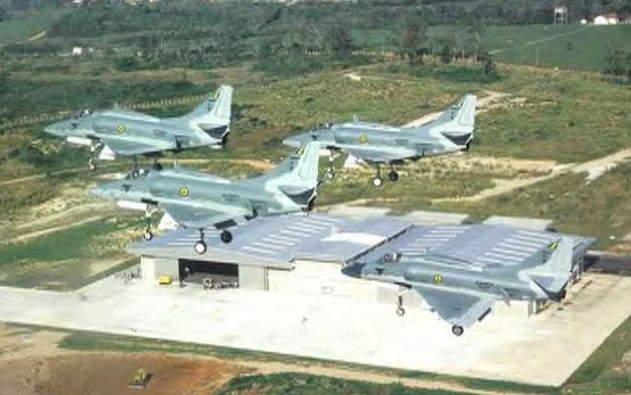
Brazil operated carrier NAe Minas Gerais until 2001 when she was replaced by the ex-French carrier Foch, renamed the NAe Sao Paulo. The Sao Paulo was better suited to operate Brazil’s newly acquired, but still second-hand batch of 20 Kuwaiti A-4KUs and TA-4KUs.
The push by the Brazilian Navy to allow its naval air arm to operate tactical jet aircraft came to a head in the 1980s, as a ruling that prohibited the Brazilian Navy from operating these aircraft was finally overturned.
After about a decade of perusing through different candidates, Kuwait’s A-4KUs, which were built in the late 1970s and were advanced for the type, were selected on the grounds that they featured very low flight hours and had almost no corrosion, as they had operated in the hot deserts of the Arabian Peninsula for decades. A $70M deal was brokered to acquire the Kuwaiti A-4s for the Brazilian Navy. These aircraft would be re-branded AF-1 after some modest upgrades were applied before entering service.
In late 2000 the ex-Kuwaiti Skyhawks took to the skies above the Minas Gerais and the Skyhawk was once again operating in a tactical role aboard a carrier. Throughout the early part of the decade the Brazil’s AF-1s participated in multiple international exercises and indigenous training events, before training aboard the Sao Paulo was cut off in 2004 when a series of mechanical failures forced the carrier into long periods of overhaul. These failures included a deadly explosion of one of her catapults in 2004 and a deadly fire in 2012. The Skyhawks kept flying, and by the late 2000s it was clear that their capabilities were still rudimentary in comparison to other modern multi-role fighters. The jets were mainly relegated to general purpose bombs and AIM-9 Sidewinders for the within-visual-range fight. They also relied on external radar direction to execute intercepts and over-the-horizon surface attacks.
The Skyhawks also suffered from some engine and spares issues as the decade wore on and thus flying hours and available airframes were greatly curtailed. In 2009, the Brazilian Navy aimed to fix these problems through a comprehensive upgrade.
A-4F Engine One Pratt & Whitney J52-P08A turbojet, 11,220 lb. Span 8.38m (27ft 6in) Wings area: 24.16m2 Wing sweep: 33 degree Length 12.23m (40ft 1.5in) Height 4.62m (l5ft2in). Empty weight: 10,465 lb / 4,899kg Maximum takeoff weight: 24,500 lb Take off weight (normal): 11,113kg Fuel capacity: wing and fuselage internal and three external tanks: 1,800 U.S. gallons Max speed: SL, M0.88 (570kts); @35,000 ft: M0.8. Armament: Two 20 mm MK 12 cannon in wing roots with 200 rpg. Accommodation: Pilot only; Douglas Escapac I G3 zero zero lightweight seat. Maximum speed: 586 knots (with a 4,000 pound bomb load) Initial climb rate: 8,440 ft/min Maximum ferry range: 1740 nautical miles G load max: 6 Hardpoints: one fuselage and four wing racks Wheel track: 2.37m Combat Radius: 575 km Wing chord at root: 4.72m Tailplane span: 3.45m Vert Tail area: 4.65m2 Horz Tail area: 4.54m2 T-O run @ 23,000lbs: 832m
A-4K Skyhawk Powerplant: Pratt & Whitney J52-P8A, 9300 lbf thrust Length: 40 ft 3 in (12.22 m) Wingspan: 26 ft 6 in (8.38 m) Maximum speed: 672 mph (1083 kph) Range (without refueling): 2000 miles (3220 km) Service ceiling: 42,250 ft (12,880 m)
A-4K Engine: 1 x Pratt & Whitney J52-P-8B/C turbojet. Wingspan: 8.38m. Length: 12.57m. Height: 4.53m. Wing area: 24.16sq.m. Empty wt: 11800 lbs. MAUW: 24,500 lbs. Fuel: Internal: 5200lb, external: up to 6600 lb. Armament: 2 20mm cannon + 4 hard point stores.
A-4M Engine: One Pratt & Whitney J52 P 408A turbojet, 11,200 lb st (5 080 kgp) for take off. Span, 27 ft 6 in (8,38 m) Overall length (excluding FR probe), 40 ft 4 in (12,29 m) Overall height, 15 ft 0 in (4,57 m) Max speed, 670 mph (1078 km/h) at sea level, or Mach= 0.88 Max speed, 646 mph (1040 km/h) with 4,000 lb (1815 kg) weapon load Initial rate of climb, 4,800 fpm (24,4 m/sec) Service ceiling, 42,250 ft (12 880 m) Take off run, 2,730 ft (832 m) at 23,000 lb (10 433 kg) weight Combat radius, 385 mls (620 km) Max ferry range, 2,350 mls (3800 km) at 24,500 lb (11113 kg) Empty weight 10,800 lb (4900 kg) Normal take off weight, 24,500 lb (11113 kg). Internal fuel capacity wing and fuselage, 800 US gal (3 028 lt) External drop tank fuselage centreline, capacity 150, 300 or 400 US gal (568, 1136 or 1514 lt), and one drop Undercarriage track 7 ft 9.5 in (2,37 m) Wing area, 260 sq ft (24,16 sq.m). Armament: Two 20 mm MK 12 cannon in wing roots with 200 rpg. Hardpoint: Fuselage 3,500 lb (1588 kg) capacity Hardpoint: two inboard wing 2,250 lb (1020 kg) Hardpoints: two outboard wing 1,000 lb (450 kg) Accommodation: Pilot only; Douglas Escapac I G3 zero zero lightweight seat. Wing chord at root: 4.72m Tailplane span: 3.45m Vert Tail area: 4.65m2 Horz Tail area: 4.54m2 T-O run @ 23,000lbs: 832m
A 4N Skyhawk II Wing span: 27 ft 6 in (8.38 m). Max speed: 645 mph (1,038 km/h).
TA 4F
A4G Skyhawk Engine One Pratt & Whitney J52-P8A, 9,300 lbs thrust Wing Span: 27 ft 6 in Length: 44 ft Height: 15 ft Empty weight: 10,100 lb Loaded weight: 24,500 lb Crew One Ceiling: 40,000 ft Speed: 657.6 kts Range: 2000 miles (ferry) Armament: 2 x 20mm cannon (100 rounds per gun)
TA4G Skyhawk Engine One Pratt & Whitney J52-P8A, 9,300 lbs thrust Wing Span: 27 ft 6 in Length: 44 ft Height: 15 ft Empty weight: 10,100 lb Loaded weight: 24,500 lb Crew Two Ceiling: 40,000 ft Speed: 657.6 kts Range: 2000 miles (ferry) Armament: 2 x 20mm cannon (100 rounds per gun)
TA-4K Engine: P&W J52-P-8B/C, 9300 lb st. Wingspan: 8.38m. Length: 13.27m. Height: 4.73m. Wing area: 24.16sq.m. Empty wt: 5897 kg. Internal fuel: 1909 kg. MTOW: 11,113 kg.
TA-4S
A-4AR Fightinghawk / OA-4AR Length: 40 ft 3 in (12.30 m) Wingspan: 27 ft 6 in (8.38 m) Height: 14 ft 11 in (4.57 m) Wing area: 259 ft² (24.15 m²) Empty weight: 4,900 kg (10,803 lbs) Loaded weight: 11,000 kg (24,251 lbs) Max. takeoff weight: 11,136 kg (24,500 lb) Powerplant: 1 × Pratt & Whitney J52P-408A Turbojet, 11,200 lbf (50.0 kN) Maximum speed: 1080 km/h (671 mph) Range: 1,700 nm (2,000 mi, 3,220 km) Service ceiling: 42,250 ft (12,880 m) Rate of climb: 8,440 ft/min (43 m/s) Wing loading: 70.7 lb/ft² (344.4 kg/m²) Thrust/weight: 0.51 Crew: 1 (2 in OA-4AR) Armament: Guns: 2× 20 mm (0.787 in) Colt Mk 12 cannon, 100 rounds/gun Missiles: 2× AIM-9M Sidewinder, CITEFA AS-25K Bombs: 9,900 lb (4,490 kg) on five external hardpoints
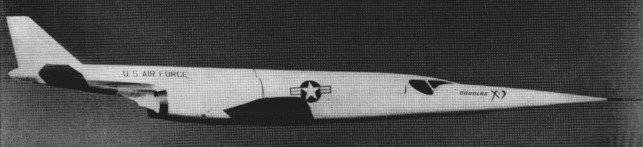
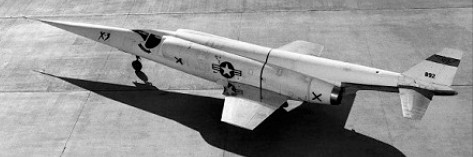
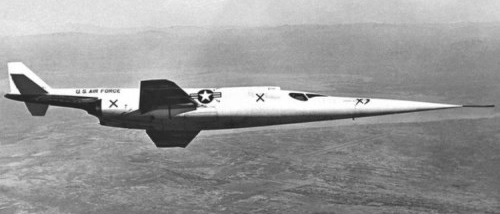
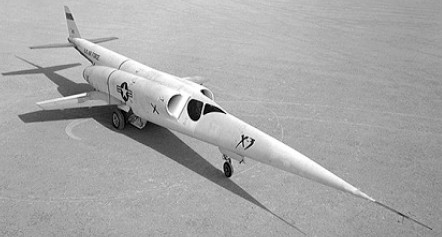
The Douglas X-3, often known as the Stiletto, was schemed for the investigation of the thermodynamic problems of flight at up to Mach 3, the performance of turbojet engines at high Mach numbers, and the characteristics of double-wedge flying surfaces at high speed. Built by Douglas Aircraft, the X-3 was jet powered and used conventional take-off and landing methods, instead of being air launched. Two X-3s were ordered. However, due to limited funding, lack of expected performance, and on-going engine difficulties, only one was completed for flight—the second was used for spare parts.
The US Air Force, Navy and NACA (predecessor to NASA) all invested in this research craft. To build the X-3 to withstand its anticipated flight regime, large amounts of titanium were used construction. Engine choice was the Westinghouse J34, one of several turbojets that failed to perform as advertised. The pilot’s ejection seat fired downwards. It raised and lowered electrically on the ground to allow access to the cockpit. The X-3 first flew on 20 October 1952, but failed to live up to its potential because the powerplant of two 4200-lb (1905-kg) afterburning thrust Westinghouse J34-WE-7 turbojets was wholly inadequate.
Although the airframe was designed to reach Mach 2.2, the best it ever achieved was Mach 1.21, in a dive. This meant it achieved little towards its objective of studying kinetic heating research. The USAF only flew the X-3 six times before handing it to NACA, who made but 20 more flights. The last of a total of 51 flights being made on 23 May 1956 It did, however, contribute somewhat to the understanding of the roll-coupling phenomenon, and pioneered the short-span low-aspect ratio wing used on several later aircraft. But the X-3’s most significant contribution may have been in the field of aircraft landing gear, namely the tires. Because the X-3 had to achieve high speeds to maintain lift, take-off and landing speeds were very high (260 mph for takeoff, 200 mph for landing), and it was common for the tires to come apart. Several aircraft tire manufacturers used data gathered by the X-3 when developing new tires for high speed applications.
To withstand the anticipated high temperatures, the glazed area was as small as possible, giving the pilot a very restricted view. The X-3 was covered in strain gauges and recording points for temperatures and pressures.
The X-3 is currently on display at the Air Force Museum in Dayton, Ohio.
Engines: 2 x Westinghouse J34 turbojets, 1900kg Max take-off weight: 10160 kg / 22399 lb Wingspan: 6.91 m / 22 ft 8 in Length: 20.35 m / 66 ft 9 in Height: 3.81 m / 12 ft 6 in Fastest Flight: 0.95 Mach (650 mph) Highest Flight: 35,000+ feet
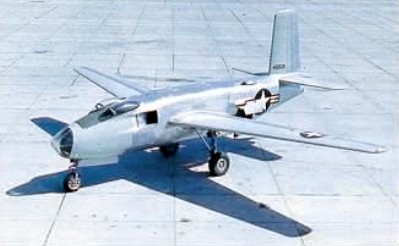
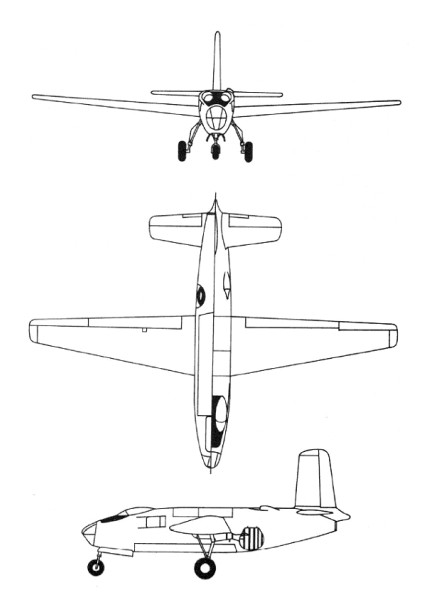
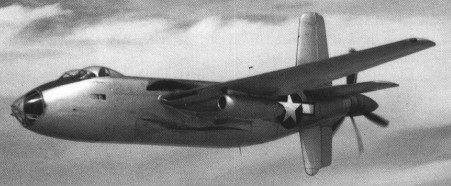
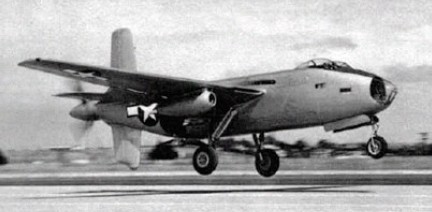
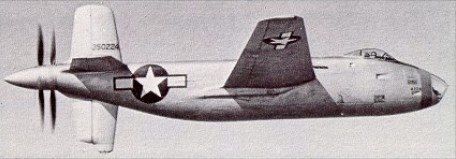
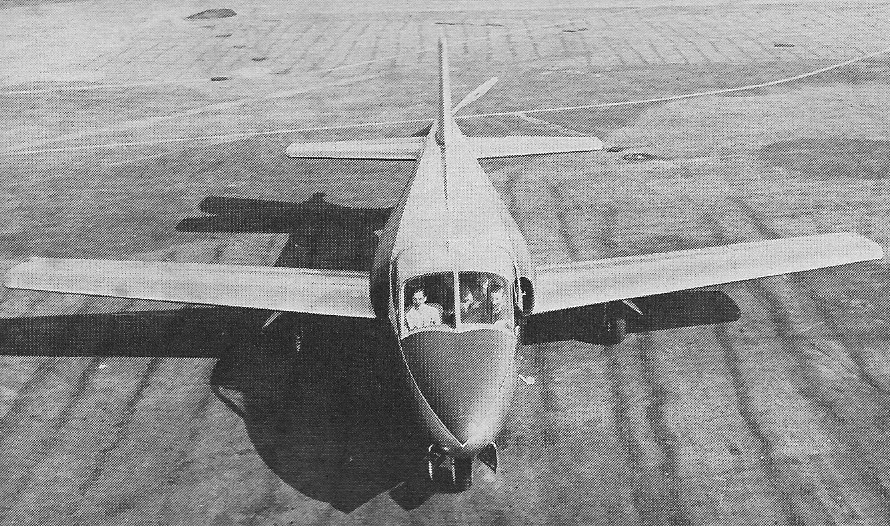
To speed the development of a pure jet bomber, the US Army Air Force contracted Douglas to produce two Douglas XB-43 bomber prototypes using the basic design of the XB-42. The proposed conversion replaced the XB-42’s Allison piston engines with two turbojets. Changes included air inlets, incorporating two extended tail pipes to discharge the jet efflux at the tail, and replacing the cruciform tail unit with a conventional structure which had a fin and rudder of increased height and area by comparison with the XB-42.
The XB-42 static test airframe was modified to produce the first XB-43. With delays resulting from the war’s end and the provision of the turbojet powerplant, eventually, the XB-43 was flown for the first time on 17 May 1946.
By that time, however, and despite the prototype’s good overall performance, The USAAF was already looking to more-capable turbojet-powered bombers and this, the US Army Air Force’s first jet-bomber, was used only for flight-test purposes. The second prototype was completed and delivered in May 1947, being used as an engine testbed before it was retired in late 1953.
XB-43 Engines: 2 x General Electric J35-GI-3 turbojet, 16.7kN Max take-off weight: 17932 kg / 39533 lb Empty weight: 9877 kg / 21775 lb Wingspan: 21.69 m / 71 ft 2 in Length: 15.6 m / 51 ft 2 in Height: 7.39 m / 24 ft 3 in Wing area: 52.3 sq.m / 562.95 sq ft Max. speed: 829 km/h / 515 mph Cruise speed: 676 km/h / 420 mph Ceiling: 11735 m / 38500 ft Range: 1770 km / 1100 miles Armament: 2 x 12.7mm rear-firing guns, 2722kg of bombs
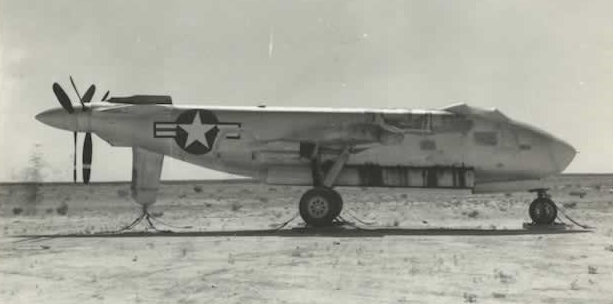
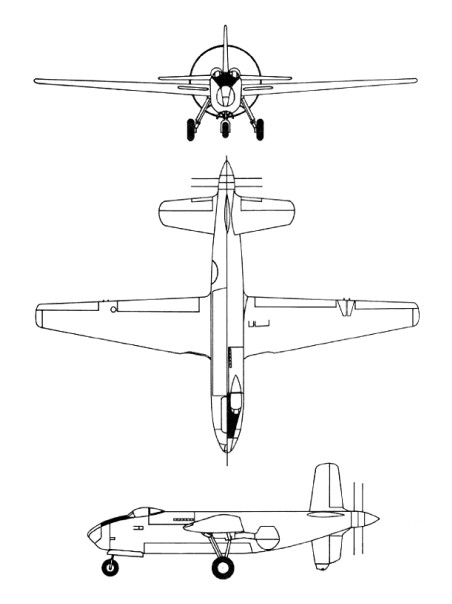
Douglas designed and built two bomber prototypes and one static test airframe under a contract received from the US Army Air Force on 25 June 1943. This was based on two 1800-hp (1342-kw) Allison V-1710-25 inline engines located in tandem in the fuselage to drive a pair of contra-rotating propellers behind the cruciform tail unit. Named Mixmaster by the company, this aircraft had a mid-set cantilever monoplane wing, cruciform tail surfaces and tricycle landing gear, whose main units retracted aft to be housed in the sides of the fuselage. The fuselage provided accommodation for a crew of three. A bomb-aimer/navigator in the nose, and the pilot and co-pilot in a side-by-side cockpit well forward on the fuselage, each beneath an individual canopy. The fuselage also incorporated an internal bomb bay, as well as housing the twin-engine powerplant in a compartment immediately to the rear of the pilot’s cockpit. The two Allison V-1710 engines were used to drive, via shafting and a reduction gearbox in the tailcone, two three-bladed contra-rotating pusher propellers to the rear of the tail unit. Opening the bomb doors in flight interrupted the airflow to the propeller and caused excessive vibrations. The bomber version had six machine guns. The four on the wing trailing edge were aimed by the copilot, whose seat could turn to face aft. An attack version armed with 16 machine guns or a 75mm cannon and two machine guns, or two 37mm cannon was proposed.
Designated XB-42, the Mixmaster was first flown on 6 May 1944.
A second prototype was flown for the first time on 1 August 1944, soon afterwards being modified by the addition of a single canopy over the pilot/copilot cockpit. This prototype was destroyed in a crash during December of that year, but by that time the USAAF had decided not to proceed with production of this design, awaiting instead the development of higher-performance turbojet-powered bombers. As an interim step to allow evaluation of turbine power, the first prototype was given a mixed powerplant comprising two 1025kW Allison V-1710-133 piston engines to drive the propellers, plus two 726kg thrust Westinghouse 19XB-2A turbojets mounted in underwing nacelles.
Redesignated XB-42A, this aircraft was used for performance testing over several months before being retired at the end of June 1949. The XB-42A is now in storage for the National Air and Space Museum. Somewhere along the way its wings were removed for transport and haven’t been seen since.
Douglas XB-42 Mixmaster in storage at Pyote AFB
XB-42 Engines: 2 x Allison V-1710-125, 1800-hp (1342-kw) Max take-off weight: 16193 kg / 35700 lb Empty weight: 9475 kg / 20889 lb Wingspan: 21.49 m / 70 ft 6 in Length: 16.36 m / 53 ft 8 in Height: 5.74 m / 18 ft 10 in Wing area: 51.56 sq.m / 554.99 sq ft Max. speed: 660 km/h / 410 mph Cruise speed: 502 km/h / 312 mph Ceiling: 8960 m / 29400 ft Range: 2897 km / 1800 miles Armament: 4 x 12.7mm machine-guns, 3629kg of bombs
XB-42A Engines: 2 x Allison V-1710-25, 1800-hp (1342-kw) & 2 x turbojets.
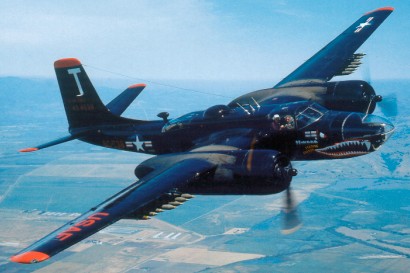
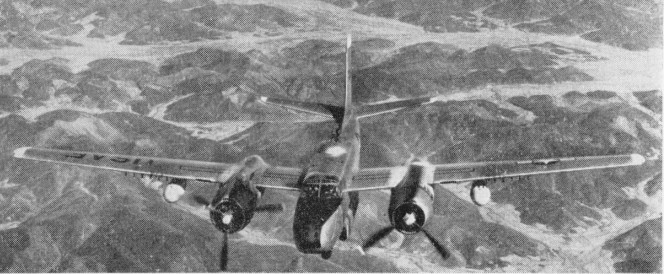
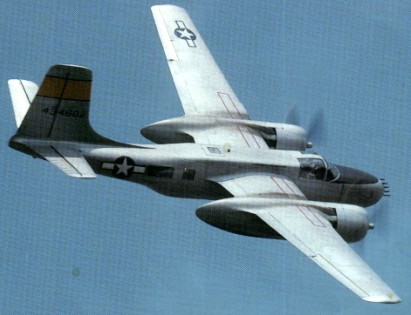
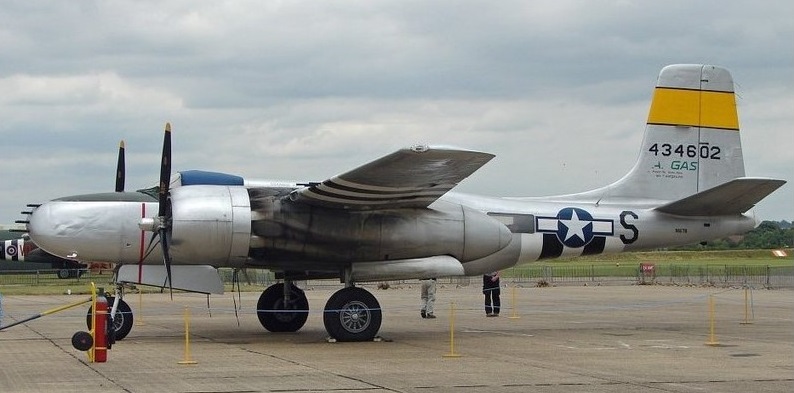
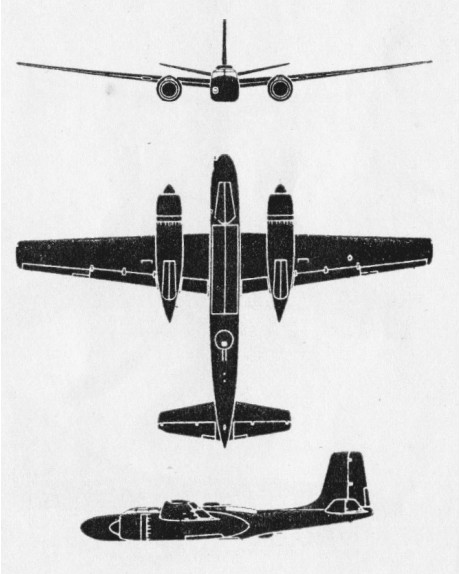
Designed to fulfil a USAAF requirement for an attack bomber to replace the B 26 Marauder, the B 25 Mitchell and the A 20 Havoc, the Douglas A 26 Invader first prototype flew on 10 July 1942. Three prototypes had been ordered in differing configurations: the Douglas XA-26 attack bomber with a bomb-aimer’s position; the XA-26A heavily-armed night-fighter; and the XA-26B attack aircraft with a 75mm cannon. After flight testing and careful examination of reports from Europe and the Pacific, the A-26B Invader was ordered into production, and deliveries to operational units began in December 1943. By the end of World War Two, production of the Invader had ceased. A total of 2,446 were built.
The A-26B Invader had six 12.7mm machine-guns in the nose, remotely controlled dorsal and ventral turrets each with two 12.7mm guns, and up to 10 more 12.7mm guns in underwing and underfuselage packs. Heavily armoured, and able to carry up to 1814kg of bombs, the A-26Bs two, 1491kW Pratt & Whitney R-2800 engines conferred a maximum speed of 375 mph / 571km/h, making the A-26 the fastest US bomber of World War II.
B-26B
Missions with the 9th Air Force in Europe began in November 1944, and at the same time the type became operational in the Pacific. The A-26C with a bomb-aimer’s position and only two guns in the nose entered service in 1945, but saw only limited use before World War II ended. A-26C production totalled 1,091. With little employment ahead of them, so far as anyone could see, one A-26B and one A-26C were converted to XJD-1 configuration, this pair being followed by 150 A-26Cs converted as target tugs for the US Navy with the designation JD-1; some were converted later to launch and control missile test vehicles and drones, under the designation JD-1D. These designations became UB-26J and DB-26J in 1962.
In 1948 the Martin Marauder was finally retired from service and the Invader took over the B 26 designation, it having previously been designated an ‘Attack’ aircraft as the A 26. Two principal sub types were in operation at this time, B 26B and C. The B 26B had a solid nose containing its main armament of six 0.5in Browning machine-guns and the remotely controlled dorsal and ventral turrets, each mounting two similar guns. The B 26C had a transparent nose.
Throughout the 1950s, the B 26 operated with the US Air Forces Europe (USAFE) as a light bomber, target tug and tactical reconnaissance aircraft. The build up of American forces in Europe, which had commenced in 1949 under the leadership of Lt General Curtis E LeMay, proceeded apace in the early 1950s. The B 26B arrived at Laon in France with the 126th Light Bombardment Wing in July 1952; and in December of that year the 7554th Tow Target Flight located to Furstenfeldbruck airbase in Germany. This unit flew the TB 26B variant.
A-26
The RB‑26s did not get off to an auspicious start. Primarily this was due to a lack of equipment, spares and appropriate facilities. On arrival in Germany only 15 days’ supply had been brought over from the US. In addition to this, their all‑important night photo missions were held up for some weeks because no one had made the necessary arrangements for a suitable range for the use of flash bomb cartridges. Eventually arrangements were made with Strategic Air Command to use the ranges at Lakenheath.
Flying for an RB‑26 crew for the first few days of their deployment in Europe consisted of familiarisation flights over their new homeland. Even this became restricted when, in May and early June, a refinery strike in the US severely restricted the use of fuel. For the period of the emergency each pilot was only allowed to for 20 hours.
The RB‑26s were fitted with the comparatively new ‘Hell Roarer’ magnesium illuminator system with split vertical camera installation using the A18 magazine. The ‘Hell Roarer’ was demonstrated to interested parties on November 5 over the Bay of Naples. It turned out to be a veritable firework bonanza. In the cold light of dawn, on November 6 the demonstrating RB‑26 was seen to have a badly scorched tail.
The RB‑26s suffered particularly from severe icing and were grounded for long periods when the temperatures were very low. In late 1953 the problems with the RB‑26 were such that the USAFE prepared to re‑equip the 1st and the 30th TRS with the ‘state‑of‑the‑art’ Martin RB‑57A Canberra. As early as December, crews were being checked out on their respective wings’ Lockheed T‑33s prior to going to Shaw AFB in the USA, home of the 363rd Tactical Reconnaissance Group, a unit also destined to receive the RB‑57A.
Significantly, while the 1st and 30th TRS were preparing to re‑equip with the RB‑57A and relinquish their RB‑26s, in March 1954 another squadron was activated at Spangdahlem with the 10th TRW which began to equip with the older aircraft. The 42nd TRS was activated on March 18.
The 42nd was divided into two flights ‑W and B. W Flight was for weather reconnaissance, and S had the electronic mission. The first RB26 was assigned to W Flight on June 18 and it was not until December that the first aircraft was assigned to B Flight. By this time the weather flight had received its full complement of aircraft.
The aircraft of B Flight increased in sophistication throughout their service with the squadron until replaced in 1956 with the Douglas RB‑66C. The RB‑26s of W Flight were replaced by T‑33As in 1955.
Used also for reconnaissance and target towing, and by Air National Guard. U.S. Navy uses same type as JD-1 for target towing.
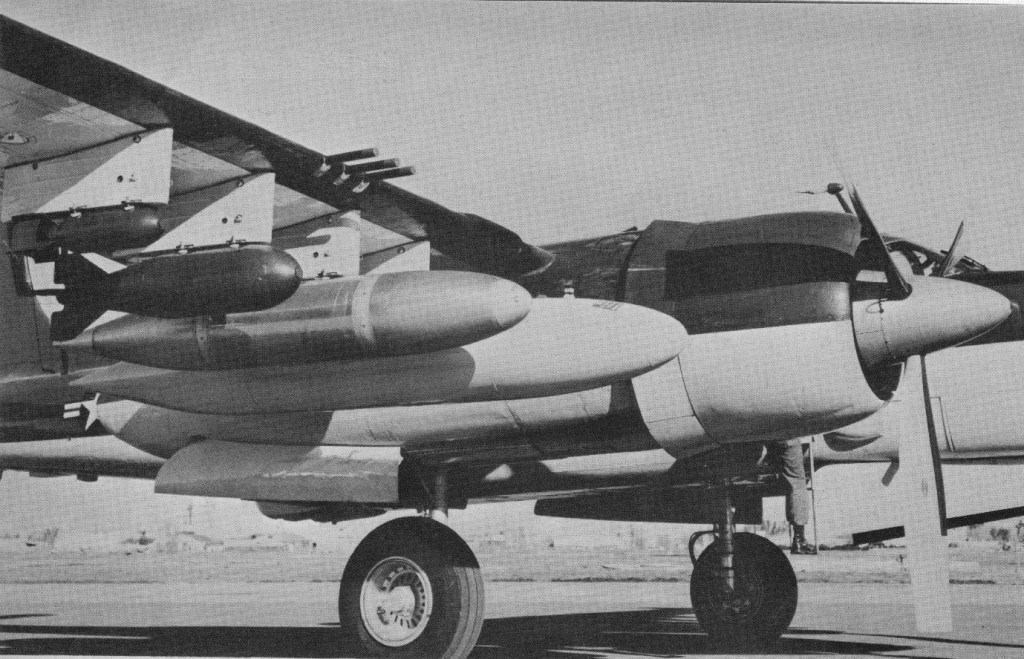
A special COIN version with very heavy armament and extra power was developed by On Mark Engineering in 1963, a prototype being designated YB-26K and named Counter Invader. Subsequently about 70 B-26s were converted to B-26K standard, 40 later being redesignated A-26A. Some were deployed in Vietnam, and others were supplied to friendly nations under the Military Assistance Program. B-26s were used also for training (TB-26B and TB-26C), transport (CB-26B freighter and VB-26B staff transport), RPV control (DB-26C), night reconnaissance. (FA-26C, from 1948 redesignated RB-26C) and missile guidance research (EB-26C). After the war, many A-26s were converted to executive, survey, photographic and even fire-fighting aircraft.
The YB-26K was the test ship for a series of highly modified B-25Ks ordered by the USAF from On Mark Engineering. The production version was to utilise clip-on gun pods instead of wing mounted guns and eliminate JATO racks seen on the YB-26K. The On Mark received old B-26’s from Davis-Monthan AFB storage or Tactical Air Command. $13,000,000 was allotted to rebuild and extensively modify the bombers.
YB-26K
Changes between the B-26B and YB-26K included the wingspan increased 2 feet to 72 ft; normal gross weight up 5000 lb to 41,000 lb; engine horsepower up 500hp each to 2500hp; maximum speed up 31kt to 345 kt; stall speed lowered 9kt to 76kt; rate of climb up 255fpm to 2990fpm; service ceiling raised 7000ft to 30,000ft; and combat radius increased 290nm to 500nm.
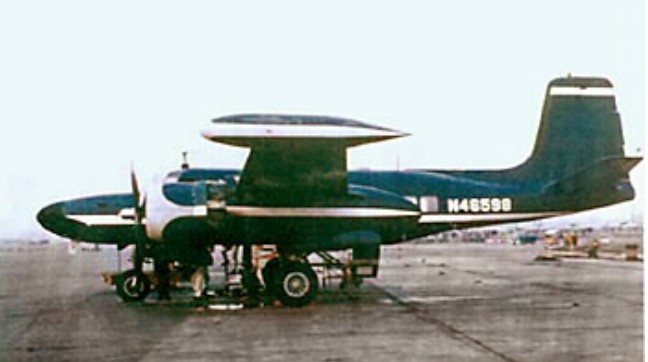
Air America’s night drop bird, 598, aka The Blue Goose or the Blivit. Parked on the Ramp at Udorn in June of 1967. It had an F111 a Terrain Following Radar (TFR) in the nose. This feature allowed low level, jungle top resupply drops at night along the Ho Chi Minh trail between the Mu Gia Pass to Tchepone. 598 had a drop ramp in the aft section and two supply pallets could be carried/dropped. It had a crew of four. Two pilots, a navigator, and a kicker or Air Freight Specialist as they were officially titled.
In total 1,355 were built.
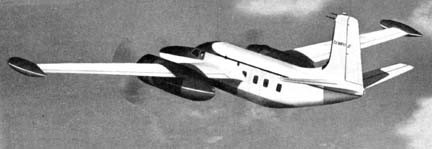
L B Smith Aircraft Corp of Miami FL., produced an executive transport version of surplus Douglas B-26 as the Smith Tempo II in 1959.
A 26B Invader Engines: 2 Pratt & Whitney R-2800. Top speed: 355 mph.
Douglas A 26 C Invader Engine : 2 x Pratt&Whitney R 2800-70 Double Wasp, 1973 hp Length : 51.247 ft / 15.62 m Height: 18.241 ft / 5.56 m Wingspan : 70.013 ft / 21.34 m Wing area : 540.030 sq.ft / 50.170 sq.m Max take off weight : 35006.6 lb / 15876.0 kg Weight empty : 22854.8 lb / 10365.0 kg Max. speed : 324 kts / 600 km/h Cruising speed : 247 kts / 457 km/h Service ceiling : 22096 ft / 6735 m Wing load : 64.78 lb/sq.ft / 316.0 kg/sq.m Range : 1217 nm / 2253 km Crew : 3 Armament : 6x cal.50 MG (12,7mm), Bombload 1814kg
B-26B Engines: 2 x Pratt & Whitney R-2800-27 or -79 Double Wasp, 1491kW Wingspan: 21.34 m / 70 ft 0 in Length: 15.24 m / 49 ft 11 in Height: 5.64 m / 18 ft 6 in Wing area: 50.17 sq.m / 540.02 sq ft Max take-off weight: 15876 kg / 35000 lb Empty weight: 10365 kg / 22851 lb Fuel capacity: 770-1590 gal Max speed: 571 km/h / 355 mph at 15,000 ft Cruise speed: 457 km/h / 284 mph Service ceiling: 6735 m / 22100 ft Range max load: 2253 km / 1400 miles Armament: 10 x 12.7mm machine-guns, 4000 lb / 1814kg of bombs Crew: 3
B-26B Engines: 2 x Pratt & Whitney R2800-79. 2,000 h.p. Wingspan: 70 ft Length: 50 ft. 8 in. Loaded weight: 35,000 lb. Max. speed: 359 m.p.h. Ceiling: over 28,000 ft. Max. range: 1,900 Miles. Armament: 10 x 0.50 in. machine-guns, 6,000 lb. bombs, 14 x 5 in. rockets. Crew: 3
RB-26 Invader
Smith Aircraft Corp Tempo II Engines: 2 x P&W R-2800-C, 2100hp Wingspan: 73’6″ Length: 60’4″ Max speed: 365 mph Cruise: 350 mph Stall: 102 mph Seats: 12
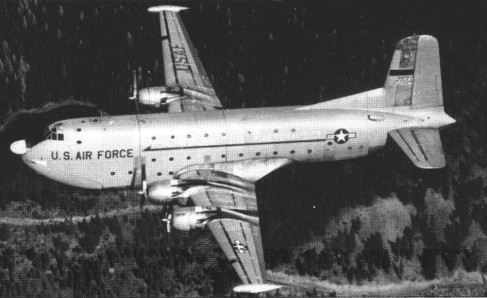
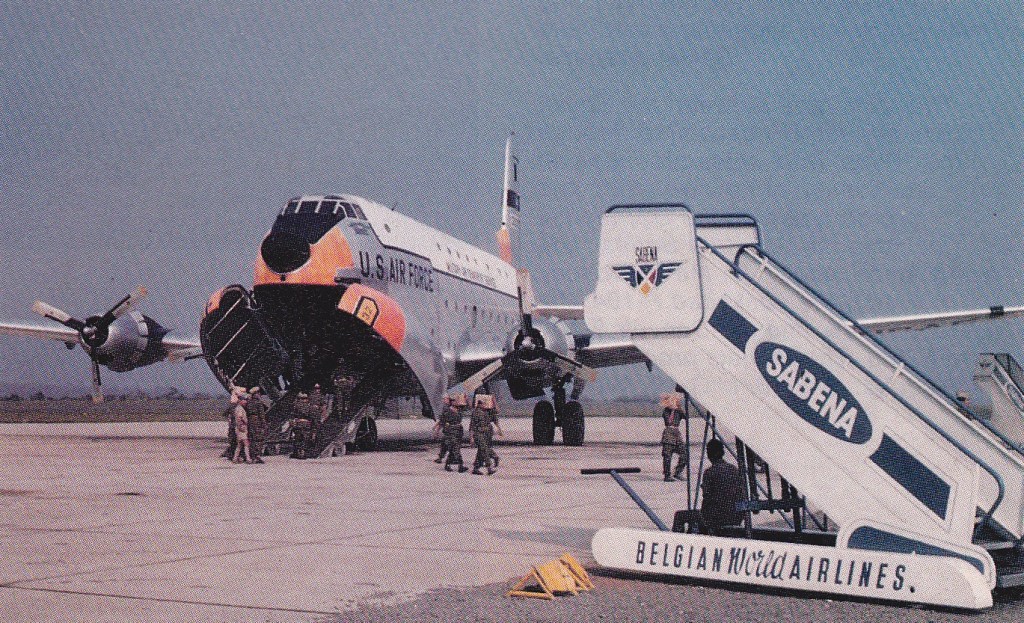
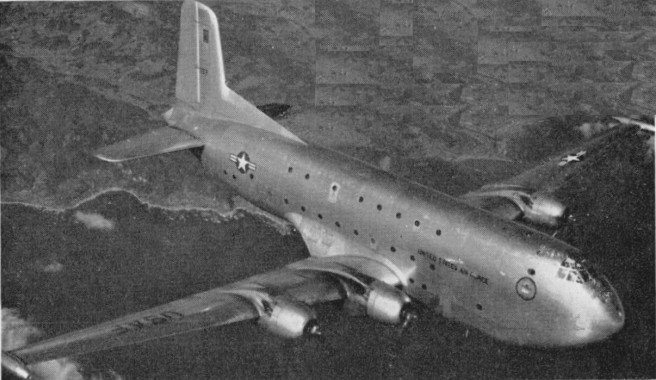
Although the production run of the C-74 Globemaster had been held to 14 airframes, the success of this oversized transport led the US Air Force and Douglas to agree upon construction of an improved long-range transport. The fifth C-74 airframe was used to create the service-test YC-124 Globemaster II which retained the earlier aeroplane’s wings, tail surfaces, and 2610kW R-4360-49 engines. The YC-124 flew on 27 November 1949. The new fuselage was double-decked and the aircraft had enormous clamshell loading doors at the nose with an associated built-in loading ramp, an electric hoist amidships, and two overhead cranes (each with a capacity of 7257kg which could traverse the entire length of the 23.47m-long cargo hold. When used in a transport role (with two decks installed), the Globemaster II could carry a maximum of 200 fully-equipped troops, or 123 stretcher cases plus 45 ambulatory patients and 15 medical attendants.
A pre-production aircraft and 28 C-124A models were retrofitted with the ‘thimble’ nose fairing containing ASP-42 radar. Douglas then manufactured no fewer than 243 C-124C models, with the radome as standard, increased fuel, wingtip fairings housing combustion heaters to de-ice the wing and tailplane leading edges and to heat the cabin, and other improvements. The first service Globemaster began duty in May 1950, the month before the outset of the Korean War. Although production was finished by May 1955, the Globemaster II remained a standard in USAF service for years thereafter.
C-124C Globemaster II of 39th Air Transport Squadron flying supplies to Leopoldville in 1963
The Globemaster IIs remained in service until replaced by the Lockheed C-5A Galaxy during 1970. The YKC-124B Globemaster II was Douglas’ bid for a major order for air refuelling tankers. In 1951, engineers began working on a C-124 airframe to be powered by 5,500-shp Pratt & Whitney YT34-P-1 turboprop engines. Gas turbine power produced a kind of ‘Super Globemaster II’ with greater speed, altitude and range capability than the ‘recip’ aeroplane but for reasons not now clear, the USAF decided instead to order the Boeing KC-97 Stratofreighter as its standard tanker even though the latter aircraft did not perform so well. By the time the turboprop Globemaster II flew on 2 February 1954, it had been redesignated YC-124B and was used for proof-of-concept evaluations. Though no orders resulted from its 32-month test programme, the YC-124B contributed substantially to knowledge needed when the C-133 Cargomaster came along.
C-124C Globemaster II Engines: 4 x Pratt & Whitney R-4360-63A Wasp Major, 3800 hp / 2795kW Wing span 173 ft 3 in / 53.1 m Length 130 ft 5in / 39.8 m Height 48ft 3.5in / 14.7 m Wing area: 2,506sq.ft. / 233.0 sq.m Empty weight: 101,165 lb. Max weight: 194,5001b. Max speed: 298 mph at 20,800 ft Cruise speed: 520 km/h / 323 mph ROC: 800 fpm Service ceiling: 21,800 ft. Range w/max.fuel: 6500 km / 4039 miles Range w/max.payload: 1970 km / 1224 miles Crew: 5 Passenger capacity: 200
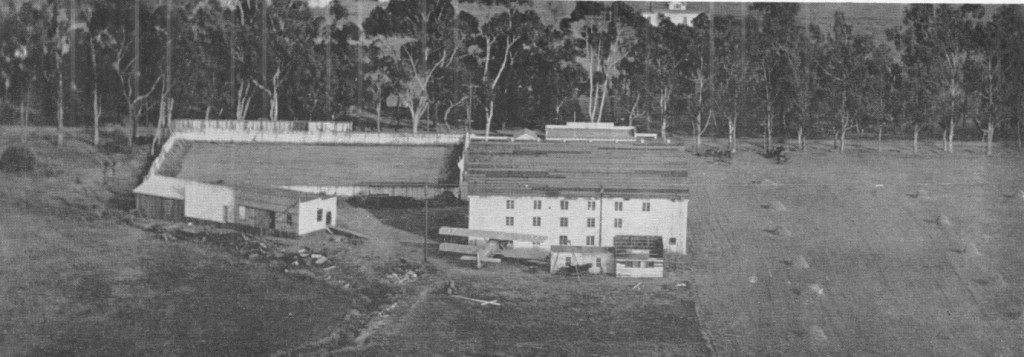
Donald Douglas, the son of a bank cashier in Brooklyn, came to Los Angeles in 1915 with a degree from the Massachusetts Institute of Technology. By 1922 he had established a factory with a capital of $350 in an abandoned motion-picture studio in Santa Monica, where he built torpedo plane for the US Navy. Two years later he had signed for his first export order, to Norway.
Douglas Aircraft, Santa Monica, California, 1920s
The Davis-Douglas Cloudster of 1920, Donald W. Douglas’s first design, was followed in 1921 by the DT torpedo- bomber for the U.S. Navy, the largest single-engined aircraft in the U.S.A. at the time. Four modified DTs, known as Douglas World Cruisers, made the first round-the-world flight in 1924, with Army crews. The Douglas Aircraft Company was formed in 1928, and in July 1929 a former Douglas engineer, Jack Northrop, set up the Northrop Aircraft Company and produced an all-metal low-wing dive-bomber, the XBT-1/A-17.
Donald Douglas, at left, working on the Cloudster design.
With the help of designer Jack Northrop, Lockheed built the F1, but it was turned down by the Navy. In 1923 Northrop left to take a job with Donald Douglas, and later founded his own corporation.
Northrop and Douglas merged in 1937 (Douglas with a majority stockholding), and in 1938 it became Douglas-El Segundo. The dive-bomber design progressed, via the Douglas TBD Devastator of 1934, to become the U.S. Navy’s first monoplane, and was followed by the Dauntless SBD. Ultimate Douglas development of the single-engined piston-engined attack-bomber was the 1945 Skyraider, which served in many roles until 1968, both in Korea and Vietnam. Last single-engined military designs by Douglas were the small delta-wing F4D Skyray jet fighter (first flown January 1951) and highly successful A4D Skyhawk jet attack-bomber (first flown June 1954 and 2,960 built up to 1979; current programs around the world keep substantial numbers of Skyhawks operationally capable with foreign forces).
The first twin-engined Douglas design appeared in 1925; the T2D for the U.S. Navy. The B7 of 1930 was the first of a series for the U.S. Army, and was followed by the B-18 in 1935. The most famous twin, however, was the DB-7/A-20 Boston (and nightfighter Havoc), which first saw action in June 1940. A total of 7,385 was built, of which 3,125 went to Russia. The A-26/B-26 Invader of 1945, developed from the A-20, served in Korea and Vietnam, and the Boston/Havoc concept was taken into the jet age by the Skywarrior and Skynight. A version of the former became the B-66 Destroyer, Douglas’s (and the USAF’s) last conventional light-attack bomber.
In 1933, under pressure from United Airlines’ Boeing 247, Transcontinental & Western Air turned to Douglas to provide a competing aircraft. The first DC-1 (Douglas Commercial) appeared in prototype only, but 131 DC-2s followed in 1932-1936. The first commercial orders were in 1933 for 40 DC-2 for the new Trans World Airways. A wide-bodied sleeper version, the DST, led to the DC-3 in 1936, which was to be the most famous airliner of all time. In 1940 the USAAC ordered it as the C-47 transport. Douglas built 9,255 of the 10,125 produced, and in 1961 1,000 were still in military use, and 600 civil DC-3s remained in operation in the U.S.A. in 1974. Douglas, consulting five airlines, developed a four-engined version, the DC-4, in 1941. The Army commandeered all civil DC-4s on U.S. entry into the war, and 1,162 military C-54s were built. After the war many reverted to DC-4 status, to be succeeded by the DC-6 and DC-7.
At Santa Monica, the Douglas company had made 29,000 aircraft during World War 2, but produced 127 in 1946.
Douglas temporarily lost its lead in transport when Boeing produced the Model 707, but then produced the very effective DC-8 and DC-9 jet.
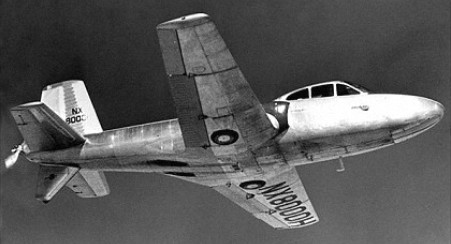
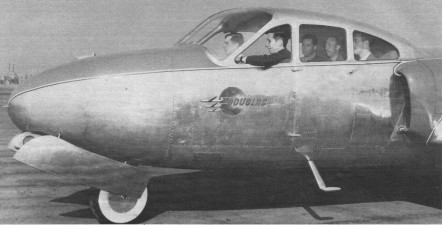
Military transport design continued with the big C-124 Globemaster in 1950, and C-133 Cargomaster of 1957, a heavy strategic freighter capable of carrying all the thencurrent IRBMs or ICBMs. In 1947 Douglas went supersonic with the jet D-558-1 Skystreak and D-558-2 rocket Skyrocket, built for NASA. The latter held the world speed record in 1953 at 1,981km/h and achieved Mach 2.01 at 19,810m in 1953. The later X-3 research aircraft was intended for flight at up to Mach 3. There was a brief involvement with executive jets with the PD-808 Vespa-jet, production being transferred from El Segundo to Rinaldo Piaggio before, in 1967, the company merged with McDonnell Aircraft to become McDonnell Douglas.
Douglas files bankruptcy and was forced to sell at a knocked down price to McDonnell of St. Louis, which had been making handsome profits out of its F-4 Phantom, supplied to the air force in Vietnam.










 All Aero