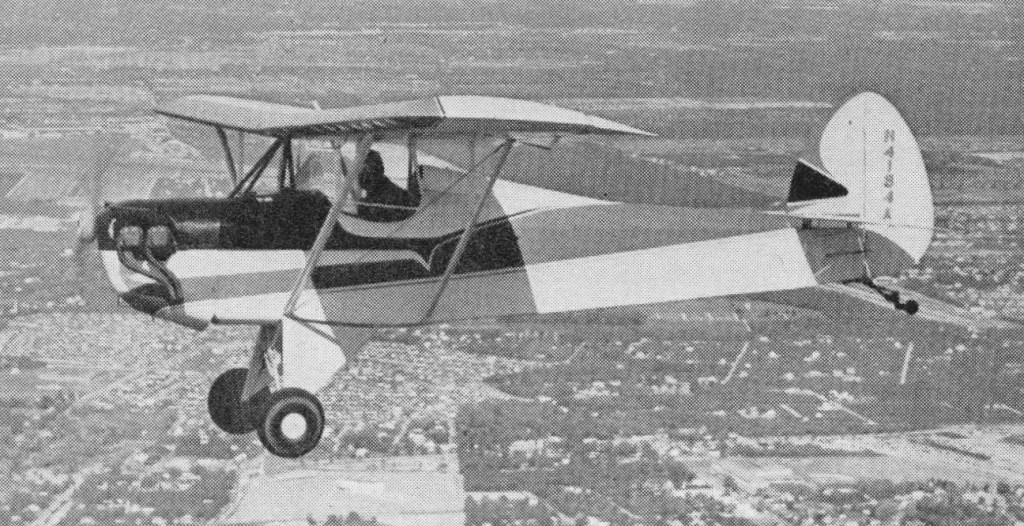
A variation of the Baby Ace of the 1930’s, the Dunn D-1 was built in spare time by E.Dunn around 1959. Power is by a Continental A-65 and cruise is 95 mph.
A variation of the Baby Ace of the 1930’s, the Dunn D-1 was built in spare time by E.Dunn around 1959. Power is by a Continental A-65 and cruise is 95 mph.
USA
Based at Opa Locka, this company produced modified Beech 18, increasing performance considerably, under the designation Dumod I. A further development, known originally as the Infinite, later as Dumod II, was produced from 1964. Rights to both acquired by Broome County Aviation in 1972.

A later and larger successor to the D.5 Turbi, the D.6 Condor was similarly a low-wing, wooden-framed monoplane available as a licence-built product or as a home build from plans.
The initial version was designated D.61 and was designed for Continental engines of 65 or 75 hp.
The D.62 was, like the D.31, built under licence by Rollason in the UK from 1961. Variants include versions converted for glider towing.
First flow in 1961, the D.62A was a pre-production version of which two were built. The D.62B was the standard production version.

The D.62C was specially equipped for glider towing with wingtip endplates, larger wheels, raised cockpit canopy, and 130 hp Rolls-Royce Continental O-240 engine.
The Condor was given a dual system of c/ns when in production with Rollason. A number prefixed RAE was re-located using exactly the same number as the aircraft’s PFA number. Production was centred on Croydon, with first flights from Redhill. Production was transferred in 1973 to Shoreham although none wee finished there.
Versions:
D.61 – Basic version, Continental A65 or A75
D.62 – Initial UK version, Continental C90
D.62A – initial production version. Rolls-Royce/Continental O-200-A
D.62B – Refined D.62A, all after c/n RAE.612, fitted with flaps
D.62C- Glider tug, Rolls-Royce/Continental O-240-A
D.63 – Tricycle undercarriage
D.62A
D.62B
Engine: 1 x 75hp Continental A 75
Max take-off weight: 669 kg / 1475 lb
Wingspan: 8.72 m / 28 ft 7 in
Length: 6.95 m / 22 ft 10 in
Height: 1.75 m / 5 ft 9 in
Cruise speed: 160 km/h / 99 mph
Range: 627 km / 390 miles
D.62B
Engine: Continental O-200, 100hp
Wingspan: 27 ft 6 in / 8.38 m
Length: 22 ft 6 in / 6.86 m
Empty weight: 920 lb / 417 kg
MTOW: 1475 lb / 670 kg
Max cruise: 100 kt / 115 mph / 185 kph
ROC SL: 610 fpm / 185 m/min
Service ceiling: 12,000 ft / 3650 m
Range MAUW: 285 nm / 328 mi / 528 km
Seats: 2
D.62C
Engine: Rolls-Royce Continental O-240, 130 hp

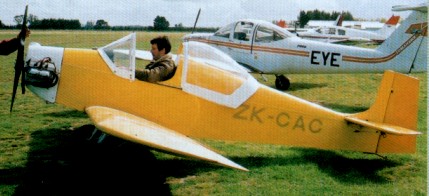
The Turbulent is an ultra-light single seat, low wing monoplane designed by M. Roger Druine in the mid 1950s, the Turbulent is normally fitted with a 30 h.p. Ardem or VW conversion, although engines up to 45 h.p. may be installed.
First flown in 1951, the initial French D.3 version, was powered by a 25 hp modified Volkswagen engine.

The fuselage is a rectangular box structure having four longerons, wooden frames, a curved turtle deck and plywood covering. The empennage structure is of wood, the tailplane and fin are plywood covered, the elevator and rudder being fabric covered. The wings are a one piece, two spar structure; the front spar having laminated spruce booms and plywood webs to form a box. A diagonal drag spar is also fitted between the front and rear spars. The ribs are of open lattice type, the aerofoil section being NACA 23012. A built-in fixed slot is located at the leading edge forward of each aileron. The leading edge is plywood covered, forming a D-nose torsion box, while the remainder of the wing is fabric covered. The main undercarriage is of divided type and uses coiled springs for shock absorption. An 8.8 Imp. gallon fuel tank is installed behind the firewall. The airframe being non-aerobatic.
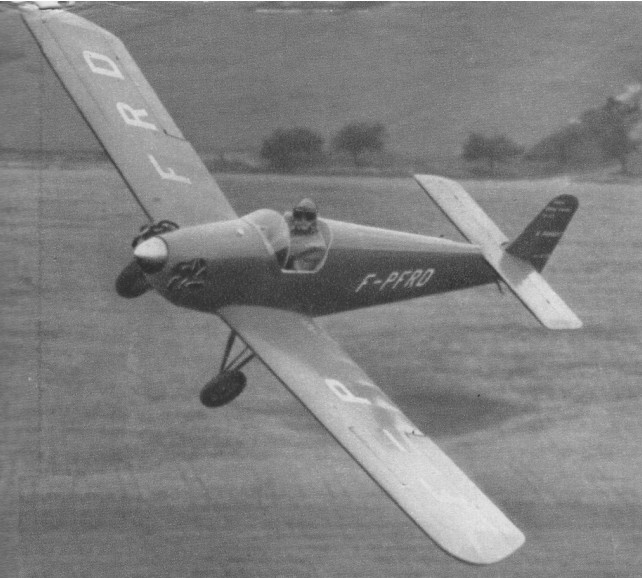
Powered by a 25 h.p. Volkswagen air-cooled car engine fitted with dual ignition and a two-bladed wooden airscrew, the Turbulent runs on 73-octane or premium car petrol, consuming 7.5 litres (1.7 gal) an hour whilst cruising, and has an extreme endurance of three hours.
This is an aircraft designed to be built by amateurs with no more than a reasonable knowledge of carpentry. Complete plans were on sale in France for 5,000 francs, and the materials bought from several firms there. The main difficulty lies in the engine. The Volkswagen is recognized in France but not abroad. (M. Druine intended to fit a 44 h.p. Lutetia vee-four and to fly his Turbulent over to England for a Coventry meeting). So far, 126 sets of plans have been sold all over the world and more than 20 Turbulents have been completed in France. M. Druine calculates that the materials cost about £150, the engine about £90, and that 800 man hours are required for construction.
In 1957 Rollason Aircraft & Engines Ltd was finding that sales of reconditioned Tiger Moths were dropping and Norman Jones was looking for another low cost aircraft for the company to manufacture. He decided that it should produce a licence built version of the Turbulent and, after introducing some mod-ifications, started to produce the aircraft in 1958. The modified D.31A, with improved main spar and an Ardem 4C02-10 was capable of gaining a full certificate of airworthiness. Over 30 were eventually produced by Rollason.
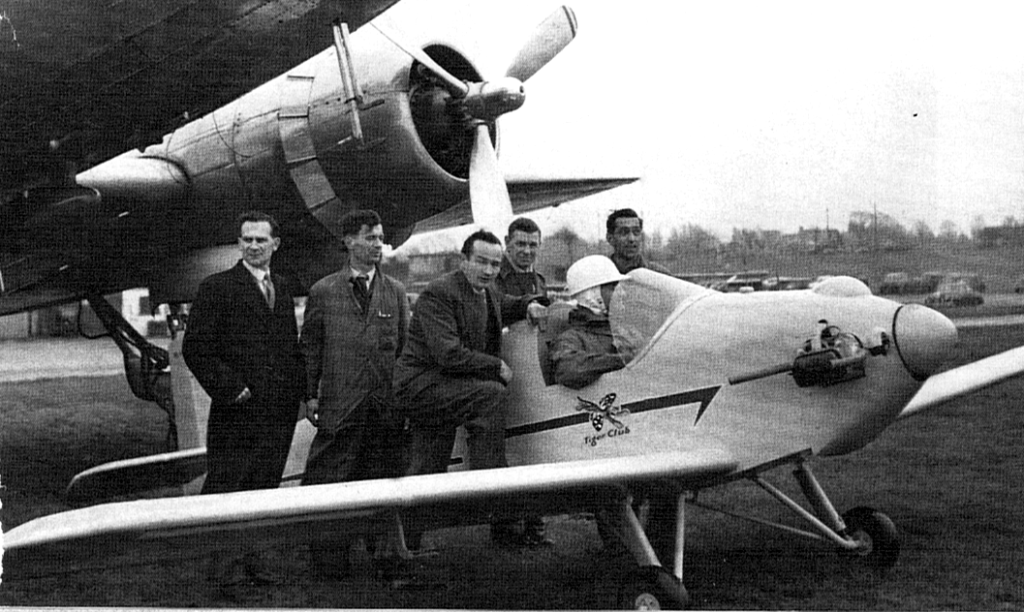
In 1955 Hans-Joachim Ludwig, a glider pilot, obtained thee licence rights from Druine to construct the Turbulent. As he did not have the financial means to construct the aircraft, he arranged to transfer the licence to Wilhelm Stark. As a result, Stark formed the Wilhelm Stark Flugzeugbau K.G. in Minder/Westfalen to undertake the quantity production of the Turbulent in Germany. But the official German aircraft regulations would not allow the original turbulent to receive a certificate of approval. Consequently, minor modifications were made to strengthen the design and at the same time a fully-enclosed cockpit was added. The first was built in Starks’ cellar, powered by a VW, it received the German certificate of approval.
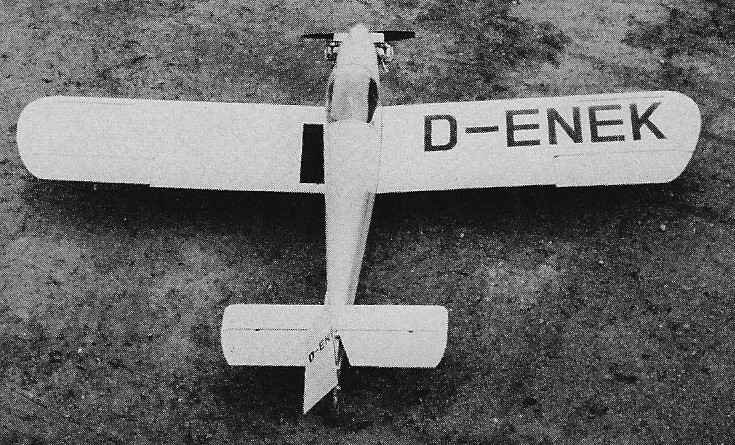
Stark established a small series production facility in a hanger on the Minden airfield. The prototype, D-EJON, after crashing from a stall was rebuilt with a slightly larger wing and became the second prototype, with the same registration.
By the summer of 1958 several Stark Turbulent D’s had been built. A total of 16 were built before production ended.
Experience
Turbulent F-PGYQ, which belonged to the designer, was kept in the Hurel-Dubois experimental hangar at the Villacoublay subsidiary airfield.
I climbed into the cockpit, fastened the lap-strap, lowered a pair of borrowed goggles and listened while M. Druine bent down and explained the cockpit to me. There were six instruments, from left to right: A.S.I. (km/hr), insensitive altimeter (metres), magnetic compass, rev counter, and V.S.I. (m/ sec). A ball-type slip indicator (below the compass), a magneto switch, throttle, stick and pedals completed the appointments.
I was told to cruise at 2,600 r.p.m. (maximum 2,800) and that was all. The airscrew was swung, and I taxied carefully out. The cockpit is just large enough, the view in all directions excellent and, although the undercarriage is a little hard, directional control is all that one could desire with the engine set at 1,600 r.p.m. The rudder is then effective and the speed over the ground about 4 m.p.h.
At the end of the grass runway I performed some Vital Actions. There was in fact nothing to do but (on this occasion) to turn the aircraft down-wind. I opened the throttle and it accelerated smoothly without any appreciable swing. The tail came up after 40 or 50 yd and after about 200 yd I flew the Turbulent off. I was immediately assailed by a series of sharp bumps and climbed away carefully, avoiding a hangar roof only to hit a violent bump over a road. But the little aeroplane rode the bumps well without any tendency to “fall out of one’s hands.” An aircraft of this size is naturally greatly affected by turbulence, but the Turbulent is eminently manageable under such conditions. The cockpit was quite warm and only one’s shoulders and forehead were exposed to a gentle slipstream. At 2,600 r.p.m. the speed built up to 110 km/hr (60 kt) indicated (120 km/hr, or 66 kt, actual). Stick forces are very light and although depending on the amount of fuel and the weight of the pilot, the trim will vary, the effect is never enough to cause any discomfort. There is a large P.E. on the A.S.I. and 16.5 kt indicated is about 27 kt actual.
I tried a slow run at 35 km/hr (19 kt) indicated with the nose well up and, into wind, almost succeeded in hovering relative to the ground. There was no decrease in control effectiveness and, on opening the throttle, cruising speed was rapidly regained. I next tried to turn the aircraft by taking my hands off the stick and holding one arm out sideways. This resulted in a slight yaw but no change in lateral attitude. One felt very free and cool; this would be the ideal occupation on a hot summer’s day.
Next I tried a stall. This is quite remarkable. I cut the power, held the nose a little way above the horizon, and waited. At no more than 28 km/hr (15.3 kt) indicated the Turbulent nodded sharply forward without dropping a wing; immediately the nose fell below the horizon the speed rose to just below 40 kmlhr (22 kt) and, being then unstalled, the nose came up again with the stick still held back. As it passed the horizon it stalled and nodded again-and so on for five or six stalls with the stick held back and without any sign of yaw or wing-drop. 1 tried it into wind and cross-wind with exactly the same results. The Turbulent simply “went downstairs” like a well-behaved child in a strange house. These characteristics are probably due to slotted ailerons and leading-edge slots forward of them, and to a very smooth plywood-covered wing leading edge.
I had to make the approach down-wind over a wood which was causing some vicious bumps. I settled down with a trickle of power at 70 km/hr (38 kt); despite the following wind, the angle of approach was quite steep and I had no difficulty in touching down by the caravan. It required very little round-out and there was not much float, and at no time did one lose a good view ahead over the nose. The landing run was about 150 yd.
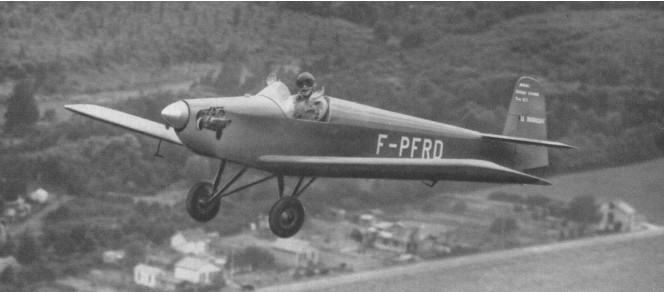
Some early standard Rollason-built D.31 were powered with 30 hp Ardem or Porsche engines. The Rollason D.31A developed version featured an improved main spar.
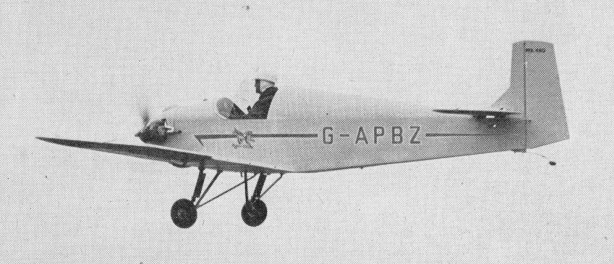
D.3
Engine: VW, 25 hp
Rollason D.31
Engine: Ardem or Porsche, 30 hp
Rollason D.31
Engine: Ardem 4C02 Mk.IV, 45 hp ot Mk.V, 55 hp
Wingspan: 21 ft 7 in / 6.58 m
Length: 17 ft 6 in / 5.33 m
Empty weight: 395 lb / 179 kg
MTOW: 620 lb / 291 kg
Max cruise 45hp: 87 kt / 100 mph / 161 kph
ROC SL 45hp: 450 fpm / 137 m/min
Service ceiling 45hp: 9000 ft / 2740 m
Range 45 min res, 45hp: 217 nm / 250 mi / 400 km
Seats: 1
Baggage capacity: 25 lb / 11.5 kg
Rollason D.31A
Engine: Ardem Mk.X, 45 hp
MTOW: 700 lb / 316 kg
Stark Turbulent D
Engine: Stamo 1400, 42 hp
Wingspan: 7.15 m
Length: 5.30 m
Height: 1.88 m
Empty weight: 200 kg
MTOW: 310 kg
Top speed: 175 kph
Cruise speed: 150 kph
Stall: 45 kph
Landing speed: 65 kph
Ceiling: 3600 m
Range: 500 km
Stark Turbulent D
Engine: Zundapp, 50 hp
Wingspan: 7.15 m
Length: 5.45 m
Height: 1.88 m
Top speed: 165 kph
Cruise speed: 145 kph
Ceiling: 3600 m
Range: 450 km
Engine: 25 h.p. Volkswagen dual ignition
Prop: two-bladed wooden
Fuel: 73-octane or premium car petrol
Wing span: 6 m 55 cm (21ft 6in)
Length: 5 m 25 cm (17ft 3in).
Consumption cruising: 7.5 litres (1.7 gal) an hour
Max endurance: 3 hours
Engine VW 45hp.
Gross weight: 620 lbs
Empty wt: 395lbs.
Fuel cap: 8.75gal.
Wingspan: 21’7”.
Length: 17’6”.
Wing area: 77.5 sq.ft.
Vmax 109mph.
Cruise 100 mph.
Climb rate: 450 fpm.
Ceiling 9000 ft
Range 250 sm.
Take off run: 500’.
Landing roll: 450’.
Seats: 1.
Engine: 1600 VW.
Cruise: 80 mph.
Climb: 500 fpm.
Range: 300 sm.
Span: 21 ft 7in.
Length: 16 ft 6 in.
Empty wt: 380 lbs.
Max wt: 620 lbs.
Engine: Ardem 4002, 30.7 h.p.
Span: 20’ 2”.
Length: 17’ 4”.
Wing Area: 80.7 sq. ft.
Empty Weight: 410 lb.
Loaded Weight: 660 lb.
Wing Loading: 8.2 lb/sq. ft.
Max. Speed: 95 mph.
Cruise Speed: 75 mph.
Stall Speed: 45 mph.
Initial Climb: 450 fpm.
Range: 340 miles.
Engine: VW 1500
Cruise: 78Kt
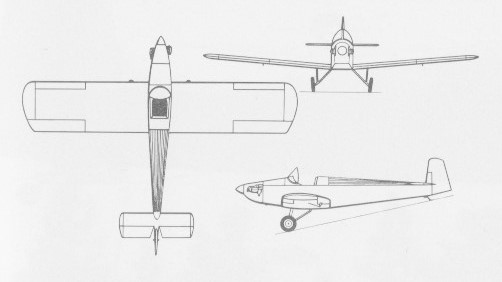
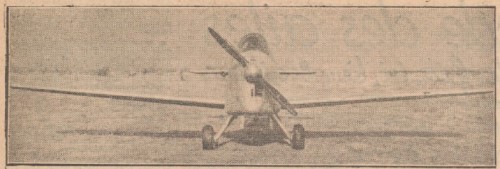
A single-seat cabin monoplane, the Aigle, first flew on April 2, 1949. Only one model was built.
Engine: 4T train, 40 hp
Wingspan: 7.14 m
Length: 5.44 m
Empty weight: 202 kg
Total weight: 320 kg
Maximum speed: 160 km / h
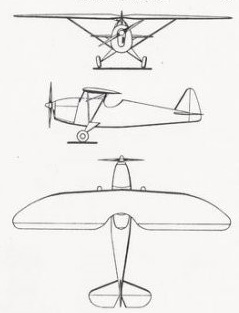
Roger Druine built his first aircraft in 1938 at the age of 17, and built a single-seat cabin monoplane, the Aigle, in 1948. His 1950 single-seat D.31 Turbulent was produced in small number by Rollason Aircraft & Engines and Stark Flugzeugbau, and remains available in plans form for home construction. Rollason also built the 1954 two-seat D.60 Condor (plans available). Also remaining available in plans form is D.5 Turbi two-seater, first flown 1951, as a development of Turbulent.
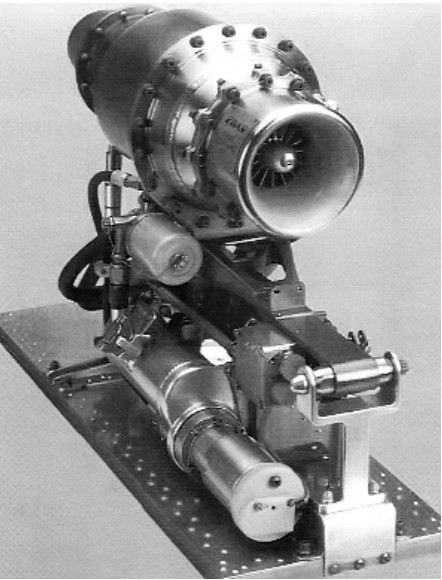
ln 1963, Max Dreher began work on the design of the youngest member of his turbine family, the TJD-76 Baby Mamba. It was designed to power a sailplane and had a static thrust of 55 lbs. He tried to keep it as simple and light as possible. No gear reduction was used and it had a free-spinning rotor. He selected a single-stage mixed flow compressor, an annular combustion chamber and a single stage axia-flow turbine for the basic layout.
A single-shaft turbojet, the air intake at the front, with an air flow of 0.50 kg (1.1 lb)/sec. The compressor is a single-stage mixed-flow, with single 17-4 PH stainless steel impeller with sixteen vanes. Splined to shaft and supported in two ball bearings. Mixed-flow two-stage diffuser of 347 stainless steel. Pressure ratio : 2.8 : 1
The compressor casing is of 2024 aluminium alloy and 347 stainless steel.
The combustion chamber is an annular type with Hastelloy X outer casing and flame tube. Vaporising system with fuel/air pre-mix. One spark plug in flame tube.Fuel system: Manual with pressurised fuel supply, or electrically-driven fuel pump. Fuel pressure 5.52 bars(80 lb/sq in). Automatic system for drone applications. Fuel grade: Kerosene or petrol.
The nozzle guide vanes are single axial stage, with sixteen investment-cast vanes in Stellite 31.Turbine: Single-stage axial-flow, with nineteen integrally-cast blades, of Inconel 713 LC. Gas temperature 770°C before turbine, 675°C after turbine, at continuous cruising power.
A fixed type jet pipe, with jet pipe and cone of Hastelloy X. LUBRICATION: Air/oil mist system with total loss, using bleed air equivalent to 2.5 per cent of total mass flow. Capacity 1 litre (2 US pints) of MIL-L-7808E (Turbo 15).
Mounting is by two rigid connections on diffuser section and one flexible connection on turbine section. Starting is by compressed air 1034 bars (150 lb/sq in), via three nozzles driving turbine wheel.
The whole job, from the begining to end, took about 3600 hours.
After initial running on the test stand, Max Dreher installed the engine on his Prue 215A sailplane. To do this he designed a jet pack consisting of the engine, the pressurized fuel system and the lubrication unit. the total weight of this first pack was 25 pounds. An auxiliary oil tank is mounted separately and employs an electrical driven gear pump.
A third unit, the jet control pack (engine controls, instruments, switches) is located in the cockpit.
Length overall: 416 mm (16.38 in)
Diameter: 151 mm (5.94 in)
Dry weight: 6.4 kg (14.1 lb)
Complete weight with fuel tank: 10.0 kg (22 lb)
Specific fuel consumption: 42.5 mg/Ns (1.5 lb/hr/lb st) At max rating
Oil consumption: 25 cc/min At max rating
Max rating: 0.245 kN (55 lb st)
Continuous rating: 0.20 kN (45 lb st)
USA
This Wichita, Kansas, company, offering conversions to provide more power and performance to Cessna models 150,170,172,175, and Cardinal, was taken over by Air-Mod Engineering Company of Oklahoma City. The Cessna 170 conversions were known as the Doyn Dart I; the Dart II of the mid-1960s was a refined version of the Piper Apache. Beech Travelair conversions were also completed.
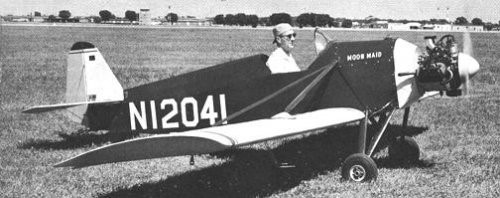
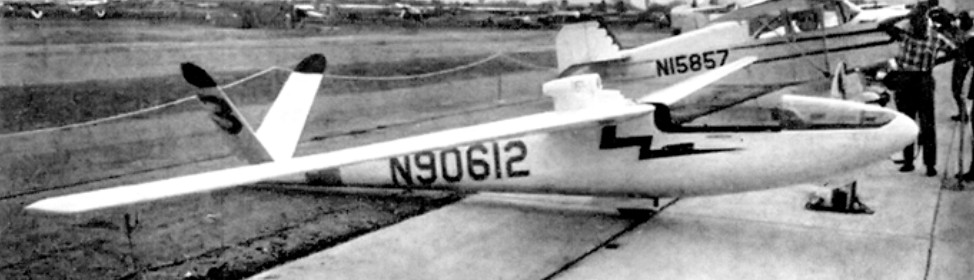
Moon Maid started out to be a gyroplane, but after a couple of years the designer/builder, Richard Doyle, decided to turn it into a standard airplane, stretching the fuselage four feet and replacing the rotor with a pair of wings spanning 23.5 feet. He pow¬ered it with a Bob Huggins 1523cc VW conversion of about 50 hp, one of the first homebuilts to use VW power.
The aircraft first took the air (now as N12041) in June 1964. The Moon Maid initially had a 25hp VW1200, later received a 50hp VW1600 and finally a 60hp VW1840.
During its career the aircraft was modified several times and amongst others received a dorsal fin, a slightly enlarged vertical tail and a new cantilever undercarriage with wheel pants.
Although plans were available for amateur construction (for engines in the 35-50hp range), no further aircraft were built.
Engine Huggins VW 1523cc conversion, 50 hp.
Gross weight 660 lbs.
Empty weight 460 lbs.
Fuel capacity 12 USgal.
Wing¬span 23 ft 6 in
Length 18 ft
Vmax 90 mph.
Cruise speed 80 mph.
Climb rate 600 fpm.
Range 200 nm.
Richard Doyle, 104 5. Albert, Mt. Prospect, IL 60056, USA.
Built the Doyle Moon Maid ROG-1 circa 1964
 All Aero