Entwicklungsring Süd GmbH was formed of a Bölkow, Heinkel, and Messerschmitt design consortium on February 23,1959 at the suggestion of the Federal German Defense Ministry, to develop a Mach 2 VTOL intercepter. By May 1963 70 flights had been made with VJ 101C research aircraft, which had tilting jet-pods at wingtips. Studies were made for an entirely different VJ 101D fighter. Heinkel withdrew in late 1964, and in July 1965 EWR changed from a consortium into a limited company. There was later an unsuccessful partnership with Fairchild Hiller.
Post WW2
Enstrom 280
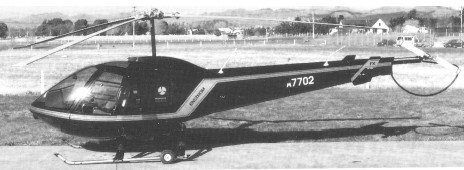
The Model 280 Shark is an improved F-28A, with revised nose contours of better aerodynamic shape. A conventional light helicopter with skid landing gear, tubular metal tail rotor protector, and a horizontal stabiliser with fins at tips. High inertia, three-blade fully articulated rotor head with blades attached by retention pin and drag link have control rods passing inside a tubular rotor shaft to a swashplate inside fuselage. No rotor brake is fitted. The non-folding blades have a MAC A 0013.5 section, and a two-blade teetering tail rotor is fitted. A thirty-groove belt drive runs from the horizontally mounted engine to the transmission.
The flying controls are conventional and manual, with a trim system that absorbs feedback from the rotor and repositions stick datum as required by pilot.
With bonded light alloy blades, the fuselage has a glass fibre and light alloy cabin section, steel tube centre-section frame, and stressed skin aluminium tailboom. The skids are carried on Enstrom oleo-pneumatic shock-absorbers. Air Cruiser inflatable floats are available optionally. Fuel is in two tanks, each of 79.5 litres. Total standard fuel capacity is 159 litres, of which 151 litres are usable. Auxiliary tank, capacity 49 litres, can be installed in the baggage compartment. Electrical power is provided by a 24V 70A engine-driven alternator, 12V 70A system optional. No hydraulic system is fitted.
Shoulder harnesses are equipped for three seats and night lighting is standard on the 280FX. Night lighting includes instrument lighting with dimmer control, position light on each horizontal stabiliser tip, anti-collision light and nose-mounted landing light. Optional equipment for both F28F and 280FX includes fixed float kit, wet or dry agricultural spray kit and cargo hook for utility missions. Wide instrument panel available for IFR training. Accomodating a pilot and two passengers, side by side on bench seat, the centre place is removable. Removable door on each side of cabin. Baggage space is aft of engine compartment, with an external door. Cabin heated and ventilated.
Developed in 1973 as a luxury version of the F-28A, FAA certification was achieved in September 1974. A collaboration between a Boston industrial design firm and the Enstrom engineering team yielded the new aerodynamically styled airframe. Immediately put into production, a number of models were developed and produced based on the body style of the 280 Shark (mechanically identical to the F-28C).
F-28C/280C: improved versions, introduced in 1975 replacing the F28A and 280, powered by the 153kW Avco Lycoming HIO-360-E1AD engine with a Rajay 301-E-10-2 turbocharger; the tail rotor was moved to the port side of the fuselage and the direction of rotation reversed. Certified by the FAA in 8 December 1975, production ceased in Novembr 1981.
In 1977 Enstrom Helicopters received FAA certification for an increase from 2,200 to 2,350 pounds gross weight for the turbo¬charged Model 280C. Fixed waste gate turbocharging on the Enstrom’s 205 hp Lycoming HIO 360 engine enables the F 28C and the 280C to lift their 2,350 pound gross weights at den-sity altitudes up to 13,000 feet. In addition to the turbo¬charging, Enstrom shifted the tail rotor from the right to the left side of the tail boom, thus placing the anti torque device where it reacts more favorably with the main rotor’s downwash and, therefore, is more effective. A tail rotor blade with a wider chord has been tested and is being retrofitted to all C models of the F 28 and the Shark 280. The FAA has approved the modification.
F-28F Falcon/280F: FAA certificated in January 1981, the F-28F and 280F were powered by the turbocharged 168kW Avco Lycoming. HIO-360-F1AD engine
280FX: updated version of the Model 280F fitted with faired landing gear, new seats, redesigned vertical and horizontal tail surfaces, covered tail rotor shaft and tail rotor guard powered by one 225 hp (168 kW) Lycoming HIO-360-F1AD. First flown in December 1983 and certificated in January 1985. Export customers include the Chilean army which bought 15
280L Hawk: work on a four-seat version of the 280C began in January 1978 and a prototype was first flown on 27 December 1978. The main rotor diameter was increased by 0.61m and the fuselage lengthened by 0.91m. Powerplant of the F-28F/280F was retained and fuel capacity increased to 170 litres. However, full development was postponed indefinitely in 1983 following a change in company ownership
Spitfire Mk 1: developed by the Spitfire Helicopter Company of Lynnfield, Massachusetts, from the basic Enstrom F-28A design, the Spitfire Mk 1 appeared in 1976, powered by a 313kW Allison 250-C20B turboshaft
The turbine-powered 280FX, a modified piston-powered model in which an Allison 250-C20 turbine engine with the Enstrom drive train and rotor system was integrated, flew first in December 1988. Turbine-powered certification of the TH28 came in September 1992 and the 480, to FAR Pt27 standards, in December 1994.
The Model 480 Eagle is a development of the 280L Hawk, with seating for five and power provided by the Allison 250-C20B turboshaft.
Although the Enstrom helicopters are intended mainly for light passenger operations, the F-28C and Model 280C can be used in the agricultural role with two side-mounted chemical hoppers and their associated spraybooms. Liquid chemical capacity is 340 litres, and powder chemical capacity 0.5cu.m.
A total of 735 of the earlier versions produced (14 F28, 315 F28A, 121 F28C, 56 F28C-2, 21 280, 206 280C and two 280L).
A total of 98 280FX built up to mid-2003, a further two 280 registered in early 2003. The Chilean Army operates 15 280FX for primary and instrument training. The Venezuelan National Guard took delivery of four 280FX for training in January 2002.
Basic 2004 price was US$320,000 for the F28F Falcon and 280FX Shark.
280 Shark
Engines: Lycoming HIO-360-C1A, 205 hp.
Seats: 3.
Disc loading: 2.67 lb/sq.ft.
Pwr loading: 10.48 lb/hp.
Max TO wt: 2150 lb.
Empty wt: 1450 lb.
Equipped useful load: 642 lb.
Payload max fuel: 402 lb.
Range max fuel/ cruise: 224 nm/2.1 hr.
Range max fuel / range: 245 nm/ 3.0 hr.
Service ceiling: 13,000 ft.
Max cruise: 102 kt.
Max range cruise: 83 kt.
ROC: 1000 fpm.
HIGE: 5600 ft.
HOGE: 3700 ft.
Max sling load: 500 lb.
Fuel cap: 240 lb.
F-280C Turbocharged
Engines: Lycoming HIO-360-E1AD, 205 hp.
Seats: 3.
Disc loading: 2.73 lb/sq.ft.
Pwr loading: 10.73 lb/hp.
Max TO wt: 2200 lb.
Empty wt: 1495 lb.
Equipped useful load: 647 lb.
Payload max fuel: 407 lb.
Range max fuel/ cruise: 193 nm/1.9 hr.
Range max fuel / range: 201 nm/ 2.7 hr.
Service ceiling: 18,000 ft.
Max cruise: 96 kt.
Max range cruise: 76 kt.
ROC: 1300 fpm.
HIGE: 13,800 ft.
HOGE: 8300 ft.
Max sling load: 500 lb.
Fuel cap: 240 lb.
280C Shark
Engine: Lycoming HIO-360-E1AD, 205 hp.
TBO: 1000 hrs.
Main rotor: 32 ft.
Seats: 3.
Length: 28.7 ft.
Height: 9.2 ft.
Max ramp weight: 2350 lbs.
Max takeoff weight: 2350 lbs.
Standard empty weight: 1592 lbs.
Max useful load: 758 lbs.
Max landing weight: 2350 lbs.
Max sling load: 1000 lbs.
Disc loading: 2.9 lbs/sq.ft.
Power loading: 11.5 lbs/hp.
Max usable fuel: 240 lbs.
Max rate of climb: 1200 fpm.
Service ceiling: 12,000 ft.
Hover in ground effect: 8800 ft.
Hover out of ground effect: 4100 ft.
Max speed: 102 kts.
Normal cruise @ 3000 ft: 92 kts.
Fuel flow @ normal cruise: 85 pph.
Endurance @ normal cruise: 2.7 hr.
280FX Shark
Engine: 1 x Textron Lycoming HIO-360-F1AD.
Instant pwr: 170 kW.
Rotor dia: 9.8 m.
MTOW: 1180 kg.
Useful load: 460 kg.
Max speed: 102 kts.
Max cruise: 102 kts.
Max range: 483 km.
HIGE: 13,200 ft.
HOGE: 8700 ft.
Service ceiling: 12,000 ft.
Crew: 1/2.
Pax: 1/2.
Seats: 3.
Enstrom F-28 / Enstrom T-28
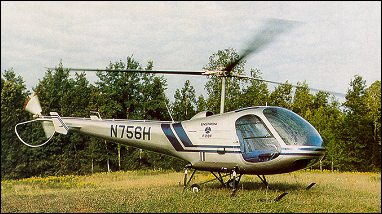
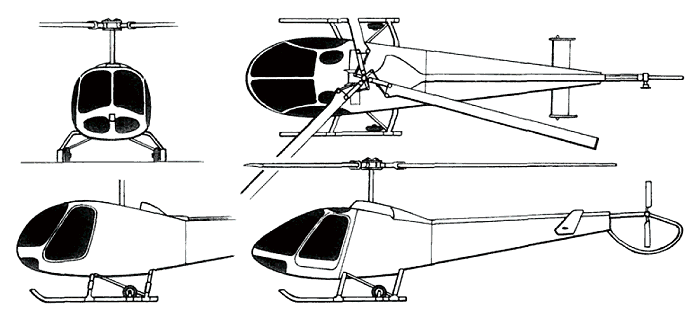
A conventional light helicopter with skid landing gear and tubular metal tail rotor protector; horizontal stabiliser with fins at tips. High inertia, three-blade fully articulated rotor head with blades attached by retention pin and drag link; control rods pass inside tubular rotor shaft to swashplate inside fuselage; no rotor brake: blade section MAC A 0013.5; blades do not fold; two-blade teetering tail rotor. Thirty-groove belt drive from horizontally mounted engine to transmission. Flying controls are conventional and manual. Trim system absorbs feedback from rotor and repositions stick datum as required by pilot.
The F-28A forward fuselage, consisting of the extensively glazed compartment for the pilot and two passengers seated side-by-side on a bench seat, is made of light alloy and glassfibre. The centre section of the fuselage, accommodating the engine, transmission and fuel tanks, as well as providing anchorage points for the steel-tube undercarriage skids, is more substantially built of steel tube. The rear fuselage, carrying small vertical tail surfaces and the two-blade teetering tail rotor of bonded light alloy construction, is a semi-monocoque structure basically conical in shape and built of aluminium.
Bonded light alloy blades. Fuselage has glass fibre and light alloy cabin section, steel tube centre-section frame, and stressed skin aluminium tailboom.
Skids carried on Enstrom oleo-pneumatic shock-absorbers. Air Cruiser inflatable floats available optionally.
One 168kW Textron Lycoming HTO-360-F1AD flat-four engine with Rotomaster 3BT5EE10J2 turbocharger. Two fuel tanks, each of 79.5 litres. Total standard fuel capacity 159 litres, of which 151 litres are usable. Auxiliary tank, capacity 49 litres, can be installed in the baggage compartment. Oil capacity 9.5 litres.
Pilot and two passengers, side by side on bench seat; centre place removable. Removable door on each side of cabin. Baggage space aft of engine compartment, with external door. Cabin heated and ventilated.
Electrical power provided by 24V 70A engine-driven alternator; 12V 70A system optional. No hydraulic system.
Shoulder harnesses for three seats. Night lighting is optional for F28F. Night lighting includes instrument lighting with dimmer control, position light on each horizontal stabiliser tip, anti-collision light and nose-mounted landing light. Optional equipment for both F28F and 280FX includes fixed float kit, wet or dry agricultural spray kit and cargo hook for utility missions. Wide instrument panel available for IFR training.
The two-seat prototype of the F-28 was flown first on 12 November 1960 with a two-bladed main rotor and an un-skinned tubular rear fuselage, followed by the first of two three-seat production prototypes on 26 May 1962. Initial FAA certification was achieved for the F-28 model in April 1965 and deliveries began in 1965. The production version appeared in the autumn of 1963. Powered by a 134kW Avco Lycoming O-360-A1A engine, it had a three-bladed main rotor and a light alloy and glassfibre cabin section with an all-metal semi-monocoque tail boom. Enstrom sold only nine F-28s before being purchased by the Purex Corporation in early 1968. An improved version of the F 28, powered by a 205 hp Lycoming H10 360 C1B and called the F 28A, was certificated in May 1968. Production of the three seat F-28A started in 1967 but only 35 were sold before Purex suspended all operations in February 1970.
The F 28A uses a normally aspirated 205 hp engine. The main rotor blades are of bonded construction and have no time limit, mainly be¬cause the F 28 rotor system originally was designed to be rigid in plane, so the blades are heavier and experience lower working stress levels than if the F 28 had been de¬signed initially to employ its present fully articulated three blade system.
The F 28A offers a cruise speed of 87 knots. Enstrom offers an option, called a throttle correlator, that is designed to facilitate throttle/collective coordination. It employs a cam like arrangement that partially couples the collective and throttle, but even the folks at Enstrom did not recommend it with much enthusiasm.
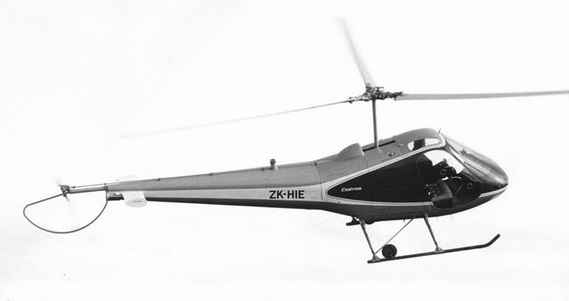
The rugged rotor system of the Enstrom gives the F 28A a heavier cyclic, or attitude, control feel than is found on other light helicopters, such as the Hughes 300. By fixed wing standards, however, the control pressures are low. The somewhat heavier cyclic control force characteristics combine with a fairly large, six inch offset in the flapping hinge to give the F 28A a nice harmony between stability and control over an allowable CG range of six inches. When the helicopter is disturbed either by a gust or a sudden cyclic control input, the F 28A experiences an initial divergence in roll or pitch but not the wild type of response that is frequently imagined to exist with helicopters. An electric pitch and roll trim, which is operated by a thumb switch on the cyclic stick, allows a pilot to remove residual control forces and establish a hands ¬off trim condition in cruising flight.
Because of its heavier rotor blades (at 51 pounds each, they are nearly twice the weight of those on the Hughes 300C), the F 28A does not gain lost rotor rpm as quickly as does a helicopter with a lighter rotor system. The higher inertia of the Enstrom rotors, however, does enable the F 28A to hold its rpm longer, at times when the pilot may need to use the rotational energy stored in the whirling rotor system.
In 1976 the improved F-28C was produced. The basic F28A and 280 were replaced by turbocharged F28C and 280C, certified by FAA 8 December 1975.A turbocharged conversion by Enstrom maintains full rated power up to 12,000 ft. Fixed waste gate Rajay 301-E-10-2 turbocharging on the Enstrom’s 153kW / 205 hp Lycoming HIO 360-E1AD engine enables the F 28C and the 280C to lift their 2,400 pound gross weights at density altitudes up to 13,000 feet. In addition to the turbocharging, Enstrom shifted the tail rotor from the right to the left side of the tail boom, thus placing the anti torque device where it reacts more favorably with the main rotor’s downwash and, therefore, is more effective. A tail rotor blade with a wider chord has been tested and is being retrofitted to all C models of the F 28 and the Shark 280. The FAA has approved the modification.
The F-28C-2 introduced a one-piece windscreen and a pedestal central instrument console for improved forward and downward vision. The 500th helicopter was delivered during June 1977. Production ceased in Novembr 1981, succeeded by the F28F.
Although the Enstrom helicopters are intended mainly for light passenger operations, the F-28C and Model 280C can be used in the agricultural role with two side-mounted chemical hoppers and their associated spraybooms. Liquid chemical capacity is 340 litres, and powder chemical capacity 0.5cu.m.
F-28F Falcon/280F was FAA certificated in January 1981, powered by the turbocharged 168kW Avco Lycoming HIO-360-F1AD engine. The basic F28F Falcon model was certified to FAR Pt 6 on 31 December 1980. The two major changes were incorporated into the F28F and 280F/280FX over the earlier F28C/280C series were an increase in power from 153kW to 168kW / 225shp and the addition of a throttle correlator to reduce pilot workload. Changes to the F28F and 280FX are the redesigned main gearbox with a heavy wall main rotor shaft (standard equipment on all new aircraft and retrofittable to all existing F models); optional lightweight exhaust silencer, which reduces noise in the hover by 40% and gives a 30% reduction when flying at 152m (can also be retrofitted to F28F, 280F and 280FX); and a lightweight starter motor.
A dedicated police version of Model 280F, the F-28F-P Sentinel, was developed for the Pasadena Police Department, and fitted with special equipment including a searchlight. First delivery was in October 1986.
The development of a turbine-powered model was initiated in 1988, culminating in certification of the TH28 in September 1992.
The T-28 experimental version featured a 240 shp AiResearch TSE 36-1 turboshaft engine, increased fuel, larger diameter tail rotor, and a new transmission system.
Customers total 735 of earlier versions (14 F28, 315 F28A, 121 F28C, 56 F28C-2, 21 280, 206 280C and two 280L). Last of 135 F28F delivered 1999 to Fresno Police Department, California, but further nine produced in 2002 and 2003. Total of 98 280FX built up to mid-2003, increasing Enstrom piston-engined helicopter production to 966; further two 280 registered in early 2003, Peruvian Army has 10 F28F for flight training; Colombian Air Force operates 12 F28F for primary and instrument training, Numerous US police departments operate F28F-P for patrol and surveillance missions.
The basic 2004 price was US$320,000 for F28F Falcon and 280FX Shark.
F-28
F-28A
Engine: Lycoming HIO-360-C1A, 205 hp.
Main rotor dia: 32 ft / 9.75 m
Disc loading: 2.67 lb/sq.ft.
Pwr loading: 10.48 lb/hp.
Length: 29 ft 6 in / 8.99 m
Cabin max width: 5 ft 1 in / 1.55 m
Empty wt: 1450 lb / 657 kg
Max wt: 2150 lb / 975 kg
Equipped useful load: 642 lb.
Payload max fuel: 402 lb.
Max sling load: 500 lb.
Range max fuel/ cruise: 204 nm/2.1 hr.
Range max fuel / range: 240 nm/ 237 mi / 381 km / 3.3 hr.
Luggage cap: 7 cu.ft or 60 lbs.
Vne: 98 kts.
Cruise: 87 kt / 100 mph / 161 kph
Max cruise: 93 kt.
Max range cruise: 74 kt.
Service ceiling: 12,000 ft / 3660 m
Hover IGE: 5600 ft.
ROC: 950 fpm / 290 m/min
Best climb/glide speed: 58 kts.
Fuel cap: 240 lb / 30 USG.
Endurance: 2.5 hr.
Baggage hold: 8 cu ft / 0.33 cu m
Seats: 3.
F-28B
Engine: Lycoming TIO-360, 275 hp
Enstrom F-28C
Engine: 1 x Avco Lycoming HIO-360-E1BD, 153kW
Main rotor diameter: 9.75m
Length: 8.94m
Height: 2.79m
Max take-off weight: 1066kg
Empty weight: 680kg
Max speed: 180km/h
Cruising speed: 172km/h
Ceiling: 3660m
Range: 435km
Crew: 1
Passengers: 1
F-28C-2 Falcon
Engine: Lycoming HIO-360-E1AD, 205 hp.
TBO: 1000 hrs.
Main rotor: 32 ft.
Seats: 3.
Length: 28.2 ft.
Height: 9.2 ft.
Max ramp weight: 2350 lbs.
Max takeoff weight: 2350 lbs.
Max wt (100mph restriction): 2500 lbs.
Max wt (90mph restriction): 2600 lbs.
Standard empty weight: 1562 lbs.
Max useful load: 788 lbs.
Max landing weight: 2350 lbs.
Max sling load: 800 lbs.
Disc loading: 2.9 lbs/sq.ft.
Power loading: 11.5 lbs/hp.
Max usable fuel: 240 lbs.
Max rate of climb: 1200 fpm.
Service ceiling: 12,000 ft.
Hover in ground effect: 9700 ft.
Hover out of ground effect: 6000 ft.
Max speed: 97 kts.
Normal cruise @ 3000 ft: 90 kts.
Fuel flow @ normal cruise: 78 pph.
Endurance @ normal cruise: 2.9 hr.
Max range cruise: 74 kt
Range max fuel / range: 196 nm/ 2.7 hr
Range max fuel/ cruise: 178 nm/1.9 hr
F-28F
Engine: Lycoming HIO-360-F1AD, 225 hp.
TBO: 1000 hrs.
Main rotor: 32 ft.
Seats: 3.
Length: 28.2 ft.
Height: 9.2 ft.
Max ramp weight: 2600 lbs.
Max takeoff weight: 2600 lbs.
Standard empty weight: 1562 lbs.
Max useful load: 1038 lbs.
Max landing weight: 2600 lbs.
Max sling load: 1000 lbs.
Disc loading: 3.2 lbs/sq.ft.
Power loading: 11.6 lbs/hp.
Max usable fuel: 240 lbs.
Max rate of climb: 1450 fpm.
Service ceiling: 18,000 ft.
Hover in ground effect: 12,400 ft.
Hover out of ground effect: 7500 ft.
Max speed: 97 kts.
Normal cruise @ 3000 ft: 94 kts.
Fuel flow @ normal cruise: 96 pph.
Endurance @ normal cruise: 2.4 hr.
T-28
Engine: AiResearch TSE 36-1 turboshaft, 240 shp
Enstrom Helicopter Corp. / R.J.Enstrom Corp.
As R. J. Enstrom Corporation, was formed in 1959 by Rudy Enstrom in Menominee, Michigan to develop experimental helicopter, first flown November 1960. Developed type (F-28) flown May 1962; and deliveries of further-improved F-28A began in 1968. First year’s production was 43 aircraft. In 1968 first tests were made with turboshaft installation.
Enstrom sold only nine F¬28s before being purchased by the Purex Corporation in early 1968, and Purex suspended all operations in February 1970.
In Janu¬ary 1971, defense lawyer F. Lee Bailey purchased the majority in¬terest in Enstrom and embarked on an ag¬gressive reorganization and production resumed in 1971 under Enstrom Helicopter Corporation title. Between ear¬ly 1972 and June 1975, the gross income of Enstrom Helicopter rose at a compounded growth rate of nearly 45 percent.
1977: Enstrom Helicop¬ter Corporation, Menominee, Michigan, USA.
After intervening acquisitions, including operation as part of Pacific Airmotive Aerospace Group, 1980 purchase by Bravo Investments BVC of the Netherlands, and acquisition by US investors, resumed manufacture. By June 1977 the 500th Enstrom helicopter had been delivered. The Enstrom Helicopter Company, offering the piston-engined three-seat F28F (first flown December 1980 as improved F-28 type) and 280FX (available since 1985), latter based on F28F but with airframe and cabin refinements. Also offers the five-seat 480 Turbine (first flown October 1989), using an Allison turboshaft engine.
Enstrom was acquired by Chinese firm Chongqing General Aviation Industry Group (CGAG) in December 2012. CGAG offers a bundle of other products and services, including emergency rescue, aerial forest fire protection, agricultural spray application, aerial photography, and a host of others through its subsidiaries.
The new owner tried to turn the storied brand around by investing up to $8 million to upgrade Enstrom’s factory. They nearly doubled the space, expanding it to a 160,000-square-foot FAA-approved manufacturing facility. The company also hired more than 200 new employees.
The company showed signs of tenacity when it celebrated its 60th anniversary in 2019.
In 2019, the company ranked third in sales of piston helicopters, with 38 sold between 2018 and 2019, but the overall rotorcraft market was in the midst of a slump. The 2019 annual report from General Aviation Manufacturers Association (GAMA) that tracks aircraft deliveries showed that 2019 was the slowest year for rotorcraft sales in the preceding seven years.
Then the pandemic hit.
GAMA’s data showed that from 2019 to 2020, the overall piston helicopter market sales and deliveries decreased by 20.7 percent.
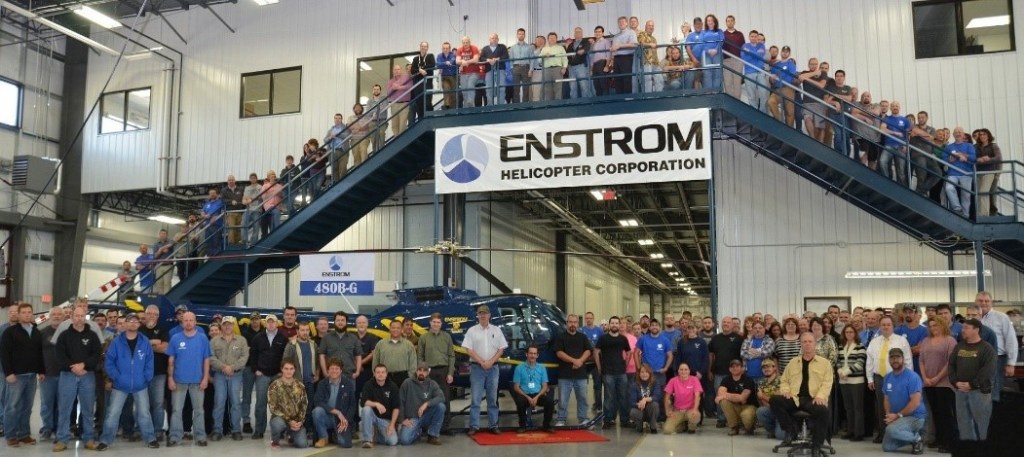
After nearly 65 years in business, Enstrom Helicopter Corp. closed its factory doors on 21 January 2021 after declaring Chapter 7 bankruptcy.
Despite building more than 1,300 helicopters that were sold to customers in more than 50 countries, the Michigan-based company announced that “several financial difficulties,” some related to the pandemic, compelled its owners to close the company.
Dennis Martin, Enstrom’s director of sales, shared the news in a letter to its suppliers and dealers in which he confirmed “all existing contracts and agreements [with the company] will become null and void.”
All employees, about 30 in total, lost their jobs.
Enstrom’s final delivery—a pair of 280FX aircraft—was to the Peruvian Air Force in December 2021. Meanwhile, Enstrom ceased its parts and overhaul supply services on January 7, before ending its technical support on January 19.
They have already fielded multiple requests from interested parties who would like to buy the company’s assets out of bankruptcy, and maybe invest in revamping the company.
In a Chapter 7 bankruptcy, the assets of a company are usually liquidated and the proceeds are used to pay off outstanding debt to creditors.
ENSAE Farfelu
The Farfelu is a two-seat training glider designed and being built at Toulouse by students of ENSAE – the Ecole Nationale Superieure de I’Aeronautique et de I’Espace. Instructor and pupil sit side by side under a one-piece canopy and the monocoque fuselage, of integrally stiffened epoxy/Nomex/epoxy sandwich construction, is built in two halves, the cockpit section tapering into a slimmer rear half carrying the tail; a metal box structure provides additional strength and reinforcement at the wing attachment points. The cantilever shoulder wings have single box spars and a laminated epoxy/Nomex/epoxy sandwich skin; there are Schempp-Hirth air brakes above and below each wing. The unswept cruciform tail unit is of similar construction to the wings, and there is a fixed monowheel in a small fairing and a tail bumper. The Farfelu prototype had not flown in 1955.
Span: 52 ft 6 in
Length: 25 ft 8 in
Wing area: 181.4 sqft
Aspect ratio: 15.19
Empty weight: 617 lb
Max weight: 1,102 lb
Min sinking speed: 2.50 ft/sec
Best glide ratio: 32:1
English Electric
Though this company became part of British Aircraft Corporation in 1960, its origins date back to 1911 at its Coventry Works (Coventry Ordnance Works Ltd.), where quantity production of other manufacturers’ designs was undertaken during First World War. After the Armistice development centered on the Kingston flying-boats, following the lines of the Cork, a product of the Phoenix Dynamo Manufacturing Company Ltd., which was then also part of English Electric. Original features manifest in Ayr flying-boat and Wren ultralight monoplane (1923), but aircraft work ceased in the mid-1920s. In 1938 it was resumed, with contracts for the Handley Page Hampden (followed by the Halifax). In May 1944 an order was placed for de Havilland Vampire jet fighters. Over 1,000 Vampires built before production got under way on company’s own Canberra, the first British jet bomber and the first to serve with the RAF. Canberra production continued for ten years, totaling over 1,300 examples, including 403 license-built Martin B-57s for the USAF. Numerous variants developed, notably for reconnaissance; other countries using the type included Ecuador, France, Peru, Rhodesia, Sweden, and Venezuela. Many records broken (e.g. London-Cape Town December 1953). Lightning twin-jet single-seat fighter of 1952 was RAF’s first supersonic fighter (in level flight); entered service December 1959. Much development of this type was undertaken by British Aircraft Corporation, but two-seat version emanated from English Electric.
British Aircraft Corporation was formed out of Bristol, English Electric, Vickers-Armstrong and Hunting Aircraft Ltd, in 1960.
England Gannett
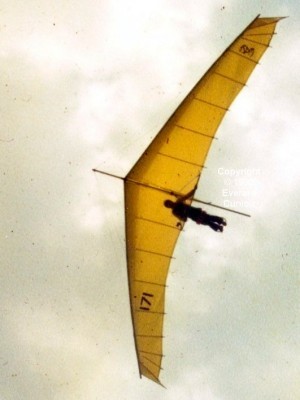
The Bob England Gannett was a 1979 hang glider.
Emigh Commuter Jr
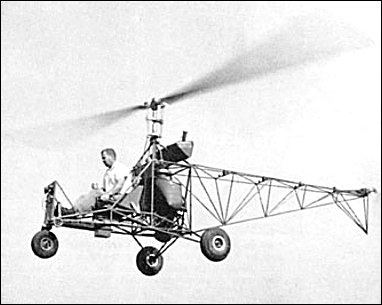
Single-seat open-cockpit helicopter powered by 65hp Continental C-65. First flown July 15, 1960. Plans marketed to home-builders.
Commuter Jr
Engine: 1 x Continental C-65, 65hp
Rotor diameter: 6.4m
Length: 7.16m
Load: 135kg
Maximum speed: 120km/h
Range: 240km
Ceiling: 3200m
Emigh Trojan
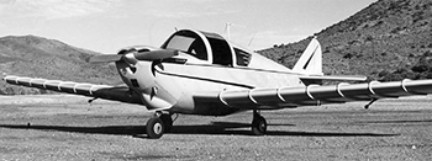
The Emigh Trojan was built in small numbers between 1948 and 1950 by the Emigh Aircraft Corporation and, later, the Emigh Trojan Aircraft Company. Its unique feature are the simplified construction methods used in its assembly. The metal fuselage of the Trojan is made up of two identical halves that are joined along their horizontal centerline. Its wingtips, tail surfaces and ailerons are all interchangeable. This side-by-side two-seat cabin airplane can still be seen at airports around the country.
Engine: 90 hp Continental
Gross weight: 1,450 lbs
Top speed: 130 mph
Cruise: 115 mph
Landing speed: 48 mph
Range: 550 nm
Service ceiling: 13,000 ft
Seats: 2
Emigh Trojan Aircraft Co / Emigh Aircraft Corp
USA
Successor to the Emigh Aircraft Corp, continuing development during 1950 of Emigh Trojan A-2 light all-metal cabin monoplane, which was built in small numbers 1948-1950. Metal fuselage was in two halves, joined on centerline. Interchangeability of components was a special feature.
 All Aero